No, AAA generally does not carry spare tires for members. AAA roadside technicians can install a functional, properly inflated spare that already belongs to your vehicle, but a car without a usable spare will usually need towing to a tire shop or repair facility. Benefits, dispatch rules, and towing limits vary by regional AAA club and membership tier.
Key Facts at a Glance
- AAA roadside tire service normally means installing the member’s own usable spare tire.
- AAA does not normally deliver a replacement wheel and tire matched to the disabled vehicle.
- A flat or unsafe spare can change a tire-installation call into a tow.
- A puncture in the center tread may be repairable, but sidewall and shoulder damage usually requires tire replacement.
- Compact temporary spares commonly carry a 50 mph speed limit, but the vehicle manufacturer’s label controls.
- AAA towing mileage, membership pricing, service-call limits, and same-day eligibility vary by regional club.
Does AAA Have Spare Tires for Roadside Calls?
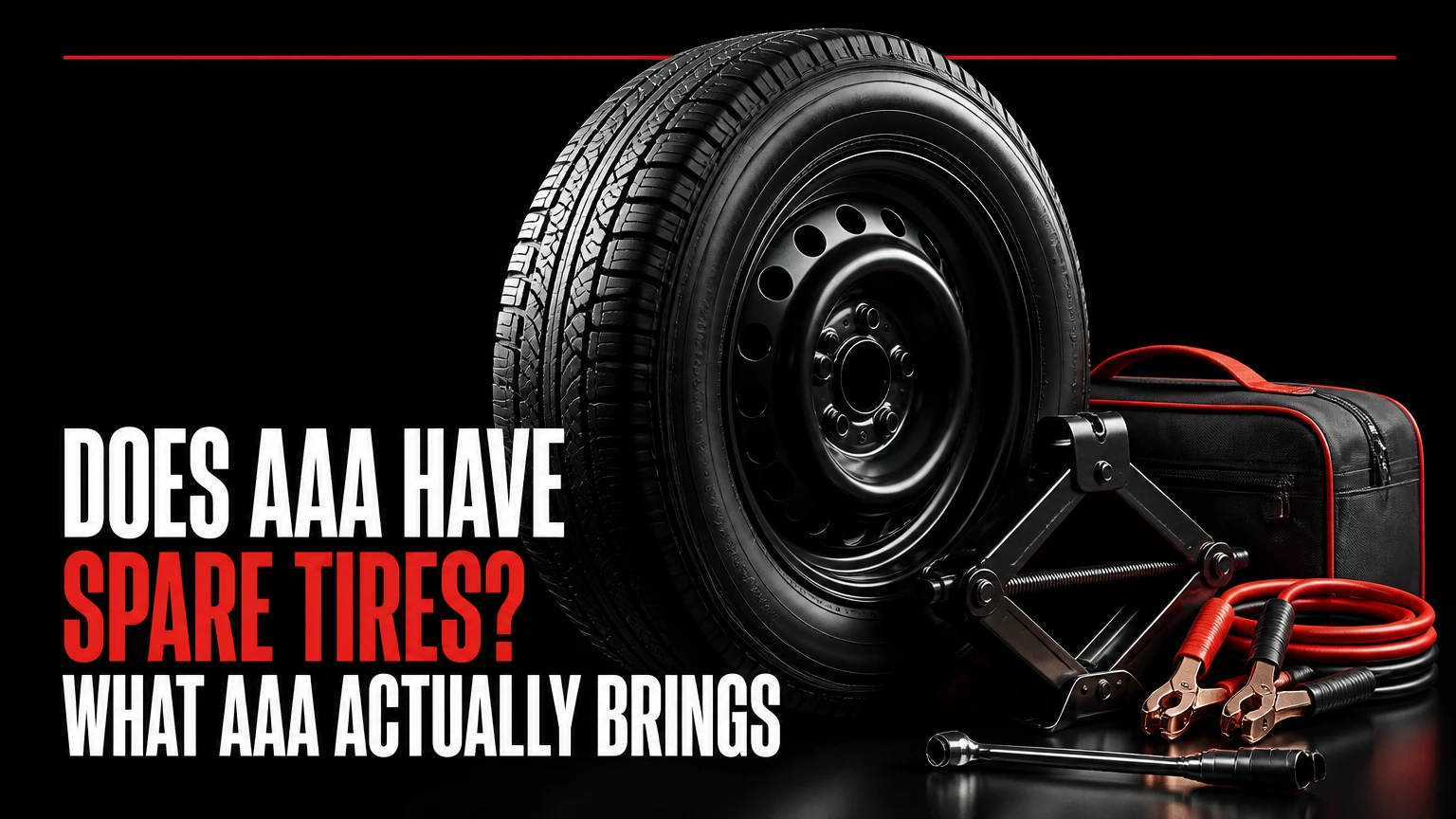
AAA does not normally bring a spare tire, wheel, or complete replacement assembly to a roadside call. AAA’s standard tire assistance is an installation service: a technician removes the damaged wheel and mounts the usable spare you already carry.
That distinction matters because “AAA changes flat tires” and “AAA provides tires” describe different services. The technician may bring a jack, impact tool, lug wrench, torque equipment, and an air compressor, but the replacement tire itself remains the vehicle owner’s responsibility.
AAA’s regional roadside pages describe spare-tire installation as assistance for members who have a spare available. Membership does not automatically include a new tire, a new wheel, or a tire-shop replacement. If you need a new tire, the technician may tow the vehicle to a facility that can inspect, repair, or replace it.
AAA does not stock universal spares because vehicle fitment is highly specific. A replacement wheel must match dimensions such as diameter, width, offset, center bore, and lug pattern. The tire must also meet load, speed, clearance, and drivetrain requirements.
What Does AAA Do When You Have a Spare?
AAA can typically replace a flat tire with your usable spare during a roadside service visit. The technician first evaluates whether the vehicle can be lifted safely and whether the spare, jack points, lug hardware, and wheel-lock key are accessible.
A normal installation follows this sequence:
- The technician confirms the disabled vehicle and checks the damaged tire.
- The technician locates the spare, wheel-lock key, and relevant vehicle hardware.
- The vehicle is secured and lifted at the manufacturer’s approved jack point.
- The damaged wheel is removed and the spare is installed.
- The lug nuts are tightened, the spare is inflated if necessary, and the vehicle is lowered.
- The technician explains temporary-spare restrictions before leaving.
The service does not turn a compact spare into a normal tire. A donut may have a 50 mph limit, a short mileage recommendation, and handling restrictions. Front-wheel-drive vehicles may have additional instructions, while some all-wheel-drive vehicles require special matching-diameter procedures.
AAA may also inflate a tire that has lost pressure without suffering visible structural damage. A technician may sometimes address a small tread puncture, but roadside repair availability is not guaranteed, and a temporary plug is not appropriate for every tire or puncture location.
Why Does AAA Not Carry Spare Tires?
AAA does not carry spare tires because one roadside truck would need a large inventory of incompatible wheel and tire assemblies. Vehicle fitment includes more than tire diameter, and even two tires labeled with the same size may require different wheels or have different load requirements.
| Fitment attribute | Typical variation | Why the technician needs an exact match |
|---|---|---|
| Wheel diameter | 14-22 inches on many passenger vehicles | Controls brake clearance and tire size |
| Tire width | About 165-325 millimeters | Affects rim fitment and handling |
| Lug pattern | 4, 5, 6, or 8 lugs; metric and SAE patterns | Determines whether the wheel mounts correctly |
| Wheel offset | Often approximately 20-60 millimeters | Controls suspension and body clearance |
| Center bore | Commonly about 54-74 millimeters | Centers the wheel on the hub |
| Load rating | Passenger, XL, LT, and vehicle-specific ratings | Supports the vehicle’s axle weight safely |
A correct tire also needs compatible rolling diameter. Installing a substantially different tire on one corner can affect anti-lock braking, traction control, speedometer accuracy, and all-wheel-drive components.
Modern vehicles add more complications. Some use tire-pressure monitoring sensors inside each wheel, some use foam-lined tires, and some have brake packages that leave little room for a temporary wheel. AAA can assist with a suitable owner-supplied spare, but the vehicle manufacturer’s requirements take priority.
What Happens If Your Car Has No Usable Spare?
If your vehicle has no spare, or the spare is flat, damaged, missing, or incompatible, AAA will generally arrange towing instead of completing a tire change. The destination may be a tire retailer, repair shop, dealership, or AAA Approved Auto Repair facility, depending on local availability and your request.
A roadside technician cannot safely install a spare with severe dry rot, a damaged valve stem, an incorrect bolt pattern, or insufficient inflation. A compact spare that has exceeded its age or shows cracking is not a safe substitute merely because it has never been driven.
Tow coverage depends on your club and plan. Some basic plans provide only a short tow, while higher tiers may include substantially longer distances. The exact mileage, destination rules, number of service calls, and member eligibility should be confirmed in the AAA app, membership documents, or regional club terms.
| Coverage question | Typical practical outcome | What can change the result |
|---|---|---|
| No spare available | Tow to a repair facility | Regional club and membership tier |
| Spare is flat or cracked | Tow or inflation assessment | Tire condition and technician judgment |
| Tire has center-tread puncture | Possible repair or tow | Puncture size, location, and service availability |
| Tire has sidewall damage | Replacement tire or tow | Vehicle location and shop access |
| Tow exceeds plan mileage | Member may pay excess miles | Local benefit schedule and destination |
| Unsafe roadside position | Immediate relocation or police support | Traffic, shoulder width, weather, and road type |
A tow is often the correct result, not a service failure. Structural tire damage cannot be made safe with air, and a vehicle lacking a compatible spare has no reliable roadside replacement option.
Can AAA Repair a Flat Tire Instead of Replacing It?
AAA may help with a minor tread puncture, but roadside repair is conditional and should not be treated as a guaranteed benefit. A puncture in the central tread area may be repairable when the tire has not been driven deflated and the hole meets recognized repair limits.
The Tire Industry Association and tire manufacturers generally distinguish repairable tread damage from unsafe shoulder or sidewall damage. A proper repair normally requires removing the tire, inspecting the inside, and using an approved plug-and-patch repair. A quick external plug at the roadside may provide temporary mobility but does not replace a full internal inspection.
| Damage type | Usual decision | Reason |
|---|---|---|
| Nail in central tread, tire still structurally sound | Possible professional repair | Repair zone may be suitable |
| Cut in sidewall | Replace tire | Sidewall flex prevents reliable repair |
| Puncture near shoulder | Usually replace | Damage lies outside the normal repair area |
| Tire driven while empty | Inspect or replace | Internal sidewall damage may be invisible |
| Bead separation or bulge | Replace immediately | Indicates structural failure |
| Slow valve-stem leak | Valve service or tire inspection | Leak may not involve the tread |
Do not keep driving on a visibly flat tire to reach a shop. Driving without pressure can destroy the sidewall even when the original puncture was small.
Which Spare Tire Options Fit Different Drivers?
A vehicle owner’s best backup depends on factory equipment, cargo space, driving distance, terrain, and drivetrain. A compact spare saves space, while a full-size spare offers better normal-driving capability but adds weight and storage demands.
| Option | Typical purchase cost | Typical restriction | Best use | Main limitation |
|---|---|---|---|---|
| Compact temporary spare | $100-$300 for wheel and tire | Often 50 mph and limited distance | City driving and short trips | Reduced grip and handling |
| Full-size matching spare | $180-$500 or more | Usually no temporary speed limit | Rural travel and long road trips | Weight, storage, and cost |
| Inflator and sealant kit | $30-$120 | Short trip to a repair shop | Small tread punctures | Cannot fix blowouts or sidewalls |
| Run-flat tire | $180-$500 per tire | Often 50 miles at 50 mph | Vehicles designed for run-flats | Harsh ride and replacement cost |
| Tire plug kit with compressor | $35-$100 | Temporary emergency mobility | Prepared drivers with training | Improper repair can be unsafe |
The figures above are typical retail ranges, not AAA prices. Vehicle-specific wheel assemblies, premium run-flat tires, and dealer-supplied kits can cost more.
A compact spare is not suitable for indefinite driving. Follow the warning label on the tire and the owner’s manual, because some temporary spares have lower speed or distance limits than the common 50-mile, 50-mph guideline.
A sealant kit is useful only for certain punctures. Sealant usually cannot repair a torn sidewall, a separated tread, a large puncture, or a tire that has come off the rim. Some sealants can also contaminate a tire-pressure monitoring sensor or complicate later tire service.
How Much Does AAA Tire Assistance Cost?
For a member, spare-tire installation is generally included within roadside assistance, but the membership fee is not the same in every region. Typical annual AAA membership pricing often falls around $60-$140 before local promotions, taxes, upgrades, or household additions.
A nonmember who is already stranded may face a new-membership waiting rule, a service-call charge, a higher same-day fee, or limited immediate eligibility. The amount is controlled by the regional AAA club rather than one nationwide price list.
| Potential cost | Typical range or condition | Important qualification |
|---|---|---|
| Basic annual membership | $60-$90 per year | Regional pricing varies |
| Higher roadside tier | $90-$180 or more per year | Includes broader towing benefits in some clubs |
| Replacement passenger tire | $80-$350 each | Brand, size, vehicle, and installation alter price |
| Temporary spare assembly | $100-$300 | Vehicle-specific fitment required |
| Out-of-plan towing | Often billed per mile | Rate and free mileage vary by club |
| Tire-shop installation | About $20-$50 per tire | Mounting, balancing, disposal, and taxes may be separate |
AAA membership is not tire insurance. A membership may cover dispatch and roadside labor while leaving the tire, wheel, repair, replacement, shop labor, and excess towing costs to the member.
Before relying on a particular tier, verify four details: free towing distance, destination restrictions, service-call allowance, and whether benefits begin immediately after enrollment. Regional AAA clubs publish different terms, so national averages cannot replace the member’s contract.
What Should You Do Before Calling AAA?
Move the vehicle away from traffic before arranging service when conditions allow. Turn on hazard lights, apply the parking brake, and keep passengers away from the traffic side of the vehicle.
Give AAA accurate information during the request. State that the vehicle has a flat, identify whether a usable spare is present, describe the spare’s location, and mention wheel locks, an enclosed parking garage, a narrow shoulder, or a trailer.
Prepare these details:
- Vehicle make, model, model year, and license plate.
- Exact location, direction of travel, and nearest exit or landmark.
- Whether the vehicle is on a highway shoulder, private road, or soft ground.
- Spare location, spare inflation status, and wheel-lock key location.
- Whether the tire has a sidewall cut, blowout, detached tread, or simple puncture.
- Number of passengers, children, pets, or mobility needs.
Do not stand behind or in front of the vehicle on a high-speed roadway. The Federal Highway Administration advises drivers with a disabled vehicle to increase visibility and prioritize personal safety, but local emergency guidance takes precedence if the vehicle remains exposed to traffic.
How Do You Check Whether Your Spare Is Ready?
A spare tire should be inspected at least whenever the vehicle receives routine maintenance and before a long trip. Check inflation with a gauge, using the pressure printed on the spare’s label or the vehicle placard, not the pressure listed for the normal road tires.
A compact spare may require approximately 60 psi, which is much higher than a normal passenger tire’s typical 32-36 psi. The exact pressure belongs on the sidewall, placard, or owner’s manual.
Use this inspection sequence:
- Remove the spare or open its access compartment.
- Check pressure with a reliable gauge.
- Inspect the tread, sidewalls, bead, and valve stem for cracking or bulges.
- Confirm that the wheel matches the vehicle’s lug pattern and brake clearance.
- Locate the jack, lug wrench, adapter, and wheel-lock key.
- Check the tire’s date code and replace an aged or deteriorated tire.
- Reinstall the assembly so it cannot shift during a collision.
Tire age matters even when tread depth looks new. NHTSA recommends following the vehicle and tire manufacturer’s replacement guidance, while several tire manufacturers recommend replacement around six to ten years depending on inspection findings and service conditions. The date code is evidence, not the only decision factor.
What Are the Most Common AAA Flat-Tire Problems?
The most common roadside failures involve an unusable spare, inaccessible wheel-lock equipment, or damage that was misdiagnosed as an ordinary puncture. These problems turn a straightforward installation into a tow or a longer roadside wait.
The spare has low pressure
A spare can lose air while sitting for years. Inflate it to its specified pressure before an emergency, and never assume the spare is ready because it has zero miles.
The wheel-lock key is missing
AAA technicians may be unable to remove locking lug nuts without the matching adapter. Store the key in the glove box or a known compartment, not inside a locked trunk beneath the flat tire.
The spare is too old
Rubber degrades through heat, oxygen, and storage conditions. Replace a spare with deep cracks, bulges, exposed cords, or a questionable age, even when the tread appears untouched.
The vehicle has all-wheel drive
Some AWD systems require closely matched rolling circumferences. A temporary spare may be limited to a specific axle, speed, or distance, and the owner’s manual may require disabling AWD or towing instead.
The car uses an EV battery compartment
Electric vehicles may lack room for a spare because the battery pack occupies the floor area. A heavy wheel can also affect cargo design and weight distribution, so an inflator kit and towing plan may be the factory strategy.
The tire failed on a dangerous shoulder
A technician may request police assistance or move the vehicle before working. A narrow shoulder, poor visibility, active traffic, or severe weather can make roadside lifting unsafe.
Can AAA Install a Spare on an AWD, EV, or Run-Flat Vehicle?
AAA can install an owner-supplied spare when the wheel is compatible and the roadside procedure is safe, but special vehicles require manufacturer-specific limits. All-wheel-drive systems, electric vehicles, low-clearance sports cars, and run-flat-equipped vehicles should be handled according to their manuals.
Run-flat tires may allow limited travel after pressure loss, commonly up to 50 miles at 50 mph, but those values are manufacturer-specific. A driver should reduce speed, avoid sharp maneuvers, and travel only to a repair facility if the tire-pressure monitoring system permits continued movement.
A run-flat tire with severe sidewall destruction, detached tread, or wheel damage still needs roadside assistance. Run-flat construction does not eliminate every failure mode.
Some vehicles lack a jack point compatible with ordinary roadside equipment, especially vehicles with damaged underbody panels or unusual suspension systems. Tell the dispatcher about low ground clearance or aftermarket wheels so the assigned provider can bring suitable equipment.
When Should You Choose a Spare, Sealant, or Towing?
Choose a spare when the tire has suffered a blowout or structural failure and the vehicle manufacturer permits the spare’s use. Choose sealant only for a small, suitable tread puncture when the kit is within its shelf life and the vehicle manual allows it.
Choose towing when the tire has sidewall damage, the spare is missing or unsafe, the wheel is bent, the vehicle has been driven flat, or the drivetrain requires matched tires. Towing is also safer when the vehicle is stopped in a dangerous location.
A practical setup for a city commuter is a charged phone, tire-pressure gauge, inflator, compatible sealant, and AAA membership. A rural or long-distance driver gains more resilience from a full-size or compact spare, wheel-lock key, reflective equipment, and a membership tier with longer towing coverage.
No setup prevents every tow. A spare cannot correct a damaged wheel, failed suspension, or drivetrain problem.
What Should You Ask AAA Before Dispatch?
Ask the AAA representative whether the call will be coded as spare installation, tire repair, or towing. Also ask about expected arrival conditions, destination mileage, and possible charges if the vehicle lacks a usable spare.
Confirm these points:
- Whether your membership is active for immediate roadside service.
- Whether a tire change counts as one roadside call.
- Whether your plan includes towing to your preferred shop.
- How many miles are covered without an additional charge.
- Whether the provider can access a parking garage or private road.
- Whether a wheel-lock key is required and available.
- Whether you need to remain with the vehicle during dispatch.
Service rules differ by club. The AAA Mobile app and your regional AAA membership agreement provide more reliable terms than a generic national estimate.
FAQ
Will AAA bring a spare tire to my house?
AAA generally does not deliver a spare tire as part of roadside assistance. A technician may install a usable spare already at your home or vehicle, but a missing or damaged spare usually requires a tire retailer, mobile tire service, or another source for the replacement assembly.
Can I use AAA for a rental car with a flat?
AAA roadside coverage usually follows the member rather than one permanently assigned vehicle, but rental-car eligibility and commercial-use exclusions vary by club and policy. Check your membership terms before relying on AAA, and contact the rental company because its roadside plan may control the vehicle.
Can I join AAA after getting a flat?
You may be able to purchase membership while stranded, but immediate service is not guaranteed. Some regional clubs impose a waiting period, same-day fee, or restricted benefit for pre-existing breakdowns. Ask the local club for the exact eligibility rule before paying.
Does AAA replace a damaged tire?
AAA roadside service may install a spare, inflate a tire, or occasionally assist with a minor puncture. AAA normally does not provide a new tire at the roadside. A damaged tire usually requires a tow or mobile tire provider that can sell and install the correct replacement.
How long can I drive on a donut spare?
Many compact temporary spares specify a maximum of 50 mph and a limited distance, often about 50-70 miles, but the printed tire warning and vehicle manual control. Drive only to a suitable repair facility, avoid heavy loads, and do not use the donut as a permanent replacement.
The Bottom Line
Does AAA have spare tires? Usually no. AAA can install your vehicle’s own properly inflated spare, but it generally does not bring a replacement tire or wheel to the roadside. If your vehicle has no safe spare, expect a tow, and confirm your regional AAA club’s mileage, eligibility, and service terms before an emergency.