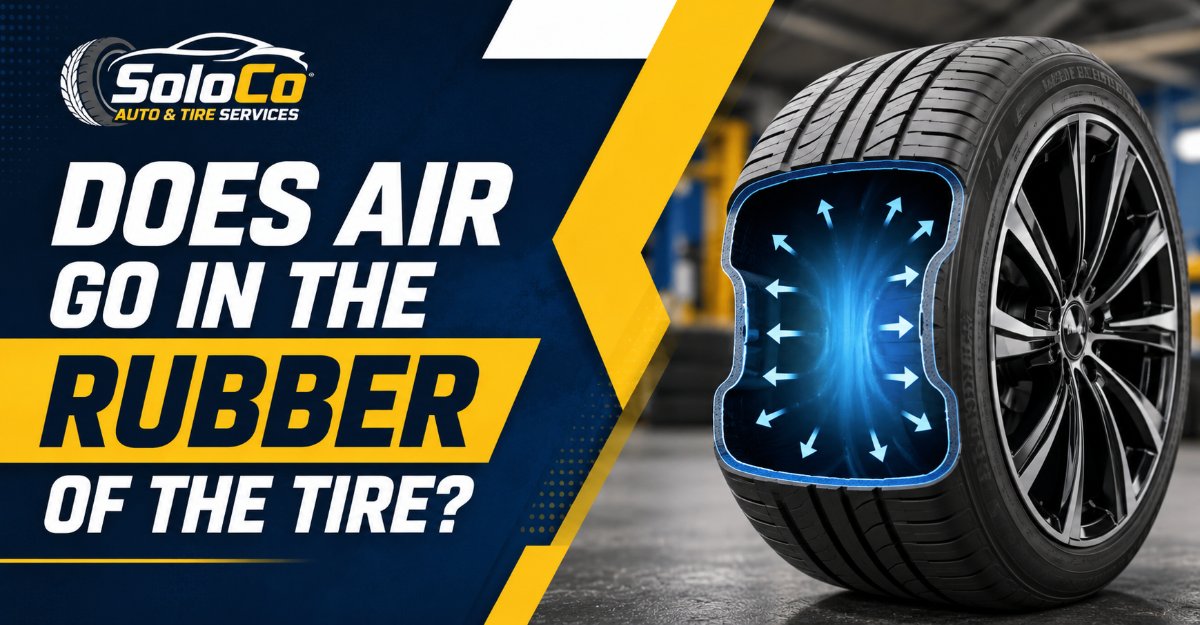
Air does not inflate the solid rubber of a tire; instead, compressed air is pumped exclusively into the hollow cavity formed between the interior tire carcass and the steel wheel rim. The rubber compound serves strictly as a flexible structural container and pressure seal, while the enclosed gas volume provides roughly ninety-five percent of the vehicle load-carrying support.
Key Facts at a Glance
- Inflation Chamber: Compressed air fills the internal void between the inner tire liner and the exterior wheel rim, never embedding within the solid rubber walls.
- Polymer Porosity: Rubber compounds are microscopically permeable, allowing gas molecules to diffuse through the material over extended timeframes at a rate of one to two pounds per square inch monthly.
- Inner Liner Barrier: Modern pneumatic tires utilize a specialized halobutyl rubber inner layer specifically engineered to minimize air loss and seal the internal chamber.
- Load Distribution: Pneumatic pressure supports the entire weight of the vehicle, while the steel belts and nylon plies maintain the structural geometry of the tread.
Where Does Air Go When You Inflate a Tire?
Air molecules entering a tire accumulate within the sealed internal cavity rather than penetrating the solid vulcanized rubber material. When an air compressor nozzle opens against the valve core, compressed atmospheric gas flows through the valve stem and fills the empty space enclosed by the tire casing and the wheel barrel. The rubber acts as a flexible containment vessel that traps this gas under pressure.
Without this hollow chamber, a tire could not function. Solid rubber lacks the elastic deformation capacity required to absorb road impacts while simultaneously supporting multi-thousand-pound vehicular loads. The compressed air inside acts as an independent fluid cushion. When a tire rolls over a pothole, the air compresses locally to absorb the shock before instantly returning to its baseline volume, protecting both the wheel assembly and the vehicle suspension.
Why Do Tires Lose Air If Air Does Not Penetrate Rubber?
Tires lose pressure over time because vulcanized rubber is not completely impervious to gas molecules at a microscopic level. Although rubber appears solid and airtight to the naked eye, its polymer chain structure contains sub-microscopic spaces. Gas molecules, particularly oxygen, are small enough to slowly migrate through these interstitial gaps in a natural physical process known as permeation.
The rate of natural pressure loss typically ranges from one to two pounds per square inch every thirty days under normal operating conditions. This diffusion occurs continuously, even when a vehicle remains parked in a temperature-stable garage. Factors that accelerate this permeation rate include ambient temperature fluctuations, wheel rim corrosion, and aging rubber compounds that have lost their original plasticizers and elasticity.
How Does the Tire Keep Air Contained Inside the Cavity?
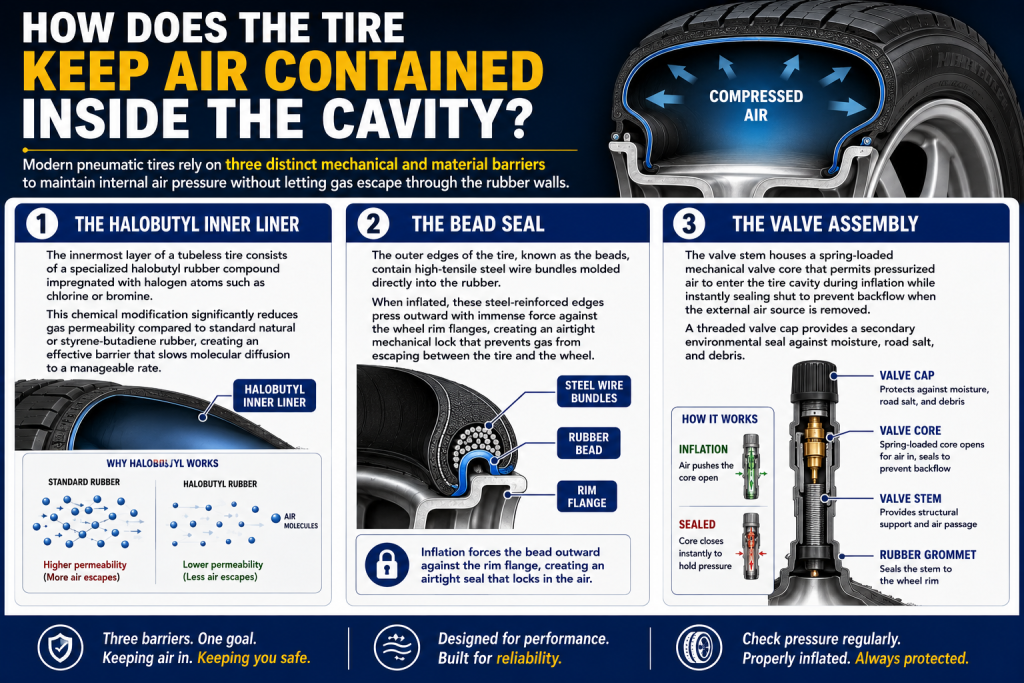
Modern pneumatic tires rely on three distinct mechanical and material barriers to maintain internal air pressure without letting gas escape through the rubber walls.
The Halobutyl Inner Liner
The innermost layer of a tubeless tire consists of a specialized halobutyl rubber compound impregnated with halogen atoms such as chlorine or bromine. This chemical modification significantly reduces gas permeability compared to standard natural or styrene-butadiene rubber, creating an effective barrier that slows molecular diffusion to a manageable rate.
The Bead Seal
The outer edges of the tire, known as the beads, contain high-tensile steel wire bundles molded directly into the rubber. When inflated, these steel-reinforced edges press outward with immense force against the wheel rim flanges, creating an airtight mechanical lock that prevents gas from escaping between the tire and the wheel.
The Valve Assembly
The valve stem houses a spring-loaded mechanical valve core that permits pressurized air to enter the tire cavity during inflation while instantly sealing shut to prevent backflow when the external air source is removed. A threaded valve cap provides a secondary environmental seal against moisture, road salt, and debris.
What Happens Inside the Tire When Pressure Drops?
Under-inflation alters the structural geometry of the tire, creating excessive mechanical stress and thermal buildup within the rubber and internal polyester cords. When air pressure falls significantly below the vehicle manufacturer specification, the sidewalls experience abnormal flexing cycles during every wheel rotation.
This continuous flexing generates internal friction, causing the tire internal temperature to rise rapidly. Excessive heat degrades the bonding agents between the steel belts, nylon plies, and rubber carcass, eventually leading to tread separation or catastrophic structural failure. Furthermore, under-inflated tires increase rolling resistance, forcing the engine to consume more fuel to maintain vehicle momentum.
Compressed Air Versus Nitrogen: Does Gas Composition Change Permeation?
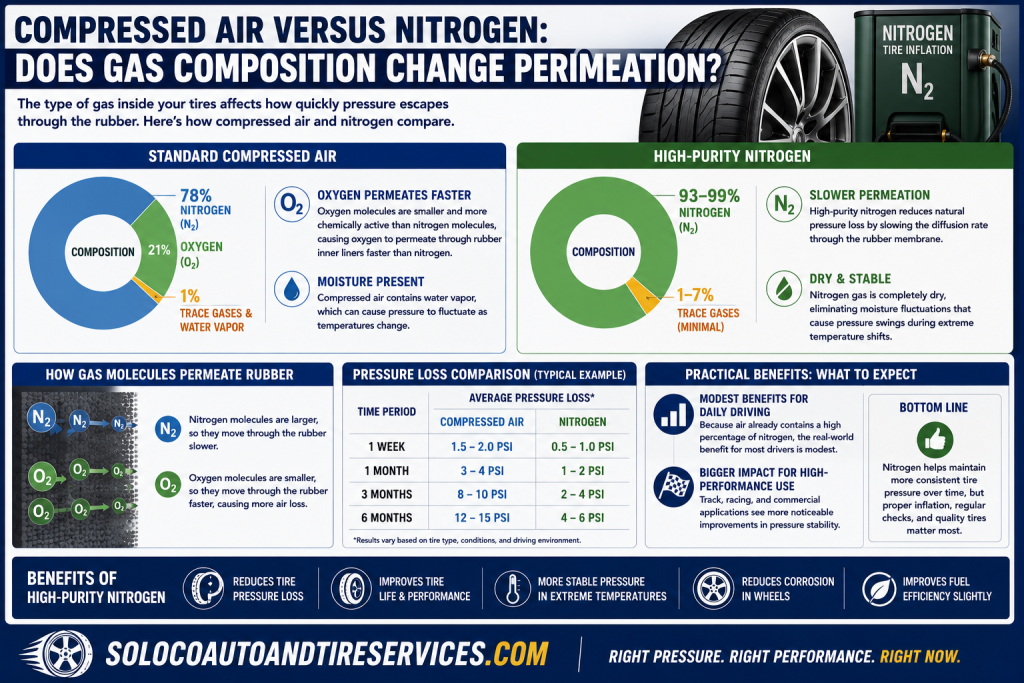
Standard compressed air consists of approximately seventy-eight percent nitrogen, twenty-one percent oxygen, and one percent trace gases and water vapor. Oxygen molecules are physically smaller and more chemically active than nitrogen molecules, causing oxygen to permeate through rubber inner liners faster than nitrogen.
Filling tires with high-purity nitrogen, typically ninety-three to ninety-nine percent pure, reduces natural pressure loss by slowing the diffusion rate through the rubber membrane. Nitrogen gas is also completely dry, eliminating the moisture fluctuations that cause compressed air pressures to swing wildly during extreme temperature shifts.
However, because standard air already contains a high percentage of nitrogen, the practical pressure retention benefits for daily street driving are modest compared to dedicated track or commercial applications.
How Often Should You Check and Correct Tire Pressure?
Vehicle operators should inspect tire pressure every thirty days and before embarking on long highway journeys using an accurate digital pressure gauge. Ambient temperature changes significantly affect internal pressure, dropping roughly one pound per square inch for every ten degrees Fahrenheit decrease in outdoor temperature.
Measuring pressure must always occur when the tires are cold, meaning the vehicle has been stationary for at least three hours or driven less than one mile at low speeds. Driving generates friction that heats the compressed air inside the cavity, causing thermal expansion that artificially elevates pressure readings by four to six pounds per square inch. Adjusting tire pressures based on hot readings results in under-inflated tires once the assembly cools down.
Frequently Asked Questions
Does the maximum PSI printed on the sidewall indicate correct inflation pressure?
The maximum pressure rating printed on the tire sidewall indicates the absolute structural limit for containment, not the recommended operating pressure for a specific vehicle. Vehicle operators must always follow the placard located on the driver-side door jamb, which accounts for vehicle weight distribution, load ratings, and suspension geometry engineered by the automobile manufacturer.
Can air escape directly through a brand new tire?
Brand-new tires still experience microscopic gas permeation through their halobutyl inner liners, resulting in a natural pressure loss of approximately one pound per square inch per month. If a new tire loses more than two pounds per square inch weekly, the cause is typically an unseated bead, a faulty valve core, or a puncture from road debris rather than normal material permeability.
Why do tires lose more pressure during winter months?
Cold weather causes the gas molecules inside the tire cavity to contract and lose kinetic energy, directly reducing internal pressure according to the ideal gas law. Additionally, sub-freezing temperatures can harden the rubber bead seal and slightly shrink the metal wheel rim, momentarily compromising the airtight interface until the assembly warms up during driving.
Does water inside compressed air lines affect tire performance?
Moisture introduced into the tire cavity via unconditioned compressed air sources can cause internal wheel corrosion on steel rims and slight pressure fluctuations during extreme temperature swings. Professional service facilities utilize inline air dryers and desiccant filters to remove water vapor before filling customer tires, ensuring stable internal environments.
What is the primary function of the rubber if it does not hold the air?
The rubber compound protects the internal structural components from environmental degradation, provides the friction necessary for traction against the road surface, and acts as a flexible containment membrane that holds the compressed air cavity in shape. Without the resilient outer rubber layer, the internal nylon cords and steel belts would immediately abrade and fail upon contact with pavement.


