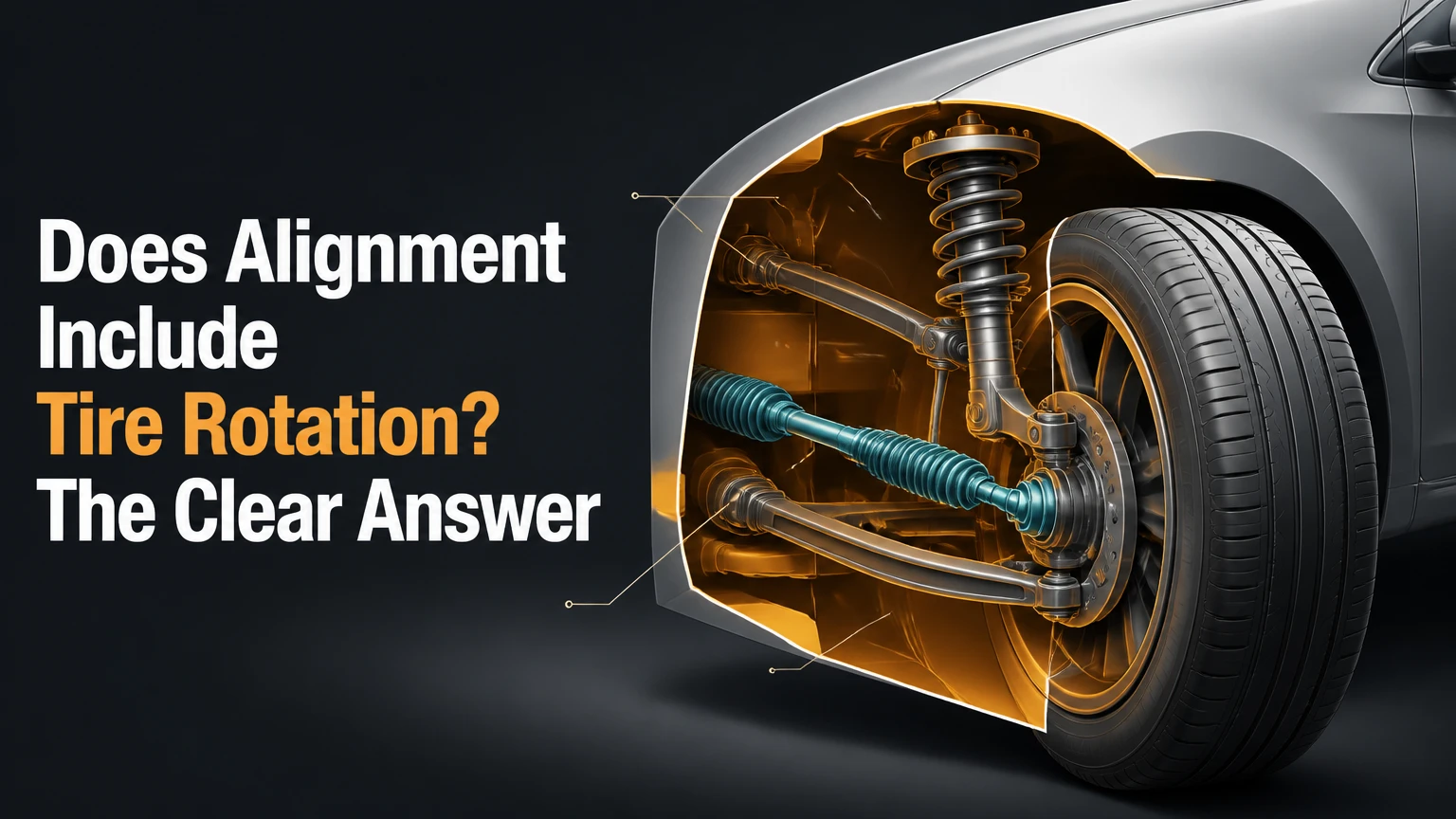
No, a wheel alignment normally does not include a tire rotation. Wheel alignment adjusts steering and suspension geometry, while tire rotation physically moves each tire and wheel to a different vehicle position. Shops may recommend both during one visit, but they are separate services and are usually listed and priced separately.
Key Facts
A wheel alignment changes suspension angles; a tire rotation changes wheel positions.
Tire rotation commonly takes 15-30 minutes, while a standard alignment commonly takes 30-60 minutes.
Typical retail pricing is $20-$50 for rotation and $100-$175 for a four-wheel alignment.
Tire rotation cannot correct incorrect toe, camber, caster, bent wheels, or worn steering parts.
Alignment cannot distribute tread wear because alignment does not relocate the tires.
Vehicle-specific tire patterns, tread direction, tire sizes, and the owner’s manual determine whether rotation is permitted.
What Is the Difference Between Alignment and Rotation?
Wheel alignment is a mechanical adjustment of the vehicle’s steering and suspension geometry. Tire rotation is a maintenance procedure that removes the wheel assemblies and places them at different corners to distribute tread wear.
The word “alignment” can cause confusion because technicians measure the wheel’s direction and tilt, but they do not normally move the tire from one axle to another. An alignment rack uses sensors or targets attached to the wheels, then compares measured angles with the manufacturer’s specifications.
Tire rotation requires a lift or suitable jacking equipment, removal of lug nuts, inspection of tread and sidewalls, and installation of each wheel in an approved position. The technician then tightens the lug nuts to the vehicle manufacturer’s torque specification.
| Service | Physical action | Main purpose | Typical result |
|---|---|---|---|
| Wheel alignment | Adjust tie rods, camber links, or other suspension hardware | Restore wheel geometry | Straighter tracking and reduced irregular wear |
| Tire rotation | Move wheel assemblies between approved positions | Equalize tread wear | More even wear across the tire set |
| Wheel balancing | Add or reposition wheel weights | Correct mass imbalance | Less vibration at speed |
| Tire inflation | Add or release air | Set cold pressure | Correct load support and contact patch |
Bridgestone describes alignment through the relationship among toe, camber, and caster, while tire manufacturers generally treat rotation as a separate tread-wear maintenance service. That distinction matters because one service cannot substitute for the other.
Does Alignment Include Tire Rotation?
A standard alignment package includes measuring and adjusting alignment angles, not moving tires between corners. A tire rotation is included only when a shop explicitly bundles it into a promotion, tire-installation package, maintenance plan, or written estimate.
Ask the service writer one precise question: “Does the quoted alignment price include removing and reinstalling all four wheels in a new position?” If the answer is no, request a separate rotation price. Some shops rotate tires at no charge with tire purchases or oil services, which can make the two procedures appear to be one package.
A shop may perform both efficiently in the same visit. The technician can inspect the tires during the alignment pre-check, rotate them after confirming the tread pattern allows it, and reset tire pressures before returning the vehicle. The invoice should still identify the work separately.
Why Do Shops Recommend Both Services Together?
Shops recommend alignment and rotation together because the services address different causes of tire wear. Alignment controls whether the tire contacts the road at the intended angle; rotation controls which tire experiences the greater steering, braking, and drivetrain loads.
Front-wheel-drive vehicles often place steering, braking, and engine-driving forces at the front axle. That combination can make front tires wear faster than rear tires, although actual wear depends on driving style, vehicle weight, tire compound, suspension condition, and road surfaces.
A rotation cannot reverse tread that has already been scrubbed away by excessive toe. An alignment cannot move a heavily used front tire to a less demanding rear position. Performing both at the appropriate time protects the remaining tread, but neither procedure repairs a damaged tire.
How Does a Wheel Alignment Work?
A professional alignment measures wheel angles against vehicle-specific specifications, adjusts the components that control those angles, centers the steering wheel, and verifies the result with a road test. A technician cannot complete an accurate adjustment if suspension or steering parts have excessive looseness.
What Happens During an Alignment?
- Pre-inspection: The technician checks tire pressures, tire condition, ride height, steering play, ball joints, tie-rod ends, wheel bearings, and suspension damage.
- Rack placement: The vehicle is positioned on an alignment rack with the steering wheel centered and the tires settled.
- Sensor installation: Targets or sensors are attached to the wheels. The system compensates for wheel runout through a rolling or compensation procedure.
- Angle measurement: The alignment computer records toe, camber, caster, thrust angle, and related measurements.
- Mechanical adjustment: The technician adjusts available tie rods, eccentric bolts, control arms, or alignment links.
- Final verification: The technician centers the steering wheel, confirms readings against specifications, prints before-and-after measurements, and typically performs a short test drive.
A printed result is useful because “green” readings alone do not explain whether the technician adjusted the car or merely measured it. Check that the final values are within the correct manufacturer range and that the steering wheel remains centered on a level road.
Which Alignment Angles Matter?
Toe most directly affects rapid tread scrubbing, camber affects inside or outside edge loading, and caster affects steering stability and self-centering. The three angles interact, so a visible symptom may have more than one mechanical cause.
| Angle | Measurement view | Typical fault symptom | Common adjustment |
|---|---|---|---|
| Toe | Viewed from above | Feathered tread and steering wander | Tie-rod adjustment |
| Camber | Viewed from the front | Inner or outer shoulder wear | Camber bolt or control-arm adjustment |
| Caster | Viewed from the side | Pulling, poor self-centering, uneven steering effort | Control-arm or strut adjustment |
| Thrust angle | Rear axle direction relative to centerline | Dog-tracking or crooked steering wheel | Rear alignment adjustment |
Vehicle specifications differ. A performance car may intentionally use more negative camber than a family sedan, so “perfectly vertical” is not a universal alignment goal. The correct target is the manufacturer’s specification or a documented performance setup.
What Types of Alignment and Rotation Exist?
Four-wheel alignment is the normal choice for most modern vehicles, while rotation patterns depend on tire construction, wheel size, and drivetrain. A two-wheel alignment may be appropriate only when the vehicle design and the shop’s measurement procedure support it.
| Service or pattern | Suitable vehicle condition | Key restriction | Typical decision |
|---|---|---|---|
| Front-end alignment | Vehicle with adjustable front geometry and fixed rear axle | Rear thrust direction may remain unchecked | Use only when manufacturer design permits |
| Four-wheel alignment | Most modern cars, SUVs, and crossovers | Rear angles must be measured and adjusted where possible | Preferred for independent rear suspension |
| Forward cross rotation | Non-directional, same-size tires | Tire must be approved for cross-axle movement | Common on front-wheel-drive vehicles |
| Side-to-side rotation | Directional or same-side tire setup | Tire remains on its original side | Used when tread direction forbids crossing |
| Front-to-rear rotation | Same-size, non-staggered tires | Front and rear positions must accept the same tire | Common on uniform wheel sets |
Can Every Tire Be Rotated?
No. Directional tires must remain on the same side unless a tire is remounted on its wheel, and staggered tire setups may use different front and rear sizes that prevent front-to-rear movement.
Check the sidewall for a directional arrow or a marking such as “rotation.” A tire with an asymmetric tread may have an “outside” sidewall but can often move between sides if it remains mounted correctly. A tire shop should also inspect load rating, speed rating, wheel width, and clearance before changing positions.
Some vehicles use different front and rear tire sizes, different tire compounds, or a manufacturer-approved limited rotation pattern. Tesla, BMW, Mercedes-Benz, and many high-performance vehicles may specify restrictions in the owner’s manual. The manual takes priority over a generic rotation diagram.
What Rotation Patterns Are Common?
Non-directional, same-size tires may use a forward cross, rearward cross, or X-pattern, depending on the drivetrain and tire manufacturer. Directional tires usually move front to rear on the same side, while staggered tires may have no practical rotation option.
| Tire configuration | Permitted movement | Position example | Inspection requirement |
|---|---|---|---|
| Same-size, non-directional | Cross-axle movement | Front left to rear right | Confirm tread and wear direction |
| Same-size, directional | Same-side front to rear | Front left to rear left | Preserve arrow direction |
| Staggered sizes | Usually side-to-side only or none | 225 front, 255 rear | Confirm wheel and axle clearance |
| AWD with uniform tires | Manufacturer-approved full pattern | All four corners | Compare tread-depth difference |
How Much Do Alignment and Rotation Cost?
Typical U.S. retail pricing is $20-$50 for a standalone tire rotation and $100-$175 for a standard four-wheel alignment. Actual prices vary with location, vehicle design, seized adjustment hardware, aftermarket suspension parts, and whether ADAS calibration is required.
| Service | Typical price | Typical time | Main price variables |
|---|---|---|---|
| Tire rotation | $20-$50 | 15-30 minutes | Tire size, shop policy, tire purchase |
| Front-end alignment | $50-$125 | 30-45 minutes | Vehicle design and adjustability |
| Four-wheel alignment | $100-$175 | 30-60 minutes | Rear suspension and labor rate |
| Performance alignment | $175-$400 | 60-120 minutes | Custom settings and adjustment difficulty |
| ADAS calibration add-on | $200-$500 or more | 1-3 hours | Camera, radar, scan-tool, and road-test needs |
Price estimates should state whether the shop includes an alignment check, adjustment, before-and-after printout, steering-angle reset, and road test. “Alignment” can mean a measurement-only inspection at one facility and a complete adjustment at another.
ADAS calibration is not automatically part of every alignment. Vehicles with lane-centering, automatic emergency braking, radar cruise control, or camera-based safety functions may require a separate electronic procedure after suspension changes or certain repairs.
When Should You Book Both Services?
Book both services when tires show uneven wear and the vehicle has reached its rotation interval, or when an alignment inspection identifies geometry problems that could continue damaging the tread. Booking both is especially sensible after pothole impact, suspension repair, or installation of four new tires.
Use the owner’s manual as the primary interval. A typical rotation interval is 5,000-8,000 miles, while many drivers choose each oil-change interval. Alignment does not have a universal mileage interval because alignment angles can remain stable for years or change immediately after a severe impact.
| Situation | Alignment check | Rotation decision | Reason |
|---|---|---|---|
| New tires installed | Recommended when old tires had uneven wear or impact occurred | Rotate if pattern permits | Protects fresh tread and establishes even wear |
| Routine maintenance | Every 12,000 miles or after symptoms, typical practice | Every 5,000-8,000 miles, manual permitting | Rotation follows wear management |
| Pothole or curb strike | Inspect promptly | Rotate only after damage inspection | Bent wheels or suspension damage may exist |
| AWD vehicle | Check when tread differences or driveline symptoms appear | Follow the manufacturer’s shorter interval | Tire circumference differences can matter |
| Suspension repair | Required after geometry-changing work | Rotate after alignment and inspection | New settings must be verified with usable tires |
A new tire installation does not automatically require an alignment. The stronger reason is evidence: uneven edge wear, a crooked steering wheel, pulling, a recent impact, or suspension work. Aligning a healthy vehicle “just because” new tires were mounted may add cost without correcting a problem.
Which Service Matches Your Symptom?
A car that pulls may need an alignment, but a vibration usually points first toward wheel balance, tire damage, or a bent rim. Tire rotation can change the location or intensity of a symptom, yet it does not repair the mechanical cause.
| Observed symptom | More likely cause | First service or check | Why |
|---|---|---|---|
| Vehicle pulls on a flat road | Alignment, pressure, road crown, tire conicity | Check pressures, then alignment inspection | Multiple causes can mimic toe or caster problems |
| Steering wheel sits crooked | Alignment or steering-wheel centering error | Four-wheel alignment measurement | Rear thrust angle may affect front-wheel position |
| Vibration at 55-75 mph | Wheel imbalance, bent rim, tire separation | Wheel balance and tire inspection | Alignment rarely corrects rotational imbalance |
| Inner shoulder is bald | Excessive negative camber, toe, underinflation | Pressure check and alignment inspection | Suspension geometry and inflation have different wear signatures |
| Tread is feathered across blocks | Incorrect toe | Alignment measurement | Lateral scrub creates alternating sharp edges |
| Vehicle shudders during acceleration | Tire, axle, mount, or drivetrain issue | Tire and driveline inspection | Alignment is not a universal vibration repair |
Can Tire Rotation Fix Pulling?
Tire rotation can alter a pull caused by tire conicity or unequal tire behavior, but it cannot correct incorrect suspension geometry. If the vehicle continues pulling after pressure correction and a position change, the shop should measure alignment and inspect steering and suspension parts.
Road crown also complicates diagnosis. Many roads slope toward drainage, so a small drift to the right does not prove an alignment fault. Test on a reasonably flat, safe road, keep both hands ready, and compare behavior in both directions rather than releasing the steering wheel for an extended period.
Can Alignment Fix Vibration?
Alignment generally cannot fix a vibration caused by wheel imbalance, a bent rim, a damaged tire, or a separated belt. A vibration that increases with vehicle speed should receive a tire and wheel inspection before alignment work.
A technician may recommend both services when vibration and uneven wear appear together. The balance addresses the vibration, while alignment addresses the wear pattern. Treating the alignment as the cure for every steering complaint is an expensive diagnostic mistake.
What Should You Check After Each Service?
After a rotation, verify tire pressures, lug-nut torque, TPMS behavior, tread direction, and the absence of new noise or vibration. After an alignment, verify the steering-wheel position, road tracking, printed measurements, and whether the vehicle has required steering-angle or ADAS calibration.
Rotation Checklist
- Confirm each tire remains within its permitted position.
- Set cold pressures from the driver-door placard, not the tire sidewall maximum.
- Confirm lug nuts were torqued to the vehicle specification.
- Reset or relearn TPMS when the vehicle requires it.
- Check for exposed cords, bulges, punctures, or tread below the legal or manufacturer limit.
- Recheck lug-nut torque after the distance specified by the vehicle or wheel manufacturer if applicable.
Alignment Checklist
- Ask for before-and-after readings.
- Confirm the steering wheel is centered during the test drive.
- Ask whether worn or damaged parts prevented adjustment.
- Confirm rear alignment was measured when the vehicle uses adjustable independent rear suspension.
- Ask whether the steering-angle sensor was reset.
- Confirm ADAS calibration requirements after suspension or wheel changes.
An alignment reading cannot make a worn ball joint safe. If a technician identifies looseness, replace the defective component first, then align the vehicle. Attempting to set angles around a moving joint produces readings that may change as soon as the vehicle drives.
What Are the Most Common Mistakes?
The most costly mistake is paying for an alignment when the real issue is imbalance, tire pressure, or worn suspension hardware. A second mistake is rotating tires without checking whether their design permits the proposed pattern.
Three practitioner rules prevent many comebacks:
- Measure before adjusting: A straight steering wheel does not prove correct rear thrust angle, and a crooked wheel does not identify the exact failed component.
- Inspect tire wear before rotating: Moving a tire can hide the corner that created the problem and make later diagnosis harder.
- Treat tread depth as a drivetrain issue on some AWD vehicles: Follow the manufacturer’s allowed difference rather than assuming four tires are interchangeable.
Do not rotate a tire with a bulge, exposed cord, severe puncture damage, or unsafe tread condition. Rotation changes position, not structural safety. Do not cross a directional tire, and do not install a smaller or differently rated tire on an axle without vehicle-specific approval.
How Do You Decide What to Book?
Book a tire rotation for routine tread-wear management, an alignment for pulling or irregular wear, and wheel balancing for speed-related vibration. Book an inspection before any of those services when a tire, wheel, steering component, or suspension part may be damaged.
Use this decision sequence:
- Check tire pressure first. Unequal pressure can create a pull and changes the contact patch.
- Inspect tread and sidewalls. Look for shoulder wear, cupping, feathering, bulges, and embedded objects.
- Identify the symptom. Pulling suggests geometry or tire behavior; vibration suggests balance, wheel, or tire damage.
- Check vehicle configuration. Confirm directional, asymmetric, staggered, run-flat, and AWD requirements.
- Ask for a written estimate. Separate rotation, alignment adjustment, balancing, repairs, TPMS service, and ADAS calibration.
- Approve repairs before adjustment. Alignment cannot remain accurate when steering or suspension parts are loose.
The best shop will explain the measured fault, identify the adjustable component, and provide a result that matches the manufacturer’s specification. A generic “green” screen without a pre-inspection or final printout gives less evidence than a documented before-and-after report.
FAQ
Is a tire rotation necessary after an alignment?
A tire rotation is not mechanically necessary after every alignment. Perform it when the tires have reached their maintenance interval, show unequal axle wear, or the vehicle and tire design permit a useful position change. Alignment adjusts geometry; rotation manages tread distribution, so the correct timing for each service remains separate.
Should tires be rotated before or after an alignment?
Inspect and rotate tires before the final alignment measurement when the vehicle’s tire positions affect the diagnosis, then perform the alignment with correct pressures and the intended wheel locations. Shops may use a different order for efficiency, but the final readings must reflect the vehicle’s actual operating configuration.
Does rotating tires affect wheel alignment?
Rotating tires does not change suspension alignment angles, but it can change how the vehicle feels because each tire has a different wear pattern, stiffness, or conicity. If a pull appears after rotation, check tire pressure, tread direction, and tire behavior before assuming the alignment changed.
How often should tires be rotated on an AWD vehicle?
AWD tire rotation intervals vary by manufacturer, but 5,000-6,000 miles is a common maintenance range when the owner’s manual does not specify another schedule. AWD vehicles can be sensitive to tire circumference differences, so measure tread depth and replace or rotate tires according to the drivetrain’s approved limits.
Is alignment included with new tires?
New-tire pricing does not automatically include wheel alignment. Tire installation normally covers mounting, balancing, and valve or TPMS-related work, while alignment is a separate adjustment unless the retailer’s written package specifically includes it. Ask whether the package includes an alignment check, adjustment, and final printout.
The Bottom Line
Does alignment include tire rotation? Normally, no. Alignment corrects wheel geometry through steering and suspension adjustments, while rotation relocates tires to distribute tread wear. Perform both during the same visit when symptoms, mileage, tire design, or vehicle configuration justify them, but confirm each service and price separately before approving the work.


