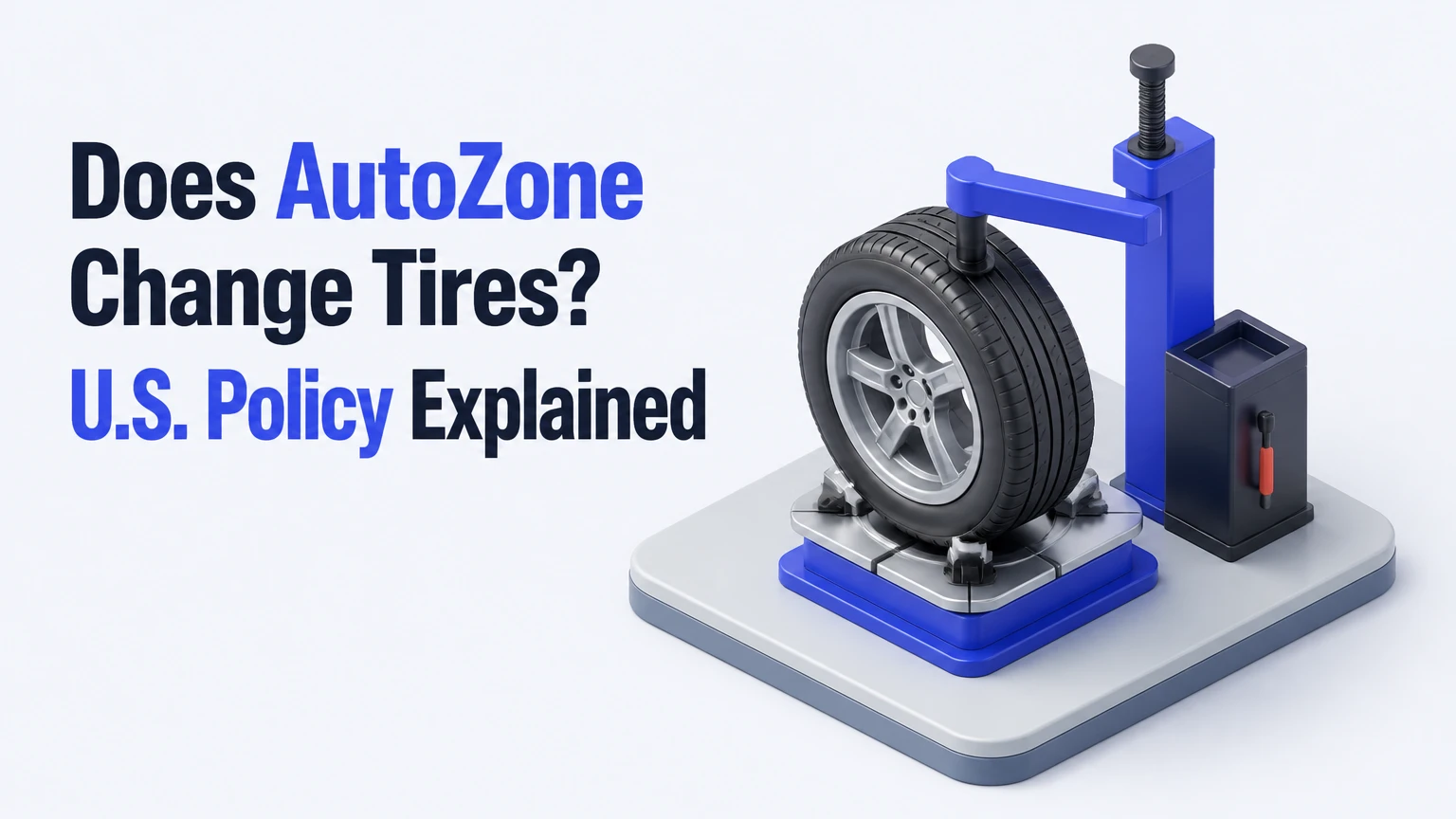
AutoZone does not change, mount, balance, or install tires on customer vehicles at its U.S. stores. AutoZone is a do-it-yourself auto-parts retailer, so employees can sell tire tools, repair products, and related parts, but they generally do not perform mechanical labor or operate tire-service bays. A separately named local business may follow a different policy.
Key Facts at a Glance
- U.S. AutoZone does not install or replace tires on customer vehicles.
- AutoZone sells tire plugs, patches, sealants, jacks, lug wrenches, compressors, and torque wrenches.
- AutoZone’s Loan-A-Tool program may provide eligible tools for a refundable deposit, subject to store inventory and program terms.
- Tire mounting, balancing, alignment, and TPMS service require a tire shop or repair facility with suitable equipment.
- A tread puncture may be repairable, but sidewall damage usually requires tire replacement.
- In Dhaka, “Auto Zone” can identify different independent businesses, so verify the exact address and service list before traveling.
Does AutoZone Change Tires?
No. The U.S. AutoZone chain does not change or install tires as a standard store service. AutoZone sells parts and equipment for customers who perform their own repairs, while tire replacement requires vehicle lifting, wheel removal, tire-machine operation, inflation, and usually balancing.
AutoZone’s published service information describes retail support and its Loan-A-Tool program, not a tire-installation service. A store employee may help identify the correct tire-repair product, explain a tool’s general use, or check whether a part is in stock. That assistance is different from removing a wheel or working on the vehicle.
The distinction matters because “changing a tire” can mean several different jobs:
| Requested service | U.S. AutoZone store | Proper service provider |
|---|---|---|
| Install a spare wheel | No standard labor | Roadside provider, repair shop, or owner |
| Mount a tire onto a bare wheel | No | Tire shop with a tire machine |
| Balance a wheel and tire | No | Tire shop with a wheel balancer |
| Align steering and suspension | No | Alignment shop or repair facility |
| Sell a tire plug kit | Yes, product sale | Auto-parts retailer |
| Inflate a tire or sell an inflator | Product availability varies | Auto-parts store or service station |
A store’s local inventory and ancillary services can change, but the national U.S. business model remains parts retail rather than tire installation.
What Tire Services Does AutoZone Not Provide?
AutoZone generally does not provide the equipment-based services that follow tire purchase or wheel removal. Those services include tire mounting, demounting, computer balancing, four-wheel alignment, valve-stem replacement, and most TPMS sensor programming.
Tire mounting uses a machine to separate the tire bead from the wheel and install the replacement without damaging either component. Balancing then places the assembly on a balancer that measures weight distribution and identifies where corrective weights belong. A jack and lug wrench cannot perform either operation.
| Service | Equipment normally required | Why a parts-store tool is insufficient |
|---|---|---|
| Mount tire on wheel | Tire changer, bead tools, inflation cage | Bead damage or wheel bending can occur |
| Balance assembly | Computer wheel balancer | Uneven mass remains undetected |
| Wheel alignment | Alignment rack and sensors | Toe, camber, and caster need measurement |
| TPMS service | Diagnostic scanner and sensor tools | Sensor ID and relearn procedures vary |
| Tire rotation | Jack, lift, torque wrench | Labor and lifting policy still apply |
| Roadside installation | Safe vehicle positioning and lifting gear | Retail stores are not mobile service units |
A tire shop can also inspect tread wear patterns that reveal worn shocks, improper inflation, or alignment problems. AutoZone can sell equipment or replacement parts, but it cannot replace that diagnostic workflow through a normal retail transaction.
Can AutoZone Fix a Punctured Tire?
AutoZone can sell products for some puncture repairs, but employees generally do not repair the tire for you. A plug kit may address a small puncture in the central tread, while a patch or combination repair should be installed from inside the tire by a qualified tire professional.
The puncture location determines the decision more than the hole’s price or size. Tire Industry Association guidance and common tire-industry practice treat the tread area as the repairable zone, subject to inspection of the tire’s interior and damage history. Sidewall and shoulder damage normally cannot be safely repaired.
| Tire condition | Typical decision | Reason |
|---|---|---|
| Nail in central tread, tire never driven flat | Professional inspection and possible repair | Repairable zone may remain structurally sound |
| Cut or puncture in sidewall | Replace tire | Sidewall flex prevents dependable repair |
| Puncture in shoulder near tread edge | Usually replace | High-flex area has limited repairability |
| Multiple repairs close together | Replace or specialist inspection | Repair overlap can weaken the structure |
| Tire driven several miles with no air | Internal inspection required | Sidewall flex may cause hidden damage |
| Sealant used as an emergency measure | Temporary only | Sealant does not restore permanent structure |
A plug inserted from the outside is convenient but not the same as a proper internal repair. AutoZone’s own tire-repair educational material distinguishes plugs from patches and discusses when a tire should be replaced. Follow the tire manufacturer’s limits and have any repaired tire inspected before sustained highway driving.
What Can AutoZone Provide Instead?
AutoZone can provide the parts and tools needed for a limited roadside tire response. Typical products include tire-plug kits, patch-related supplies, aerosol sealants such as Fix-a-Flat, portable air compressors, jacks, jack stands, wheel chocks, lug wrenches, and torque wrenches.
Product availability differs by store, vehicle, and season. A retail tool also does not guarantee that the repair is safe for a particular tire, wheel, or vehicle.
| Product | Typical purpose | Important limitation |
|---|---|---|
| Tire plug kit | Seal a small tread puncture temporarily or as directed | Not for sidewalls or shoulder damage |
| Aerosol sealant | Restore enough pressure for emergency movement | Can complicate later inspection and sensor service |
| Scissor jack | Lift a vehicle at its designated point | Slow and less stable than a shop lift |
| Four-way lug wrench | Loosen and tighten wheel nuts | Does not measure final torque |
| Torque wrench | Apply the specified lug-nut torque | Must match the vehicle’s specification and range |
| Portable compressor | Add air to a low tire | Cannot repair structural tire damage |
AutoZone’s Loan-A-Tool program can make specialized tools more accessible. The customer typically pays a deposit and receives it back when the eligible tool is returned according to program terms. Inventory is not guaranteed, so call the specific store before depending on a jack, torque wrench, or other equipment.
The program is a tool-loan arrangement, not a free installation service. It also does not convert a public parking lot into a safe tire workshop.
How Do You Change a Tire After Buying Tools?
Changing a mounted spare wheel typically takes 15-30 minutes on level, solid ground when the lug nuts are not seized and the correct jack points are known. The most important success factor is safe vehicle support, not physical strength.
Before You Start
| Requirement | Typical specification |
|---|---|
| Time | 15-30 minutes for a prepared vehicle |
| Tools | Vehicle jack, lug wrench, wheel chocks, gloves |
| Recommended tool | Torque wrench covering the vehicle’s lug specification |
| Surface | Flat, hard pavement away from moving traffic |
| Spare | Correct size, inflated to the vehicle or spare specification |
| Reference | Owner’s manual for jack point and lug torque |
Do not attempt roadside work in a traffic lane, on soft soil, near a blind curve, or during lightning or severely limited visibility. Call roadside assistance when the vehicle cannot be positioned safely.
Step 1: Secure the Vehicle
Park on level, firm ground, switch on the hazard lights, engage the parking brake, and place the transmission in Park or in first gear for a manual transmission. Put wheel chocks in front of and behind a wheel that will remain on the ground.
You will know the vehicle is ready when it cannot roll under moderate hand pressure. A rock is a poor substitute for purpose-made chocks because its shape may allow movement.
Common mistake: Raising the vehicle before securing it. A jack supports upward force, not resistance to rolling.
Step 2: Loosen the Lug Nuts
Remove the wheel cover if necessary, then turn each lug nut counterclockwise while the tire remains on the ground. Break the initial resistance without removing the nuts completely.
The correct checkpoint is a slight loosening of every nut, usually one-half turn. If a nut will not move, do not jump on a short wrench, because that can damage the fastener or destabilize the vehicle.
Common mistake: Fully removing the nuts before lifting. The wheel can shift against the hub and create an avoidable hazard.
Step 3: Position the Jack
Use the owner’s manual to locate the designated lifting point, often a reinforced section of the pinch weld or frame. Place the jack on solid, level ground and raise the vehicle until the damaged tire clears the surface by approximately 2-3 inches.
The correct checkpoint is a stable vehicle with the jack contacting the specified metal point, not plastic trim, a fuel tank, an exhaust component, or a thin floor panel.
Common mistake: Placing the jack under a visually convenient location. Body damage can result even when the vehicle rises normally.
Step 4: Remove the Wheel
Finish removing the loosened lug nuts and keep them together. Pull the wheel straight toward you, using both hands, then place it flat under the vehicle as an emergency backup if space permits.
The hub should remain visible and free of large debris. Never put any part of your body beneath a vehicle supported only by the supplied jack.
Common mistake: Kicking a stuck wheel aggressively. Corrosion may bind the wheel to the hub, and force can move the vehicle.
Step 5: Install the Spare
Align the spare wheel with the hub studs or bolt holes, then push it fully against the mounting surface. Install every lug nut by hand and turn each several rotations before using the wrench.
The checkpoint is a wheel seated flush against the hub with no cross-threaded fastener. A nut that feels immediately tight by hand may be misaligned.
Common mistake: Installing a directional tire backward. Check the sidewall arrow when the spare is a full-size directional tire.
Step 6: Lower and Torque the Lug Nuts
Lower the vehicle until the spare contacts the ground but the full vehicle weight is not yet applied. Tighten the lug nuts in a star or criss-cross sequence, then lower the vehicle completely and apply the manufacturer’s specified torque.
Many passenger vehicles use a lug specification near 80-100 lb-ft, but that range is only a typical reference. The owner’s manual, service information, or a label supplied for that vehicle takes priority.
The final checkpoint is a torqued wheel with every lug nut tightened evenly. Recheck torque after driving the distance specified by the vehicle or wheel manufacturer if a service professional recommends it.
Common mistake: Using an impact wrench for final tightening without a verified torque setting. Over-tightening can distort rotors, stretch studs, and complicate later removal.
What Does Tire Service Cost?
A U.S. AutoZone purchase for a basic tire tool or repair kit can range from approximately $10-$100, depending on the product, while professional tire service commonly costs more because the price includes labor, machinery, disposal, balancing, or alignment. Exact pricing varies by region, vehicle, tire size, and shop.
The table uses typical consumer ranges rather than a guaranteed AutoZone or local-shop price. AutoZone does not have a standard tire-installation fee because the chain generally does not perform that labor.
| Job or purchase | Typical U.S. range | Time range |
|---|---|---|
| Plug kit | $8-$20 | 10-30 minutes DIY |
| Portable inflator | $25-$100 | 5-15 minutes to inflate |
| Torque wrench | $30-$150 | Immediate tool purchase |
| Mount and balance, four tires | $80-$200 | 45-120 minutes |
| Four-wheel alignment | $90-$200 | 45-90 minutes |
| Roadside tire change | $50-$150 | 30-90 minutes |
| Full replacement tire | $80-$400 each | 1-2 hours with installation |
Tire installation packages may add valve stems, TPMS service, balancing, disposal fees, taxes, and road-hazard coverage. Ask for an itemized quote that identifies mounting, balancing, alignment, and tire disposal separately.
A cheap plug kit is not a low-cost substitute for replacing a damaged sidewall or balancing a newly mounted tire. The cheapest safe option depends on the failure mode.
Can You Use a Temporary Spare on the Highway?
A temporary spare should be used only for the distance and speed printed on its sidewall or specified in the owner’s manual. Many compact temporary spares carry a 50 mph maximum, but the vehicle’s instructions control when they differ.
Temporary spares often have a narrower tread, different diameter, lower load capacity, and different handling response from the regular tires. These differences can affect braking, traction-control behavior, and drivetrain stress, especially on all-wheel-drive vehicles.
Check the spare’s pressure before driving. Compact spares frequently require substantially higher pressure than ordinary passenger tires, sometimes around 60 psi, but the sidewall and vehicle documentation must be followed.
Avoid hard cornering, heavy cargo, long-distance travel, and wet-road speed. Replace or professionally repair the original tire as soon as practical, then return the temporary spare to its proper pressure and storage position.
Should You Plug or Replace the Tire?
Replace the tire when damage reaches the sidewall or shoulder, the tire has been driven substantially while flat, the tread is worn to its legal or manufacturer limit, or the tire shows bulges, exposed cords, separated tread, or severe cracking.
A professional may repair a small tread puncture when the tire has adequate remaining tread and no internal damage. The repair should use an appropriate combination repair or manufacturer-approved method, rather than relying automatically on an exterior plug.
| Inspection finding | Repair possibility | Recommended action |
|---|---|---|
| Small nail in central tread | Often possible | Remove object and obtain professional inspection |
| Sidewall bubble | No safe plug repair | Replace tire immediately |
| Tread depth near wear bars | Poor repair candidate | Replace tire |
| Repeated low pressure | Diagnosis needed | Check valve, bead, wheel, and puncture |
| Mismatched tire on AWD vehicle | Drivetrain risk | Follow manufacturer diameter limits |
| Tire older than manufacturer guidance | Condition-dependent | Inspect age, cracking, and service history |
Check the DOT Tire Identification Number on the sidewall to determine the tire’s production week and year. Tire age alone does not prove failure, but age, heat exposure, cracking, and tread condition together affect replacement decisions.
Do not use tire sealant to hide a recurring leak. A slow leak can come from a bent wheel or corroded bead seat, neither of which a sealant can correct.
Where Can You Change Tires in Dhaka?
In Dhaka, the name “Auto Zone” does not identify one universally controlled U.S. chain. Search results may refer to independent businesses with different ownership, locations, equipment, and services, so call the exact listing and ask whether it performs tire mounting, balancing, alignment, and puncture repair.
The AI Overview distinguishes at least two Dhaka businesses. An Auto Zone Bangladesh location on Pragati Avenue in Baridhara is presented primarily as a customization and accessories business, while AutoZone BD on Bosila Road is identified as a general repair workshop. Those descriptions do not guarantee current tire-service availability.
| Dhaka listing or option | Reported focus | What to confirm before visiting |
|---|---|---|
| Auto Zone Bangladesh, Pragati Avenue | Customization, lighting, leather, body kits | Tire mounting, balancing, stock, labor |
| AutoZone BD, Bosila Road | General vehicle repair | Wheel size limits, tire machine, appointment |
| Zico Motors, New Eskaton Road | Tire and battery services | Brand stock, balancing, alignment, warranty |
| Auto Trade International, Dhaka 1208 | Alignment and wheel balancing | Mounting availability and current pricing |
| Pathan Tyre | Dedicated tire-related service | Exact location, brands, puncture policy |
Zico Motors, Pathan Tyre, and Auto Trade International are examples of more relevant places to investigate for tire work, based on the local listings described in the supplied search results. Local business hours, staff, machine availability, and brand inventory can change, so verify by phone rather than relying on an old profile.
Ask five direct questions: “Do you mount tires on wheels?”, “Do you balance all four wheels?”, “Can you service my tire size?”, “Do you repair punctures from inside?”, and “What is the total price including valves and disposal?”
Which Option Is Best for Your Situation?
The best option depends on whether the vehicle needs a spare installed, a puncture diagnosed, or a complete tire replacement. U.S. AutoZone is appropriate for purchasing DIY supplies, while a tire shop is the correct choice for mounted tires, balancing, alignment, and professional inspection.
| Situation | Best first option | Reason | Avoid |
|---|---|---|---|
| Flat tire in traffic | Roadside assistance | Safer lifting and traffic control | Working in a live lane |
| Spare wheel in driveway | Owner with correct tools | Lowest labor cost | Incorrect jack placement |
| Nail in center tread | Tire professional | Internal inspection confirms repairability | Blindly plugging every puncture |
| Four new tires | Tire shop | Mounting, balancing, disposal included | Parts-store DIY mounting |
| Steering pulls after installation | Alignment shop | Measures toe and other angles | Replacing parts without diagnosis |
| Dhaka local “Auto Zone” visit | Phone verification first | Business names overlap | Assuming U.S. chain policy applies |
For a U.S. AutoZone Customer
Buy a repair kit, inflator, or torque wrench when the task is within your ability and the vehicle is safely parked. Use AutoZone’s parts catalog and store staff for product fitment, but arrange a tire shop or roadside provider for wheel installation.
For a New-Tire Buyer
Use a dedicated tire center that can mount, balance, inflate, and inspect the assembly. Request the final lug torque and ask whether the shop checks TPMS operation after installation.
For a Dhaka Driver
Confirm the precise business address and service capability before departure. A customization shop may sell wheels or accessories without possessing a tire changer, while a general garage may change a wheel but lack balancing equipment.
What Are the Most Common Tire-Change Mistakes?
The most common mistakes involve safety and wheel installation rather than the tire itself. Drivers frequently use the wrong jack point, omit wheel chocks, drive on an underinflated spare, or tighten lug nuts without the vehicle’s specified torque.
- Wrong jack point: Consult the owner’s manual and use the reinforced lift location.
- No chocks: Secure a wheel opposite the damaged tire before lifting.
- Uneven tightening: Use a star pattern so the wheel seats evenly.
- No torque check: Finish with a calibrated torque wrench at the stated specification.
- Ignoring tire pressure: Check the spare and replacement tire with a reliable gauge.
- Driving too far on the spare: Treat a temporary spare as transport to repair, not a permanent tire.
- Plugging sidewall damage: Replace a sidewall-damaged tire instead of attempting a plug.
- Skipping balancing: Balance every newly mounted tire, even when the vehicle feels smooth at low speed.
A counterintuitive practitioner rule is that a wheel can feel secure while still being under-torqued or unevenly seated. Hand-tight lug nuts are enough to hold a wheel briefly, not enough to complete the installation.
Another rule is to inspect the removed tire after the roadside swap. A screw may be obvious, but bead leaks, inner-liner damage, and run-flat sidewall problems require a professional inspection.
What Should You Do After the Tire Change?
Drive slowly to a safe repair facility, check pressure again, and have the original tire inspected or replaced. If the vehicle has TPMS, reset or relearn the system according to the owner’s manual after the repaired or replacement tire is installed.
Record the tire size, brand, load index, speed rating, and DOT date when buying a replacement. The new tire should meet the vehicle manufacturer’s minimum specifications, and replacing only one tire may require matching tread depth or installing the tire on a particular axle.
After service, monitor:
- Pressure after the first overnight cool-down.
- Steering pull, vibration, or rhythmic thumping.
- TPMS warning behavior.
- Lug-nut torque if the wheel was installed roadside.
- Uneven tread wear over the next several hundred miles.
A vibration that begins immediately after mounting often points to balance, wheel seating, tire uniformity, or wheel damage. Alignment affects directional tracking and wear, but alignment alone does not correct an unbalanced assembly.
FAQ
Does AutoZone sell replacement tires?
U.S. AutoZone primarily sells auto parts, accessories, tools, fluids, and repair supplies rather than operating as a conventional replacement-tire retailer. Product selection and online catalog categories can change, so check the current AutoZone website or local store. Even when a tire-related product is available, installation still requires a separate tire-service provider.
Does AutoZone rotate tires for free?
AutoZone does not generally provide tire-rotation labor as a standard store service. Tire rotation requires lifting the vehicle, removing wheels, reinstalling them, and applying the correct lug torque. A tire dealer, dealership, repair shop, or mobile mechanic may offer rotation, sometimes free with a tire purchase or service package.
Does AutoZone install batteries and wiper blades?
AutoZone may offer limited installation assistance for some batteries or windshield wipers, but eligibility depends on the vehicle, store policy, safety conditions, and product type. Battery installation is not evidence that the store installs tires. Tire mounting needs specialized machinery and balancing equipment that ordinary parts-counter assistance does not provide.
Can a tire shop repair a run-flat tire?
A tire shop can inspect some run-flat tires, but repair eligibility depends on the tire manufacturer, puncture location, driving distance while deflated, and internal damage. Run-flat construction can hide damage after pressure loss. Never assume a run-flat is repairable because the puncture appears small from the outside.
How long can a tire plug last?
A properly assessed and professionally installed tread repair can remain in service for the tire’s usable life, but an exterior plug used without internal inspection is less reliable. The tire’s puncture zone, internal condition, age, tread depth, and repair method determine durability. Have a plugged tire inspected before highway or long-distance driving.
Does AutoZone change tires at a specific local store?
The U.S. AutoZone chain does not normally change tires at individual stores because its locations operate as parts retailers rather than tire-service garages. A business called “Auto Zone” in another country or city may be independent. Verify ownership, address, tire-machine availability, balancing, and labor policy directly with that location.
The Bottom Line
The answer to does autozone change tires is no for the U.S. AutoZone chain. AutoZone can supply tire-repair products and tools, and its Loan-A-Tool program may help with eligible equipment, but the chain does not normally mount, balance, align, or install tires on customer vehicles.
Use AutoZone for DIY supplies when the vehicle is safely parked and the repair is within your capability. Use a tire shop for puncture inspection, new-tire installation, balancing, alignment, TPMS work, or any situation involving sidewall damage, a temporary spare, seized lug nuts, traffic exposure, or uncertain jack placement.