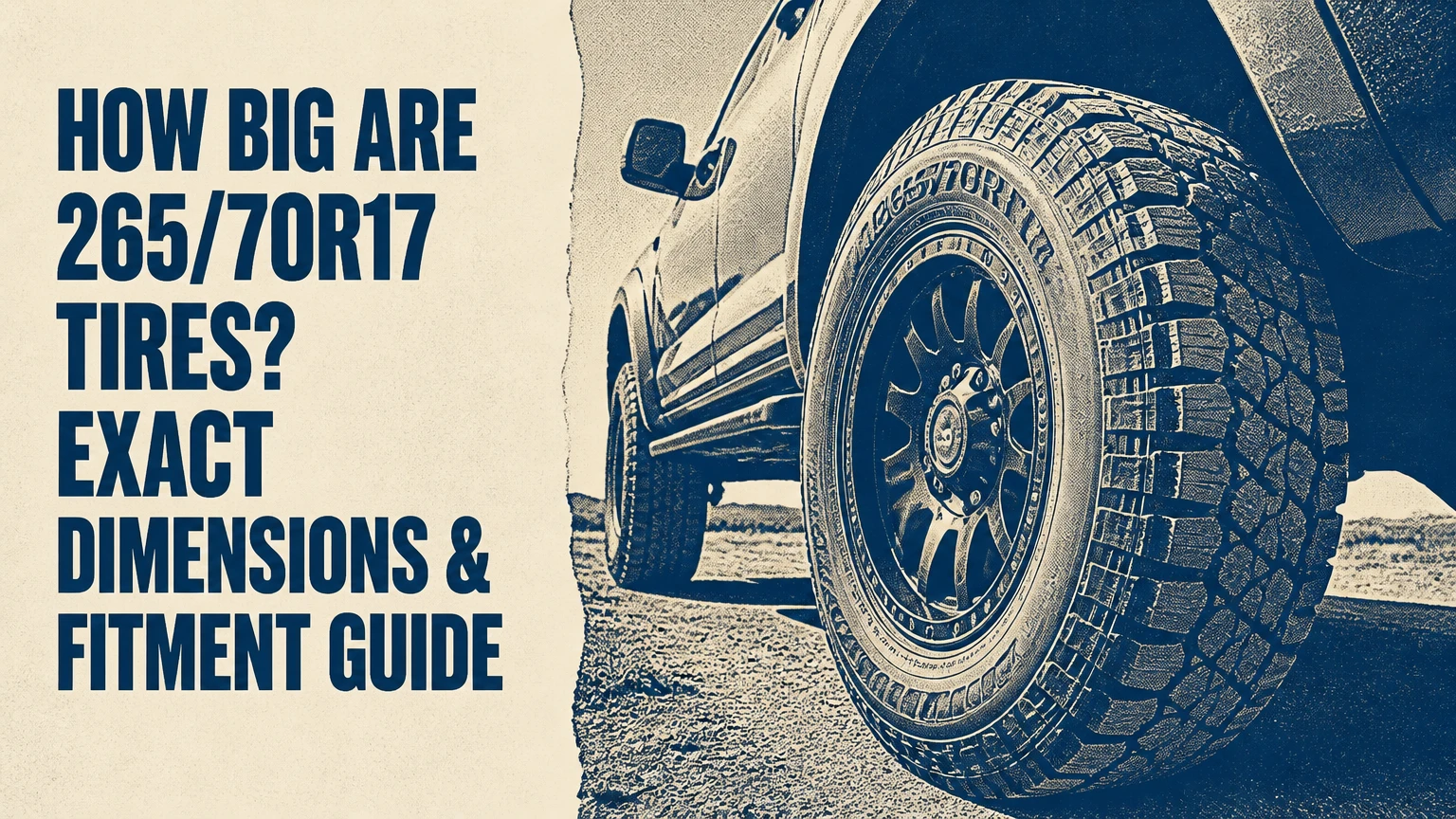
A standard 265/70R17 tire measures approximately 31.6 inches tall and 10.4 inches wide. This tire size serves as a highly popular factory and aftermarket equipment choice for mid-size and full-size trucks and SUVs, including the Toyota Tacoma, Jeep Wrangler, and Ford F-150, balancing comfortable highway manners with off-road utility.
At a Glance: Key Facts About 265/70R17 Tires
- The section width of a 265/70R17 tire is 265 millimeters, equal to 10.43 inches across the widest point of the sidewall.
- The overall diameter mathematically equals 31.61 inches when mounted on a standard 17-inch rim.
- This specific tire size is universally classified and marketed as a 32-inch tire by manufacturers and retailers.
- Upgrading from a smaller factory tire to a 265/70R17 can decrease fuel economy by 0.5 to 1.5 MPG due to increased rolling resistance and weight.
- Proper inflation ranges from 32 to 35 PSI for standard passenger construction and 40 to 45 PSI for heavy-duty light truck variants.
What are the exact dimensions of a 265/70R17 tire in inches?
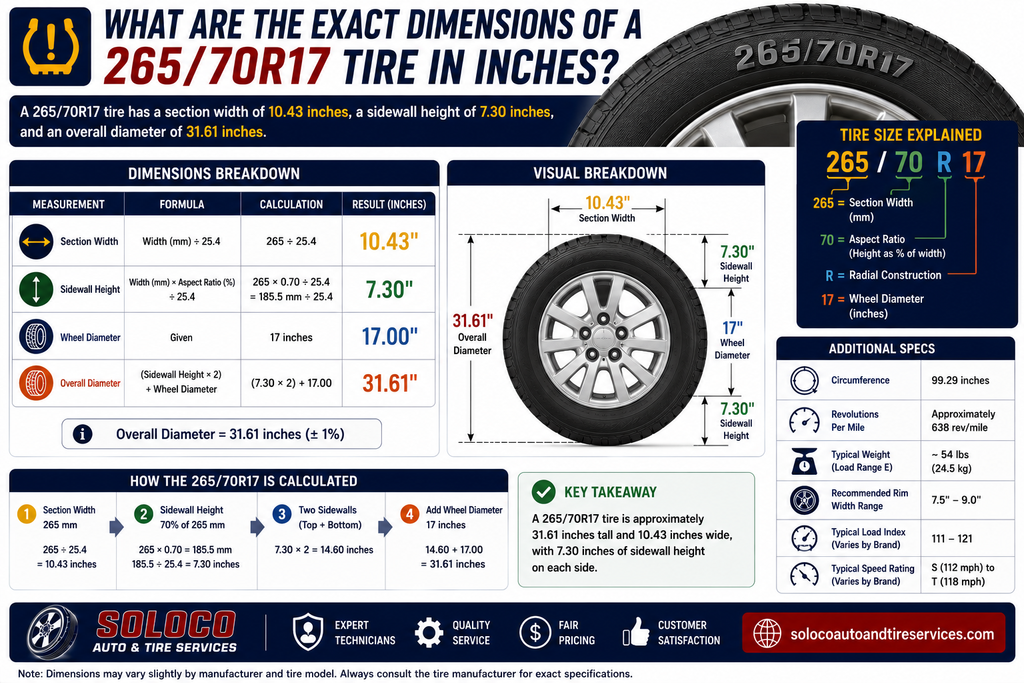
A 265/70R17 tire features a section width of 10.43 inches, a sidewall height of 7.30 inches, and an overall diameter of 31.61 inches. Tire sizing relies on a hybrid of metric width, percentage-based aspect ratios, and imperial rim diameters.
The mathematical breakdown uses specific formulas to derive each physical dimension. The first number, 265, represents the section width in millimeters, which converts to 10.43 inches when divided by 25.4. The second number, 70, is the aspect ratio, meaning the sidewall height is 70 percent of the 265 mm section width, resulting in 185.5 mm or 7.30 inches of rubber between the tread and the wheel. Multiplying the 7.30-inch sidewall height by two and adding the 17-inch wheel diameter yields the 31.61-inch overall height. This geometry produces a circumference of 99.29 inches and requires approximately 638 revolutions per mile.
Is a 265/70R17 tire considered a 32-inch or 33-inch tire?
The 265/70R17 tire is universally classified and marketed as a 32-inch tire. Because its mathematical diameter sits at 31.61 inches, it falls just short of the threshold required to be labeled as a true 33-inch tire.
In the automotive aftermarket, tire sizes are frequently grouped into nominal whole-inch categories for easier communication between buyers and manufacturers. While true 33-inch metric sizes like the 285/70R17 measure around 32.7 to 32.8 inches tall, the 265/70R17 rests firmly in the 32-inch family. Knowing this distinction prevents confusion when selecting suspension components, clearance kits, or replacement parts designed around nominal tire classifications.
How do manufacturer variances affect real-world 265/70R17 tire sizing?
Manufacturer variances cause physically identical nominal tire sizes to differ in height and width by up to a quarter of an inch. Tire brands interpret industry design standards with slight flexibility during the molding process.
When placing a 265/70R17 BFGoodrich All-Terrain T/A KO2 side-by-side with a Goodyear Wrangler or Falken Wildpeak of the exact same specification, minor discrepancies emerge. Tread compound hardness, shoulder lug wrapping, and internal carcass construction influence the final unloaded dimensions. Drivers planning tight clearance modifications should review specific manufacturer spec sheets rather than relying solely on the metric sidewall label.
How does rim width affect the actual height and width of a 265/70R17 tire?
Rim width alters the physical profile of a 265/70R17 tire by compressing or stretching the sidewalls upon inflation. Mounting the tire on a narrow or wide wheel changes both the contact patch and the overall vertical height.
When installed on a narrow 17×7-inch wheel, the wheel beads are pinched inward. This compression crowns the center tread block, slightly increasing the overall vertical height of the tire while narrowing the footprint. Conversely, mounting the same 265/70R17 tire on a wide 17×9-inch wheel stretches the sidewalls outward. This action broadens the tread contact patch on the pavement while slightly reducing the overall static diameter.
Will 265/70R17 tires fit on a stock truck without rubbing?
Factory-equipped trucks and mid-size SUVs can generally accept 265/70R17 tires without rubbing under normal driving conditions. This size serves as standard equipment on many trim packages, ensuring adequate clearance within factory wheel wells.
General online consensus often guarantees hassle-free fitment for this dimension on stock vehicles. However, factory clearance assumes original equipment manufacturer wheel specifications, undamaged suspension components, and standard alignment settings. Deviating from these baseline parameters introduces clearance risks that require closer inspection of wheel well geometry.
How do aftermarket wheel offsets cause 265/70R17 tires to rub?
Aftermarket wheels with negative offsets push 265/70R17 tires outward from the vehicle centerline, causing the outer edges to swing in a wider turning arc. This increased arc forces the tire tread into contact with the front bumper plastic or the cab mount area during sharp turns.
When a wheel features a low or negative offset, the mounting hub is shifted inward relative to the wheel width, moving the entire tire assembly outward. As the steering wheel turns from lock to lock, the outside shoulder of the tire sweeps through a significantly larger diameter circle. Even though a 265/70R17 tire has a modest 31.6-inch overall diameter, this altered pivot geometry frequently requires trimming plastic liners or performing a body mount chop.
How does suspension sag impact 265/70R17 tire clearance?
Suspension sag reduces the operational clearance of 265/70R17 tires by lowering the vehicle body closer to the axle hubs. Older trucks and SUVs with worn-out factory coil springs or sagging leaf packs sit lower than their original design specifications.
A vehicle with 150,000 miles on the original suspension will compress further over bumps and dips than a brand-new showroom model. While a 265/70R17 tire clears the inner fenders effortlessly on a fresh vehicle, a sagging suspension allows the inner liner to contact the tire shoulder during compression events, producing unwanted rubbing sounds and premature tread wear.
Can I swap 265/70R17 tires for 265/65R17 tires?
Switching from a 265/70R17 tire to a 265/65R17 tire is mechanically possible, but it reduces overall tire height by approximately one inch. The 65-series tire measures roughly 30.6 inches tall compared to the 31.6-inch height of the 70-series.
Choosing the taller 70-series tire fills out wheel wells more effectively and provides an extra half-inch of ground clearance beneath the differential housing. However, transitioning down to the 265/65R17 lowers the vehicle stance, firms up effective gear ratios slightly, and alters the vehicle’s speedometer reading to show a higher speed than actual travel.
How much will 265/70R17 tires hurt my fuel economy?
Upgrading to 265/70R17 tires from a smaller factory size like the 245/75R17 typically decreases fuel economy by 0.5 to 1.5 MPG. The heavier weight and wider tread pattern increase both rolling resistance and aerodynamic drag.
The magnitude of the fuel economy penalty depends heavily on the chosen tire construction. Selecting an aggressive 10-ply Load Range E all-terrain or mud-terrain version adds significant unsprung weight compared to a standard passenger-construction tire. This additional rotating mass requires more engine torque to accelerate from a stop, directly impacting fuel efficiency during city driving.
What tire pressure should I run in a 265/70R17 tire?
Standard P-metric passenger construction 265/70R17 tires require the vehicle manufacturer’s door placard pressure, usually set between 32 and 35 PSI. LT-metric light truck variants require higher inflation pressures, typically ranging from 40 to 45 PSI, to support identical vehicle loads safely.
Maintaining correct tire pressure ensures even tread wear, predictable handling, and optimal load-carrying capacity. Because LT-metric tires feature heavier sidewall plies and stiff internal carcasses, running them at low passenger-car pressures causes excessive heat buildup and shoulder wear. Drivers must verify their specific tire placard and sidewall maximum load ratings before setting operational pressures.
How does tread depth and category change the physical size of a 265/70R17 tire?
Mud-Terrain and aggressive All-Terrain 265/70R17 tires feature deep tread blocks that make them physically larger when brand new than highway-focused all-season alternatives. An off-road tire in this size often measures close to 31.8 inches tall, whereas a smooth highway tire may sit closer to 31.4 inches.
Tread category dictates the thickness of the rubber foundation and the height of the void-heavy lugs. While all models share the same internal casing dimensions, the external rubber layers vary substantially. Installers must account for these category-based size fluctuations when calculating exact clearance tolerances for tight wheel wells.
What is the difference between P-metric and LT-metric 265/70R17 tires?
P-metric 265/70R17 tires are engineered for passenger comfort and lighter loads with flexible sidewalls, while LT-metric tires feature heavy-duty multi-ply construction designed for towing and harsh off-road environments. P-metric tires prioritize a smooth ride, whereas LT tires emphasize puncture resistance and structural integrity.
The internal construction difference changes how the tire behaves under weight. P-metric tires flex readily to absorb road imperfections, reducing harsh feedback in daily driving. LT-metric tires utilize reinforced polyester and steel cord plies in the sidewalls, resulting in a stiffer ride, heavier total weight, and superior resistance to sharp rocks and trail hazards.
How do 265/70R17 tires compare to 285/70R17 tires in clearance requirements?
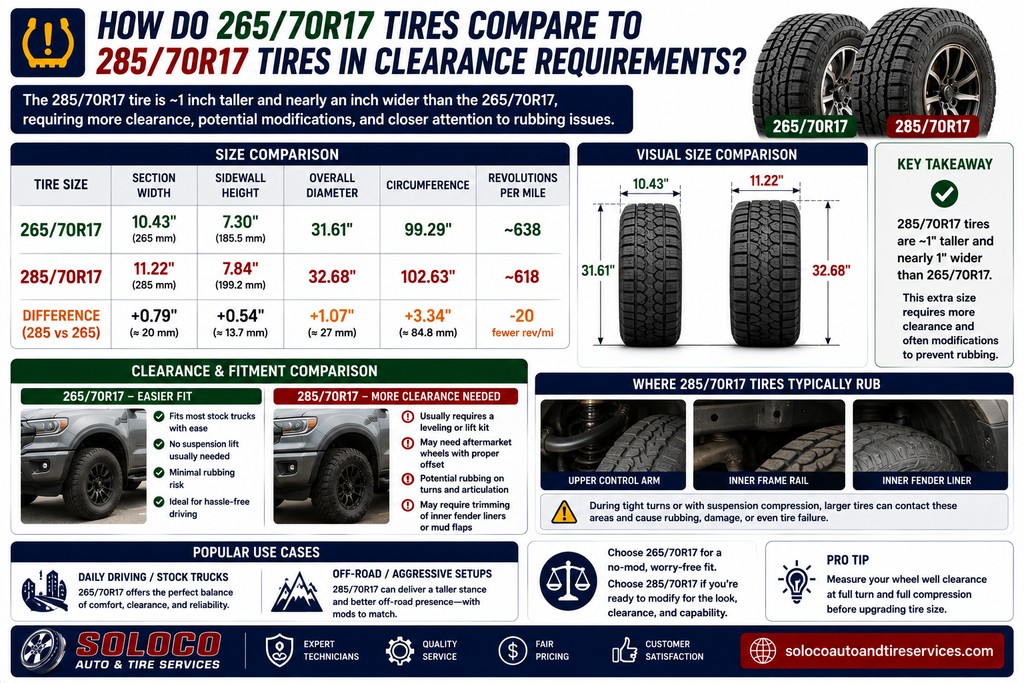
The 285/70R17 tire is approximately one inch taller and nearly an inch wider than a 265/70R17 tire, demanding significantly more clearance modification. While 265/70R17 tires fit most stock trucks easily, stepping up to 285/70R17 usually requires a leveling kit, aftermarket wheels with favorable offsets, or trimming of internal plastic liners.
Transitioning to the wider 285-series profile increases the risk of rubbing against the upper control arm and inner frame rails during tight turns. Drivers seeking a hassle-free fitment without suspension modifications find that 265/70R17 tires offer a trouble-free alternative that avoids the clearance hurdles associated with larger sizes.
Do 265/70R17 tires require a speedometer recalibration?
Switching to a 265/70R17 tire from a smaller factory baseline size requires a speedometer recalibration to maintain accurate speed and odometer readings. If the factory vehicle came equipped with a smaller tire like a 245/70R17, the larger 265/70R17 rotates fewer times per mile, causing the speedometer to read slower than actual travel speed.
A discrepancy of one inch in overall tire diameter introduces a noticeable error in vehicle speed calculations, affecting transmission shift points and fuel economy calculations displayed on the dashboard. Utilizing a digital programmer or dealership scan tool updates the computer’s tire revolution parameter to restore factory accuracy.
How much weight can a single 265/70R17 tire safely support?
A standard Standard Load P-metric 265/70R17 tire supports approximately 2,400 to 2,600 pounds, while a Heavy Duty Load Range E LT-metric version supports up to 3,195 pounds at maximum PSI. Load capacity scales directly with tire construction and proper inflation pressure.
Vehicle owners hauling heavy cargo trailers or adding aftermarket steel bumpers must evaluate their tire load index carefully. Exceeding the maximum weight rating printed on the sidewall compromises structural stability and increases the risk of tread separation under heavy operational loads.
The Bottom Line
A 265/70R17 tire stands approximately 31.6 inches tall and 10.4 inches wide, making it a versatile 32-inch factory and aftermarket upgrade for modern trucks and SUVs. While this size generally fits stock vehicles without modification, careful attention must be paid to aftermarket wheel offsets, suspension sag, and tread category variations to avoid rubbing. Balancing correct tire pressure with appropriate load ratings ensures optimal safety, handling, and fuel efficiency across daily driving and off-road applications.