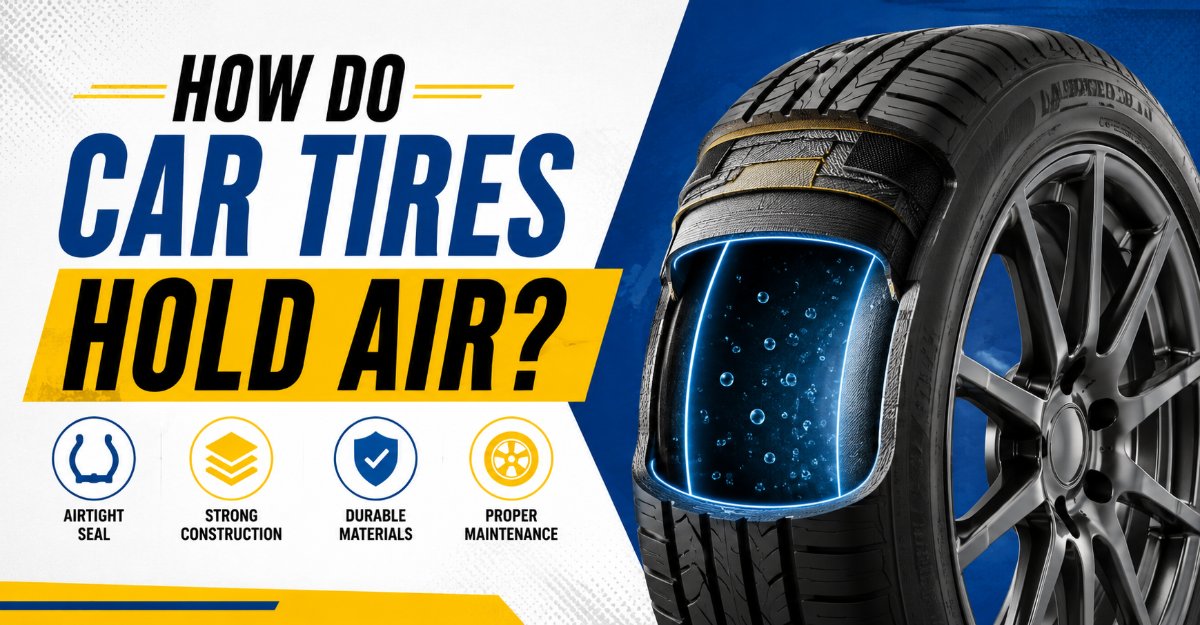
Car tires hold air through a combination of an impermeable inner halobutyl rubber liner, mechanical clamping force from the steel tire bead against the metal rim, and a spring-loaded Schrader valve. Modern tubeless tires and wheels form a sealed pressure vessel capable of containing 32 to 35 PSI of air pressure.
At a Glance
- Modern passenger cars utilize tubeless tire systems where the tire and wheel rim work together as a sealed pressure vessel.
- The inner liner consists of a 0.5mm to 1.5mm layer of halobutyl rubber that slows down molecular air diffusion by roughly 100 times compared to natural rubber.
- The tire bead uses high-tensile steel wire bundles that press against the metal wheel rim with thousands of pounds of force when inflated.
- A Schrader valve featuring a spring-loaded pin and rubber O-ring controls air entry and prevents backward leakage.
- Healthy tires naturally lose 1 to 2 PSI per month through microscopic molecular diffusion through the rubber walls.
What is a tubeless tire system?
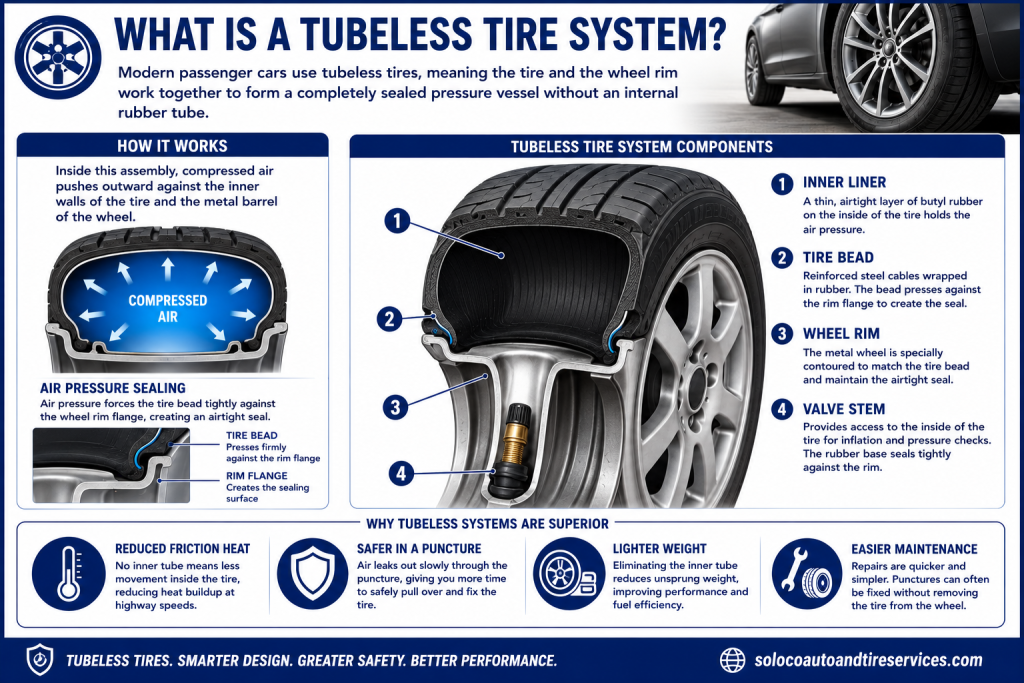
Modern passenger cars use tubeless tires, meaning the tire and the wheel rim work together to form a completely sealed pressure vessel without an internal rubber tube. Inside this assembly, compressed air pushes outward against the inner walls of the tire and the metal barrel of the wheel.
The elimination of inner tubes reduces friction heat at highway speeds and prevents catastrophic sudden deflation during a puncture.
How does the inner liner stop air diffusion?
The inside of a tubeless tire is coated with a 0.5mm to 1.5mm layer of halobutyl rubber, specifically chlorobutyl or bromobutyl compounds. Regular natural rubber features microscopic molecular networks that allow air molecules to slip through easily. Halobutyl rubber is highly impermeable, effectively slowing down air diffusion by approximately 100 times compared to untreated natural rubber compounds.
How does the tire bead create an airtight seal?
The tire bead is the inner reinforced edge of the tire that sits securely on the wheel rim, containing high-tensile steel wire bundles wrapped in hard rubber. When a tire is inflated to a standard 32 to 35 PSI, internal pressure pushes outward in all directions. For a standard 16-inch wheel, this internal pressure clamps the tire bead against the metal rim with thousands of pounds of total force, creating an airtight mechanical press-fit.
How does a Schrader valve prevent air from escaping?
Air enters and exits the tire through a Schrader valve containing a spring-loaded metal pin. When an air chuck pushes onto the valve, the pin depresses to allow compressed air to flow inward. When the chuck is removed, internal air pressure combined with a tiny internal spring snaps the valve shut. A rubber O-ring inside the valve core provides the definitive air seal against the exterior atmosphere.
How much air pressure do tires lose naturally every month?
A perfectly healthy tire naturally loses 1 to 2 PSI of air pressure every month purely through microscopic molecular diffusion through the rubber walls. Air molecules are small enough to slowly migrate through the halobutyl liner over time, making monthly pressure checks a mandatory maintenance requirement even when no punctures or mechanical leaks exist.
How does ambient temperature affect tire pressure?
Tire pressure drops or rises at a rate of roughly 1 PSI per 10°F change in ambient temperature, adhering directly to Charles’s Law where gas pressure is proportional to temperature. When a vehicle transitions from a warm garage into freezing winter weather, internal tire pressures drop significantly, requiring cold-weather adjustments.
What causes a tire to lose air without a puncture?
Tires lose air without a puncture due to physical anomalies including wheel bead corrosion, rubber valve stem dry rot, and low-profile bead unseating from impacts. When these components degrade, microscopic pathways open up between the tire and the wheel rim, allowing air to escape continuously over several days or weeks.
What is bead corrosion and how does it cause slow leaks?
Alloy wheels built from aluminum-magnesium blends oxidize when exposed to road salt, moisture, and debris over time. This oxidation creates a rough, flaky layer of aluminum oxide directly where the tire bead meets the metal rim. Air escapes through these microscopic metal craters, causing a tire to lose 3 to 5 PSI per week without any visible nail or puncture.
Why do rubber valve stems crack and leak over time?
Rubber valve stems degrade over a 5 to 7 year lifespan because constant exposure to ultraviolet rays and ozone causes the rubber compound to dry out and crack. Centrifugal force acting on the spinning wheel at 60 mph bends the weakened valve stem outward, opening up these micro-cracks and venting air while the vehicle is moving or parked.
What is low-profile tire bead unseating?
Tires with very short sidewalls, such as those with 35 or 40 aspect ratios, feature very little vertical flex to absorb road impacts. Hitting a sharp pothole compresses the short sidewall entirely down to the metal rim, violently forcing the tire bead inward and momentarily breaking the airtight seal, a phenomenon known as burping air. This impact can also permanently bend the wheel rim flange.
When should you ignore standard tire pressure placard advice?
Standard driver door placard advice should be adjusted during extreme off-road driving, heavy towing scenarios, and severe winter storage transitions. The factory placard specifies pressures optimized for standard daily commuting and empty passenger loads under moderate weather conditions.
Why do off-road drivers deflate their tires?
Off-road drivers deflate or air down their tires to 15 to 20 PSI when driving on deep sand, loose rock, or deep snow to prevent getting stuck. Lowering tire pressure increases the tire contact patch by up to 100 percent, allowing the vehicle to distribute its weight and float over soft obstacles rather than digging trenches.
How does heavy towing change required tire inflation?
Loading a vehicle with heavy cargo or hitching a heavy trailer causes standard 32 PSI tires to over-flex, generate excessive internal heat, and risk tread separation or blowouts. Drivers must look at the maximum load inflation pressure stamped directly on the tire sidewall, which is often 44 to 50 PSI, and inflate closer to that metric to safely support heavy-duty payloads.
What happens to tire pressure in severe winter storage?
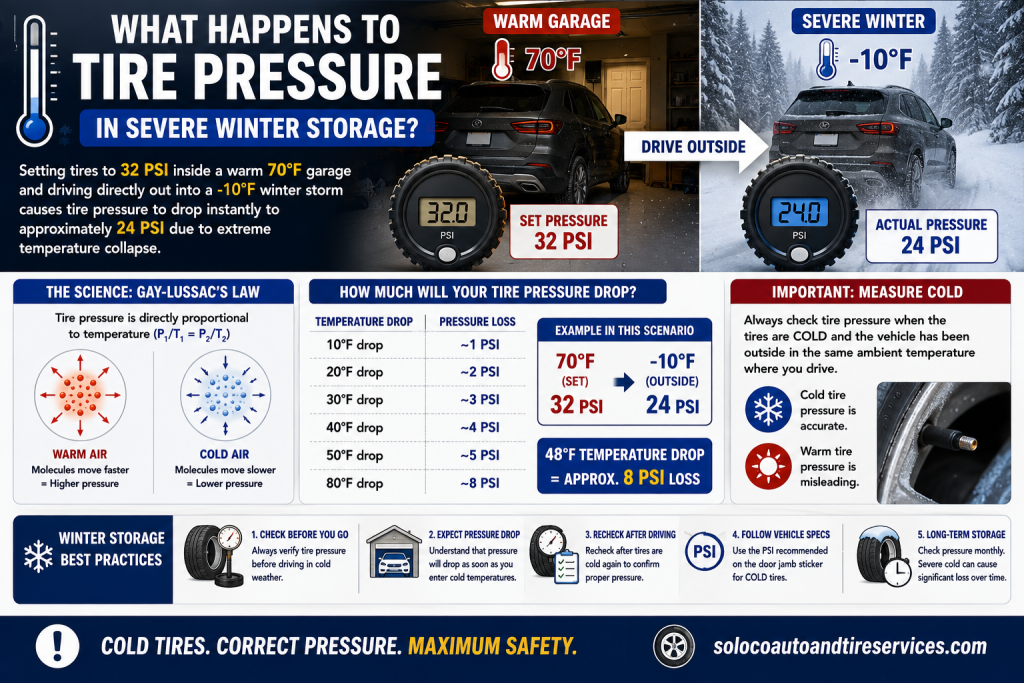
Setting tires to 32 PSI inside a warm 70°F garage and driving directly out into a -10°F winter storm causes tire pressure to drop instantly to approximately 24 PSI due to extreme temperature collapse. Cold tire pressure measurements must always match the actual ambient outdoor environment where the vehicle is driven.
Should you fill car tires to the maximum PSI printed on the sidewall?
Drivers should never fill passenger car tires to the maximum PSI printed on the sidewall unless carrying maximum rated payload weights. The number printed on the sidewall represents the maximum safe pressure the tire structure can hold at maximum load, not what an empty or lightly loaded car requires. Over-inflating reduces the road contact patch, causes harsh ride quality, accelerates center tread wear, and increases braking distances.
Does filling tires with nitrogen actually stop air loss?
Filling tires with nitrogen slows down pressure loss only marginally because nitrogen molecules are slightly larger than oxygen molecules, causing them to diffuse through the inner halobutyl liner roughly 30 to 40 percent slower. While a nitrogen-filled tire might lose 0.5 PSI per month instead of 1.5 PSI, normal atmospheric air already contains 78 percent nitrogen, making paid upgrades rarely cost-effective for everyday passenger vehicles.
Can a wheel rim itself leak air through metal porosity?
Cast aluminum wheels can occasionally suffer from porosity defects originating during the manufacturing process. When molten metal cools unevenly, microscopic air pockets form within the solid metal structure, creating tiny invisible pathways directly through the wheel barrel or spokes that allow compressed air to bleed out slowly over time.
The Bottom Line
Car tires maintain air pressure through an integrated system relying on impermeable halobutyl inner liners, thousands of pounds of mechanical clamping force at the wheel bead, and secure Schrader valve mechanisms. Understanding how temperature shifts, bead corrosion, and load variations impact this pressure vessel ensures optimal safety, better fuel efficiency, and extended tire longevity. Regular monthly pressure checks remain the best defense against gradual air loss.