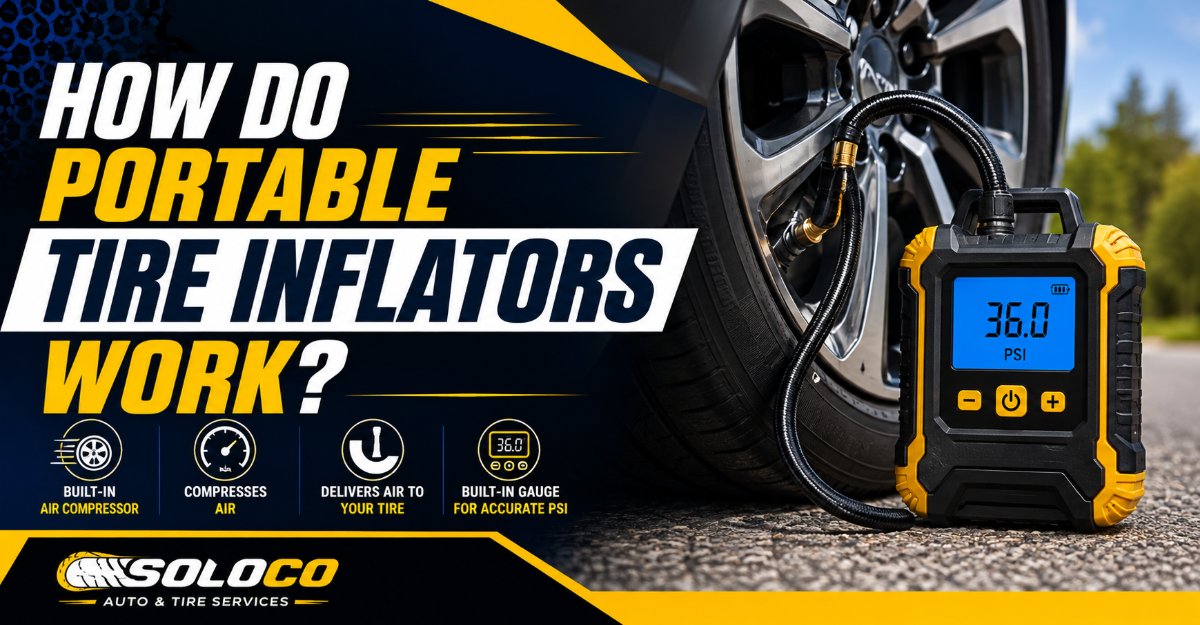
Portable tire inflators convert electrical energy into mechanical kinetic energy using a miniature reciprocating piston system driven by a direct current motor. This continuous mechanical cycle compresses ambient air and forces it past a one-way valve directly into a vehicle tire valve stem at high pressure. Understanding the internal physics, operational limits, and failure modes of these compact devices ensures optimal performance during roadside emergencies.
At a Glance
- Portable tire inflators rely on a direct current motor spinning at 10,000 to 15,000 revolutions per minute.
- Most standard 12V plug-in units draw between 10 and 15 Amps of electrical current.
- Standard passenger tire inflators operate at a 10% to 20% duty cycle, requiring mandatory cooling breaks.
- Dynamic pressure readings during active inflation are typically 2 to 5 PSI higher than static pressure readings.
- Leaving a vehicle engine off while running a 12V inflator will rapidly drain the battery and reduce motor output.
How Do Portable Tire Inflators Work?
Portable tire inflators function by transforming electrical power from a vehicle accessory port or internal battery into mechanical pressure that forces air into a tire. The internal direct current motor rotates a counterbalance cam that converts circular motion into linear strokes inside a compression cylinder. Ambient air is drawn in on the downward stroke, compressed on the upward stroke, and pushed through a one-way check valve until the target pressure is reached.
Professional mechanics note that while the concept is simple, the tolerances inside these miniature pumps are tight. Continuous operation without breaks causes extreme heat buildup, which can warp plastic internal components if safety thresholds are ignored.
What Are the Internal Mechanical Components of a Tire Inflator?
Portable tire inflators consist of five core mechanical and electrical components working in sequence: a power source, an electric motor, a gear or cam assembly, a reciprocating piston, and a one-way delivery valve. The power source supplies electrical current to spin the DC motor at high speeds. The motor turns a reduction gear attached to a counterbalance cam, which forces the piston up and down inside a sealed metal cylinder.
During the piston downstroke, a vacuum opens an intake valve to pull in atmospheric air at approximately 14.7 pounds per square inch. On the upstroke, the intake valve seals shut, and the piston compresses the trapped air volume. Once internal pressure exceeds the counter-pressure inside the tire, a one-way ball-check valve opens, allowing compressed air to flow through the delivery hose into the tire.
What Is the Difference Between a 12V Plug-In and a Battery-Powered Inflator?
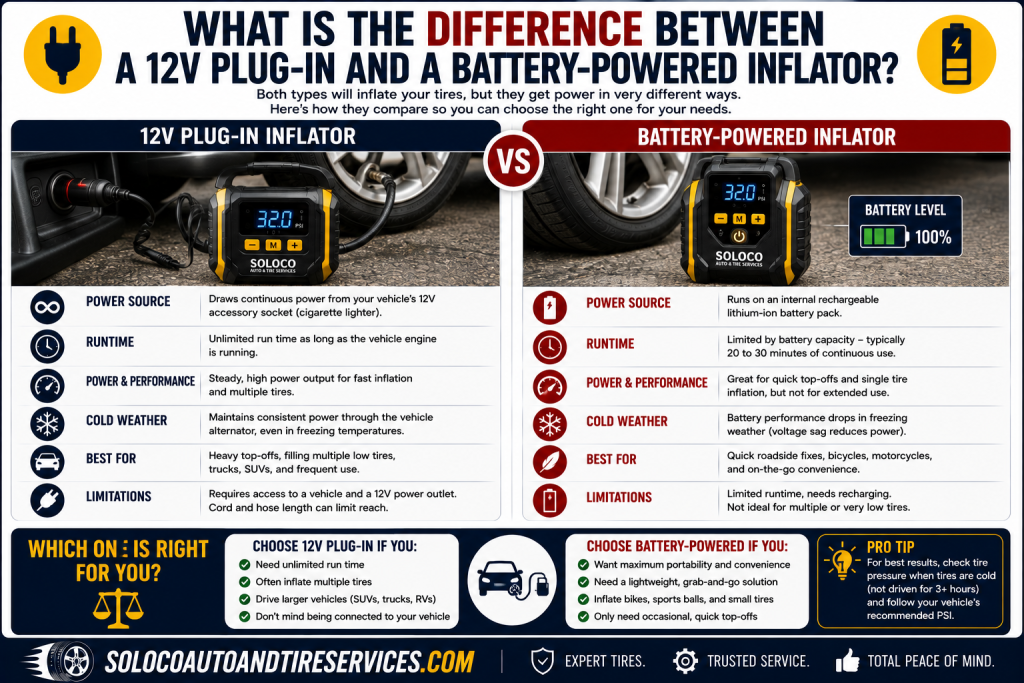
Plug-in 12V units draw continuous power directly from a vehicle’s accessory socket, whereas cordless battery-powered inflators rely on internal lithium-ion battery packs. Plug-in models offer unlimited run time as long as the vehicle engine is running, making them ideal for heavy top-offs or filling multiple low tires. Cordless models provide unmatched portability and convenience for quick roadside fixes without being tethered to a power cord, but their total runtime is strictly limited by battery capacity.
Battery units also suffer from voltage sag in freezing weather, whereas plug-in units maintain steady power through the vehicle alternator. Selecting the right model depends on whether you prioritize unlimited operational duration or grab-and-go convenience.
How Long Does It Take a Portable Tire Inflator to Fill a Completely Flat Tire?
A standard portable tire inflator with an airflow rate of 30 Liters Per Minute takes 10 to 15 minutes to fill a completely flat standard passenger car tire from zero to 35 PSI. For routine maintenance top-offs, such as raising a tire from 25 to 35 PSI, the same unit requires only 3 to 5 minutes of continuous operation. Heavy-duty off-road compressors featuring airflow rates exceeding 60 Liters Per Minute can cut these times in half, while compact pocket-sized cordless inflators may take up to 20 minutes for a total fill.
Exceeding these runtime windows on standard consumer pumps will trigger thermal overload protections, requiring mandatory cool-down periods before completion.
What Is a Duty Cycle, and Why Does It Cause Inflators to Overheat?
A duty cycle is the percentage of time a portable tire inflator can run continuously within a specific time window before requiring a mandatory cooling period. The vast majority of consumer portable tire inflators feature a 10% to 20% duty cycle, meaning they can run continuously for 2 to 3 minutes before needing 8 to 10 minutes of rest. Rapid air compression generates massive thermal energy at the cylinder head through adiabatic heating, not friction.
If an operator ignores the duty cycle and runs the pump continuously for 15 minutes, the intense heat will melt plastic piston rings, deform cylinder walls, and permanently burn out the electric motor winding.
Why Does the Air Hose Get Burning Hot Near the Machine During Use?
The air hose on a portable tire inflator becomes extremely hot near the pump cylinder due to the physical laws of adiabatic compression, which states that squeezing a gas into a smaller volume rapidly increases its temperature. When atmospheric air is compressed from 14.7 PSI up to 35 or 45 PSI within a fraction of a second, the concentrated thermal energy spikes dramatically, often exceeding 100 degrees Celsius at the cylinder head. This heat transfers directly into the metal fittings and rubber hose near the outlet.
Users frequently mistake this high temperature for motor friction or mechanical failure, but it is simply a natural thermodynamic byproduct of air molecules being forced together under high pressure.
Why Does the Pressure Gauge Drop When I Turn the Inflator Off?
The pressure gauge drops by 2 to 5 pounds per square inch when you turn off a portable inflator because the unit transitions from measuring dynamic pressure to measuring static pressure. While the motor is running, the gauge reads dynamic pressure, which includes the physical resistance and friction of air forcing its way through the narrow hose and valve stem. Once the motor stops and air movement ceases, the gauge reads static pressure, representing the true balanced pressure inside the tire cavity.
Always evaluate your tire pressure with the motor completely stopped to avoid under-inflating your tires.
Why Won’t My Tire Inflator Start When Connected to a Pre-Pressurized Tire?
A portable tire inflator may fail to start if connected to a tire that already contains high air pressure because the miniature DC motor lacks the starting torque to push the piston against existing back-pressure. When the piston is stationary at the bottom of the stroke and faces 35 PSI of resistance from the start, the electrical current spikes, stalling the motor or blowing a fuse.
The proper operating procedure requires turning the inflator on first to build momentum and open the internal check valve, and then screwing the connector onto the tire valve stem. Alternatively, purchase an inflator equipped with an automatic unloader valve designed to relieve initial startup load.
Should I Leave My Car Engine Running While Using a 12V Plug-In Inflator?
You should always leave your car engine running while operating a 12V plug-in tire inflator to prevent draining your vehicle battery and to maintain stable electrical voltage. Most plug-in inflators draw 10 to 15 Amps of current, which will quickly deplete a stationary car battery. Furthermore, with the engine off, vehicle system voltage drops from approximately 14.4 volts down to 12.2 volts.
This voltage drop forces the inflator motor to spin slower and draw higher current, resulting in accelerated motor overheating and potential burnout. Running the engine keeps the alternator active, providing a stable 14-volt supply that keeps the pump running efficiently.
Can I Use a Portable Tire Inflator for Large Truck Tires or RVs?
Portable tire inflators designed for passenger cars cannot handle large truck tires or high-pressure recreational vehicle tires because they lack the necessary volume capacity and thermal endurance. Large off-road truck tires require massive air volume that overwhelms small consumer compressors, causing them to trigger thermal shutdowns before reaching target pressures. Commercial RV tires require high pressures ranging from 80 to 110 PSI, which standard 12V consumer pumps cannot sustain without stalling or melting internal seals.
If you drive a heavy-duty truck, lifted off-road vehicle, or motorhome, you must invest in a dedicated high-output 12V compressor rated for heavy-duty duty cycles and high-pressure delivery.
Can I Use a Portable Tire Inflator to Inflate Air Mattresses or Pool Floats?
You cannot effectively use a portable tire inflator to inflate air mattresses or pool floats because these items require high volume and low pressure, whereas tire inflators provide low volume and high pressure. Trying to inflate a large air mattress with a tire inflator will take hours because the pump moves less than 30 Liters Per Minute. Furthermore, operating a tire inflator against minimal structural resistance restricts the cooling airflow around the pump motor, drastically increasing the risk of overheating and motor failure.
Use a dedicated high-volume electric blower or foot pump for inflatables and reserve your tire inflator strictly for automotive tires.
How Do Freezing Temperatures Affect Cordless Battery-Powered Inflators?
Freezing temperatures severely degrade the performance of cordless battery-powered tire inflators by reducing chemical reaction rates inside lithium-ion battery cells. When left in a freezing car trunk during winter months, a lithium battery experiences sharp voltage sag under heavy load. When the user attempts to inflate a tire, the battery cannot deliver the high current required to start the motor against back-pressure, causing the unit to immediately shut down with a flashing error light or low battery warning.
To prevent cold-weather failure, store your cordless inflator inside the vehicle cabin during sub-zero weather or use a direct 12V plug-in model that draws power from your running vehicle engine.
How Do I Prevent My Car Fuse From Blowing When Plugging in an Air Compressor?
Preventing a blown fuse when using a 12V plug-in air compressor requires verifying that your vehicle accessory socket is rated for at least 15 Amps before plugging in the device. Many older vehicles or secondary console ports are wired on 10-Amp fuses, which will instantly blow the moment a high-draw compressor motor starts. Always plug the unit directly into the primary cigarette lighter port designated for high-draw accessories.
Additionally, always turn the compressor power switch to the off position before inserting the plug into the socket to eliminate initial electrical arcing and surge spikes.
What Is the Difference Between Digital and Analog Portable Tire Inflators?
Analog tire inflators use a traditional spring-loaded mechanical dial gauge to display pressure, whereas digital inflators use an electronic pressure sensor and an LCD screen equipped with auto-shutoff capabilities. Analog gauges are durable and do not require batteries, but they are difficult to read accurately in low-light conditions and require manual monitoring to stop inflation at the correct PSI. Digital inflators allow users to pre-set a target pressure, automatically turning the machine off the exact moment the target is reached.
While digital units offer superior precision and ease of use, they contain sensitive electronic components that can fail if exposed to extreme moisture or severe physical drops.
How Often Should I Test and Calibrate My Portable Tire Inflator?
You should test and calibrate your portable tire inflator every six months, or prior to taking any long road trip, by comparing its pressure readings against a certified standalone mechanical tire gauge. Portable inflators experience mechanical wear and vibration shock during storage in vehicle trunks, which can cause internal pressure sensors or analog needles to drift out of calibration over time.
If your inflator reading deviates by more than 2 PSI from a trusted reference gauge, note the offset and manually compensate your target inflation setting to ensure your tires are never dangerously under-inflated or over-inflated.
The Bottom Line
Portable tire inflators rely on direct current motors and reciprocating piston mechanics to convert electrical energy into high-pressure compressed air. While highly effective for emergency passenger vehicle top-offs, successful operation requires understanding strict duty cycles, voltage requirements, and thermal limitations. Always run your vehicle engine during use, respect mandatory cool-down breaks to prevent motor burnout, and verify pressure readings with the motor turned off to ensure safe driving conditions.