Tires stay securely mounted on wheel rims through a complex combination of high-tensile bead wire reinforcement, precise mechanical interference fits, and continuous pneumatic air pressure. These three opposing forces work in unison to lock the tire rubber tightly against the metal wheel flanges during acceleration, braking, and cornering.
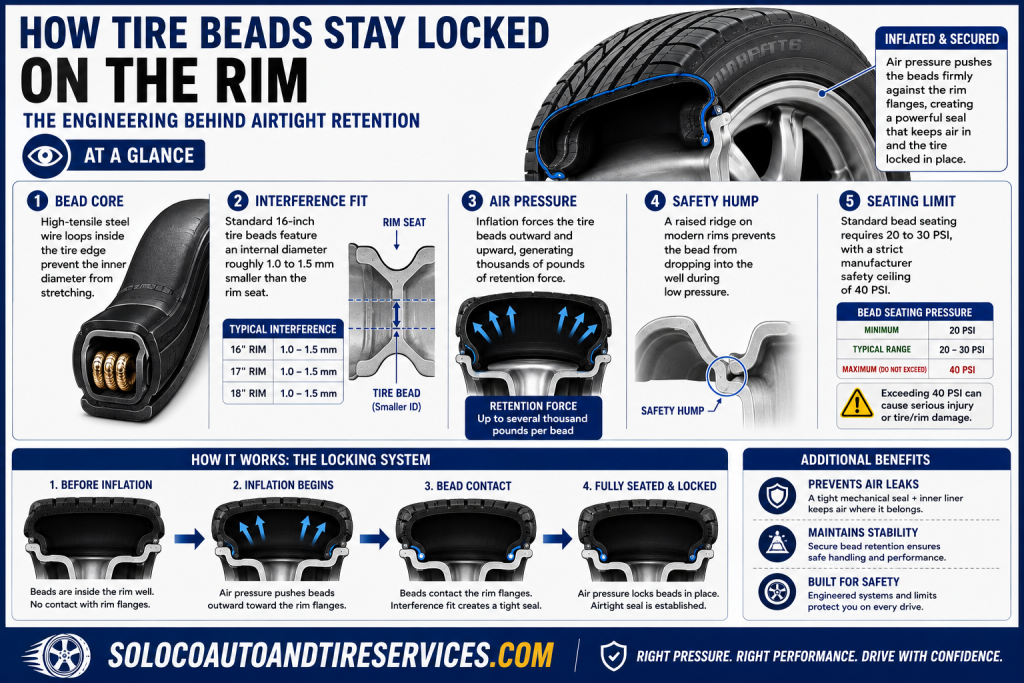
At a Glance
Bead Core: High-tensile steel wire loops inside the tire edge prevent the inner diameter from stretching.
Interference Fit: Standard 16-inch tire beads feature an internal diameter roughly 1.0 to 1.5 mm smaller than the rim seat.
Air Pressure: Inflation forces the tire beads outward and upward, generating thousands of pounds of retention force.
Safety Hump: A raised ridge on modern rims prevents the bead from dropping into the well during low pressure.
Seating Limit: Standard bead seating requires 20 to 30 PSI, with a strict manufacturer safety ceiling of 40 PSI.
What is a tire bead and what is its role in wheel retention?
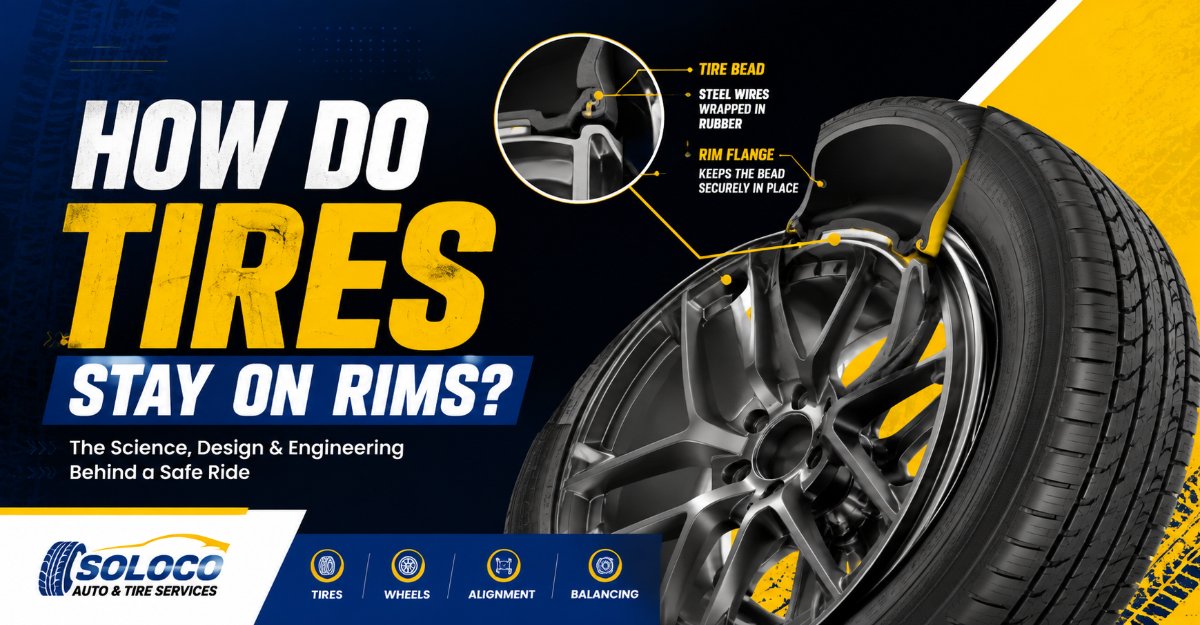
The tire bead is the reinforced inner edge of the tire that makes direct physical contact with the metal wheel rim. Composed of high-tensile steel wire bundles wrapped in rubber, the bead serves as the structural anchor that prevents the flexible rubber carcass from flying off the wheel under rotational and centrifugal forces. Without a rigid, unyielding bead core, pneumatic pressure would simply cause the rubber to balloon outward and peel away from the metal hub.
Professional technicians know that any structural compromise to the steel bundle inside the bead—such as a bend caused by improper use of a tire iron—permanently destroys the tire’s ability to maintain a safe mechanical lock.
How does mechanical interference fit keep a tire secured to a wheel?
Mechanical interference fit occurs because the inner diameter of the tire bead is manufactured to be slightly smaller than the outer diameter of the wheel rim seating surface. For instance, a standard passenger vehicle 16-inch tire bead has an internal diameter roughly 1.0 to 1.5 mm smaller than the rim surface it must mount onto. This intentional size discrepancy means the tire cannot simply drop onto the wheel; it must be stretched and forced over the outer lip of the rim using specialized mounting equipment. Once positioned, this tight dimensional mismatch creates constant inward tension, clamping the tire rubber against the metal wheel before a single PSI of air is added.
What role does pneumatic air pressure play in maintaining tire retention?
Pneumatic air pressure acts as the primary active force that pushes the tire beads outward and upward against the vertical walls of the wheel rim flanges. At a standard operating pressure of 35 PSI, the compressed air inside the tire exerts roughly 2,000 to 3,000 pounds of outward force pressing the rubber beads securely against the metal wheel barrel. This immense pressure guarantees that even when a vehicle encounters potholes, sharp turns, or sudden braking forces, the tire remains locked rigidly in its designated operating position.
Why do tires make a loud “pop” when being inflated?
The loud popping sound heard during tire inflation is the steel-reinforced tire bead forcefully overriding the rim’s raised safety hump and snapping into its final seating position. This acoustic indicator signifies that the bead has successfully cleared the drop center of the wheel and locked tightly against the outer rim flange. Experienced mechanics listen for this distinct sound sequence on both sides of the wheel to confirm that the tire is evenly seated before mounting the assembly onto a vehicle.
What is the safety hump on a wheel rim and why is it important?
Modern safety rims feature a raised metal ridge—known as the safety hump—that stands roughly 0.75 to 1.0 mm high just inside the bead seat. This hump acts as a mechanical barrier preventing the tire bead from slipping backward into the central dropped well of the rim during sudden air loss or heavy cornering maneuvers. Without this safety hump, a momentary drop in tire pressure would allow the bead to slide inward, instantly causing the tire to unseat and separate from the wheel.
What are standard tire bead seating pressures and safety limits?
Seating a tire bead typically requires an inflation pressure of 20 to 30 PSI, though stubborn beads may require slightly more. Most tire and wheel manufacturers enforce a strict safety limit of 40 PSI maximum for the bead-seating process to prevent catastrophic structural failure. Exceeding 40 PSI while attempting to seat a stubborn bead places extreme stress on the tire casing and rim, dramatically increasing the risk of an explosive blowout in the shop.
How do tubeless tires differ from tubed tire systems in rim retention?
Modern tubeless tires form a direct, airtight seal against the metal wheel rim using specialized inner rubber liners and tight bead geometry. Older tubed systems utilize a separate inflatable rubber tube inside the tire casing; while the air pressure inside the tube presses the tire bead against the rim, the tire itself does not require an airtight seal with the metal wheel. Consequently, traditional tubed wheels lack the strict safety humps and precise bead seat contours found on modern tubeless alloy and steel wheels.
How do beadlock wheels work for off-road and low-pressure driving?
Off-road vehicles running extremely low tire pressures for traction cannot rely on pneumatic pressure alone to keep tires mounted, so they use mechanical beadlocks. A beadlock wheel utilizes a heavy bolted outer ring that physically sandwiches the outer tire bead against the wheel frame using 15 to 24 high-strength steel bolts torqued to roughly 20 to 25 lb-ft. This physical clamping mechanism locks the rubber directly to the metal, allowing drivers to drop tire pressures below 10 PSI for sand or rock crawling without risking bead separation.
What causes a tire to unseat or pop off a rim?
Tires unseat from rims when the combined forces of lateral cornering loads, low inflation pressure, and sudden impacts overcome the mechanical interference fit and pneumatic retention forces. When tire pressure drops too low, the outward pneumatic force diminishes, allowing the bead to slip past the safety hump and drop into the wheel well. Once the bead enters this dropped well, the tire loses its airtight seal and separates completely from the outer rim flange.
Can you put a wider tire on a narrow rim without risking de-beading?
You can install a wider tire on a narrow rim only within strict manufacturer-approved dimensional limits. Exceeding recommended rim width charts forces the tire sidewalls to distort inward at an aggressive angle, which reduces the effective bead clamping force against the rim flange. This structural distortion compromises cornering stability and significantly increases the likelihood that the tire will unseat during high-speed evasive maneuvers or hard cornering.
What happens to tire retention when you drive on a flat tire?
Driving on a completely flat tire causes the rubber bead to lose all pneumatic support and slip over the safety hump into the center dropped well of the rim. Once trapped in this well, the weight of the vehicle forces the metal rim edge to physically cut and shred through the unseated rubber within a few hundred meters. This destroys the tire casing beyond repair and can severely damage the outer lip of the wheel rim.
How do heavy commercial vehicles and split rims manage extreme high-pressure retention?
Large commercial trucks and military vehicles utilize multi-piece wheels, often referred to as split rims or multi-piece ring wheels, to manage extreme inflation pressures exceeding 100 PSI. Instead of a continuous drop-center design, these assemblies use a removable steel locking ring to hold the tire side flange securely in place. The mechanical locking ring safely contains the immense forces generated by heavy-duty commercial tires without relying solely on traditional rubber bead stretches.
What are the risks of using improper bead lubricants during tire installation?
Using improper lubricants—such as household soap, oil, or grease—instead of proprietary tire bead paste causes the tire to slip uncontrollably on the rim during hard braking. Proprietary bead lubricants are engineered to dry into a tacky, high-friction seal after installation. Petroleum-based greases never dry properly, allowing the entire tire to rotate around the metal wheel under braking torque, which shears off the metal valve stem and causes instant air loss.
How does rim corrosion cause slow air leaks and ultimate bead failure?
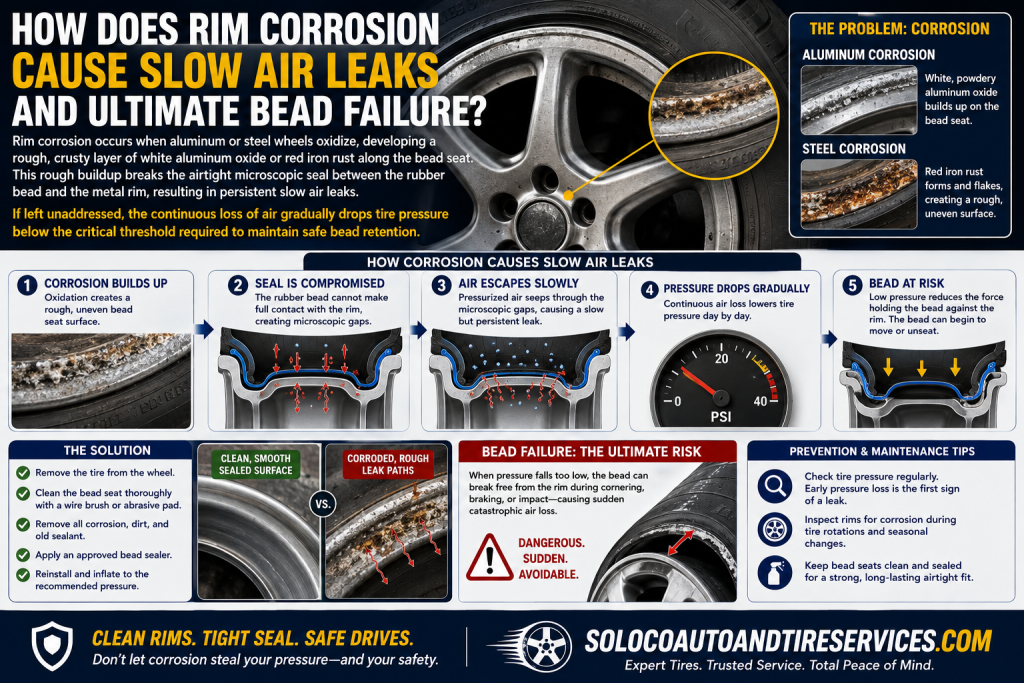
Rim corrosion occurs when aluminum or steel wheels oxidize, developing a rough, crusty layer of white aluminum oxide or red iron rust along the bead seat.
This rough buildup breaks the airtight microscopic seal between the rubber bead and the metal rim, resulting in persistent slow air leaks. If left unaddressed, the continuous loss of air gradually drops tire pressure below the critical threshold required to maintain safe bead retention.
How does high-speed centrifugal growth affect tire bead retention?
At extreme speeds exceeding 300 km/h (186 mph), centrifugal force causes the tread and sidewalls of a tire to stretch and expand outward through high-speed centrifugal growth. Without advanced structural reinforcement layers made of aramid or carbon fiber, this radial expansion places immense outward pull on the tire carcass, reducing the inner bead tension and risking sudden, catastrophic de-beading on the track.
The Bottom Line
Tires stay firmly attached to wheel rims through a precise trifecta of high-tensile steel bead cores, mechanical interference fits, and thousands of pounds of pneumatic air pressure. Maintaining proper inflation levels, inspecting wheels for corrosion, and respecting manufacturer seating limits ensure that this mechanical and pneumatic lock remains uncompromised under all driving conditions.