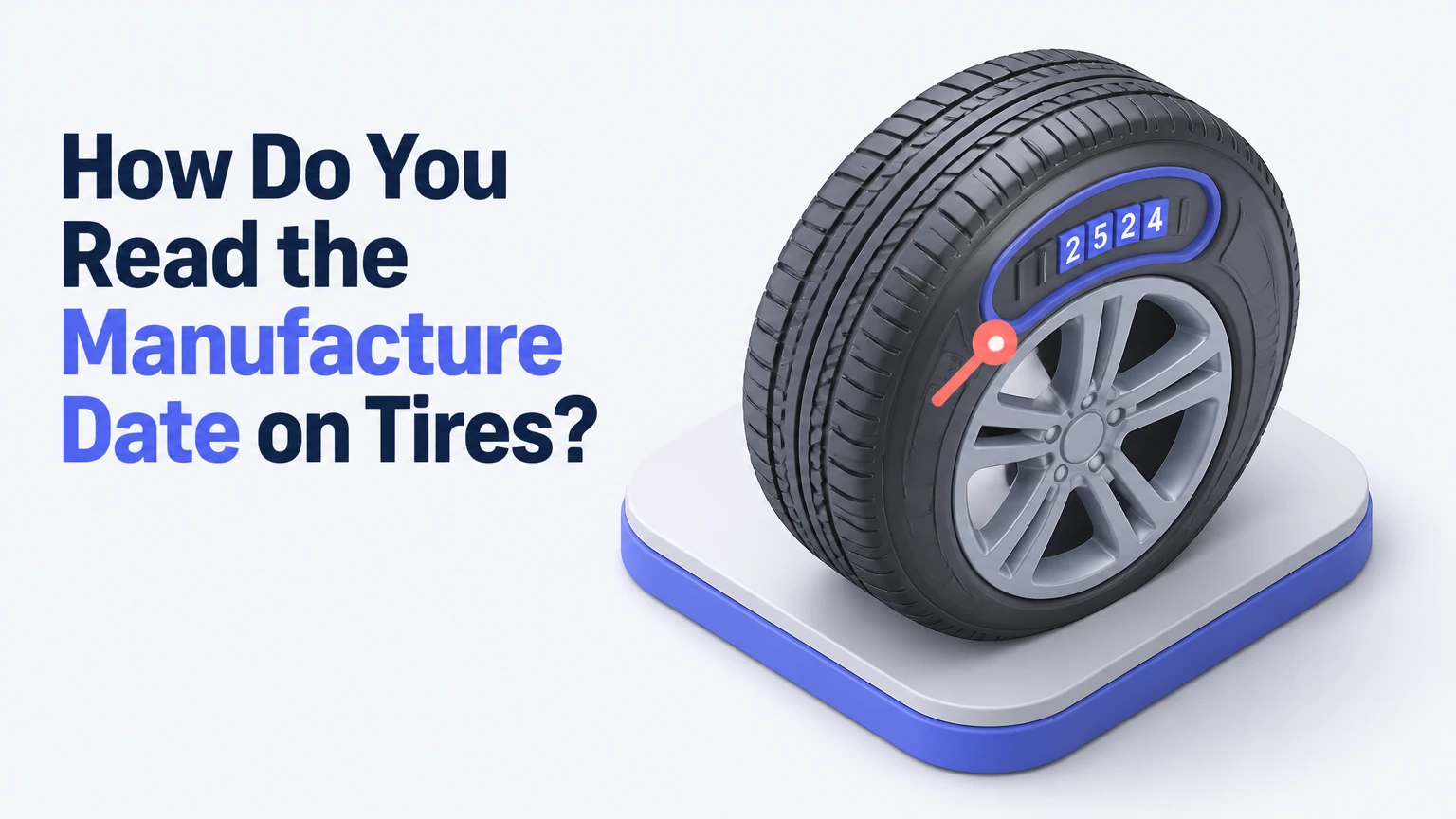
To read a tire’s manufacture date, locate the Department of Transportation string on the sidewall and examine the final group of numbers. For tires built after the year 2000, this is a four-digit code where the first two digits indicate the production week and the last two digits designate the production year.
At a Glance: Essential Tire Date Facts
- Post-2000 tire production dates consist of a mandatory four-digit numerical sequence at the end of the DOT code.
- The first two digits represent the precise week of production, running from 01 through 52.
- The last two digits denote the exact calendar year the tire was manufactured in a factory.
- Federal regulations require full DOT date codes to be printed on only one sidewall of a passenger tire.
- Most automotive and tire manufacturers recommend replacing all tires six to ten years from their build date.
Where Is the DOT Code Located on a Tire?
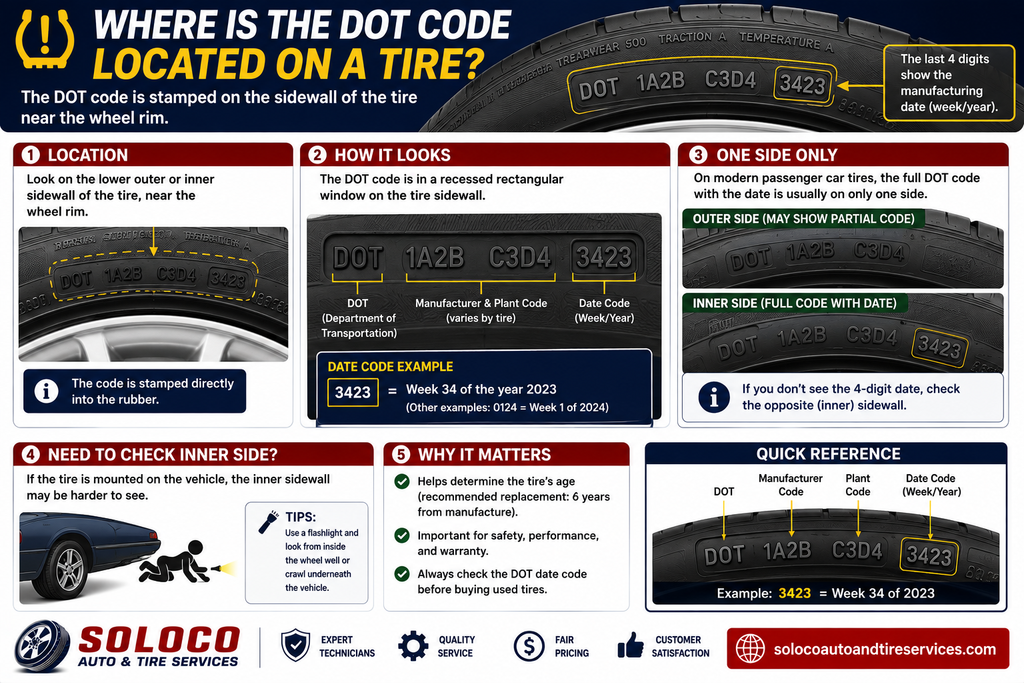
The DOT code is located on the lower outer or inner sidewall of the tire, stamped directly into the rubber near the wheel rim. Finding this code requires locating the letters “DOT” followed by a string of alphanumeric characters, which ends with an isolated numerical sequence representing the production date.
Manufacturers stamp this code into a slightly recessed rectangular window on the rubber casing. On modern passenger car tires, the full sequence containing the manufacturing date is typically displayed on only one side of the tire. If the exterior sidewall displays only partial letters and no trailing four-digit number, the complete code resides on the opposite, inward-facing sidewall. Mechanics and vehicle owners inspecting tires while mounted on a vehicle may need to use a flashlight or crawl underneath the chassis to view the inner sidewall configuration.
What Does a 4-Digit Tire Date Code Mean?
A four-digit tire date code indicates the specific week and year of production, formatted with the manufacturing week first and the production year second. For example, a code ending in 1423 indicates the tire was manufactured during the 14th week of the year 2023, corresponding to early April.
This standardized four-digit format was mandated by the United States Department of Transportation and adopted industry-wide starting in the year 2000 to eliminate ambiguity in tire age tracking. The first two digits always range from 01 to 52, representing the calendar week of manufacture. The final two digits reflect the calendar year, meaning a code ending in 0126 signifies production during the first week of 2026. Recognizing this format allows vehicle operators to instantly calculate the exact calendar age of any modern tire before purchase or installation.
How Do You Read Pre-2000 Three-Digit Tire Date Codes?
Pre-2000 tire date codes use a three-digit sequence where the first two digits represent the week of production and the final single digit designates the year of that specific decade. For example, a code ending in 245 indicates the tire was manufactured during the 24th week of 1995 or 1985.
Because the final digit represents only the last number of the decade without specifying which ten-year block the tire belongs to, pre-2000 tires require contextual inspection of the tire’s wear bars, tread design, and sidewall branding. Any tire featuring a three-digit date code is at least twenty-six years old based on current timeline parameters. These vintage or neglected tires possess dangerously degraded rubber compounds and must be removed and replaced immediately, regardless of remaining tread depth.
Why Is There No 4-Digit Date Code on One Side of My Tire?
A missing four-digit date code on one sidewall occurs because federal safety regulations require full DOT serial numbers and date stamps to appear on only one side of a tire. The opposing sidewall displays an incomplete DOT identification number that omits the final date digits.
This manufacturing practice reduces mold changeover complexity during production, as tire molds only require engraving the full date cluster on a single serial plate insert. When inspecting a tire and finding only a partial DOT sequence ending in batch letters or empty space, the inspector must check the opposite sidewall facing the vehicle’s suspension components. Fleet managers and technicians inspecting vehicles on lift systems frequently encounter this asymmetry and must verify the inner sidewall before condemning a tire for missing production data.
What Does a Triangle Delta Symbol Mean on Older Tires?
A triangle delta symbol (▲) placed immediately following a three-digit date code on 1990s-era tires signifies that the tire was manufactured during the 1990s rather than the 1980s. Tire manufacturers introduced this punctuation mark to resolve the decade ambiguity inherent in the pre-2000 three-digit coding standard.
Finding a triangle delta symbol next to a three-digit code confirms the tire was produced between 1990 and 1999. Because even a tire manufactured in late 1999 exceeds safety age thresholds by decades, the presence of this symbol serves as an absolute indicator of expired, hazardous rubber. Vehicles discovered with delta-marked tires require immediate tire replacement to prevent catastrophic structural tread separation at highway speeds.
How Long Are Tires Safe to Use Regardless of Tread?
Tires are generally safe to use for a maximum of six to ten years from their manufacture date, even if the tread depth remains above legal minimums. Environmental exposure causes continuous chemical degradation of the rubber compounds over time, rendering old tires structurally unsafe despite pristine visual appearance.
Automotive manufacturers, rubber councils, and safety agencies universally cite oxidation as the primary driver of this aging process. As oxygen and ozone interact with volatile oils within the rubber matrix, the material loses elasticity, becomes brittle, and suffers internal belt separation. Professional guidelines dictate that professional inspections should occur annually after a tire reaches five years of service, with mandatory retirement occurring at the ten-year mark from the DOT production date stamp.
Can I Buy “New” Tires That Are Already Old?
Yes, consumers frequently purchase brand-new tires from retail inventories that were manufactured one to three years prior. Tires stored in climate-controlled warehouse distribution centers experience minimal degradation, but inventory aging remains a routine retail reality.
To avoid inadvertently mounting aged inventory, buyers should inspect the four-digit DOT code on every tire prior to purchase and installation. Reputable tire retailers generally consider stock up to two years old acceptable for sale as new, provided the tires were stored away from direct sunlight, ozone-generating electrical equipment, and extreme temperature fluctuations. If a retailer attempts to install tires older than three years from the manufacture date as new inventory, the customer should request a fresher production batch.
What Is Dry Roaming and How Does It Relate to Tire Age?
Dry rot is the progressive cracking and hardening of tire rubber caused by cumulative ultraviolet radiation exposure, atmospheric ozone, and heat cycling over time. High chronological tire age directly correlates with advanced dry rot development across the sidewall and tread grooves.
As plasticizers and softening agents evaporate from the rubber compound, the outer skin loses flexibility and fractures under standard flexing loads. Visible micro-cracking in the sidewall or deep fissures between tread blocks indicate that the structural integrity of the tire has failed. A tire exhibiting dry rot is unsafe for operation and must be replaced immediately, regardless of whether the remaining tread depth measures above the legal limit of two-thirty-seconds of an inch.
Does the Manufacture Date Code Apply to Spare Tires?
The manufacture date code applies directly to spare tires, which age at the exact same chronological rate as the tires mounted on a vehicle’s active wheel hubs. Trunk-stored spares and under-chassis mounted spare tires frequently degrade faster than road tires due to extreme ambient heat accumulation in enclosed compartments.
Vehicle owners frequently overlook spare tires during routine maintenance, assuming that a tire hidden in a trunk remains preserved indefinitely. When a roadside emergency requires deploying an expired spare tire, the aged, oxidized rubber is highly susceptible to sudden blowout under load. Vehicle safety protocols mandate checking the DOT date code on the spare tire during every routine tire rotation or seasonal service interval.
How Do Commercial Truck Tires Differ in Age Limits?
Commercial truck tires often feature higher annual mileage accumulation rates and heavier load duty cycles, resulting in shorter active service lifespans compared to passenger car tires. While passenger tires are bound by a ten-year absolute calendar limit, commercial medium truck radial tires are frequently retired much earlier based on casing retread cycles and commercial regulatory frameworks.
Commercial transport operators utilize multi-lifecycle casing management programs where tire treads are buffed off and replaced via retreading. Fleet safety standards dictate that commercial tire casings older than five to seven years, or those subjected to multiple retread cycles, are decommissioned to prevent commercial highway blowouts. Furthermore, commercial truck DOT codes follow the exact same four-digit weekly format, but federal and state Department of Transportation regulations enforce stricter commercial enforcement thresholds for sidewall integrity and age-related cracking.
Do European E-Mark Tires Use a Different Date System?
European E-mark tires utilize the exact same four-digit DOT manufacturing date format as tires sold in North America, because international standardization agreements require global manufacturing compliance. While European regulations emphasize the “E” approval mark and numerical country code enclosed in a circle or rectangle, the chronological production date remains designated by a standard four-digit stamping.
Imported European performance tires and specialty passenger car fitments display the standard week-and-year sequence within the broader identification block on the lower sidewall. Technicians servicing imported vehicles do not need to convert regional date codes, as global tire manufacturers unified date coding protocols under international regulatory guidelines to streamline global supply chain tracking and recall execution.
How Does Ozone and Atmospheric Pollution Accelerate Tire Aging?
Ozone exposure accelerates tire aging by chemically attacking unsaturated carbon-carbon bonds within synthetic and natural rubber polymers, causing rapid surface micro-fissuring. Atmospheric pollution, smog, and proximity to electrical motors or heavy traffic generate high localized ozone concentrations that degrade tire structural compounds faster than sunlight alone.
When ozone reacts with stressed rubber under load, it creates distinct, perpendicular ozone cracks along the sidewall flex zones. Tire manufacturers compound modern rubber mixtures with anti-ozonant waxes that migrate to the surface to protect the casing, but this protective mechanism depletes over time. Vehicles parked outdoors in urban environments or industrial zones experience accelerated rubber degradation, shortening the safe operating lifespan of the tires well before the physical tread wears out.
What Are the Legal Implications of Driving on Expired Tires?
Driving on severely aged or degraded tires exposes vehicle operators to significant legal liabilities, including potential commercial citations, regulatory penalties, and heightened tort liability following an accident. While passenger vehicle federal laws do not explicitly mandate a specific expiration calendar date for private motorists, operating a vehicle with defective, cracked, or dangerously oxidized tires violates general motor vehicle safety statutes.
Commercial motor vehicle operators face rigorous federal enforcement under Federal Motor Carrier Safety Regulations, where inspectors can place a commercial truck out of service for severe sidewall cracking or expired casing conditions. In civil litigation scenarios, driving on known expired tires—especially when negligence or catastrophic failure causes personal injury—serves as primary evidence of failure to maintain safe vehicle operating conditions.
How Should Tires Be Stored to Maximize Their Usable Lifespan?
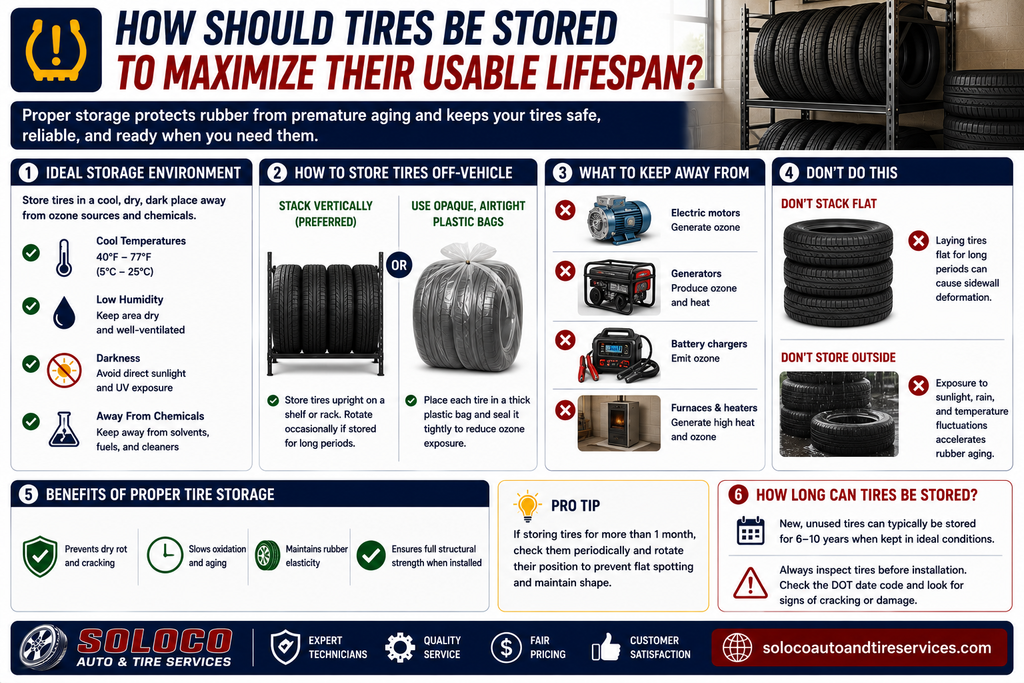
Storing tires in a cool, dry, dark environment away from direct sunlight, ozone sources, and chemical solvents maximizes their unmounted shelf life. Proper storage slows down the oxidation process and prevents premature chemical degradation of the rubber compounds.
To store tires correctly off-vehicle, stack them vertically on shelves rather than laying them flat for extended periods, or place them in opaque, airtight plastic bags to minimize ozone circulation. Storage locations must maintain stable ambient temperatures well away from electric motors, generators, battery chargers, and furnaces that emit ozone or high heat. Implementing these storage controls preserves fresh rubber elasticity, ensuring that stored seasonal or spare tires retain their full structural service life prior to installation.
When Should You Replace Tires Even If They Pass the Age Limit?
Tires require immediate replacement prior to reaching their age limit if they exhibit structural damage, internal belt separation, severe punctures, or irregular wear patterns. Physical damage compromises tire integrity faster than chronological aging alone.
Specific failure triggers requiring immediate retirement include sidewall bulges indicating internal carcass cord separation, punctures larger than one quarter of an inch in the tread shoulder, bead damage from improper mounting, or deep cuts exposing internal steel belts. Additionally, tires exhibiting severe cupping, flat-spotting, or feathering from alignment failure must be replaced to restore proper handling dynamics. Visual and tactile physical inspection must always take precedence over calendar age when evaluating immediate tire replacement needs.
The Bottom Line
Reading a tire’s manufacture date requires locating the DOT string on the sidewall and examining the final four-digit code, where the first two digits indicate the production week and the last two digits represent the production year. Because rubber continuously degrades through oxidation, UV radiation, and ozone exposure, tires become structurally unsafe after six to ten years regardless of remaining tread depth. Always verify both outer and inner sidewalls, inspect for dry rot cracking, and replace aged or damaged tires to ensure total vehicle safety.