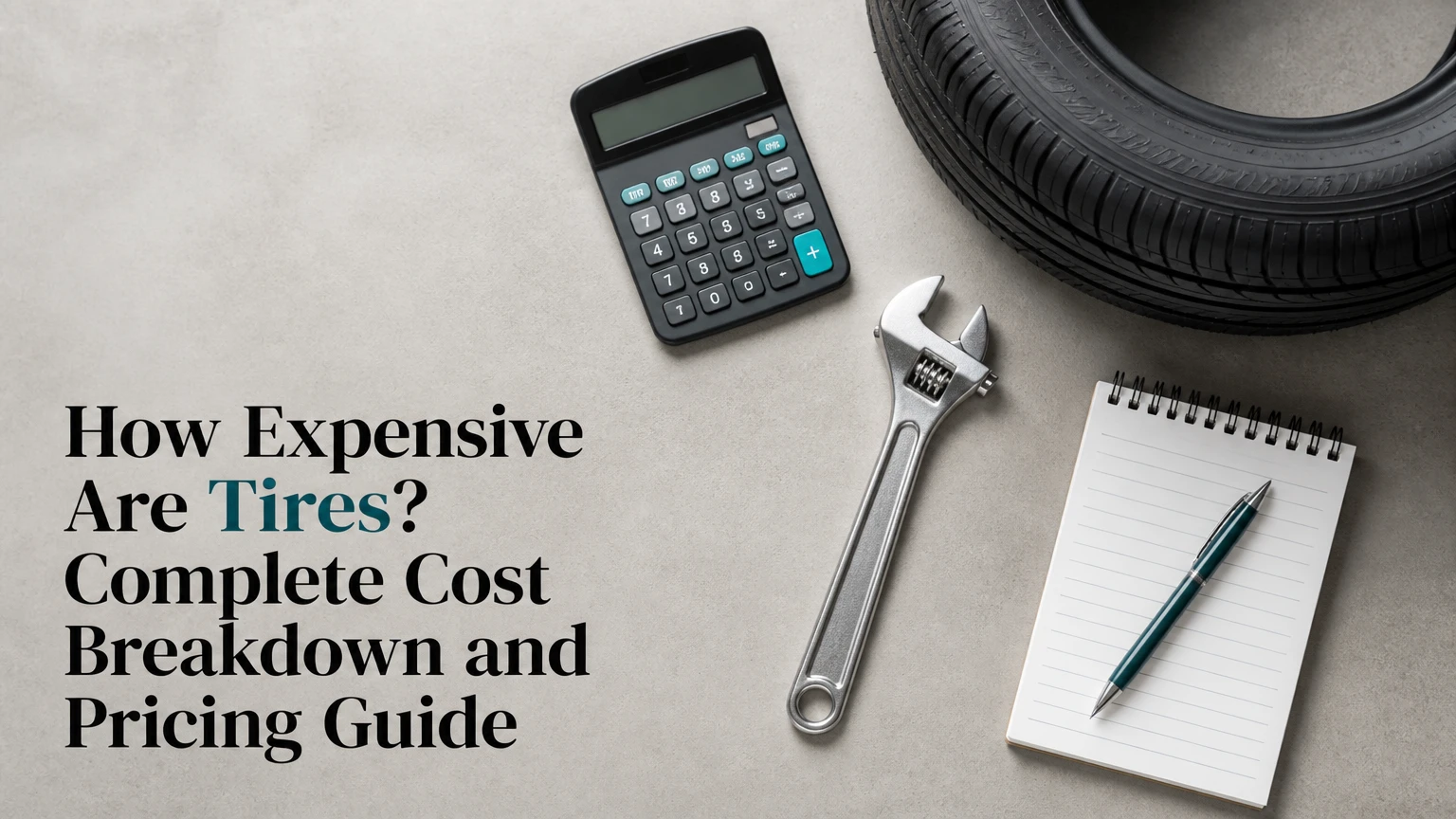
Tires generally cost between $50 and $600 plus per tire, with a standard passenger vehicle set totaling $400 to $800 for rubber alone. Total replacement costs depend heavily on vehicle classification, installation fees, specialized engineering requirements, and whether single tires or full sets must be replaced.
At a Glance: Key Tire Cost Facts
- Budget and economy car tires range from $50 to $100 per tire.
- Standard sedans and crossovers require tires costing $100 to $200 each.
- SUVs and light trucks feature tire prices ranging from $150 to $350 per tire.
- High-performance sports cars demand specialized tires priced between $200 and $600 plus each.
- Mandatory out-of-pocket installation fees typically add an extra $100 to $200 per set.
What is the price breakdown of tires by vehicle category?
Tire prices vary significantly based on vehicle classification, rubber compound quality, and performance design needs. Economy vehicles utilize smaller rim diameters requiring cheaper materials, while luxury and performance vehicles demand advanced engineering.
Budget and economy cars like the Honda Fit or Chevy Spark require tires priced from $50 to $100 per tire. Standard sedans and crossovers such as the Toyota Camry or Subaru Outback utilize tires ranging from $100 to $200 per tire. SUVs and light trucks like the Ford F-150 or Jeep Wrangler demand heavier construction, pushing prices to $150 to $350 per tire. High-performance sports cars such as the Chevrolet Corvette or Porsche 911 require high-speed rated compounds costing $200 to $600 plus per tire. Purchasing a full set of four requires multiplying these individual figures and factoring in mandatory shop labor charges.
What hidden installation fees are added to tire purchases?
The advertised price of a tire represents only a fraction of the final checkout bill at a service center. Additional shop fees and environmental surcharges apply to every single tire mounted on a vehicle.
Mounting and balancing services cost between $15 and $45 per tire to secure the rubber onto the wheel rim and ensure smooth rotation at highway speeds. State-mandated tire disposal fees add $3 to $7 per old tire for recycling processing. TPMS valve stem service or rebuild kits cost $5 to $10 per wheel to maintain tire pressure monitoring sensors. A professional four-wheel alignment, which is strongly recommended to protect new tread, costs $80 to $150 total. Total out-of-pocket extras routinely add $150 to $250 to a standard four-tire purchase.
Why do run-flat tires cost so much more than standard tires?
Run-flat tires cost 30% to 50% more than standard pneumatic tires, with prices regularly ranging from $200 to $400 plus per tire. This elevated cost stems from reinforced internal sidewall architecture designed to support vehicle weight temporarily after a complete loss of air pressure.
Run-flat technology allows motorists to drive up to 50 miles at restricted speeds following a puncture without requiring an immediate roadside tire change. However, this stiff sidewall construction complicates manufacturing and increases material density. Furthermore, most run-flat models cannot be legally or safely repaired after a puncture because the internal structural plies sustain hidden damage while driving flat, necessitating a full replacement rather than a simple patch.
How much more expensive are electric vehicle (EV) tires?
Electric vehicle tires cost 20% to 40% more than traditional internal combustion engine vehicle tires of equivalent dimensions. EVs place unique mechanical demands on rubber due to instantaneous high torque delivery and hundreds of extra pounds of battery pack weight.
Specialized EV tires feature reinforced internal carcasses, noise-canceling foam linings to suppress cabin road hum, and rolling-resistance-optimized tread compounds to maximize battery driving range. Despite higher initial purchase prices, EV tires wear out up to 30% faster than standard tires under aggressive acceleration. Drivers frequently discover that heavy electric crossovers and sedans burn through expensive specialty rubber much sooner than anticipated.
Why do oversized mud-terrain truck tires cost so much?
Oversized mud-terrain tires sized 35 inches or larger easily run $400 to $700 plus per individual tire. These massive specialty tires require heavy-duty casing plies, deep void ratios for off-road traction, and thick sidewall lug patterns to resist sharp rock punctures.
Custom lifted trucks and heavy off-road vehicles demand specialized manufacturing processes to support high load ratings while maintaining highway stability. Because fewer factories produce extreme dimensions in low-volume specialty sizes, manufacturing economies of scale do not apply. Replacing a set of four oversized mud-terrain tires on a customized truck routinely exceeds $2,500 for the rubber alone before accounting for specialized mounting equipment.
Can I buy just one tire instead of a full set?
Motorists can purchase a single replacement tire only if the remaining three tires retain a tread depth of 8/32 of an inch or greater, which is nearly brand new. Replacing a single worn tire with a brand new one creates severe handling imbalances on wet or dry pavement.
Tire tread depth differences exceeding 2/32 of an inch between a new tire and worn tires cause uneven traction, erratic braking response, and potential anti-lock braking system calibration errors. If three existing tires are half-worn at 4/32 of an inch, installing a single new tire creates dangerous mechanical disparities. In such scenarios, professional shops will either recommend replacing at least two tires on the same axle or shaving the new tire down to match the existing tread depth.
Why do all-wheel-drive (AWD) vehicles require replacing all four tires?
All-wheel-drive systems require all four tires to maintain identical rolling diameters and tread depths to protect sensitive internal differentials. Even minor discrepancies in outer circumference force the drivetrain components to spin at slightly different speeds constantly.
Vehicles produced by brands like Subaru and Audi utilize sophisticated center differentials that interpret rotational speed variances as wheel slippage. Running mismatched tread depths forces the differential clutch packs to slip continuously, generating extreme friction and heat that can permanently destroy the transfer case. If an AWD vehicle suffers a sidewall blowout with worn tires, owners must replace all four tires simultaneously or pay a specialty machine shop to shave a brand new tire down to match the exact millimeter depth of the remaining set.
Are wholesale club tires at Costco or Sam’s Club actually cheaper?
Wholesale club tire centers offer competitive pricing on the rubber itself, matching online retailers while providing massive savings on total installation packages. Membership warehouses frequently feature manufacturer promotions such as $150 off a set of four tires.
The primary financial advantage of buying tires at Costco or Sam’s Club lies in the included ancillary services. Wholesale club installation packages routinely bundle lifetime tire rotation, computerized spin balancing, flat tire repairs, and nitrogen inflation at no extra recurring charge. While traditional retail tire shops charge separately for these maintenance procedures over the lifespan of the tire, wholesale clubs absorb them into the initial purchase cost.
How do I know if I am being ripped off on a wheel alignment?
Vehicle owners can determine if a wheel alignment recommendation is legitimate by evaluating steering wheel centering, vehicle tracking behavior, and old tread wear patterns. An alignment is unnecessary if the vehicle tracks straight on a flat highway, the steering wheel sits centered, and old tires exhibit perfectly even wear across the contact patch.
Service shops frequently recommend a wheel alignment automatically with every new set of tires as an upselling measure. However, an alignment is only genuinely required if the previous tires show feathering, cupping, or rapid inner shoulder wear, or if the vehicle recently sustained heavy impact from a severe pothole or curb strike. Requesting a before-and-printout of alignment machine metrics protects consumers from paying for unnecessary adjustment labor.
What do the numbers and letters on a tire sidewall mean?
Tire sidewall codes contain standardized alphanumeric sizing and rating indicators that define physical dimensions and performance capabilities. Taking a common passenger designation like P215/55R17 reveals precise engineering specifications.
The prefix letter P designates a passenger vehicle application. The first numerical value, 215, represents the section width of the tire measured in millimeters from sidewall to sidewall. The second number, 55, indicates the aspect ratio, meaning the sidewall height equals 55% of the tire width. The letter R denotes radial construction, which is the industry standard for modern vehicle manufacturing. Finally, the number 17 specifies the wheel rim diameter in inches that the tire is engineered to fit.
Do high-mileage tire warranties actually save money?
High-mileage warranties promising 60,000 to 80,000 miles of service rarely deliver full financial savings in real-world driving conditions. Tire manufacturers honor these mileage guarantees only if owners can produce rigorous documentary proof of professional tire rotation every 5,000 miles.
Furthermore, aggressive mountain driving, heavy electric vehicle battery weight, and rough road surfaces cause tires to wear out significantly faster than laboratory ratings suggest. If a tire rated for 65,000 miles wears out completely at 40,000 miles due to heavy vehicle weight, the manufacturer pro-rates the replacement discount based on remaining tread. Consumers often find that pro-rated warranty credits require purchasing replacement tires from the same brand at retail price, neutralizing anticipated savings.
Is it safe to buy the cheapest budget tires available?
Ultra-budget economy tires manufactured by unknown overseas brands present distinct safety compromises and long-term cost drawbacks. These cheap tires frequently utilize hard, low-grade rubber compounds designed for maximum longevity at the expense of grip.
Testing reveals that ultra-budget tires can require up to 20 feet longer stopping distances on wet pavement compared to mid-tier or premium brand alternatives. Furthermore, cheap tires wear out significantly faster, requiring replacement twice as often. This frequent replacement cycle doubles total labor, mounting, and balancing expenses, eliminating any initial upfront savings achieved at the cash register.
The Bottom Line
Tire expenses encompass far more than the initial sticker price of the rubber, with total costs ranging from $400 to $1,000 plus per set once installation fees, balancing, and alignments are included. Specialized vehicle requirements such as heavy EV weights, AWD differential protection, and run-alt safety designs further elevate ownership costs. Prioritizing mid-tier quality and rigorous maintenance ensures optimal braking safety and long-term value.