
Replacing four tires takes 45 to 60 minutes at a professional shop, assuming you have a scheduled appointment and the service bay is operating normally. This timeframe covers vehicle lifting, wheel removal, tire dismounting, new valve stem installation, computerized wheel balancing, and final torque verification by an automotive technician.
At a Glance: Tire Replacement Facts
- Standard shop turnaround time for four tires ranges strictly from 45 to 60 minutes under normal operating conditions.
- Specialized tires like low-profile sports car models or heavy truck tires add 15 to 30 minutes due to stiff sidewalls.
- Walk-in appointments without a reservation can extend total wait times to 3 to 6 hours during peak seasonal rushes.
- Wheel alignment is optional during installation but recommended to prevent premature tread wear, adding 30 to 45 minutes.
- Re-torquing lug nuts after driving 50 to 100 miles is mandatory to ensure wheel security.
What Is the Step-by-Step Time Breakdown for a Standard Tire Replacement?
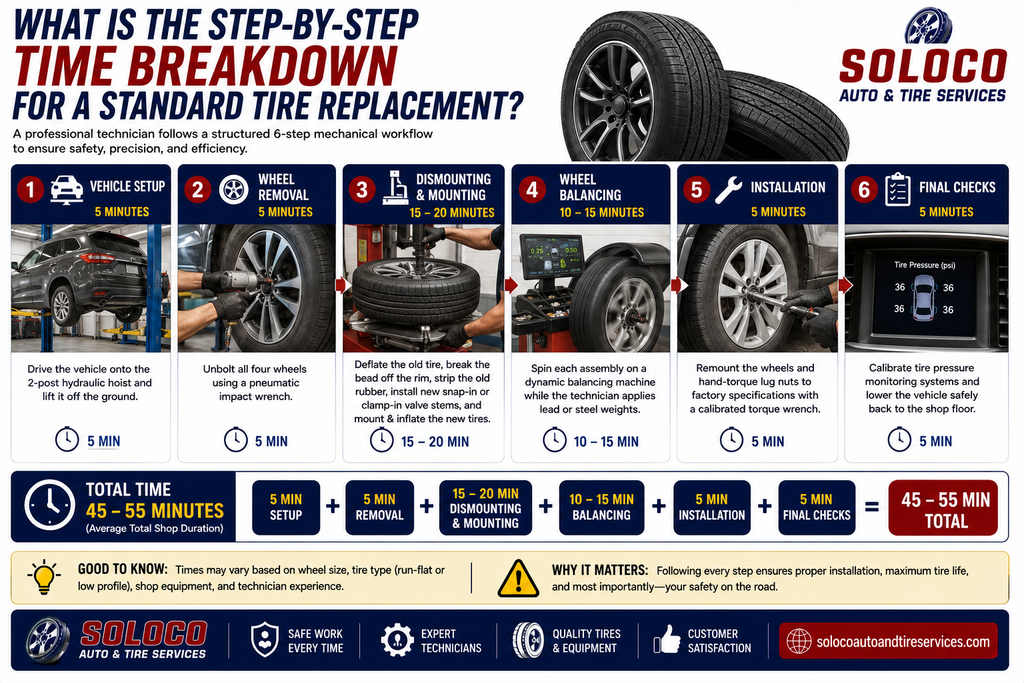
A professional technician follows a structured 6-step mechanical workflow that dictates total shop duration. Vehicle setup takes 5 minutes to drive the car onto a two-post hydraulic hoist and lift it off the ground. Wheel removal takes another 5 minutes to unbolt all four wheels using a pneumatic impact wrench.
Dismounting and mounting takes 15 to 20 minutes, which involves deflating the old tires, breaking the bead off the rim, stripping the old rubber, installing new snap-in or clamp-in valve stems, and inflating the new tires.
Wheel balancing consumes 10 to 15 minutes, requiring each assembly to spin on a dynamic balancing machine while the technician applies lead or steel weights. Installation takes 5 minutes to remount the wheels and hand-torque lug nuts to factory specifications with a calibrated torque wrench. Final checks take 5 minutes to calibrate tire pressure monitoring systems and lower the vehicle safely back to the shop floor.
Can I Wait in the Lobby, or Should I Drop Off My Vehicle?
Vehicle owners can safely wait in the customer lobby for standard appointments lasting under one hour, provided the shop has an active queue management system. Waiting in the lounge is ideal when booking the first appointment of the morning, as service bays open with zero backlog. However, vehicle drop-offs are recommended during peak operational windows, such as Saturday mornings, seasonal winter tire changeovers, or major holiday sales promotions. Dropping off a vehicle frees drivers from waiting through unexpected diagnostic delays, seized hardware extraction, or parts delivery lags that routinely stretch multi-hour queue times.
Why Do Low-Profile and Run-Flat Tires Take Longer to Install?
Low-profile passenger tires and heavy run-flat tires feature heavily reinforced, rigid sidewalls that resist standard mechanical flex. Traditional tire-changing machines struggle to grip stiff sidewalls without risking damage to expensive alloy rims or tearing the tire bead. Technicians must use specialized, arm-assisted mounting equipment and manual tire levers, adding 15 to 25 minutes of labor to the overall process. Furthermore, run-flat tires require extreme precision during the mounting phase to prevent internal structural failure, forcing technicians to work at a deliberate, methodical pace rather than relying on standard speed.
What Causes a Car to Ride Rough or Vibrate After Getting Four New Tires?
Unresolved wheel vibration after a new tire installation is almost always caused by improper dynamic balancing, a bent alloy rim, or road force variation. If a balancing weight falls off immediately after leaving the shop, or if the technician calibrated the wheel on an out-of-calibration balancing machine, steering wheel shimmy occurs at highway speeds between 55 and 70 miles per hour. Another frequent culprit is a tire out of round, where the internal steel belts have minor manufacturing defects. Drivers experiencing post-installation vibration must return to the shop immediately for a high-speed Road Force balancing test to isolate and correct the mechanical imbalance.
Should I Get a Wheel Alignment with New Tires?
A professional wheel alignment is strongly recommended whenever purchasing a new set of four tires, even though it is not strictly mandatory for the physical installation process. Driving on old, worn-out tires often masks underlying suspension wear, toe misalignment, or camber drift. Installing pristine tread on a misaligned suspension allows the vehicle to drag the new rubber sideways across the pavement, destroying the outer or inner shoulders within 5,000 to 10,000 miles. Adding a computerized four-wheel alignment extends the usable lifespan of the new investment and guarantees straight tracking on the highway.
What Happens If I Skip a Wheel Alignment After Buying New Tires?
Skipping a wheel alignment risks accelerated, uneven tread wear that can ruin a brand-new set of tires in a fraction of their normal lifespan. When suspension geometry is out of specification, tires experience constant scrubbing friction rather than rolling freely. This generates feathered tread edges, cupping, or bald patches on one side of the tire contact patch. Beyond financial loss from premature replacement, unaligned vehicles suffer from poor directional stability, increased rolling resistance, and reduced fuel economy. Fixing alignment issues at the time of purchase eliminates the need for premature replacement down the road.
Can I Replace Just Two Tires Instead of Four?
Two tires can be replaced independently on front-wheel-drive and rear-wheel-drive vehicles under strict safety guidelines. New tires must always be installed on the rear axle of the vehicle, regardless of whether power is sent to the front or rear wheels. Putting newer tires on the rear axle provides superior wet traction, preventing dangerous oversteer, hydroplaning, and fishtailing during emergency braking maneuvers on slick roadways. Moving the partially worn tires from the rear to the front axle maintains directional steering control while maximizing overall vehicle safety.
What Happens If I Replace Only Two Tires on an AWD Vehicle?
Replacing only two tires on an All-Wheel Drive (AWD) vehicle risks catastrophic mechanical failure of the central transfer case and differentials. AWD systems rely on identical rolling diameters across all four wheels to ensure equal rotational speed through the drivetrain. Mixing brand-new tires with high tread depth alongside worn tires with shallow tread forces the differential gears to spin at different speeds continuously. This relentless internal friction generates extreme heat, burns up transmission fluid, and can shatter differential components, resulting in repair bills costing thousands of dollars.
How Do Staggered Wheel Setups Change Tire Replacement Logistics?
Staggered wheel setups—where the rear wheels are wider and possess a different tire size than the front wheels—complicate standard rotation and replacement logistics. Vehicles equipped with staggered configurations cannot perform traditional front-to-back tire rotations, which causes rear tires to wear out significantly faster than front tires. During a replacement, shops must verify specific directional tread patterns and unique load ratings for both front and rear axles. Furthermore, ordering replacement sets requires matching exact manufacturer specifications to prevent electronic traction control errors or anti-lock braking system malfunctions.
Do I Need to Re-Torque My Lug Nuts After Driving?
Lug nuts must be re-torqued after driving 50 to 100 miles following any tire service. Metal components on modern vehicles experience severe thermal cycling, expanding under high friction braking heat and contracting as they cool down. Furthermore, microscopic layers of rust, paint, or debris between the wheel mating surface and the brake rotor can compress under heavy vehicle weight. This settling process occasionally causes factory lug nuts to loosen slightly, creating a dangerous mechanical hazard if left unverified. Most reputable tire shops offer this re-torque check as a free, walk-in service taking less than five minutes.
What Are the Mechanical Risks of Ignoring Lug Nut Re-Torquing?
Ignoring lug nut re-torquing risks severe wheel separation, stripped wheel studs, and catastrophic structural damage to the vehicle hub assembly. As a wheel loosens on its mounting studs, it begins to wobble laterally under load, creating impact shock waves that elongate the conical mounting holes in the alloy rim. If multiple studs shear off while driving at highway speeds, the wheel can detach entirely from the vehicle, causing loss of steering control and potential rollover accidents. Ensuring proper torque verification after 50 miles neutralizes this structural risk entirely.
How Does Cold Weather Affect Tire Rubber Stiffness and Shop Turnaround Times?
Cold weather significantly increases tire rubber stiffness and operational delays at automotive service centers. When ambient temperatures drop below freezing, synthetic rubber compounds stiffen dramatically, making tire beads exceptionally difficult to peel off metal rims without specialized warming equipment. Simultaneously, the first major snowstorm of winter triggers a massive influx of walk-in customers seeking winter tire swaps. This seasonal surge overwhelms shop bays, turning a standard 45-minute service into an all-day wait or forcing multi-day booking backlogs.
How Long Does Mobile Tire Installation Take Compared to a Shop?
Mobile tire installation takes approximately 60 to 90 minutes per vehicle when performed at a home driveway or office parking lot. Mobile service vans operate with a single mobile technician utilizing van-mounted pneumatic changers and balancers, which lack the sheer speed of commercial, multi-bay fixed facility hoists. However, mobile installation eliminates travel time, waiting room friction, and scheduling hassles, offering unmatched convenience for busy vehicle owners who prefer on-site service.
Why Do Rusted Wheel Hubs and Missing Wheel Lock Keys Delay Service?
Rusted wheel hubs and missing wheel lock keys frequently add 15 to 30 minutes of unexpected delay to a standard tire replacement. In regions with heavy winter road salting, aluminum wheels often fuse electrochemically to steel brake rotors, requiring technicians to hammer them loose manually and scrub away iron oxide corrosion with wire brushes. Similarly, if a vehicle owner misplaces the proprietary spline key for security wheel locks, the shop must use specialized extraction sockets to bite into and destroy the locking lug nut, requiring replacement hardware before the new tires can be mounted.
The Bottom Line
Replacing four tires is a straightforward 45 to 60-minute procedure when booked in advance at a professional service center, though edge cases like rusted hubs, TPMS rebuilding, or stiff low-profile sidewalls can extend the timeline. Maintaining proper safety requires respecting vehicle-specific rules, such as matching all four tires on AWD drivetrains, pairing rear axles correctly on FWD vehicles, and returning for a lug nut re-torque after 50 miles. Combining a new tire purchase with a professional wheel alignment protects your investment against premature tread wear and ensures optimal highway handling.