The total out-of-pocket cost for four new tires ranges between $600 and $1,500 for most passenger vehicles. While the rubber alone costs a median of $848, mandatory mounting, balancing, disposal fees, and wheel alignments push the final cash amount higher depending on your vehicle type and local shop rates.
At a Glance
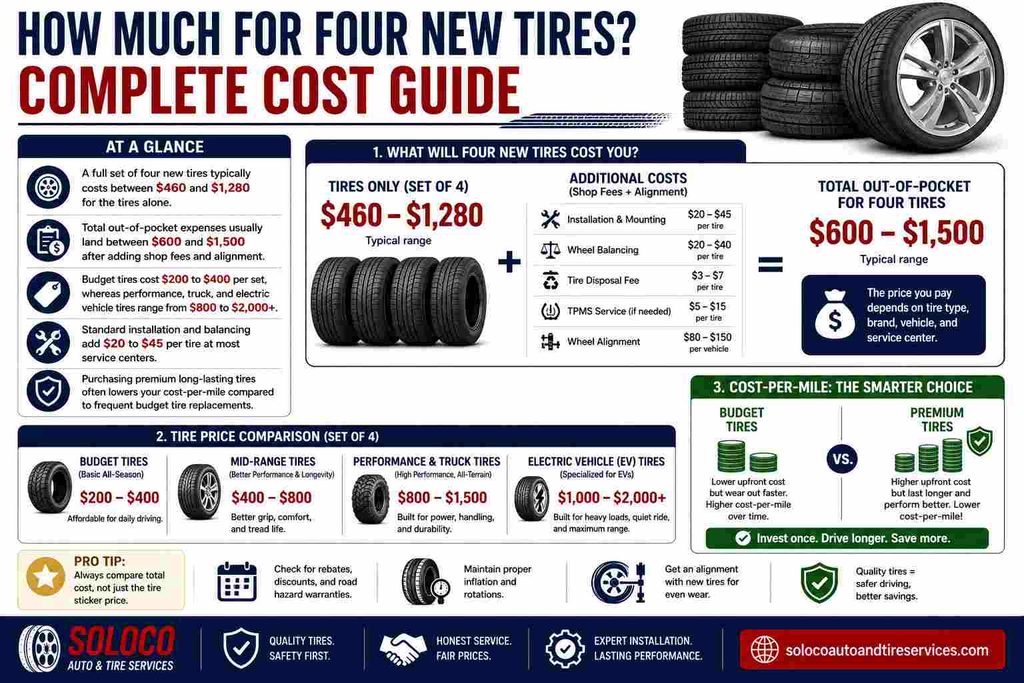
- A full set of four new tires typically costs between $460 and $1,280 for the tires alone.
- Total out-of-pocket expenses usually land between $600 and $1,500 after adding shop fees and alignment.
- Budget tires cost $200 to $400 per set, whereas performance, truck, and electric vehicle tires range from $800 to $2,000+.
- Standard installation and balancing add $20 to $45 per tire at most service centers.
- Purchasing premium long-lasting tires often lowers your cost-per-mile compared to frequent budget tire replacements.
What factors change the total cost of a new tire set?
The total cost of a new tire set changes based on vehicle weight, tire dimensions, rubber compound chemistry, and seasonal performance ratings. Tire manufacturing requires heavy capital investment in specialized silica compounds, steel belts, and nylon caps, which scale directly with the physical size of the product. Larger rims require larger sidewalls and more raw material, driving up baseline production costs. Furthermore, specialized engineering features like sound-dampening foam linings for electric vehicles or reinforced sidewalls for heavy pickup trucks add substantial premiums to the sticker price. Regional labor rates, local environmental disposal taxes, and whether you purchase your tires during manufacturer rebate seasons also alter the final cash total you pay at the register.
What hidden fees should I expect when buying tires?
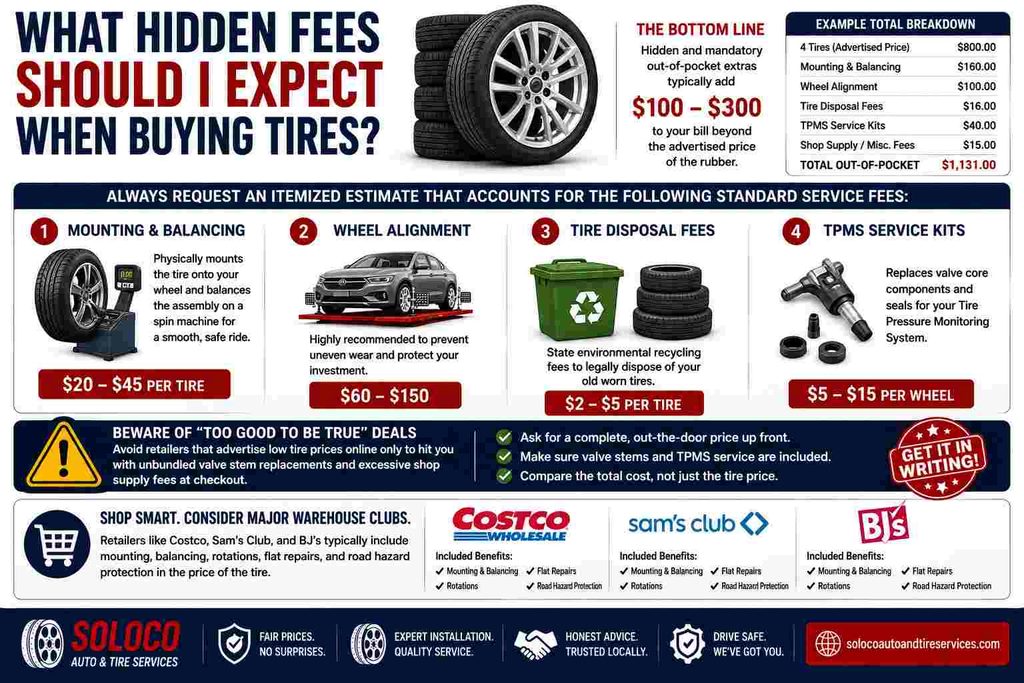
Hidden and mandatory out-of-pocket extras typically add $100 to $300 to your bill beyond the advertised price of the rubber. When purchasing tires, always request an itemized estimate that accounts for the following standard service fees:
- Mounting and Balancing: Expect $20 to $45 per tire to physically mount the rubber onto your wheel rims and balance the assembly on a spin machine.
- Wheel Alignment: Highly recommended to protect your investment, costing between $60 and $150.
- Tire Disposal Fees: State environmental recycling fees of $2 to $5 per tire to legally discard your old worn rubber.
- TPMS Service Kits: Replacing valve core components and seals for your Tire Pressure Monitoring System adds $5 to $15 per wheel.
Avoid retailers that advertise low tire prices online only to hit you with unbundled valve stem replacements and excessive shop supply fees at checkout. Major warehouse clubs like Costco and Sam’s Club typically bundle installation and lifetime balance services into transparent upfront package pricing.
How do tire size and vehicle category affect pricing?
Tire pricing scales directly with vehicle category and rim diameter constraints. Small compact cars using 15-inch rims require less material and lower load ratings, whereas heavy trucks and luxury sports cars demand industrial-grade construction.
| Vehicle Category | Typical Rim Size | Cost Per Tire | Total Cost for Four (Tires Only) |
| Budget & Compact Cars | 14 to 15 inches | $50 – $100 | $200 – $400 |
| Standard Sedans & Crossovers | 16 to 18 inches | $110 – $220 | $440 – $880 |
| Trucks & Large SUVs | 18 to 22 inches | $200 – $350 | $800 – $1,400 |
| Premium Sports & Electric Vehicles | 19 inches and up | $250 – $500+ | $1,000 – $2,000+ |
Choosing the correct load index and speed rating specified on your vehicle placard ensures safety and prevents premature tread separation caused by under-rated sidewalls.
Are expensive tires actually worth the extra money?
Expensive, premium tires are mathematically worth the money if you plan to keep your vehicle for more than three years. Standard advice often suggests buying cheap budget tires to save money upfront, but this creates a false economy. According to durability data from Consumer Reports, budget tires costing $70 often wear out completely after 30,000 miles. In contrast, premium tires like the Michelin Defender 2 cost around $200 but easily deliver up to 80,000 miles of service life. When you calculate the cost of paying mounting, balancing, and shop disposal fees twice for two sets of cheap tires, the premium tire delivers a significantly lower cost-per-mile while providing superior wet-weather braking distance.
Do I really need to replace all four tires at once?
Whether you need to replace all four tires depends entirely on your vehicle drivetrain configuration.
- For All-Wheel Drive (AWD) Vehicles: Yes, you must replace all four tires simultaneously. AWD systems require matching tread depths across all four wheels to prevent internal drivetrain wind-up. A tread depth variance greater than 2/32nds of an inch tricks the computer system into thinking a wheel is constantly slipping, which overheats and destroys the center differential.
- For Front-Wheel or Rear-Wheel Drive (2WD) Vehicles: No, you can replace just two tires at a time. However, safety regulations dictate that the two new tires must always be installed on the rear axle. Putting new tires on the rear prevents dangerous wet-weather fishtailing and hydroplaning, regardless of whether your car is front-wheel or rear-wheel drive.
Can I mix different tire brands or tread patterns on the same axle?
You should never mix different tire brands, construction types, or drastically different tread patterns on the same axle. Mixing bias-ply and radial tires, or pairing a aggressive mud-terrain tire with a smooth highway-terrain tire on the same axle, creates unbalanced traction characteristics. During emergency braking or high-speed cornering, asymmetrical grip levels cause unpredictable vehicle handling, loss of steering control, and immediate activation of electronic stability control systems. If you must mix tire brands due to an emergency roadside replacement, ensure that matching tires are paired strictly on the same axle, and upgrade to a matched set as soon as financial circumstances permit.
How do I read a tire date code to avoid buying old stock?
You can determine the exact age of a tire by inspecting the Department of Transportation (DOT) safety code printed on the exterior sidewall. The DOT string ends in a four-digit numerical sequence where the first two digits represent the manufacturing week and the last two digits represent the manufacturing year. For example, a code ending in “1425” means the tire was manufactured during the 14th week of the year 2025. Rubber compounds degrade, harden, and develop micro-fissures over time due to ultraviolet exposure and thermal cycling, even when sitting unused on a retail shelf. Never pay full price for brand new tires that have been sitting in storage for more than three years from their stamped DOT manufacture date.
What do speed ratings and load indexes mean for safety?
Speed ratings and load indexes are standardized alpha-numeric codes molded into the tire sidewall that dictate the maximum weight capacity and safe operating velocity of the tire. The load index is a numerical code like 91 or 104, which correlates to a specific weight limit in pounds. The speed rating is represented by a letter from L up to Y, where T denotes speeds up to 118 miles per hour and V denotes speeds up to 149 miles per hour. Installing tires with a lower load index than your vehicle manufacturer recommends can cause structural sidewall blowouts under heavy cargo loads or high-speed interstate driving conditions. Always match or exceed the factory placard specifications located on the driver-side door jamb.
Are all-season tires enough for winter driving conditions?
Traditional all-season tires are not sufficient for severe winter driving conditions because their rubber compounds harden like plastic when temperatures drop below 45 degrees Fahrenheit (7 degrees Celsius). While all-season tires handle light rain and dry pavement effectively, they lose vital grip and pliability in freezing snow and ice. If you live in a region with heavy winter storms, look for All-Weather tires featuring the Three-Peak Mountain Snowflake (3PMSF) symbol on the sidewall. All-weather tires cost roughly the same as standard all-season tires but feature aggressive siping and specialized rubber compounds designed to maintain traction in deep winter snow without requiring a mandatory seasonal swap to dedicated winter tires.
Why do electric vehicles require specialized tires?
Electric vehicles (EVs) require specialized tires because instant high torque delivery and heavy battery pack weights accelerate rubber wear by up to thirty percent compared to internal combustion vehicles. EV tires feature reinforced sidewalls, stiffer internal carcass constructions, and specialized polyurethane sound-dampening foam insulation glued inside the inner liner to reduce cabin road noise. Furthermore, EV tires are engineered with low rolling resistance compounds to maximize driving range per battery charge. Buying standard budget tires for a heavy electric vehicle often results in rapid shoulder wear, poor energy efficiency, and premature tread destruction.
Are run-flat tires worth the higher replacement cost?
Run-flat tires are worth the higher cost only if you prioritize personal safety and convenience over ride comfort and upfront savings. Standard on many luxury vehicles like BMW and Mercedes-Benz, run-flat tires feature ultra-stiff reinforced sidewalls that support the weight of the vehicle for up to 50 miles at 50 miles per hour after sustaining a complete loss of air pressure. This eliminates the dangerous necessity of changing a flat tire on a busy highway shoulder. However, run-flats cost between $200 and $400+ per tire, produce a noticeably stiffer ride quality, wear out faster than conventional tires, and often cannot be repaired after a puncture due to internal sidewall damage.
Is a wheel alignment mandatory with every new set of tires?
A wheel alignment is not strictly mandatory with every new set of tires, but skipping it almost always voids your new tire treadwear warranty and causes rapid, uneven wear. Potholes, curb strikes, and normal suspension component wear over thousands of miles knock your steering geometry out of alignment. If your previous tires wore down unevenly on the inner or outer edges, your suspension alignment is compromised. Spending $60 to $150 on a professional four-wheel alignment immediately after mounting new tires ensures your contact patch remains flat against the road, maximizing the operational lifespan of your expensive new rubber investment.
How do road hazard warranties work and should I buy them?
Road hazard warranties are optional protection plans offered by tire retailers that cover accidental damage from potholes, nails, glass, and sharp rocks that cannot be repaired. When a covered tire suffers irreparable damage, the retailer replaces the tire for free or at a heavily prorated discount based on remaining tread depth. Road hazard coverage typically costs between 10 to 15 percent of the total tire purchase price. You should buy a road hazard warranty if you drive through active construction zones, urban areas with severe potholes, or rural gravel roads. If you drive primarily on well-paved interstate highways and practice defensive driving, you can usually decline the coverage and save your cash.
What causes premature tire wear and how do I prevent it?
Premature tire wear is primarily caused by incorrect inflation pressure, mechanical misalignment, worn suspension components, and neglected tire rotation schedules. Over-inflation causes the center tread to wear out rapidly, while under-inflation causes excessive heat buildup and severe shoulder wear on both sides of the tire. To prevent premature wear, check your tire pressure monthly using a reliable digital gauge, inspect tread depth using the penny test, and rotate your tires every 5,000 to 7,500 miles to ensure even wear across all four wheel positions.
Are used or budget tires a safe way to save money?
Used tires are generally an unsafe gamble that rarely saves money over the long term. Buying used tires means inheriting unknown structural damage, hidden internal belt separations, and compromised rubber aging from previous owners. Budget tires from reputable tier-three manufacturers represent a safer alternative to used tires, provided they carry proper safety certifications and valid manufacturer warranties. If your budget is tight, look for certified pre-owned options from trusted service centers or take advantage of manufacturer rebate programs rather than buying undocumented used tires off online marketplaces.
The Bottom Line
Replacing four new tires requires an investment ranging from $600 to $1,500 once you factor in mandatory mounting, balancing, and alignment fees. To maximize your financial return, avoid cheap budget tires that wear out prematurely, match your tire type to your specific climate and drivetrain requirements, and protect your investment with regular rotations and proper inflation maintenance.


