The absolute minimum safe tire tread depth for standard driving conditions is $4/32$ of an inch ($3.18\text{ mm}$), although legal limits in most jurisdictions drop to $2/32$ of an inch ($1.59\text{ mm}$). While tires remain legally usable down to $2/32\text{“}$, real-world testing proves that wet-weather traction and stopping distances degrade catastrophically once tread falls below $4/32\text{“}$.
At a Glance: Essential Tire Safety Facts
- The practical safety threshold for rain and slick roads is $4/32\text{“}$ ($3.18\text{ mm}$).
- Legal minimum limits globally are set at $2/32\text{“}$ ($1.59\text{ mm}$).
- Winter snow tires require a minimum of $6/32\text{“}$ ($4.8\text{ mm}$) to maintain mechanical grip.
- All-Wheel Drive (AWD) vehicles typically require replacing all four tires simultaneously to protect the drivetrain.
- Tires older than 6 years must be inspected annually, and tires exceeding 10 years must be discarded regardless of remaining tread.
What Are the Legal Tire Tread Limits Around the World?
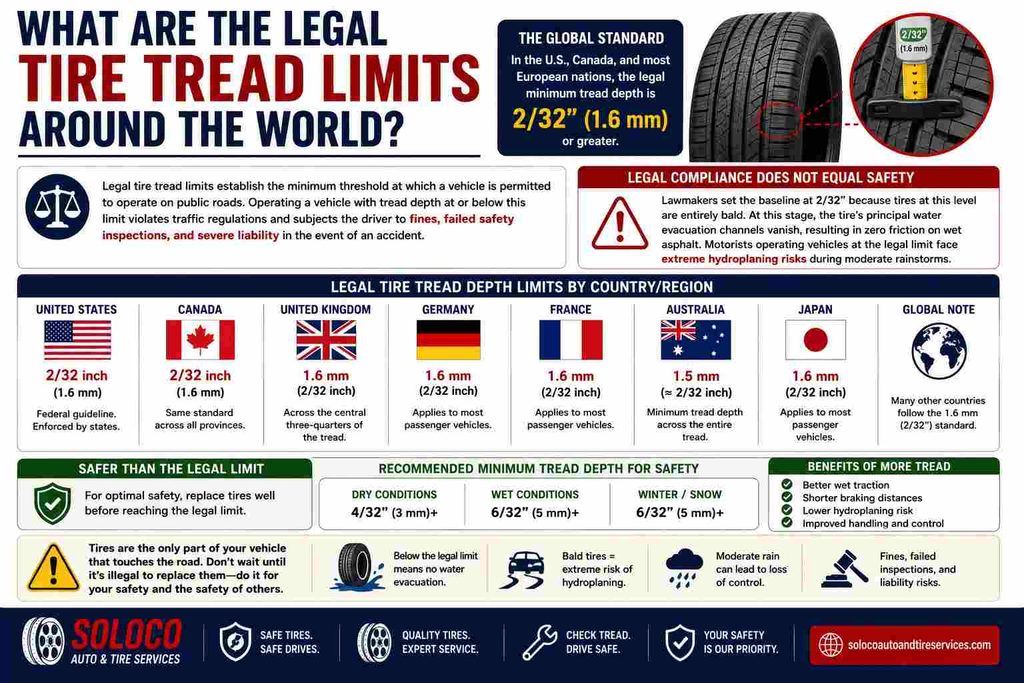
Legal tire tread limits establish the minimum threshold at which a vehicle is permitted to operate on public roads. In the United States, Canada, and most European nations, the legal limit is $2/32\text{ of an inch}$ ($1.6\text{ mm}$). Operating a vehicle with tread depth at or below this limit violates traffic regulations and subjects the driver to fines, failed safety inspections, and severe liability in the event of an accident.
Governments establish these limits based on basic vehicle control, but legal compliance does not equal safety. Lawmakers set the baseline at $2/32\text{“}$ because tires at this level are entirely bald. At this stage, the tire’s principal water evacuation channels vanish, resulting in zero friction on wet asphalt. Motorists operating vehicles at the legal limit face extreme hydroplaning risks during moderate rainstorms.
How Do Tire Tread Depths Impact Wet-Weather Stopping Distance?
Tread depth directly dictates stopping distance on wet or flooded roadways by governing how efficiently water escapes from beneath the tire contact patch. In wet conditions at $60\text{ mph}$ ($96.5\text{ km/h}$), a passenger vehicle fitted with worn $2/32\text{“}$ tires requires approximately $100\text{ feet}$ ($30.5\text{ meters}$) more stopping distance than an identical vehicle equipped with healthy $10/32\text{“}$ tires.
This drastic difference stems from fluid mechanics. Brand-new tires feature deep grooves that channel standing water away from the rubber footprint. As tread wears down, the volume capacity of those channels shrinks. When depth drops below $4/32\text{“}$, the tire cannot clear water quickly enough, forming a microscopic wedge of water under the rubber. This lifts the tire off the pavement entirely, converting the vehicle into an uncontrollable sled.
How Do I Accurately Measure Tire Tread Depth at Home?
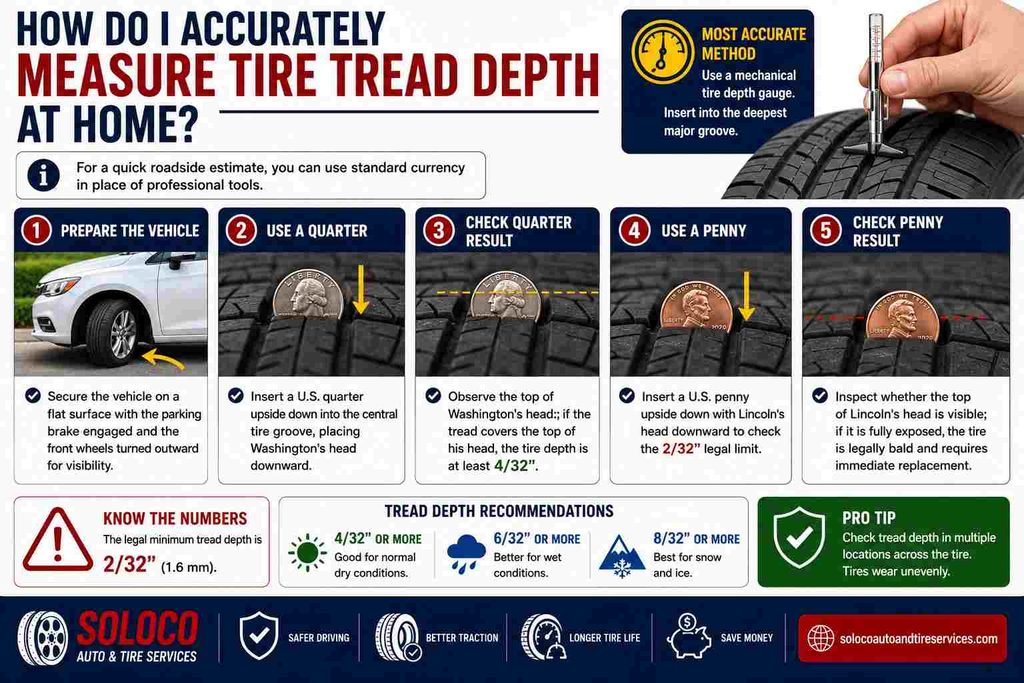
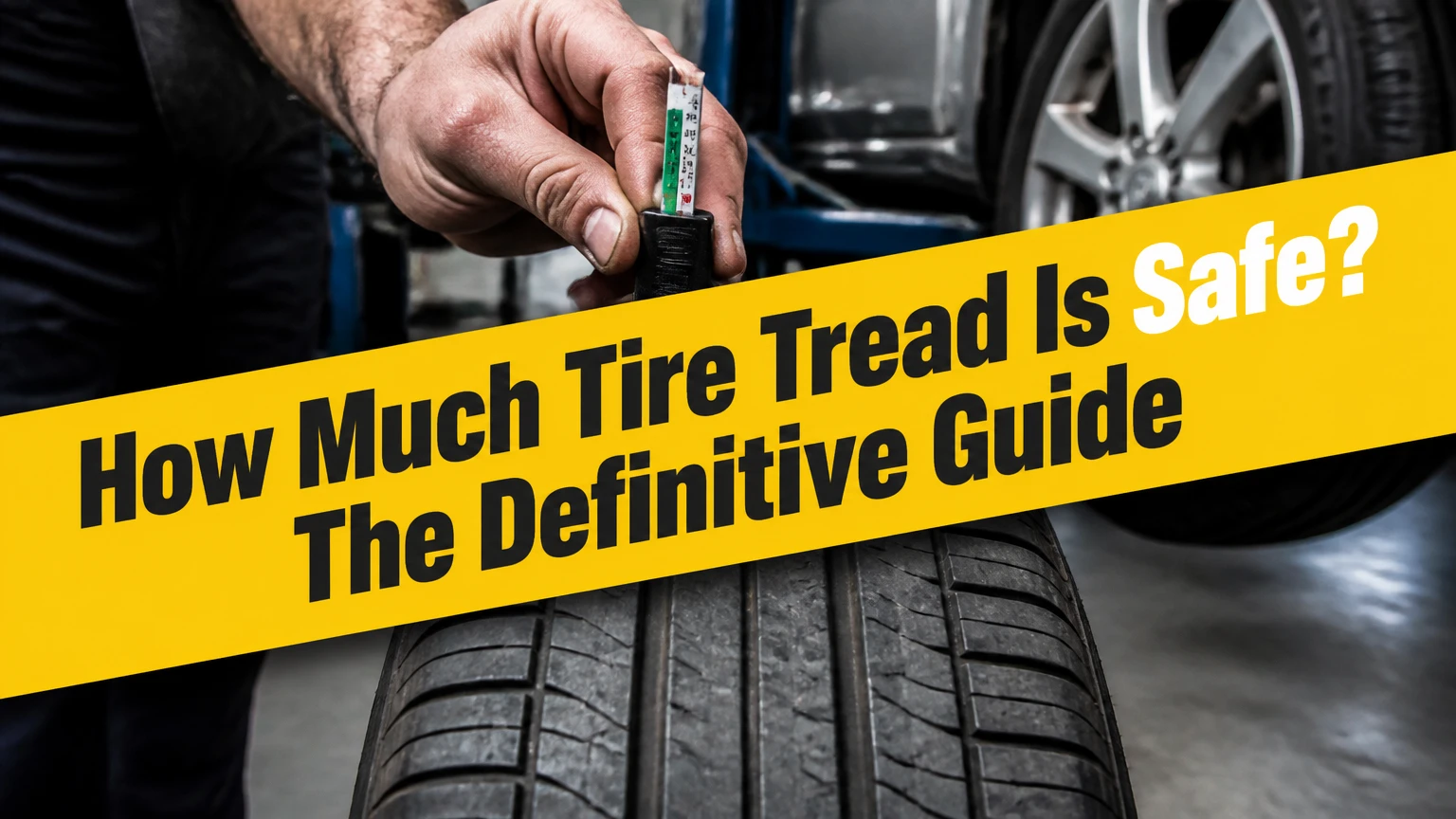
Accurate measurement of tire tread depth requires a dedicated mechanical tire depth gauge inserted into the deepest major groove of the tire. For a quick roadside estimate, motorists can use standard currency in place of professional tools.
- Secure the vehicle on a flat surface with the parking brake engaged and the front wheels turned outward for visibility.
- Insert a U.S. quarter upside down into the central tire groove, placing Washington’s head downward.
- Observe the top of Washington’s head; if the tread covers the top of his head, the tire depth is at least $4/32\text{“}$.
- Insert a U.S. penny upside down with Lincoln’s head downward to check the $2/32\text{“}$ legal limit.
- Inspect whether the top of Lincoln’s head is visible; if it is fully exposed, the tire is legally bald and requires immediate replacement.
How Do I Read Tire Wear Indicator Bars?
Tread wear indicator bars are narrow, hard rubber bridges molded directly into the base of the primary circumferential grooves across the face of the tire. When the surrounding tread rubber wears down completely flush with these horizontal cross-bars, the tire has reached an exact depth of $2/32\text{“}$.
Drivers can locate these bars by searching for the “TWI” abbreviation or small embossed triangle and Michelin Man icons along the outer sidewall shoulder, which point directly to the location of the hidden wear bars in the tread blocks. When these bars connect across the groove, the tire structure is compromised and unsafe for highway use. Drivers must replace the tire before driving another mile in wet weather.
When Should Winter Tires Be Replaced Due to Tread Depth?
Winter tires require a minimum tread depth of $6/32\text{ of an inch}$ ($4.8\text{ mm}$) to perform safely in snow, slush, and ice. Standard passenger all-season tires can safely reach $4/32\text{“}$ for rain, but winter tires operate under an entirely different physical mechanism.
Snow tires rely on functional biting edges and open void spaces that pack snow into the tread grooves to grip the packed snow on the road surface. Furthermore, many specialized winter tires utilize dual-layer rubber compounds. Once the upper $50\%$ of the soft winter tread wears away down to $6/32\text{“}$, the specialized cold-weather rubber compound terminates, exposing standard all-season base rubber underneath. Operating winter tires below $6/32\text{“}$ sacrifices deep snow traction and increases stopping distances significantly.
What Are the Legal Tread Depth Requirements for Heavy Commercial Trucks?
Heavy commercial trucks and semi-trailers are governed by strict federal safety regulations enforced by transportation authorities due to their massive momentum and weight. Steer axles—the front steering wheels of commercial trucks—must maintain a minimum tread depth of $4/32\text{ of an inch}$ at all times.
For drive axles and trailer axles on heavy commercial vehicles, the legal minimum tread depth drops to $2/32\text{ of an inch}$. Because front steer tires control vehicle direction during a blowout or hydroplaning event, transportation regulators enforce a higher safety threshold on the front axle compared to the rear drive and trailer wheels.
Why Do High-Performance Sports Cars Require Earlier Tire Replacement?
High-performance sports cars with wide tire profiles, such as widths of $275\text{ mm}$ or greater, face an exponentially higher risk of hydroplaning compared to standard commuter cars. A wide contact patch must push away a massive wall of water across a broad surface area.
Performance summer tires feature softer rubber compounds designed to maximize dry grip, but their tread patterns often feature fewer sipes and shallower initial grooves. Because of this structural layout, high-performance summer tires should be monitored aggressively and replaced as soon as they approach $4/32\text{“}$. Delaying replacement on performance vehicles turns wide tires into effective water skis during severe downpours.
How Does Tire Age and Dry Rot Affect Safety Regardless of Tread Depth?
Tires age out and degrade structurally due to environmental exposure, regardless of how much unused tread depth remains on the rubber blocks. Rubber compounds oxidize over time, causing natural oils to evaporate and creating microscopic surface fissures known as dry rot.
Any tire exceeding 6 years of age from its Department of Transportation manufacturing date stamp should undergo annual professional inspections. Tires surpassing 10 years of age must be replaced immediately, even if they display full, unused tread depth. Internal steel belts and fabric plies separate as rubber loses elasticity, creating a catastrophic blowout risk at highway speeds.
How Does Irregular Wear Make Healthy-Looking Tread Dangerous?
A driver can measure $8/32\text{ of an inch}$ of tread on the outer shoulder of a tire and still experience a blowout due to hidden irregular wear. Poor wheel alignment, worn suspension components, or incorrect inflation pressures cause localized wear patterns across the contact patch.
If a vehicle suffers from excessive negative camber, the extreme inside edge of the tire can wear down completely to the internal steel cords ($0/32\text{“}$) while the outer edge displays a healthy tread reading. Motorists must inspect the entire inner and outer circumference of every tire, rather than spot-checking a single convenient location.
Do I Need to Replace All Four Tires at the Same Time?
Vehicle drivetrain configuration dictates whether tires can be replaced in pairs or if all four must be changed simultaneously. All-Wheel Drive (AWD) vehicles require replacing all four tires at the same time to match overall tire rolling diameters.
- All-Wheel Drive (AWD) Vehicles: Must replace all four tires simultaneously. Differing tire diameters create rolling circumference variances that strain the center differential, generating persistent drivetrain heat and destroying expensive transfer cases.
- Front-Wheel and Rear-Wheel Drive Vehicles: Tires can be replaced in pairs (two at a time) on a single axle. Technicians must install the new pair on the rear axle to prevent sudden oversteer and loss of vehicle control during emergency braking or cornering on wet roads.
What Are the Signs of Structural Sidewall Damage That Require Immediate Replacement?
Sidewall damage compromises the internal structural integrity of a tire, rendering tread depth measurements completely irrelevant. Drivers must inspect sidewalls regularly for bulges, bubbles, deep cuts, or exposed cords.
A bubble or bulge on the sidewall indicates that the internal fabric plies have ruptured, allowing interior air pressure to push the thin outer rubber outward. This localized weakness creates an extreme blowout hazard under normal driving loads. Any tire exhibiting sidewall structural deformation requires immediate replacement, regardless of tread wear status.
How Does Tire Pressure Affect Tread Wear Rates and Safety?
Incorrect tire inflation pressures accelerate tread wear and degrade vehicle safety long before the rubber reaches its wear limits. Overinflated tires balloon outward in the center of the tread, causing rapid, uneven wear across the middle ribs and reducing the available contact patch.
Underinflated tires sag in the middle, forcing the outer shoulders to shoulder the entire friction load of the vehicle. This causes accelerated shoulder wear on both sides, increases rolling resistance, generates excessive internal heat, and compromises handling response. Drivers should check tire pressures monthly when tires are cold using an accurate digital pressure gauge.
Is It Safe to Mix Different Tire Brands or Tread Patterns on the Same Axle?
Mixing different tire brands, constructions, or tread patterns on the same axle creates dangerous handling imbalances. Tires with varying rubber compounds, sidewall stiffness ratings, and water evacuation channels react differently to braking forces and cornering loads.
Vehicle manufacturers and safety organizations mandate that tires mounted on the same axle share identical size, load index, speed rating, and construction type. Mixing mismatched tires across an axle induces unpredictable steering pull, erratic braking performance, and sudden loss of traction on slippery surfaces.
How Does Vehicle Weight and Electric Vehicle (EV) Torque Impact Tire Tread Longevity?
Electric vehicles and modern heavy SUVs accelerate tire tread wear at rates up to $30\%$ faster than traditional gasoline-powered commuter cars of comparable size. The immense instantaneous torque delivered by electric motors places heavy shear stress on the tire contact patch during acceleration.
Furthermore, heavy battery pack weights increase the vertical load pushing down on every tire. Drivers operating heavy electric vehicles or large utility trucks must monitor tread depth more frequently and adopt smooth acceleration habits to prevent premature tire degradation.
The Bottom Line
Tire tread safety is a critical factor that directly dictates stopping distance and vehicle control during emergency maneuvers. While global legal limits permit driving down to $2/32\text{ of an inch}$, safety experts recommend replacing tires once they reach $4/32\text{ of an inch}$ to ensure reliable wet-weather traction. Inspect tire pressures monthly, monitor tires for age-related dry rot, and maintain proper alignment to ensure your vehicle stops safely in every driving condition.