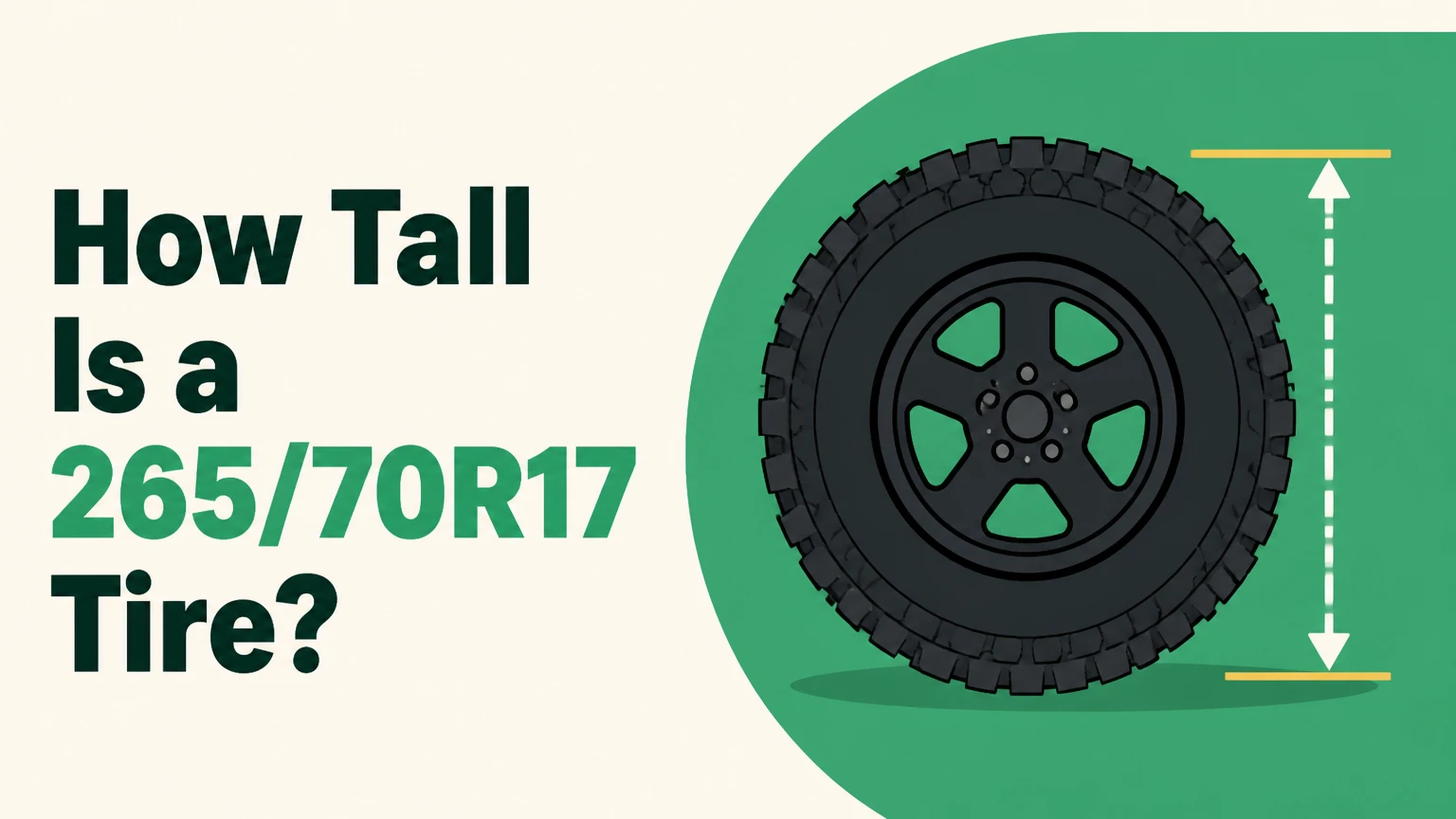
A 265/70R17 tire is theoretically 31.6 inches tall, but its actual mounted and loaded height typically ranges between 30.5 and 31.2 inches due to vehicle weight, inflation pressure, and manufacturer mold variations. This tire size combines a 265 mm section width, a 70 percent aspect ratio, and a 17-inch wheel diameter.
At a Glance: Key Tire Facts
- Theoretical Height: Exactly 31.61 inches (80.3 cm) based on mathematical formulas.
- Metric Breakdown: 265 mm width, 185.5 mm sidewall height, mounted on a 17-inch rim.
- Imperial Equivalent: Closest to a traditional 32×10.50R17 floating tire size.
- Weight Range: 38 to 44 pounds for passenger ratings, up to 55 pounds for heavy-duty LT ratings.
- Approved Rim Width: Fits wheel widths ranging from 7.0 to 9.0 inches safely.
How is tire height calculated using metric sizing?
Tire height is calculated by combining the double sidewall height with the wheel diameter using a standard metric formula. To find the sidewall height, multiply the section width by the aspect ratio. For a 265/70R17 tire, the section width is 265 millimeters and the aspect ratio is 70 percent.
Multiplying 265 millimeters by 0.70 yields 185.5 millimeters for a single sidewall. Because a tire has both a top and bottom sidewall relative to the wheel center, this figure is multiplied by two to get 371 millimeters. Dividing 371 millimeters by 25.4 converts the metric measurement to 14.61 inches. Finally, adding the 17-inch wheel diameter results in a total theoretical height of 31.61 inches.
What is the difference between static loaded radius and free height?
The static loaded radius is the actual distance from the center of the wheel to the ground when mounted on a vehicle, which is always shorter than the free unmounted height. While an unmounted 265/70R17 tire measures approximately 31.6 inches on paper, the weight of a truck or SUV compresses the lower sidewall against the pavement.
This vehicle weight reduces the effective rolling diameter to roughly 30.5 to 31.0 inches. Mechanics and off-road builders use the static loaded radius rather than the theoretical height when calculating precise ground clearance and clearance thresholds for suspension components.
Why do different brands of 265/70R17 tires vary in actual height?
Different tire manufacturers use proprietary molds, rubber compounds, and casing designs that cause physical dimensions to vary significantly between brands. For example, an all-terrain tire manufactured by BFGoodrich may measure 31.8 inches mounted, while a highway tire from another brand in the exact same 265/70R17 specification might measure only 31.3 inches.
Tire engineers design casings to expand slightly under specific internal pressures and load conditions, meaning nominal sizing is treated as a general category rather than an exact manufacturing standard across the entire global tire industry.
How does wheel width change the height and profile of a 265/70R17 tire?
Wheel width directly alters the physical profile, footprint flatness, and overall height of a 265/70R17 tire. Mounting this tire on a narrow 7.0-inch rim pinches the tire beads inward, which crowds the rubber toward the center and makes the tire slightly taller and more crowned.
Conversely, installing the same tire on a wide 9.0-inch rim stretches the sidewalls outward, which widens the contact patch and slightly decreases the overall vertical height of the tire. Maintaining a balanced rim width ensures even tread wear and predictable handling characteristics across varying road surfaces.
How much do all-terrain and mud-terrain tread depths add to tire height?
Aggressive tread patterns on All-Terrain and Mud-Terrain tires add between 0.2 and 0.4 inches of actual height compared to standard Highway-Terrain tires of the exact same nominal size. Highway tires typically feature shallower tread depths designed for low rolling resistance and fuel efficiency on paved roads.
Off-road variants incorporate deep voids and chunky shoulder lugs that extend the outer circumference of the tire casing. When replacing stock highway tires with aggressive mud-terrains, this extra tread depth must be factored into tight wheel well clearances to prevent accidental rubbing.
How does changing tire psi alter the measured height of a 265/70R17?
Adjusting inflation pressure directly changes the vertical height of a mounted 265/70R17 tire by altering how much the sidewall bows under vehicle load. Running a tire at a lower pressure, such as 25 psi for off-road traction, causes the sidewall to flex and shortens the distance from the wheel hub to the pavement.
Inflating the tire to its maximum rated pressure of 35 or 50 psi stiffens the casing and pushes the tread outward, returning the tire closer to its theoretical 31.6-inch height. Over-inflation creates a crowned contact patch that accelerates center tread wear, while under-inflation generates excessive heat and wears the shoulder blocks prematurely.
Will a 265/70R17 fit a stock truck without a lift kit?
A 265/70R17 tire fits most modern stock mid-size and full-size trucks without requiring an aftermarket lift kit. Automakers frequently select this exact size as a factory option for vehicles like the Toyota Tacoma TRD Off-Road, Chevrolet Silverado, Ford F-150, and Jeep Wrangler.
However, older trucks, smaller crossover SUVs, or vehicles with sagging original suspension springs may experience clearance issues. In those instances, installing a modest 1-to-2-inch leveling kit prevents the larger tire casing from making unwanted contact with factory suspension components.
Which specific vehicles experience fender or sway bar rubbing at full steering lock?
Mid-size trucks like older generation Toyota Tacomas and Nissan Frontiers frequently experience minor rubbing against the inner frame rails or sway bars when turning a 265/70R17 tire to full lock. Although the tire clears easily when driving straight, its 10.4-inch section width creates interference during tight parking lot maneuvers.
Full-size trucks generally avoid this issue unless paired with aftermarket wheels featuring an aggressive negative offset, which pushes the outer edge of the tire further away from the hub and into the plastic inner fender liners.
What is the traditional imperial or floating size equivalent to a 265/70R17?
The traditional imperial or floating size equivalent to a 265/70R17 tire is a 32×10.50R17. In the off-road and restoration communities, truck owners often refer to this metric specification informally as a 32-inch tire or a large 31-inch tire.
While older imperial sizing used straightforward whole numbers for overall diameter and section width, modern metric sizing incorporates aspect ratios to give consumers precise engineering data regarding sidewall profile and load capacity performance.
How much does a 265/70R17 tire weigh across different load ratings?
Passenger-rated P-metric 265/70R17 tires typically weigh between 38 and 44 pounds, whereas heavy-duty light truck LT versions weigh between 48 and 55 pounds. Light truck tires feature multi-ply sidewalls and robust steel belts engineered to withstand sharp rocks and heavy towing loads.
This substantial difference in unsprung weight directly impacts acceleration performance, braking distances, and ride comfort, requiring drivers to match their tire load range to their actual daily hauling requirements rather than aesthetic preferences.
How much does upgrading to heavy-duty LT 265/70R17 tires affect MPG?
Upgrading from standard passenger-rated tires to heavy-duty LT 265/70R17 tires typically reduces fuel economy by 1 to 2 miles per gallon due to increased rotational mass and rolling resistance. Each LT tire adds roughly 10 pounds of extra un-sprung weight to the vehicle corners, forcing the engine to work harder during initial acceleration.
Drivers who prioritize highway fuel efficiency often choose standard P-metric or lightweight All-Terrain constructions, saving the heavier load-range tires strictly for commercial towing or dedicated rock-crawling applications.
How much does switching to a 265/70R17 throw off your speedometer?
Switching from a smaller stock tire, such as a 245/70R17 measuring 30.5 inches, to a 265/70R17 measuring 31.6 inches makes your speedometer read roughly 3.6 percent too slow. When the vehicle instrument cluster displays a traveling speed of 60 miles per hour, the vehicle is actually moving at approximately 62.2 miles per hour.
This discrepancy occurs because larger circumference tires cover more ground per complete wheel rotation than the factory computer programmed into the vehicle transmission control module expects.
Do you need to recalibrate your speedometer or change gear ratios?
Recalibrating your speedometer using a digital programmer is recommended when upgrading to a 265/70R17 tire, though changing physical axle gear ratios is unnecessary for this minor size increase. A 3.6 percent speed difference will not strain modern automatic transmissions or trigger diagnostic trouble codes in most vehicles.
However, recalibration ensures accurate odometer tracking for fuel mileage calculations, scheduled maintenance intervals, and strict adherence to local highway speed limits without risking accidental traffic citations.
What is the difference in sidewall strength between P-metric and LT tires?
Light Truck tires feature multi-ply polyester or nylon sidewall construction with high turn-up cords, whereas P-metric tires use a flexible single-ply sidewall optimized for smooth ride quality. LT 265/70R17 tires resist sharp rock punctures and pinch flats on rugged trails because their reinforced sidewalls contain significantly more rubber compound.
Passenger-rated tires absorb road imperfections more comfortably on paved asphalt, but their thinner sidewalls remain vulnerable to tearing or bruising when subjected to heavy off-road trail obstacles.
The Bottom Line
A 265/70R17 tire provides a theoretical height of 31.6 inches, though real-world installations yield between 30.5 and 31.2 inches due to vehicle weight and tread patterns. Understanding the math behind metric sizing, checking factory wheel well clearance limits, and accounting for weight variations ensures a successful fit for your truck or SUV.