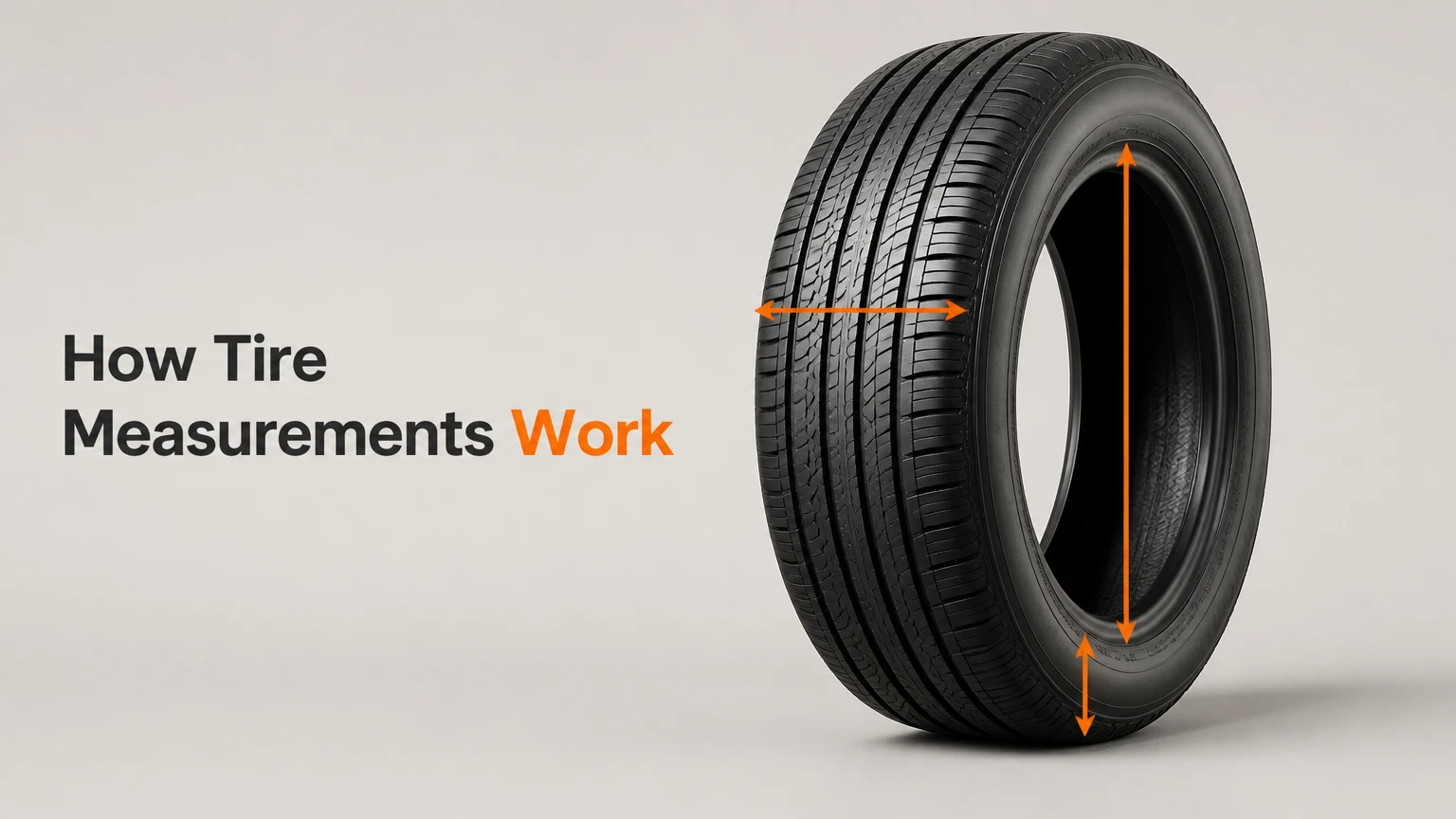
Tire measurements use a standardized but highly confusing mix of metric units, percentages, and imperial units to describe a tire’s physical size, internal construction, and performance capabilities. Reading a tire sidewall requires decoding a sequence of letters and numbers that dictate section width, sidewall aspect ratio, wheel diameter, load capacity, and maximum safe speed thresholds.
At a Glance
- Tire codes combine metric section widths in millimeters with imperial wheel diameters measured in inches.
- The aspect ratio is a percentage, meaning two tires with the same ratio can have vastly different physical sidewall heights.
- Calculating total tire diameter requires multiplying section width by the aspect ratio, converting millimeters to inches, and doubling that figure before adding the rim diameter.
- Light truck and off-road tires frequently abandon metric standards entirely in favor of high-flotation imperial sizing.
- Modifying overall tire diameter by more than 3 percent alters speedometer accuracy, transmission shift points, and anti-lock braking system calibrations.
How Do Tire Measurements Work?
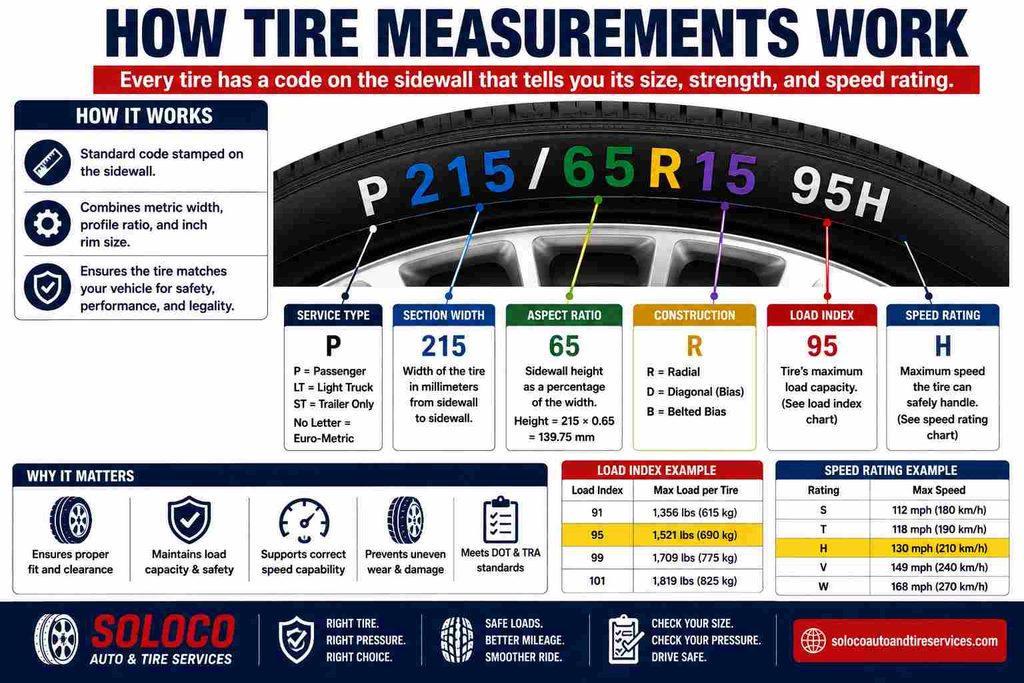
Tire measurements work by stamping a standardized alphanumeric code directly onto the outer rubber sidewall of every pneumatic tire. This coding system merges metric measurements for width, percentage ratios for sidewall height, and imperial inch measurements for wheel diameter. Automotive engineers use this standardized formula so drivers, mechanics, and regulatory bodies can instantly verify whether a specific tire matches the weight, speed, and clearance parameters of a given vehicle.
Manufacturing standards established by the Department of Transportation and the Tire and Rim Association dictate that every tire must display its service type, width, profile, construction type, rim size, load index, and speed rating in a unified sequence. Understanding this sequence prevents catastrophic equipment failures, premature tread wear, and improper vehicle handling dynamics.
What Does Each Number and Letter Mean on a Tire Sidewall?
Every character in a standard tire code represents a specific physical dimension or performance threshold. Consider a common passenger vehicle tire code such as P215/65R15 95H:
- P (Service Type): The letter “P” stands for Passenger car, indicating the tire is engineered to federal standards for passenger vehicles.
- 215 (Section Width): The three-digit number represents the total width of the tire from the widest point of the outer sidewall to the widest point of the inner sidewall measured in millimeters, which equals 215 millimeters here.
- 65 (Aspect Ratio): The two-digit number following the slash is the aspect ratio, meaning the sidewall height is 65 percent of the section width.
- R (Internal Construction): The letter “R” designates Radial construction, meaning the internal body plies run radially across the tire from bead to bead.
- 15 (Wheel Diameter): The number following the construction type denotes the diameter of the wheel rim that the tire fits, measured in inches, which is 15 inches.
- 95 (Load Index): The numerical code matches a standardized weight capacity table, where a rating of 95 translates to a maximum load capacity of 1,521 pounds per tire.
- H (Speed Rating): The final letter indicates the maximum safe operating speed for the tire under proper inflation and load, where H equals 130 miles per hour.
How Do You Calculate the Total Diameter of a Tire Using Metric and Imperial Units?
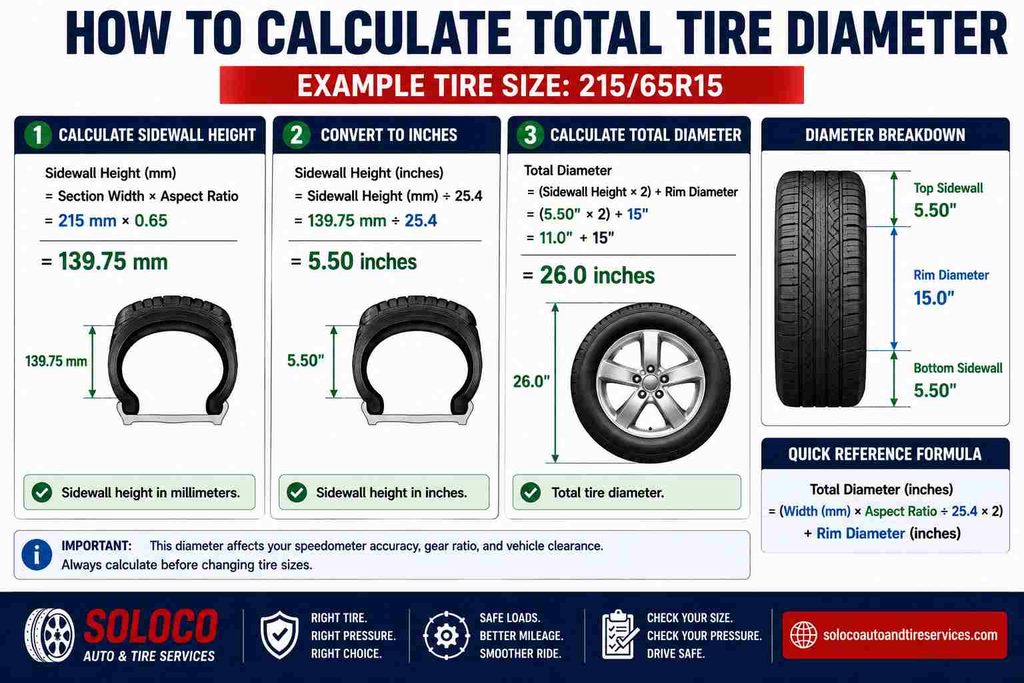
Calculating the total diameter of a tire requires a three-step mathematical formula that converts metric width and percentage profiles into inches, then adds the rim diameter. Professional technicians execute this exact formula whenever calculating gear ratio changes or suspension clearance limits:
- Calculate Sidewall Height: Multiply the section width in millimeters by the decimal form of the aspect ratio. For example, a 215/65R15 tire requires multiplying $215 \text{ mm} \times 0.65$, which equals $139.75 \text{ mm}$ of sidewall height.
- Convert Millimeters to Inches: Divide the metric sidewall height by $25.4$ inches per millimeter. Continuing the example, $139.75 \text{ mm} / 25.4$ yields $5.50$ inches of sidewall height.
- Calculate Total Diameter: Double the single sidewall height to account for both the top and bottom sections of the tire, then add the wheel rim diameter. Multiplying $5.50$ inches by two gives $11.0$ inches of total sidewall height. Adding the $15$-inch rim diameter results in a total tire diameter of $26.0$ inches.
What Does an Off-Road High-Flotation Tire Size Like 33×12.50R15 LT Mean?
High-flotation light truck tires bypass the metric system entirely, utilizing a direct United States customary measurement system tailored for heavy-duty off-road applications. A size designation like 33×12.50R15 LT breaks down into three distinct imperial metrics:
- 33: The first number represents the total overall diameter of the inflated tire in inches, meaning the tire stands 33 inches tall from the ground to the top tread block.
- 12.50: The second number indicates the total section width of the tire in inches, meaning the tire is 12.5 inches wide.
- R15 LT: The letter “R” designates radial construction, the number 15 specifies the required wheel rim diameter in inches, and the letters “LT” stand for Light Truck, indicating heavier internal sidewall ply construction designed for high payload limits and rough terrain.
What Does a European Metric Tire Size with a Missing Aspect Ratio Mean?
European metric tire sizes, often called hard metric sizing, omit the aspect ratio entirely from the sidewall code, appearing simply as a format like 185R14. When no aspect ratio is explicitly printed on the tire sidewall, industry standards dictate that the aspect ratio is automatically assumed to be 82 percent.
This means a tire marked 185R14 is functionally identical to a metric tire marked 185/82R14. Mechanics encounter this legacy sizing on older commercial vans, classic European automobiles, and heavy-duty utility trailers where tall, high-volume sidewalls absorb heavy loads at moderate highway speeds.
What Does the Z Speed Rating Placement Mean in a Code Like 245/40ZR18?
The letter “Z” positioned inside a performance tire code like 245/40ZR18 signifies an ultra-high-performance tire engineered to safely sustain continuous speeds exceeding 149 miles per hour. Historically, tire manufacturers placed the “Z” immediately before the “R” construction marker to denote high-speed structural integrity.
Modern tire technology frequently combines the “Z” designation with a specific service description at the end of the string, such as 245/40ZR18 97Y. Technicians must always verify the final letter at the end of the code, such as Y, which confirms a top speed rating of up to 186 miles per hour, ensuring the tire matches the high-speed capability of modern sports cars.
Why Is Trusting the Aspect Ratio for Physical Wheel Well Clearance Dangerous?
Trusting the aspect ratio as a direct indicator of physical tire height is a dangerous mistake because aspect ratios are relative percentages rather than fixed measurements. Changing the section width of a tire drastically alters the actual physical height of the sidewall, even if the aspect ratio number remains identical.
For example, a 275/60R20 tire features a 60 percent aspect ratio applied to a 275 mm width, resulting in a physical sidewall height of 165 millimeters. Conversely, a 205/60R16 tire also features a 60 percent aspect ratio, but applied to a narrower 205 mm width, yielding a sidewall height of only 123 millimeters. Assuming both tires will fit identical clearance gaps based on their shared “60” designation will result in severe rubbing against suspension components or fender liners.
What Are the Safety Risks of Ignoring Rim Width Limits When Buying New Tires?
Ignoring manufacturer-specified rim width ranges when installing new tires compromises vehicle handling, accelerates tread wear, and introduces severe bead failure risks. Every tire model is engineered to be mounted on a specific range of wheel widths, and deviating outside this window creates immediate mechanical hazards.
Mounting a wide tire like a 245 mm width onto a wheel rim that is too narrow, such as a 7-inch rim, pinches the sidewalls inward. This creates a bulbous footprint that reduces cornering stability and causes rapid center-tread wear due to over-inflation ballooning. Conversely, stretching that same 245 mm tire onto an excessively wide 9.5-inch rim forces the sidewalls outward at an extreme angle, exposing the metal wheel lip to curb damage and risking sudden bead unseating during hard cornering maneuvers.
How Does Changing Tire Size Impact Your Vehicle Speedometer and Odometer?
Changing overall tire diameter alters the rolling circumference of your wheels, directly throwing off the calibration of your vehicle speedometer, odometer, and transmission shift schedules. Modern vehicle computers calculate vehicle speed by measuring the rotational speed of the transmission output shaft or wheel speed sensors, assuming factory-standard tire dimensions.
If you install taller tires that increase your overall tire diameter by just 5 percent, your actual ground speed will be 5 percent higher than what your dashboard speedometer displays. Traveling at a true 63 miles per hour will register as 60 miles per hour on your gauge cluster, creating a hidden speeding ticket risk. Furthermore, this discrepancy corrupts your vehicle odometer, causing it to under-report total mileage accrued, and disrupts the calculations of anti-lock braking and traction control computer systems.
How Does Switching to Extra Load (XL) Tires Change Inflation Pressure and Load Capacity Requirements?
Switching to Extra Load (XL) tires increases the maximum load-carrying capacity of a tire size by utilizing reinforced internal casing plies and higher bead strength. Standard load passenger tires typically achieve their maximum weight ratings at an inflation pressure of 35 PSI, whereas XL-rated tires can safely accept inflation pressures up to 41 or 42 PSI.
When installing XL tires, drivers must adjust their inflation pressures based on load tables rather than assuming factory door placard pressures are optimal. Failing to inflate XL tires to adequate pressure levels negates their structural benefits, leading to excessive internal heat generation, soft sidewall flex, and premature shoulder wear under heavy loads.
Can You Mix Different Tire Speed Ratings or Load Indices on the Same Axle?
Mixing different tire speed ratings or load indices on the same vehicle axle is strongly discouraged by all major tire manufacturers and automotive safety organizations. If emergency situations force a temporary mismatch, technicians must install the tires with the higher speed rating and greater load index on the rear axle of the vehicle.
Placing lower-rated tires on the rear axle of a rear-wheel-drive or front-wheel-drive vehicle creates dangerous oversteer conditions during sudden evasive maneuvers or wet cornering. Under high lateral loads, tires with weaker sidewalls and lower speed capabilities will lose grip faster than the front tires, causing the rear end of the vehicle to slide out unpredictably. Never mix different tire sizes, construction types, or speed ratings on the same individual axle.
What Happens If You Try to Mount a Tire on a Wheel Rim of a Mismatched Half-Inch Size?
Attempting to mount a tire onto a wheel rim with even a half-inch size discrepancy, such as trying to fit a 16-inch tire onto a 16.5-inch wheel, causes immediate catastrophic failure during the inflation process. Tire beads and wheel rims are manufactured to precise engineering tolerances measured down to fractions of a millimeter.
A mismatched half-inch variance prevents the tire bead from forming an airtight seal against the wheel safety humps. Attempting to force inflation causes the bead to slip violently off the rim flange, resulting in an explosive rupture that can cause severe personal injury, flying metal debris, and total destruction of the tire carcass.
How Do You Read the Manufacturing Date Code on a Tire Sidewall?
Reading the manufacturing date code on a tire requires locating the Department of Transportation (DOT) serial number stamped into the inner or outer rubber sidewall. The final four digits of this long alphanumeric sequence indicate the exact week and year the tire was manufactured.
For example, a DOT code ending in the numbers 3224 reveals that the tire was manufactured during the 32nd week of the year 2024. Automotive safety experts recommend inspecting tires annually after five years of service and replacing all tires once they reach ten years of age from their manufacture date, regardless of remaining tread depth, due to rubber compound degradation.
How Do Staggered Tire Fitments Affect Rolling Circumference Calculations on All-Wheel-Drive Vehicles?
Staggered tire fitments—where rear tires feature a wider section width or different aspect ratio than front tires—require precise calculation to ensure rolling circumference discrepancies remain within strict manufacturer tolerances. Modern all-wheel-drive systems rely on wheel speed sensors to monitor slippage; if front and rear tires rotate at significantly different speeds due to mismatched diameters, the central transfer case or differential engages continuously.
Engineers calculate rolling circumference by multiplying total tire diameter by pi ($\pi$). On all-wheel-drive platforms, the variance between front and rear rolling circumferences must typically remain under 1 percent. Exceeding this threshold overheats transfer case clutch packs, triggers constant traction control fault codes, and causes premature driveline component failure.
What Are the Legal and Insurance Safety Implications of Installing Tires with a Lower Load Index Than the Manufacturer Door Placard?
Installing replacement tires with a lower load index than the official vehicle manufacturer placard located on the driver-side door jamb violates federal safety standards and invalidates vehicle insurance liability coverage in heavy-load accident scenarios. The load index numerical code is a federally mandated safety rating ensuring the tire can support the gross axle weight rating of the fully loaded vehicle.
If a vehicle is involved in a collision while outfitted with under-rated tires that suffered structural failure due to overloading, insurance investigators can deny coverage for negligence. Professional installers and vehicle owners must always match or exceed the original equipment load index specification when selecting replacement tires.
The Bottom Line
Mastering how tire measurements work requires combining metric widths, percentage aspect ratios, and imperial rim diameters into precise calculations for physical clearance and load capacity. Always verify that your replacement tires match or exceed factory load indices and speed ratings while keeping rolling circumference variations under 3 percent. Respecting these mechanical limits ensures optimal braking performance, accurate speedometer readings, and maximum safety on the road.