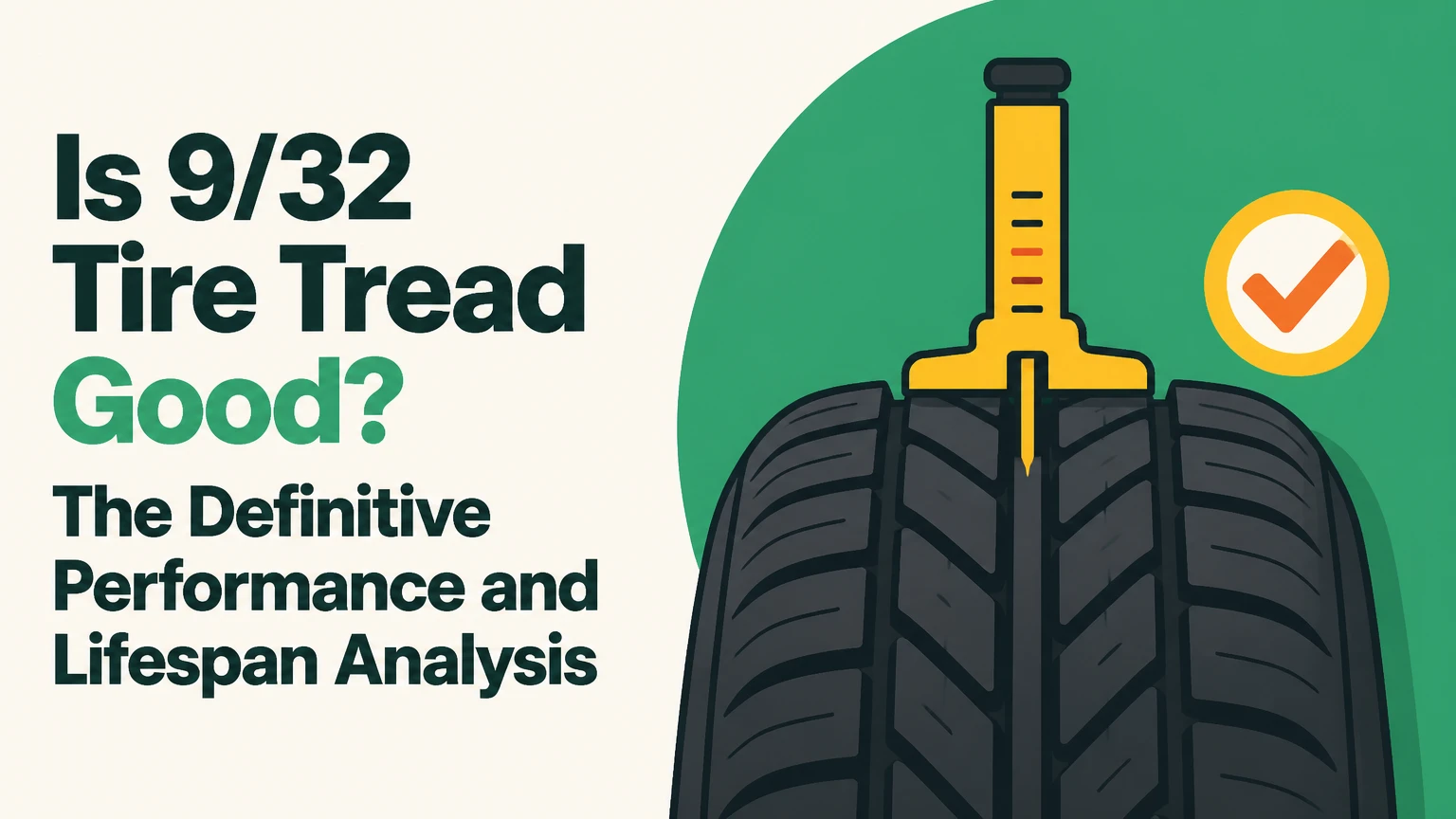
A 9/32-inch tire tread depth is exceptionally good, representing approximately 70% to 80% of a brand-new passenger tire’s total usable lifespan.
At this depth, a tire retains optimal hydroplaning resistance, short wet and dry stopping distances, and strong structural integrity across standard highway and adverse weather conditions.
Most passenger car tires start life between 10/32 and 11/32 of an inch, meaning a 9/32 measurement indicates a lightly used tire that has only experienced its initial phase of wear.
Key Facts at a Glance
- Remaining Lifespan: Typically provides 20,000 to 40,000 miles of remaining service life depending on vehicle drivetrain and driving habits.
- Metric Conversion: 9/32 of an inch is approximately 7.14 millimeters of usable rubber depth above the wear bars.
- Safety Status: Well above the 2/32-inch legal replacement threshold and safely outside the 4/32-inch wet-traction degradation window.
- Wear Rate Baseline: Standard passenger tires wear down at an average rate of 1/32 of an inch every 3,000 to 5,000 miles.
- Hydroplaning Defense: Deep drainage channels remain fully effective at pumping water away from the contact patch at highway speeds.
What Does a 9/32 Inch Measurement Mean for Tire Health?
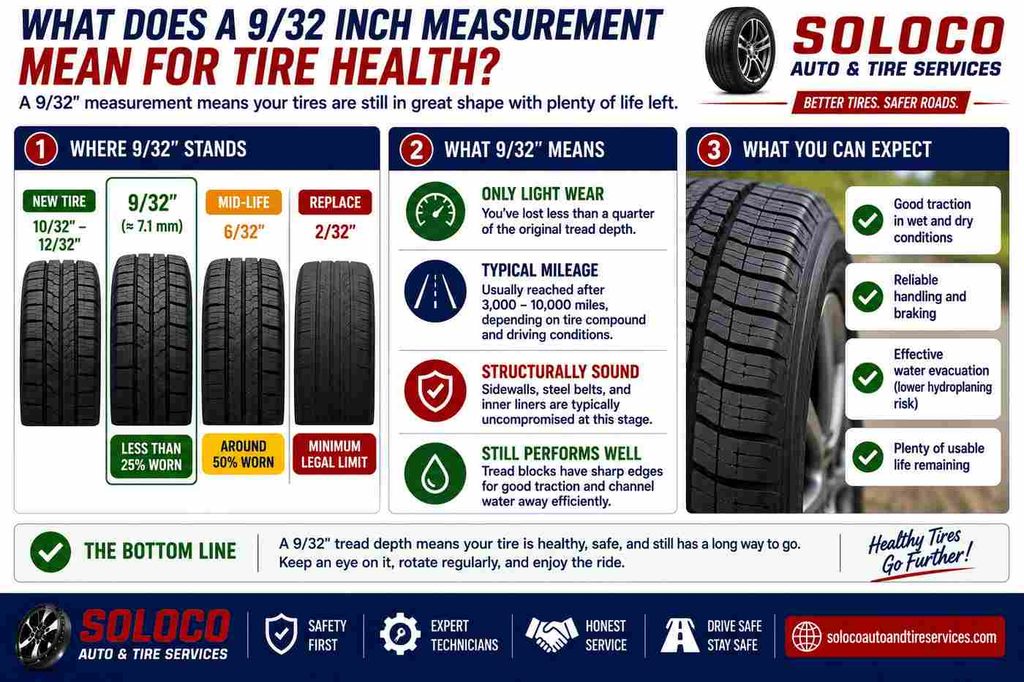
A 9/32-inch tire measurement indicates a tire that has shed less than a quarter of its original tread depth. When passenger tires leave the factory, their tread patterns are cast deep into the rubber compound to provide maximum block rigidity and void volume. As the vehicle rolls down the road, abrasive friction strips away microscopic layers of rubber.
Reaching a 9/32 measurement means the tire has been driven roughly 3,000 to 10,000 miles depending on compound softness. The structural integrity of the sidewalls, steel belts, and inner liners is typically uncompromised. The tread blocks still possess sharp, factory-cut edges that bite cleanly into loose surfaces and channel standing water efficiently away from the tire footprint.
How Many Miles Are Left on a 9/32-Inch Tire?
A tire with 9/32 of an inch of remaining tread will typically last another 20,000 to 40,000 miles. However, mileage output depends heavily on specific operational variables rather than simple math.
The average tire wear rate sits at roughly 1/32 of an inch per 4,000 miles. Because the legal safety threshold occurs at 2/32 of an inch, a 9/32 tire gives you 7/32 of usable rubber before replacement is legally required.
Several external factors accelerate or decelerate this remaining mileage:
- Vehicle Weight and Drivetrain: Heavy electric vehicles and front-wheel-drive configurations wear front tires significantly faster than lightweight rear-wheel-drive sedans.
- Road Surface Abrasiveness: Coarse asphalt found in the southwestern United States wears rubber down up to 30% faster than smooth concrete highways in the Midwest.
- Driving Style: Aggressive acceleration, hard cornering, and frequent heavy braking increase thermal friction, accelerating tread loss.
- Tire Rotation Frequency: Neglecting tire rotations every 5,000 to 7,000 miles can cause premature shoulder wear, cutting estimated remaining mileage in half on specific axle positions.
How Does 9/32 Tread Perform in Wet and Winter Conditions?
Wet and winter traction rely directly on void depth. When water accumulates on a roadway, a tire must displace that liquid faster than the vehicle moves forward to prevent hydroplaning. At 9/32 of an inch, the tread depth grooves are deep enough to swallow and expel standing water even at highway speeds exceeding 60 miles per hour.
As tires wear down to 4/32 of an inch, water evacuation capacity drops precipitously, and braking distances on wet pavement increase by upwards of 80 feet. At 9/32, you operate safely within the high-performance zone for rain.
For winter conditions, deep snow traction requires aggressive biting edges and open spaces to pack and clear snow. While dedicated winter tires start at 12/32 or 14/32 of an inch for maximum snow compaction, a 9/32 measurement on an all-season or winter tire still offers robust performance in light snow and slush. Once winter tires drop below 6/32 of an inch, their deep-snow capabilities degrade rapidly, but at 9/32, winter traction remains entirely viable.
Performance Comparison Across Tire Tread Depths
| Performance Metric | 9/32-Inch Tread (Lightly Used) | 4/32-Inch Tread (Worn) | 2/32-Inch Tread (Legal Minimum) |
| Hydroplaning Resistance | Excellent; high water volume displacement | Moderate; begins sliding at lower speeds | Dangerous; immediate risk in standing water |
| Wet Braking Distance (60-0 mph) | Baseline (~195 feet) | Adds 40 to 80 feet of stopping distance | Adds 120 to 150+ feet of stopping distance |
| Dry Cornering Stability | Good; minor tread block flex under load | Excellent; stiff, short blocks reduce squirm | Maximum responsiveness; minimal rubber flex |
| Snow and Slush Traction | Strong bite; effective clearing channels | Marginal; inadequate void space for packing | Extremely dangerous; zero grip on loose snow |
| Rolling Resistance & Fuel Economy | Standard baseline fuel efficiency | Slightly improved due to lower mass | Maximum fuel efficiency, zero safety margin |
How to Accurately Measure Your Tire Tread Depth
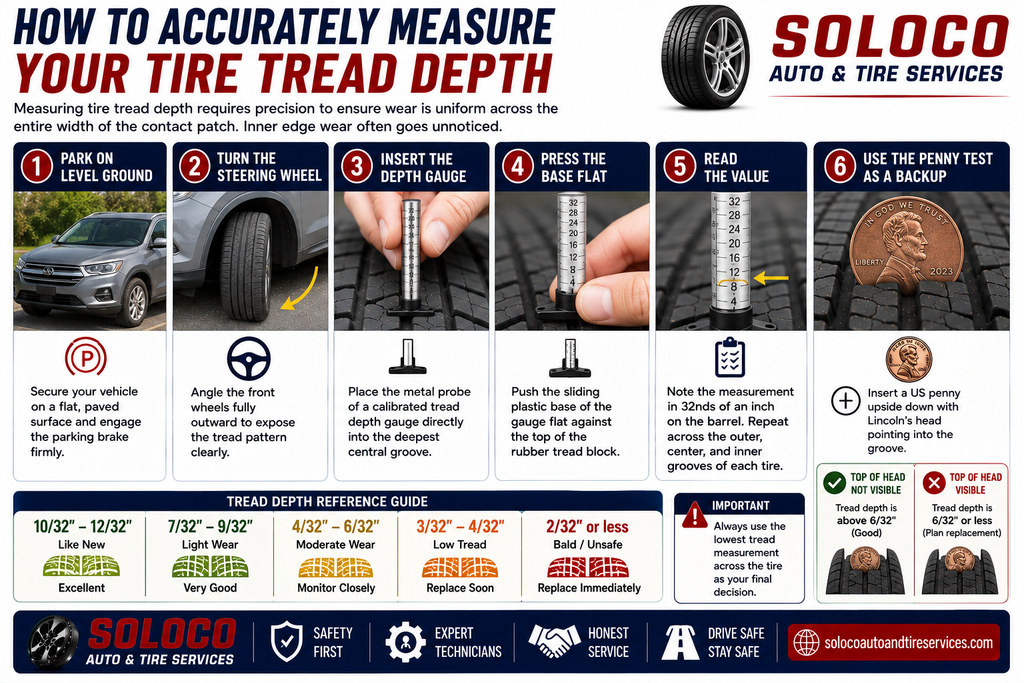
Measuring tire tread depth requires precision to ensure wear is uniform across the entire width of the contact patch. Relying on visual estimations often leads to false security, as inner edge wear frequently goes unnoticed.
Step-by-Step Measurement Procedure
- Park on Level Ground: Secure your vehicle on a flat, paved surface and engage the parking brake firmly.
- Turn the Steering Wheel: Angle the front wheels fully outward to expose the tread pattern of the front tires clearly.
- Insert the Depth Gauge: Place the metal probe of a calibrated tread depth gauge directly into the deepest central circumferential groove.
- Press the Base Flat: Push the sliding plastic base of the gauge flat against the top of the rubber tread block.
- Read the Value: Note the measurement in 32nds of an inch on the barrel. Repeat this process across the outer, center, and inner grooves of each tire.
- Use the Penny Test as a Backup: If you lack a professional gauge, insert a US penny upside down with Lincoln’s head pointing into the groove. If the top of Lincoln’s head is completely covered by rubber, your tread depth is safely above 6/32 of an inch.
What Are the Pros and Cons of Having 9/32-Inch Tread?
Advantages
- High Safety Margin: Provides robust resistance against hydroplaning during sudden heavy downpours.
- Extended Longevity: Offers years of everyday commuting before requiring a capital investment in a new set of tires.
- Strong Resale Value: If you are buying or selling a used vehicle, tires at 9/32 represent significant remaining value to a prospective buyer.
Disadvantages
- Slight Tread Squirm: Taller tread blocks possess more flexibility, which can introduce a very minor amount of lateral squirm during high-speed cornering compared to shaved or worn tires.
- Higher Rolling Resistance: Deeper rubber creates more internal friction and hysteresis, causing a negligible drop in fuel economy compared to nearly bald tires.
Common Mistakes When Evaluating Tire Tread Depth
Vehicle owners often make critical errors when assessing tire health, leading to premature replacements or overlooked safety hazards.
- Checking Only One Spot: Measuring solely the outer edge of a tire while ignoring the inner shoulder. Inner wear caused by negative camber or misaligned toe settings often ruins a tire before the center shows distress.
- Confusing Tread With Tire Age: Believing a tire is safe simply because it measures 9/32 of an inch, while ignoring that the rubber compound is 8 to 10 years old and suffering from dangerous dry rot and microscopic sidewall cracking.
- Ignoring Axle Wear Discrepancies: Leaving high-tread tires on one axle while letting the opposing axle wear down below safe thresholds, creating dangerous oversteer or understeer imbalances in wet weather.
- Mistaking Wear Indicator Bars: Confusing the built-in Tread Wear Indicator (TWI) transverse rubber bars—which sit flush at 2/32 of an inch—with a healthy operating depth.
Troubleshooting Uneven 9/32 Wear Patterns
If your tires measure 9/32 in some spots but show accelerated wear in others, your vehicle has underlying mechanical or inflation issues that require immediate correction.
- Center Groove Wear Exceeds Shoulders: The tire is consistently overinflated. Reduce air pressure back to the vehicle manufacturer specification listed on the driver-side door jamb placard.
- Both Outer Edges Worn Faster Than Center: The tire is chronically underinflated. Add compressed air immediately to restore proper contact patch shape and prevent premature sidewall fatigue.
- Cupping or Scalloping (Cup-Shaped Dips): Indicates failing shock absorbers, worn suspension struts, or severely out-of-balance wheel assemblies.
- Single-Edge Feathering: The vehicle’s alignment—specifically toe or camber angles—is significantly out of specification. Schedule a professional four-wheel alignment to prevent ruining the remaining 9/32 of tread.
Frequently Asked Questions
Is 9/32 tire tread considered brand new?
No, 9/32 is not entirely brand new, but it is close. Most passenger car tires leave manufacturing facilities with between 10/32 and 11/32 of an inch of tread depth. A 9/32 measurement means the tire has lost roughly 10% to 20% of its total depth, placing it in lightly used, excellent condition.
Can I mix a 9/32 tire with brand new 11/32 tires on my vehicle?
Yes, mixing a 9/32 tire with new 11/32 tires is generally safe on front-wheel-drive or rear-wheel-drive vehicles, provided they match the correct speed rating, load index, and tire size. However, on all-wheel-drive (AWD) vehicles, mismatched tread depths can strain the differential. Most AWD manufacturers require tire circumferences to remain within 2/32 of an inch of each other.
Is it safe to buy used tires with 9/32 tread?
Buying used tires with 9/32 of an inch of tread is an exceptional financial decision, provided the tires are less than five years old, free of internal patch repairs near the sidewall, and show no signs of dry rotting or bead damage. You receive 70% to 80% of the tire’s lifespan at a fraction of retail cost.
How long will a 9/32 tire last if I drive 12,000 miles per year?
If your driving habits span 12,000 miles annually and your vehicle maintains an average wear rate of 1/32 of an inch every 4,000 miles, your 9/32 tires will reach the 4/32 critical warning zone in roughly 20,000 to 24,000 miles, translating to approximately two years of standard driving before replacement is necessary.
Do winter snow tires perform well at 9/32 tread depth?
Winter snow tires perform exceptionally well at 9/32 of an inch. While dedicated snow tires often start deeper at 12/32 or 13/32 to maximize ice and deep-powder grip, a 9/32 measurement retains more than enough functional sipe depth to maintain secure traction on cold, snowy, and icy roadways.