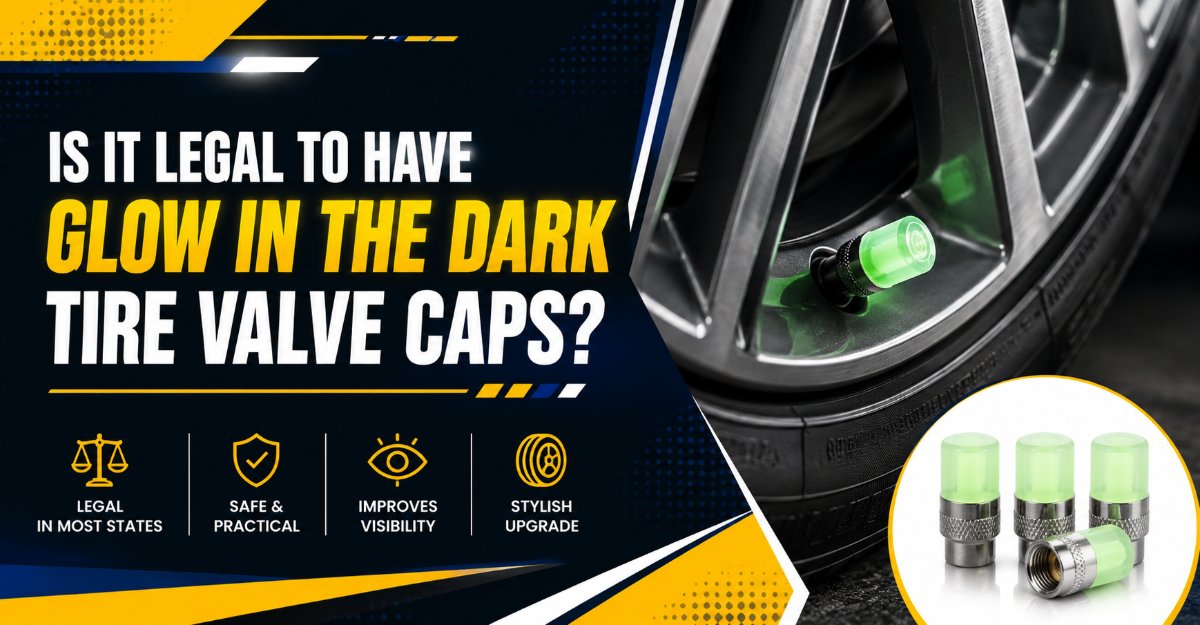
Passive, glow-in-the-dark tire valve caps are generally legal for civilian use on public roads because they rely on ambient light absorption rather than active electrical power. However, legality changes instantly if the caps emit active LED illumination or display restricted emergency colors like blue or red.
At a Glance
- Passive phosphorescent caps function as standard dust caps and are legal in almost all jurisdictions.
- Active LED caps that flash or mimic emergency vehicle colors violate state and federal highway lighting codes.
- Metal aftermarket caps can react with aluminum valve stems, causing galvanic corrosion on tire pressure sensors.
- Heavy active or metal caps weighing over 5 grams can induce wheel vibration at highway speeds.
- Strict state inspection regions may penalize any uncertified exterior vehicle modification.
What is the difference between passive and active tire valve caps?
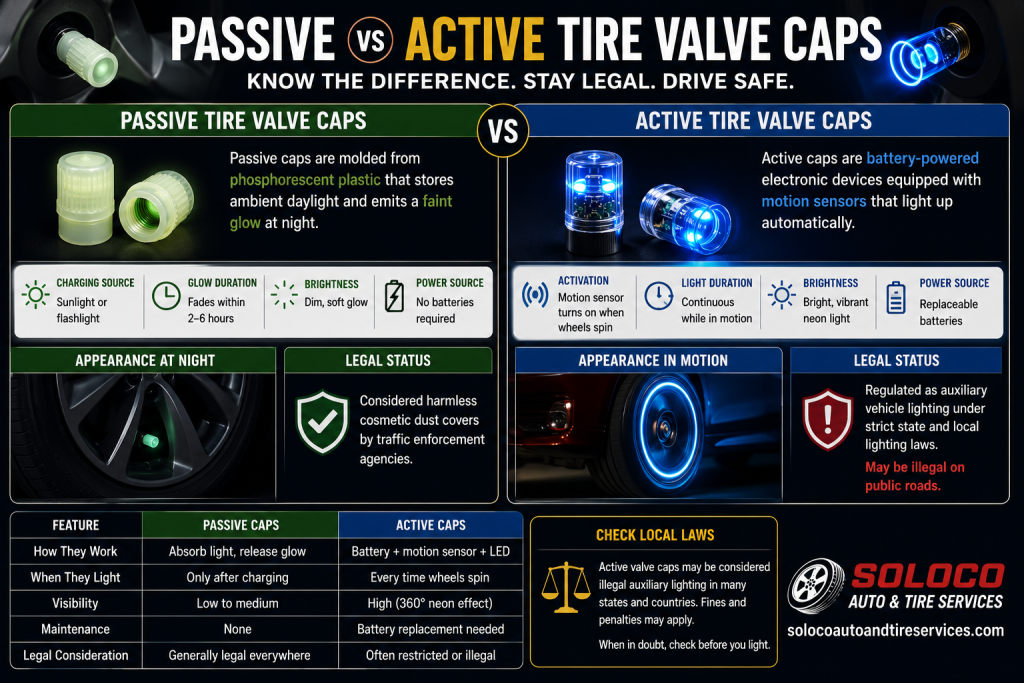
Passive valve caps are molded from phosphorescent plastic that stores ambient daylight and emits a faint glow at night, whereas active valve caps are battery-powered electronic devices equipped with motion sensors. Passive caps require external charging from the sun or a flashlight and fade within hours. Active caps utilize internal circuitry to generate vibrant, continuous neon light circles whenever the vehicle wheels spin. Traffic enforcement agencies classify passive caps as harmless cosmetic dust covers, while regulating active caps under strict auxiliary vehicle lighting statutes.
Are green or multicolored glow valve caps illegal under vehicle lighting codes?
Multicolored or green glow valve caps are technically legal if they are strictly passive and remain dim, but they enter a legal gray area if their luminescence is bright enough to mimic authorized auxiliary lamps. Vehicle lighting codes restrict specific hues to designated zones of a car. White lights are mandatory for forward-facing visibility, amber or yellow is permitted exclusively for side markers, and blue or red is strictly prohibited for civilian use. If a green or white phosphorescent cap is charged to an ultra-bright intensity using a UV flashlight, law enforcement officers possess the legal discretion to pull you over for operating unauthorized auxiliary lights.
Do spinning tire valve caps violate flashing light laws on public roads?
Spinning active LED valve caps frequently violate public road statutes prohibiting flashing, blinking, or oscillating consumer lighting. Most traffic safety codes mandate that any auxiliary lighting on moving vehicles must remain at a steady 0 Hz burn. When a car travels at slow speeds or sits idle in heavy traffic, motion-sensor LED caps flicker or strobe as the wheel accelerates and decelerates. Passive glow-in-the-dark caps completely avoid this violation because their phosphorescent glow remains steady, continuous, and non-flashing as the wheel rotates.
Can metal glow caps cause tire pressure monitoring system corrosion?
Cheap metal aftermarket glow caps will chemically weld to your tire valve stems if they interact with the aluminum alloy components found on modern Tire Pressure Monitoring Systems. This destructive chemical reaction is known as galvanic corrosion, which occurs when dissimilar metals fuse together in the presence of moisture and road salt. Resolving this issue often requires professional automotive intervention to cut off the seized cap and replace the entire TPMS sensor assembly. Sticking with high-grade plastic caps completely eliminates this costly mechanical risk.
Do glow-in-the-dark valve caps disrupt high-speed tire balancing?
Standard passive plastic glow caps weigh less than 1 gram and create zero measurable impact on vehicle tire balance. Conversely, heavy aftermarket metal caps or battery-operated LED variants can weigh between 5 and 10 grams each. At sustained highway speeds exceeding 65 miles per hour, this concentrated weight at the outer edge of the wheel creates a centrifugal imbalance. Drivers will experience noticeable steering wheel vibrations, premature tread wear, and compromised suspension handling unless the assembly is professionally re-balanced.
How do modern strontium aluminate plastic caps differ from traditional zinc sulfide?
Modern strontium aluminate plastic compounds glow up to ten times brighter and last significantly longer than older zinc sulfide formulations. Traditional zinc sulfide caps fade into near invisibility within twenty minutes of darkness. Strontium aluminate can retain a visible luminescent charge for over eight hours after initial exposure to sunlight. While this superior illumination performance pleases motorists, it also increases the risk of police scrutiny if the freshly charged caps shine brightly enough to resemble unauthorized lighting modifications.
Do strict OEM states like Virginia or Pennsylvania ban non-DOT exterior accessories?
States with rigorous vehicle safety inspection frameworks enforce strict rules prohibiting any exterior automotive accessory lacking Department of Transportation certification. In jurisdictions like Virginia and Pennsylvania, state troopers and safety inspectors possess the legal authority to cite motorists for any unapproved modification attached to the exterior body, regardless of whether it poses a direct safety hazard. Passive plastic caps usually slip past inspection due to their diminutive size, but prominent or glowing modifications can trigger immediate failure notices during annual vehicle checkups.
What are the actual fine amounts and ticket types for illegal wheel lights?
Operating a vehicle with illegal active LED wheel lights typically results in a non-moving traffic infraction carrying a fine ranging from $50 to $250 depending on the state. If the active caps emit restricted emergency colors like blue or red, the offense escalates from a basic equipment violation into a misdemeanor charge for impersonating law enforcement personnel. Police officers issue these citations under specific transportation statutes governing unauthorized auxiliary lamps and improper vehicle coloration.
Why do glow valve caps frequently get stolen or lost on public streets?
Glow valve caps experience high rates of theft and accidental loss because they are easily removable by hand and highly visible in dark parking lots. Neighborhood pranksters, pedestrians, and children frequently target glowing wheel accessories to harvest them for bicycles or personal collection. Furthermore, if a motorist fails to thread the plastic caps on tightly enough, centrifugal force at high speeds will unscrew them entirely, sending the caps flying onto the asphalt.
Can you legally use bright active LED caps on private property or race tracks?
Automotive lighting regulations and equipment restrictions apply exclusively to public highways, municipal streets, and state-maintained roadways. Motorists are legally permitted to install any bright, flashing, or multi-colored active LED valve cap imaginable when operating on closed race tracks, private off-road trails, or static car show exhibitions. Once the vehicle transitions back onto a public asphalt road, all standard lighting codes immediately resume enforcement.
Are regulations for bicycle tire and valve lights different from motor vehicles?
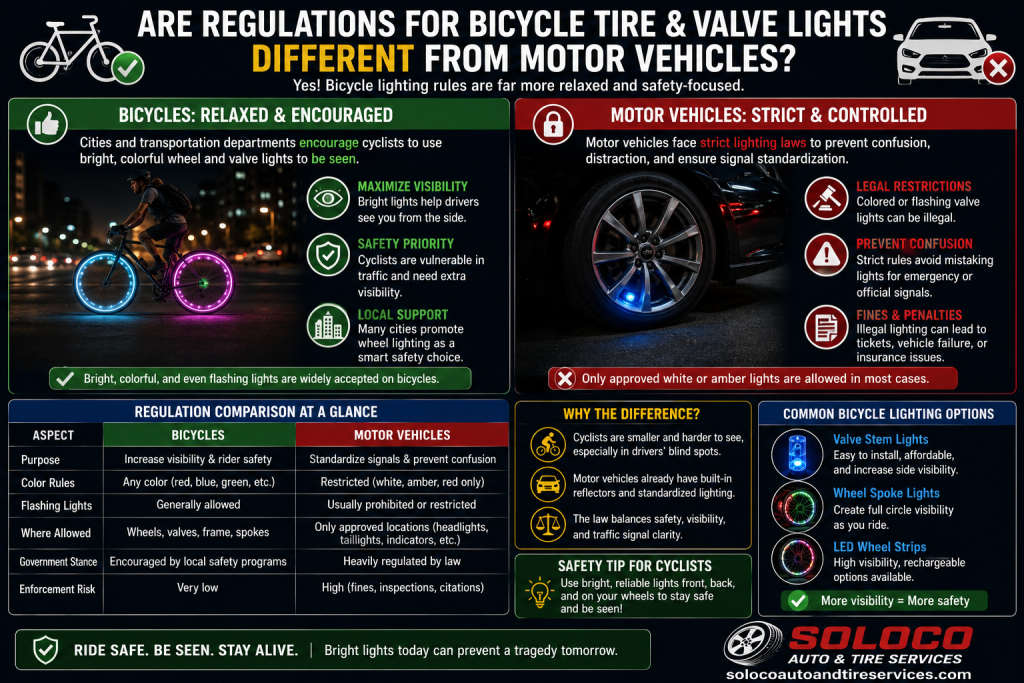
Municipalities enforce significantly more relaxed and supportive regulations for bicycle wheel lighting compared to motor vehicles. Local transportation safety departments actively encourage cyclists to utilize bright, colorful wheel and valve illumination to maximize lateral visibility for motorists at night. Cyclists face a heightened risk of blind-spot collisions, prompting city ordinances to prioritize night safety over strict color uniformity on human-powered cycles.
Do automated police license plate readers get confused by wheel luminescence?
Automated license plate readers and traffic enforcement cameras are specifically angled to scan registration plates mounted on the front and rear bumpers of vehicles. Low-intensity phosphorescent glow emanating from tire valve caps sits too low and too far out of the primary optical scanning zone to interfere with automated traffic cameras. Automated ticketing systems and police optical scanners remain entirely unaffected by passive wheel rim illumination.
Can professional mechanics refuse to balance tires equipped with aftermarket caps?
Automotive repair shops and tire service centers routinely remove and discard heavy aftermarket metal or electronic valve caps during routine maintenance to prevent liability issues. Mechanics know that seized metal caps destroy TPMS sensors, and they prefer to install standard plastic OEM caps to protect themselves from customer disputes over damaged hardware. Service technicians will not hesitate to swap out non-standard accessories if they complicate routine tire rotations or pressure checks.
Does using non-compliant active wheel lights affect auto insurance claims after a night collision?
Operating a vehicle with illegal, highly distracting active LED wheel lights can complicate insurance liability determinations if a nighttime accident occurs. If an opposing driver or investigating officer notes that unauthorized auxiliary lights contributed to road distraction or visual confusion, the insurance provider may assign partial fault to the vehicle owner. Maintaining strict compliance with state vehicle lighting laws protects motorists from denied claims or disputed liability percentages.
The Bottom Line
Passive, glow-in-the-dark tire valve caps remain entirely legal for public road use as long as they function as non-powered phosphorescent dust covers without emitting harsh light or restricted emergency colors. Motorists should avoid heavy metal variants and active LED illuminators to prevent TPMS corrosion, wheel balancing issues, and costly traffic citations. Stick to lightweight, passive plastic caps to enjoy unique styling without breaking the law.


