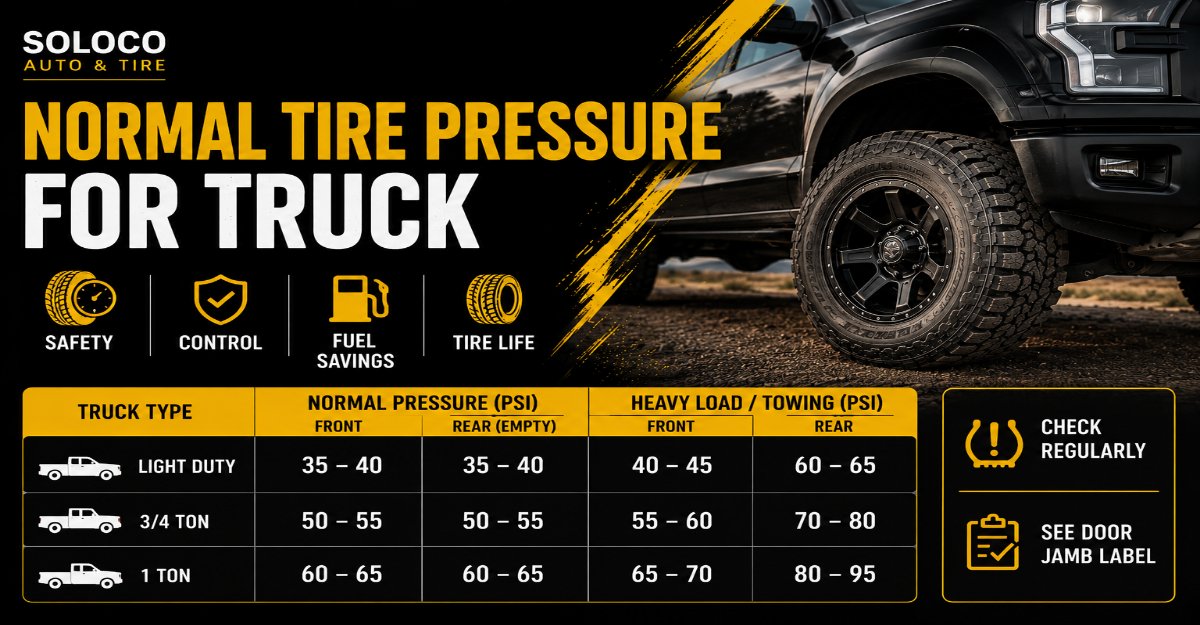
Normal truck tire pressure typically ranges from 30 to 35 PSI for light-duty pickup trucks, 50 to 80 PSI for heavy-duty payload haulers, and 100 to 120 PSI for commercial semi-trucks. Compressed air inside the pneumatic cavity acts as the primary load-bearing structure supporting the vehicle mass, rather than the structural rubber plies alone. Maintaining correct inflation optimizes the tire footprint, reduces destructive thermal buildup within the sidewalls, and maximizes fuel economy across diverse operating weights.
Key Facts at a Glance
- Light-Duty Baseline: Standard half-ton pickups require 30 to 35 PSI for empty daily commuting.
- Heavy-Duty Scaling: Three-quarter and one-ton trucks require up to 80 PSI in the rear when towing heavy loads.
- Commercial Standard: Class 7 and 8 semi-trucks operate between 100 and 120 PSI depending on axle loads.
- Thermal Rule: Tire pressure naturally shifts by approximately 1 PSI for every 10 degrees Fahrenheit of ambient temperature change.
- Measurement Window: Always measure tire pressure when tires are cold, meaning the vehicle has been stationary for at least three hours.
Why Compressed Air is the True Load-Bearing Structure
Compressed air inside a pneumatic tire functions as the actual load-bearing element of a truck. The rubber carcass, steel belts, and polyester cords simply contain the pressurized gas and maintain structural integrity. When a truck is loaded with cargo or towing a heavy trailer, the compressed air absorbs the vertical load forces, distributing the weight evenly across the contact patch where the tread meets the road surface.
Without adequate air pressure, the structural load shifts entirely to the flexible sidewalls. This causes excessive cyclic flexing during rotation, generating extreme internal heat that breaks down the molecular bonds between the rubber and internal steel belts. Conversely, excessive air pressure reduces the contact patch to a narrow strip along the center of the tread, diminishing braking traction and accelerating centerline wear.
How to Determine Your Truck’s Exact Target PSI
Finding the correct tire pressure requires ignoring the maximum PSI stamped on the tire sidewall and referencing the vehicle manufacturer placard located on the driver’s side door jamb. The sidewall rating indicates the maximum pressure the tire can safely hold under its absolute maximum load capacity, not the ideal operating pressure for a specific vehicle weight.
Vehicle manufacturers calculate the placard PSI based on the gross vehicle weight rating, weight distribution across the front and rear axles, and suspension geometry. For light-duty trucks driven empty, the door placard usually specifies 35 PSI. However, heavy-duty trucks often feature dual rear wheels and require significantly higher rear PSI values to support heavy tongue weights or fifth-wheel payloads.
Truck Tire Pressure Specifications by Vehicle Class
Different truck categories demand vastly different internal pressures to maintain safe handling dynamics and prevent premature tread degradation.
| Truck Classification | Representative Models | Recommended Cold PSI Range | Maximum Load PSI Rating |
|---|---|---|---|
| Light-Duty Half-Ton | Ford F-150, Toyota Tacoma, RAM 1500 | 30 to 35 PSI | 44 PSI |
| Heavy-Duty Three-Quarter & One-Ton | RAM 2500, Ford F-350, Chevrolet Silverado 3500 | 50 to 80 PSI | 80 PSI (Load Range E) |
| Commercial & Semi-Trucks | Freightliner Cascadia, Kenworth W900 | 100 to 120 PSI | 120 PSI |
Step-by-Step Truck Tire Inflation Protocol
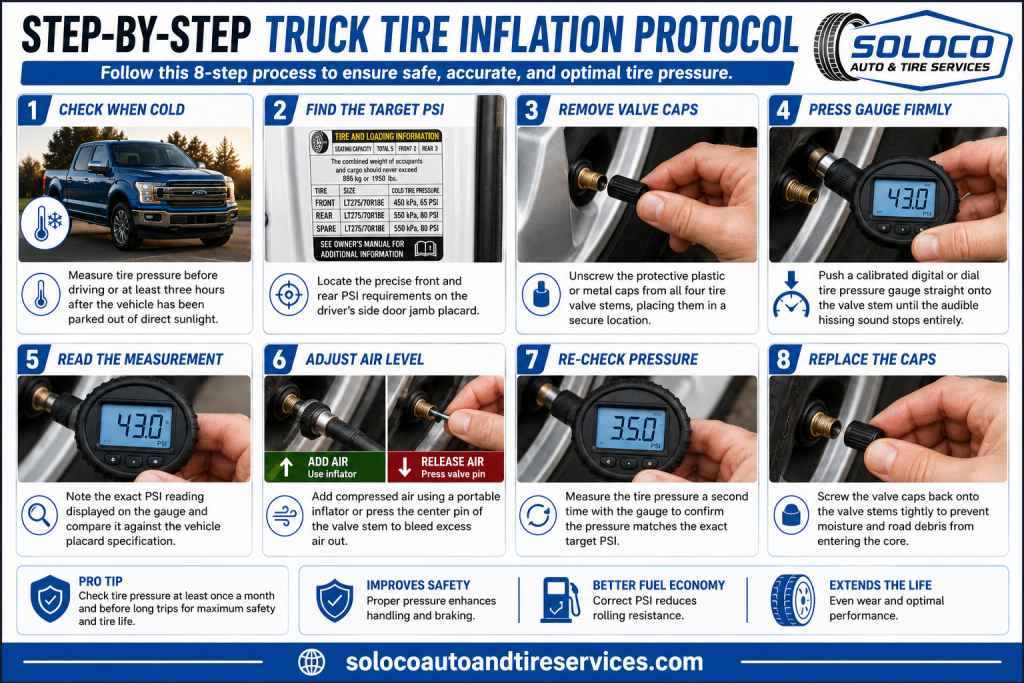
Checking and adjusting truck tire pressure requires precision to ensure safe operating conditions. Follow this eight-step protocol to measure and correct your tire pressure accurately:
- Check when cold: Measure tire pressure before driving or at least three hours after the vehicle has been parked out of direct sunlight.
- Find the target PSI: Locate the precise front and rear PSI requirements on the driver’s side door jamb placard.
- Remove valve caps: Unscrew the protective plastic or metal caps from all four tire valve stems, placing them in a secure location.
- Press gauge firmly: Push a calibrated digital or dial tire pressure gauge straight onto the valve stem until the audible hissing sound stops entirely.
- Read the measurement: Note the exact PSI reading displayed on the gauge and compare it against the vehicle placard specification.
- Adjust air level: Add compressed air using a portable inflator or press the center pin of the valve stem to bleed excess air out.
- Re-check pressure: Measure the tire pressure a second time with the gauge to confirm the pressure matches the exact target PSI.
- Replace the caps: Screw the valve caps back onto the valve stems tightly to prevent moisture and road debris from entering the core.
Nitrogen Inflation Versus Standard Compressed Air
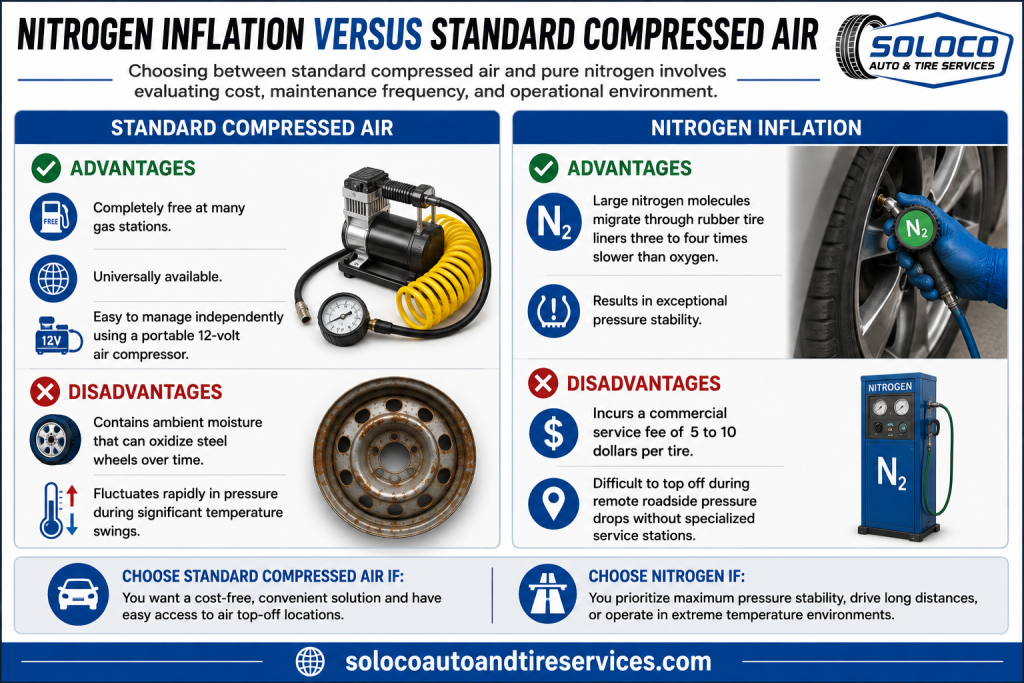
Choosing between standard compressed air and pure nitrogen involves evaluating cost, maintenance frequency, and operational environment.
Standard Compressed Air
- Advantages: Completely free at many gas stations, universally available, and easy to manage independently using a portable 12-volt air compressor.
- Disadvantages: Contains ambient moisture that can oxidize steel wheels over time; fluctuates rapidly in pressure during significant temperature swings.
Nitrogen Inflation
- Advantages: Large nitrogen molecules migrate through rubber tire liners three to four times slower than oxygen, resulting in exceptional pressure stability.
- Disadvantages: Incurs a commercial service fee of 5 to 10 dollars per tire; difficult to top off during remote roadside pressure drops without specialized service stations.
Critical Mistakes to Avoid When Managing Truck Tires
Avoiding common operational errors preserves tire lifespan and prevents hazardous driving conditions on the highway.
- Inflating to the sidewall maximum: Never inflate your truck tires to the pressure printed on the sidewall. That figure represents the structural safety limit for maximum rated payload, leading to a harsh ride and center tread destruction during daily unladen driving.
- Adjusting pressure on hot tires: Driving generates internal friction heat that raises tire pressure by 4 to 6 PSI. Bleeding air out of hot tires guarantees that the tires will be dangerously under-inflated once cooled down.
- Neglecting the spare tire: Spare tires lose approximately 1 to 2 PSI per month through natural gas permeation. Checking your truck spare during routine maintenance prevents finding a flat tire during an emergency roadside change.
- Relying solely on dashboard TPMS warnings: Factory Tire Pressure Monitoring Systems often fail to illuminate until a tire has lost 25 percent of its recommended pressure, a point where internal structural damage may have already occurred.
Troubleshooting Abnormal Tire Wear Patterns
Inspecting your truck tread patterns reveals underlying inflation and mechanical alignment issues that require immediate correction.
- Center tread degradation: Excessive wear along the middle ribs indicates chronic over-inflation, which reduces the contact patch and concentrates vehicle weight onto a narrow strip of rubber.
- Outer shoulder wear: Rapid wear on both outer edges indicates chronic under-inflation, causing the tire center to collapse inward and drag the shoulders across the pavement during cornering.
- Cupping and scalloping: Patchy, choppy dips around the tread circumference point toward worn shock absorbers, failing ball joints, or severely unbalanced wheel assemblies.
- Morning low pressure warnings: Seasonal temperature drops cause compressed air to contract, triggering early morning TPMS lights that frequently disappear after driving for ten minutes as friction warms the air.
Frequently Asked Questions
How often should I check my truck tire pressure?
Check your truck tire pressure every 30 days and whenever ambient outdoor temperatures shift by more than 10 degrees Fahrenheit. Seasonal temperature transitions cause significant volumetric changes in compressed air, requiring proactive manual adjustments to maintain optimal PSI levels.
Should I change my truck tire pressure when towing heavy loads?
Yes. When attaching a heavy trailer or loading the truck bed with cargo, increase the rear tire pressure up to the maximum limit specified on the door placard. Once you disconnect the trailer, lower the rear pressure back to standard unladen levels to prevent rapid center tread wear and harsh ride quality.
What is the correct tire pressure for off-roading in a truck?
Off-roading over soft sand, deep mud, or sharp rocks requires airing down truck tires to 15 to 20 PSI to expand the contact footprint and improve flotation. Re-inflate your tires back to highway placard specifications immediately upon returning to paved roads to prevent bead separation and catastrophic sidewall failure.
Why does my truck tire lose pressure even without a puncture?
Natural air permeation through the rubber inner liner causes tires to lose roughly 1 to 2 PSI every month. Additionally, corrosion along the aluminum wheel bead seat or a leaking valve stem core can create slow air leaks that require professional cleaning and resealing.
Can I drive on a tire with low pressure if I keep my speed down?
Driving on a significantly under-inflated truck tire generates excessive internal heat through sidewall flexing, which can destroy the tire carcass within miles. Always inflate the tire to the recommended PSI using a portable compressor or change to the spare before operating the vehicle at speed.