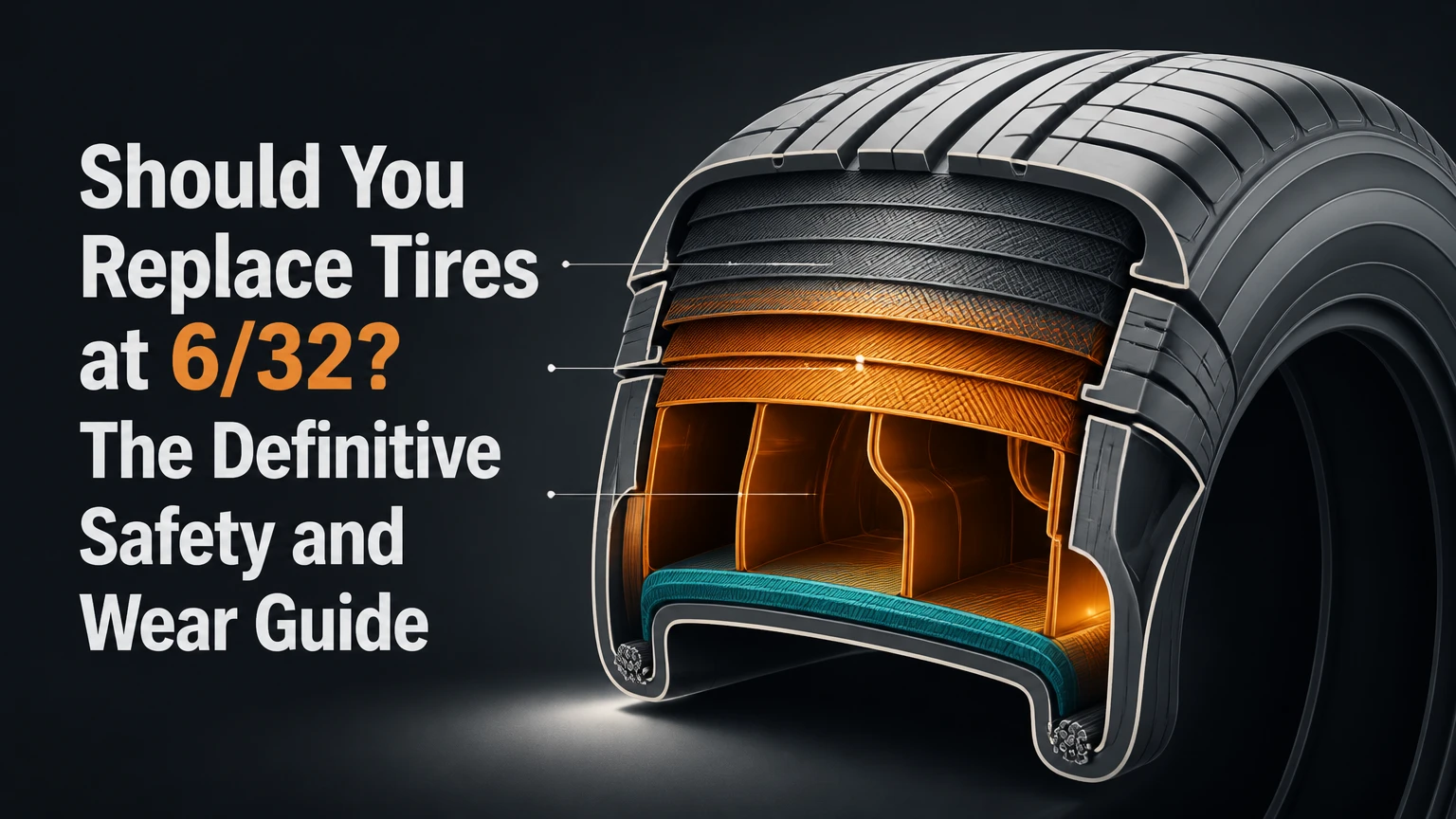
No, you generally do not need to replace your tires at 6/32 of an inch because they retain approximately 50 to 60 percent of their original usable tread and continue to deliver safe performance under standard driving conditions. Brand new passenger car tires typically start at 10/32 or 11/32 of an inch, meaning a 6/32 reading puts your tires right at their midpoint. While wet braking distances begin to increase slightly compared to brand-new rubber, the tire retains more than enough functional depth to pass legal safety inspections everywhere in North America and Europe, where the mandatory replacement threshold is 2/32 of an inch.
Key Facts at a Glance
- Tread Range: New tires start at 10/32 to 12/32 inches; legal replacement limit is 2/32 inches.
- Wear Status: A 6/32 measurement indicates roughly 40% to 50% wear, or the exact halfway point of a standard tire’s lifespan.
- Safety Verdict: Completely safe for dry driving, spring, summer, and autumn; requires monitoring only if entering severe winter conditions.
- Remaining Mileage: Typically provides another 12,000 to 20,000 miles of safe driving depending on vehicle weight, driving style, and maintenance.
What Does a 6/32 Inch Tread Depth Actually Mean?
A 6/32 inch tread depth represents the exact midpoint of a standard passenger tire’s operational lifespan. Tread depth is measured from the top of the rubber block to the bottom of the deepest circumferential drainage grooves using specialized fractional or digital depth gauges.
When your tires measure 6/32, they have worn down by 4/32 to 5/32 of an inch from their factory original state. Structurally, the tire still possesses ample void volume to channel water away from the contact patch, preventing premature hydroplaning during moderate rainstorms.
The structural integrity of the steel belts, polyester casing, and sidewalls remains entirely intact at this stage. You are not facing structural degradation, but you are officially entering the second half of the tire’s wear cycle. Routine monthly pressure checks and bi-annual tire rotations become critical maintenance habits to ensure the remaining rubber wears evenly across the contact patch.
How Does 6/32 Inch Tread Affect Wet and Dry Braking Performance?
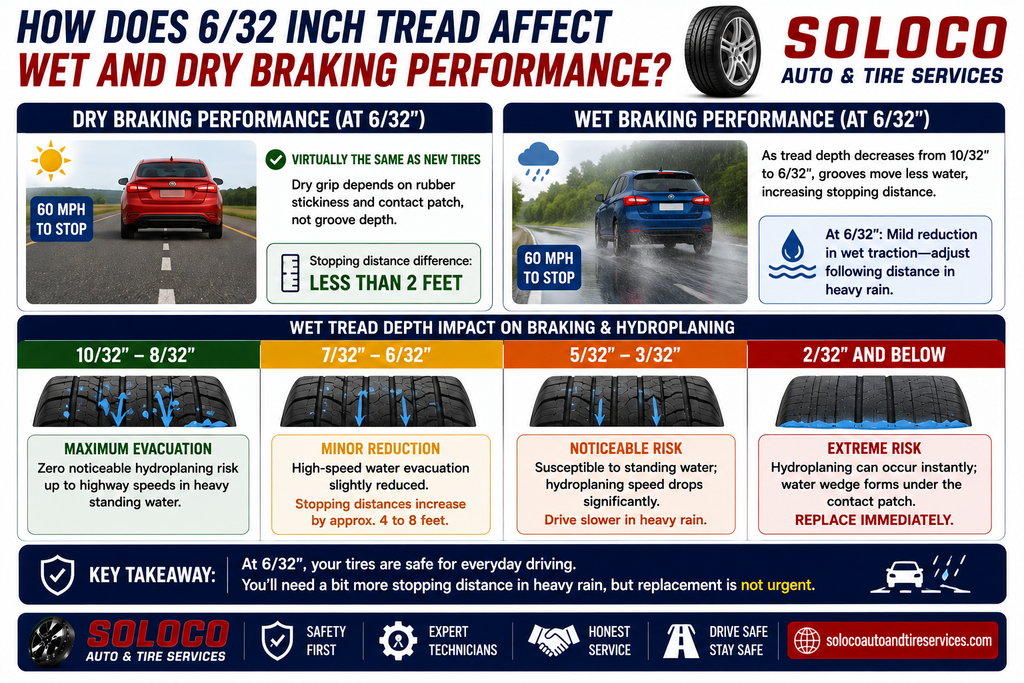
Dry braking performance at 6/32 of an inch is virtually indistinguishable from brand-new tires because dry grip relies primarily on rubber compound stickiness and contact patch area rather than void depth. On dry asphalt at 60 miles per hour, stopping distances will differ by less than two feet compared to new rubber.
Wet braking performance, however, undergoes measurable changes. As tread depth decreases from 10/32 to 6/32, the volume of water the grooves can evacuate drops proportionally.
- 10/32 to 8/32 Inches: Maximum water evacuation capacity; zero noticeable hydroplaning risk up to highway speeds in heavy standing water.
- 7/32 to 6/32 Inches: Minor reduction in high-speed water evacuation; stopping distances on wet pavement increase by approximately 4 to 8 feet from 60 miles per hour.
- 5/32 to 3/32 Inches: Noticeable susceptibility to standing water; hydroplaning velocity thresholds drop significantly, requiring slower speeds in heavy rain.
- 2/32 Inches and Below: Extreme hydroplaning risk; water wedge forms instantly beneath the contact patch.
At 6/32, you experience a mild, acceptable reduction in wet traction that requires slight adjustments in following distance during heavy downpours, but it does not mandate immediate replacement for normal daily commuting.
How Much Mileage and Lifespan Remain at 6/32?
Tires typically wear down at a rate of roughly 1/32 of an inch every 3,000 to 5,000 miles, heavily influenced by wheel alignment, tire pressure consistency, vehicle drivetrain configuration, and driving aggressiveness.
Given that standard passenger tires reach their legal discard depth at 2/32 of an inch, a tire measuring 6/32 has 4/32 of usable tread remaining before it hits the wear bars. At standard wear rates, this translates to 12,000 to 20,000 miles of remaining service life.
For an average driver covering 12,000 miles per year, a 6/32 reading means your tires will last another 12 to 18 months before hitting the mandatory safety floor. This remaining runway represents substantial financial value, meaning premature replacement would discard hundreds of dollars of usable rubber.
Does Tire Type Change the 6/32 Replacement Rule?
The decision to keep or replace a tire at 6/32 depends heavily on the specific tire category installed on your vehicle, as seasonal engineering dictates how performance degrades over time.
| Tire Category | Performance at 6/32 | Replacement Recommendation |
| All-Season Touring | Excellent longevity; minor wet traction loss; optimal dry grip. | Keep driving; monitor wear every 6 months. |
| Summer / Performance | Sticky rubber compound still functional; track-level wet grip decreases. | Keep driving for street use; replace if dedicated track days are planned. |
| Winter / Snow | Sipes lose depth; specialized soft compound transitions to harder base rubber. | Consider replacing if entering severe unplowed winter conditions. |
Winter tires are a critical exception to the standard rule. Dedicated snow tires rely on micro-sipes and deep tread blocks (often starting at 12/32 or 14/32) to interlock with snow pack. Many winter tire manufacturers embed secondary tread wear indicators at 6/32 or 5/32. Once a winter tire wears down to 6/32, its ability to claw through deep snow diminishes drastically. If you live in a region with severe winter storms, replacing winter tires at 6/32 is frequently recommended to maintain snow traction.
How Do You Accurately Measure Tread Depth at Home?
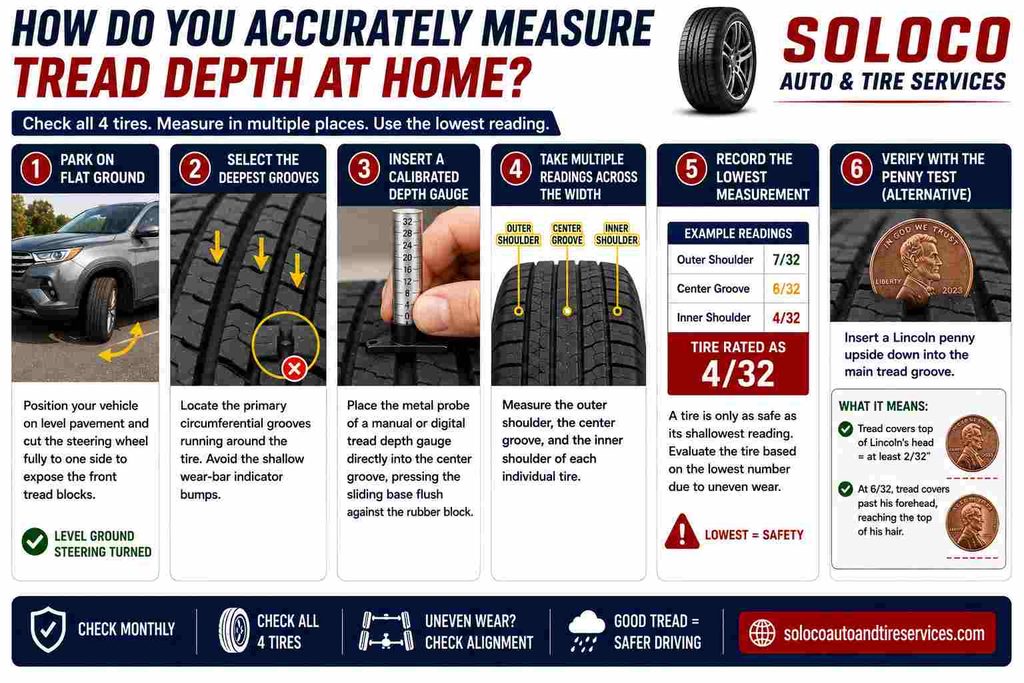
Ensuring your tires are genuinely at 6/32 across the entire width requires proper measurement technique because tires rarely wear evenly. Follow this diagnostic inspection process:
- Park on Flat Ground: Position your vehicle on level pavement and cut the steering wheel fully to one side to expose the tread blocks on the front tires.
- Select the Deepest Grooves: Locate the primary circumferential grooves running around the circumference of the tire, avoiding the shallow wear-bar indicator bumps.
- Insert a Calibrated Depth Gauge: Place the metal probe of a manual or digital tread depth gauge directly into the center groove, pressing the sliding base flush against the rubber block.
- Take Multiple Readings Across the Width: Measure the outer shoulder, the center groove, and the inner shoulder of each individual tire.
- Record the Lowest Measurement: A tire is only as safe as its shallowest reading. If your outer shoulder measures 7/32, the center measures 6/32, and the inner edge measures 4/32, the tire must be evaluated as a 4/32 tire due to alignment wear.
- Verify with the Penny Test (Alternative): Insert a Lincoln penny upside down into the main tread groove. If the tread covers the top of Lincoln’s head, you have at least 2/32. At 6/32, the tread will cover past his forehead, roughly reaching the top of his hair.
What Are the Hidden Dangers of Uneven Wear at 6/32?
An average reading of 6/32 can mask severe underlying mechanical issues if the wear distribution across the tire face is unbalanced. Uneven wear patterns instantly alter your vehicle’s safety profile long before the overall tread depth reaches a critical level.
[Outer Shoulder] ---> 7/32 (Normal)
[Center Groove]  ---> 6/32 (Normal)
[Inner Shoulder] ---> 3/32 (Critical Alignment Wear)
When an inner or outer shoulder drops to 3/32 while the center remains at 6/32, your vehicle suffers from improper wheel alignment, incorrect tire inflation pressure, or worn suspension components such as ball joints, control arm bushings, or strut mounts.
- Toe-Out or Toe-In Misalignment: Causes rapid feathering and shoulder scrubbing, reducing cornering stability.
- Excessive Positive or Negative Camber: Concentrates vehicle weight onto a single edge of the contact patch, accelerating localized tread loss.
- Chronic Under-Inflation: Causes both outer shoulders to wear prematurely while the center groove remains deep, creating excessive heat and structural sidewall stress.
If your tires show uneven wear at 6/32, you must immediately correct the vehicle alignment and perform a suspension inspection, even if you choose not to replace the tires themselves.
Frequently Asked Questions
Can I mix tires at 6/32 with brand-new tires on an all-wheel-drive vehicle?
Most modern all-wheel-drive (AWD) and four-wheel-drive systems require rolling circumferences to match closely across all four corners to prevent permanent damage to the transfer case or differential clutches. Mixing brand-new tires (10/32) with partially worn tires at 6/32 creates a significant variance in rotational speed per mile. Consult your vehicle owner’s manual; many manufacturers mandate that tire tread depths must remain within 2/32 to 4/32 of each other on AWD platforms.
Should I rotate my tires if they are currently at 6/32?
Yes, rotating your tires every 5,000 to 7,500 miles is the single most effective way to maximize the remaining lifespan of tires at 6/32. Front tires experience higher lateral cornering loads and braking friction, wearing down faster than rear tires on front-wheel-drive platforms. Rotating them ensures that all four tires reach the eventual replacement threshold simultaneously.
Will insurance deny a claim if I drive on 6/32 tread depth?
No, insurance companies will not deny coverage or claims for driving on tires measuring 6/32 of an inch. A 6/32 tread depth is fully legal in every jurisdiction worldwide, as legal minimum limits are universally set at 2/32 (or 1.6 millimeters) in the United States and Europe.
Why do some auto repair shops recommend replacing tires at 6/32?
Some commercial service centers recommend tire replacement at 6/32 or 5/32 to hit aggressive sales quotas or adhere to conservative corporate liability guidelines. While replacing tires early maximizes wet-weather safety margins, it is rarely a strict mechanical necessity. Always verify technician claims by reading a physical depth gauge yourself before authorizing replacement work.
How do I know if steering wheel vibration at 6/32 is caused by tread wear?
Steering wheel vibration at highway speeds when your tires are at 6/32 is rarely caused by the tread depth itself. Uniform tread wear does not produce harmonic vibration. Instead, steering shake at this stage typically stems from lost wheel weights causing dynamic imbalance, a bent wheel rim from a pothole, or a separated internal belt inside the tire carcass. Have a technician perform a high-speed road-force balance test to isolate the root cause.


