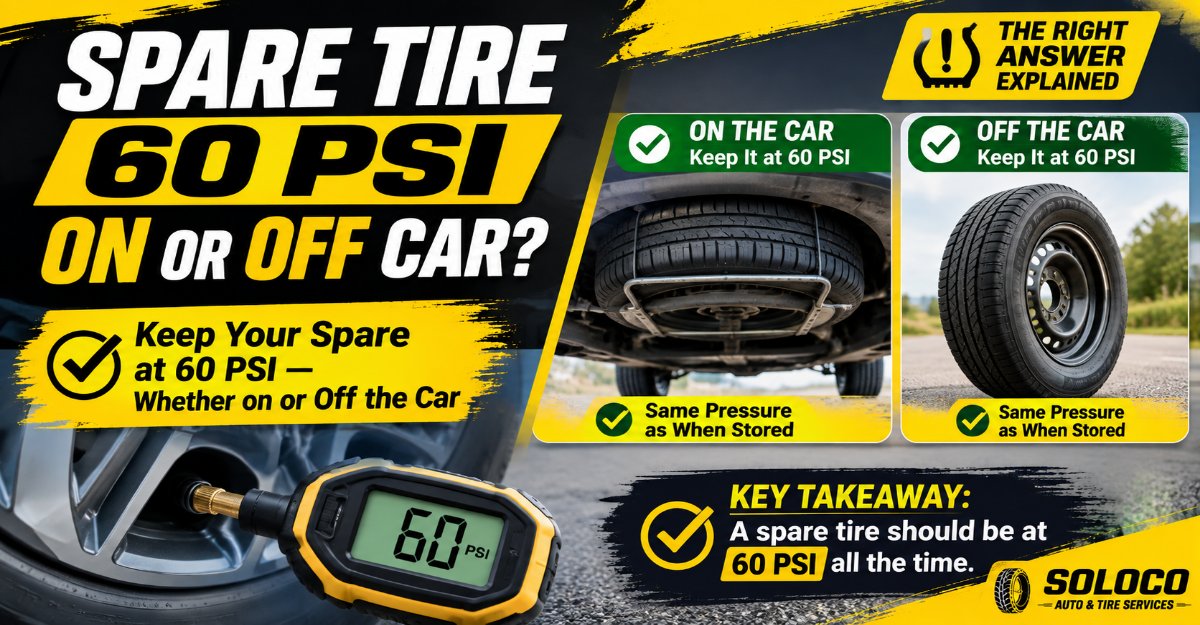
A 60 PSI spare tire must always be inflated to 60 PSI while off the car during routine maintenance and checked or maintained at 60 PSI when installed on the car for temporary emergency driving. Because compact space-saver spares possess a significantly reduced internal air volume compared to standard passenger tires, they require high internal pressure to support vehicular load safely.
Key Facts At a Glance
- Target Pressure: Exactly 60 PSI (pounds per square inch) cold.
- Natural Leakage Rate: 1 to 2 PSI loss per month due to rubber permeability.
- Speed Limit: Maximum 50 miles per hour (80 kilometers per hour).
- Distance Limit: Maximum 50 miles (80 kilometers) before replacement or repair.
- Lifespan Limit: 6 to 10 years maximum from the Department of Transportation manufacturing date code.
Why Does a Space Saver Spare Require 60 PSI?
A 60 PSI compact spare tire requires high pressure because its physical volume is roughly half that of a standard vehicle tire. To support the static load of a passenger vehicle without bottoming out the wheel rim against the asphalt, the internal gas pressure must be doubled compared to standard tires running at 32 to 35 PSI.
When a tire has a smaller cross-sectional area and a narrower tread width, the footprint touching the ground is drastically reduced. High inflation pressure stiffens the sidewall structure, transforming the tire into a rigid high-pressure cylinder capable of temporarily bearing vehicle weight despite its small size.
Should You Check and Inflate Your Spare Tire On or Off the Car?
You should always check and inflate your 60 PSI spare tire while it is off the car during scheduled maintenance, though you must verify the pressure immediately after mounting it in an emergency.
Checking and Inflating Off the Car
When the spare tire is stored in its trunk well or mounted underneath the chassis, it is in an unloaded state. This is the optimal time to check pressure because no vehicle weight is compressing the carcass.
- Access the spare tire well by removing trunk liners and unscrewing the central retention bolt.
- Remove the plastic valve stem cap.
- Attach a calibrated digital or analog pressure gauge to the valve stem.
- Connect a portable 12V air compressor or garage air hose if the reading is below 60 PSI.
- Inflate the tire precisely to 60 PSI. If you check your spare infrequently, technicians recommend overinflating slightly to 62 or 63 PSI to account for natural air permeation over the next ninety days.
Verifying Pressure When Installed On the Car
If you experience a flat on the highway and mount the spare, you must check the pressure once the vehicle is lowered onto the ground if you suspect the tire was neglected. However, removing a wheel to check pressure while it is bolted to the vehicle is unnecessary and unsafe. The rule separating on versus off the car refers strictly to routine maintenance intervals, where checking the spare in your garage while it sits unmounted in the trunk is standard protocol.
Step-by-Step Protocol for Maintaining Your 60 PSI Spare Tire
Maintaining a high-pressure temporary spare prevents dangerous surprises during roadside emergencies. Follow this quarterly protocol to ensure readiness.
Before You Start
- Time Required: 10 minutes.
- Difficulty: Beginner.
- Cost: Zero (assuming existing gauge and pump).
- Tools Required: Calibrated tire pressure gauge, portable 12V inflator or floor pump, rubber cleaner.
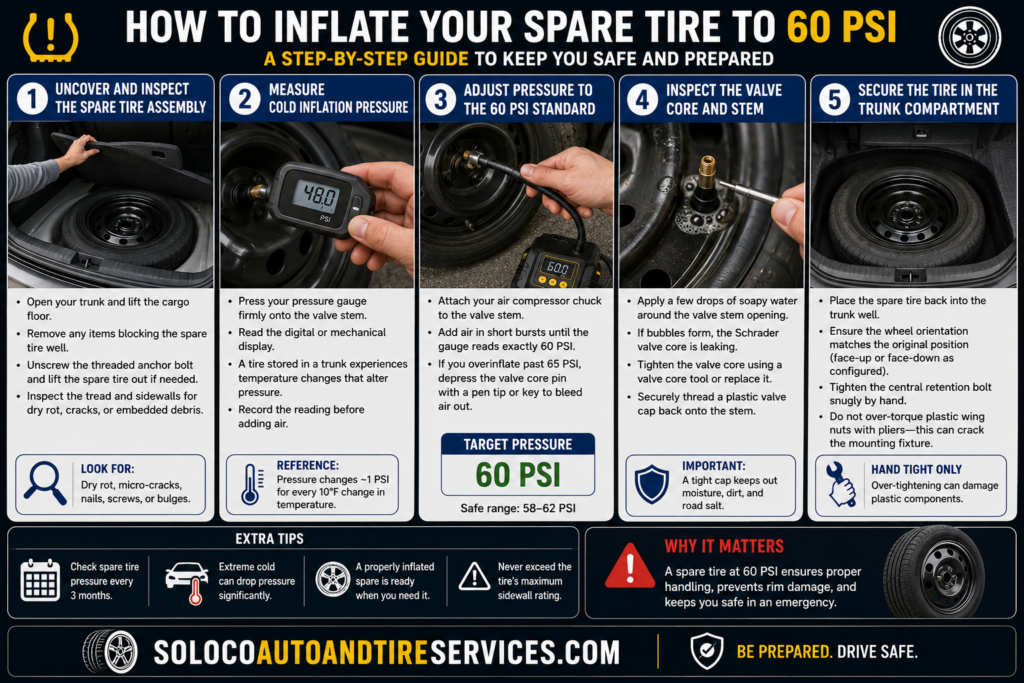
Step 1: Uncover and Inspect the Spare Tire Assembly
Open your trunk, lift the cargo floor, and remove any stored items obstructing the spare tire well. Unscrew the threaded anchor bolt and lift the spare tire out of the vehicle if visibility or access to the valve stem is restricted. Inspect the tread grooves and sidewalls for dry rot, micro-cracks, or embedded road debris.
Step 2: Measure Cold Inflation Pressure
Press your pressure gauge firmly onto the valve stem. Read the digital or mechanical display. A tire stored in a trunk experiences ambient temperature fluctuations that alter pressure by approximately 1 PSI for every 10 degrees Fahrenheit change in temperature. Always record the reading before adding air.
Step 3: Adjust Pressure to the 60 PSI Standard
Attach your air compressor chuck to the valve stem. Add compressed air in short bursts until the gauge reads exactly 60 PSI. If you accidentally overinflate past 65 PSI, depress the center valve core pin momentarily with a pen tip or key to bleed air out until the gauge stabilizes at 60 PSI.
Step 4: Inspect the Valve Core and Stem
Apply a few drops of soapy water around the valve stem opening. If bubbles form, the Schrader valve core is leaking and must be tightened using a valve core tool or replaced entirely. Securely thread a plastic valve cap back onto the stem to prevent moisture and road salt ingress.
Step 5: Secure the Tire in the Trunk Compartment
Place the spare tire back into the trunk well, ensuring the outer face of the wheel matches its original orientation (either face-up or face-down depending on factory configuration). Tighten the central retention bolt snugly by hand. Do not over-torque plastic wing nuts with pliers, as this cracks the mounting fixture.
Critical Safety Limitations of a 60 PSI Donut Spare
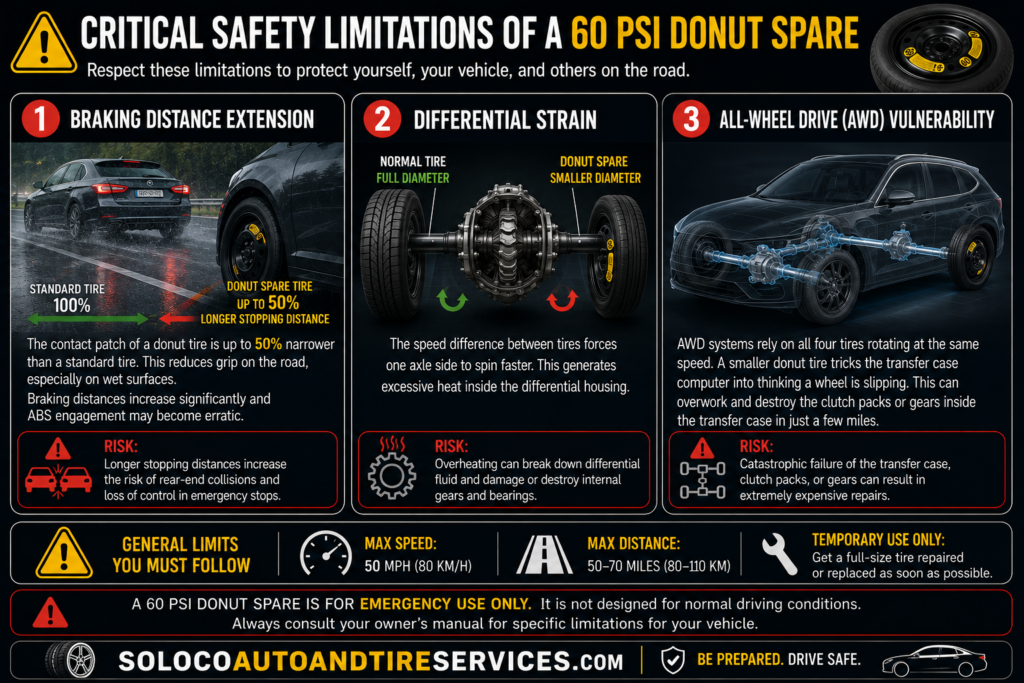
Driving on a 60 PSI compact spare introduces severe dynamic compromises that every driver must respect to avoid accidents or mechanical damage.
- Braking Distance Extension: Because the contact patch of a donut tire is up to 50 percent narrower than a standard tire, braking distances on wet or dry asphalt increase significantly. ABS engagement may become erratic.
- Differential Strain: On vehicles equipped with an open or limited-slip differential, running a significantly smaller diameter tire forces one axle side to spin much faster than the other. This generates excessive heat inside the differential housing.
- All-Wheel Drive (AWD) Vulnerability: AWD systems transfer torque continuously between front and rear axles. A mismatch in tire rolling circumference tricks the transfer case computer into thinking a wheel is slipping, which can fry clutch packs or shear gear teeth within miles.
Frequently Asked Questions
Why does my TPMS light stay on after installing a 60 PSI spare?
Most compact spare tires do not contain a Tire Pressure Monitoring System (TPMS) radio frequency sensor. Once the vehicle computer fails to detect a signal from the missing wheel, or notices a radical discrepancy in wheel speed rotation from the ABS sensors, it illuminates the dashboard warning light. This light will extinguish automatically once you repair and remount your standard full-size wheel.
Can I drive on a 60 PSI spare on the highway?
You must avoid sustained highway driving on a 60 PSI donut spare. The absolute maximum speed rating for standard space-saver spares is 50 miles per hour (80 kilometers per hour). Exceeding this speed generates high centrifugal forces and internal heat that can lead to sudden structural tread separation or catastrophic blowout.
How often should I check my spare tire pressure?
You should check your spare tire pressure every three months, or concurrently with every seasonal oil change and tire rotation. Because rubber compounds are semi-permeable, high-pressure tires lose air faster than standard tires, dropping 1 to 2 PSI every single month even without a puncture.
What should AWD owners do if they get a flat tire?
If your vehicle utilizes an All-Wheel Drive or Four-Wheel Drive system and you suffer a flat on the front steering axle, do not mount the 60 PSI spare directly to the front. Instead, remove a healthy full-size rear tire, move that full-size tire to the front flat position, and mount the 60 PSI spare onto the rear axle. This protects your front differential and steering geometry from destructive internal binding.
How long does a spare tire last if it is never used?
A spare tire has a maximum chronological lifespan of 6 to 10 years, even if it has never touched the road. Ultraviolet light exposure, extreme trunk temperature swings, and chemical oxidation cause the rubber compounds to harden and develop microscopic ozone cracks, rendering the tire unsafe for emergency loads regardless of tread depth.