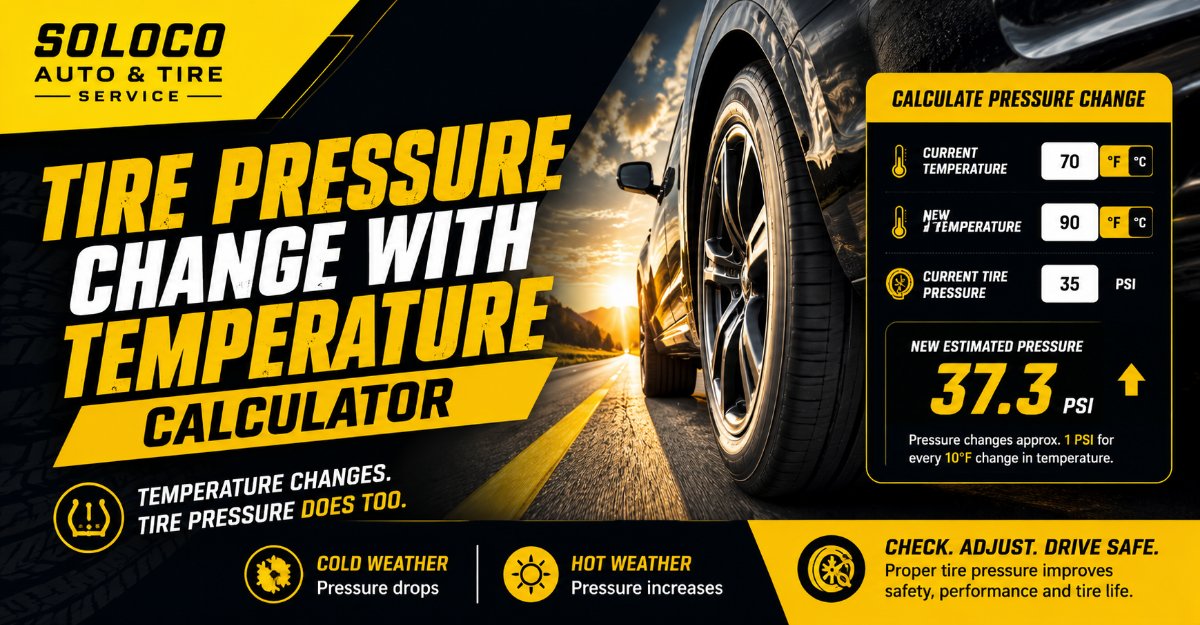
A tire pressure change with temperature calculator uses Gay-Lussac’s Law to determine exactly how ambient heat or cold alters tire inflation. For a constant volume, the pressure of a gas is directly proportional to its absolute temperature. Drivers must calculate these shifts to maintain the exact cold PSI listed on their vehicle door placard across changing seasons.
Key Facts / At a Glance
- Tire pressure changes by 1 PSI for every 10 degrees Fahrenheit of temperature shift.
- The Tire Pressure Monitoring System (TPMS) warning triggers when pressure drops 25 percent below the manufacturer recommended baseline.
- Manual calculations require converting standard gauge pressure to absolute pressure by adding atmospheric pressure (14.7 PSI).
- Fahrenheit temperatures must be converted to Kelvin to satisfy the Ideal Gas Law formula.
- Normal driving increases tire pressure by 4 to 6 PSI due to internal friction and road surface heat.
How Does Temperature Affect Tire Pressure?
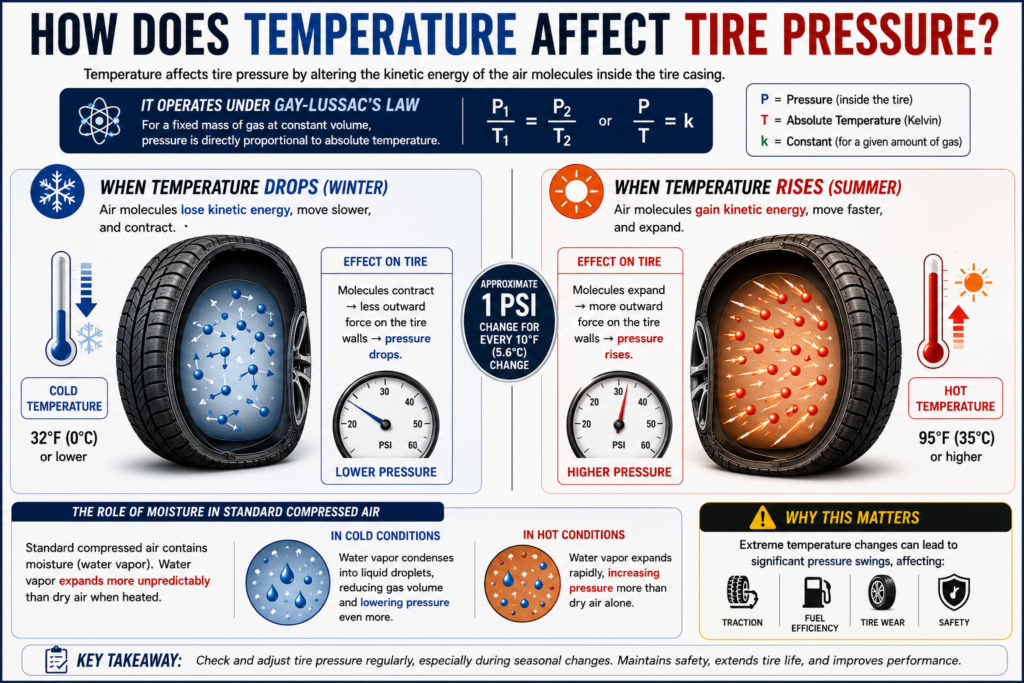
Temperature affects tire pressure by altering the kinetic energy of the air molecules inside the tire casing. This physical relationship operates strictly under Gay-Lussac’s Law, a core principle of ideal gas behavior. The law dictates that the pressure of a fixed mass of gas is directly proportional to its absolute temperature, assuming the tire’s internal volume remains perfectly constant.
When winter temperatures drop, the air molecules inside the tire lose kinetic energy and contract. This contraction results in less outward force against the inner tire wall, causing the tire pressure to drop. Conversely, when summer temperatures rise, the air molecules absorb thermal energy and expand rapidly.
This increased kinetic energy pushes harder against the rubber casing, causing the tire pressure to rise. Standard compressed air also contains moisture, and this water vapor expands more unpredictably than dry air when heated, further compounding pressure spikes during extreme heat.
Before You Start: Prerequisites and Formulas
Calculating your precise tire pressure change requires basic algebra and an understanding of absolute values.
- Time Required: 5 minutes for calculation.
- Difficulty: Intermediate.
- Tools Needed: A scientific calculator, a digital tire pressure gauge, and your vehicle’s door jamb placard.
- Core Formula: P1/T1=P2/T2 (where P is absolute pressure and T is absolute temperature).
- Crucial Rule: The single factor that most determines the success of this calculation is converting your baseline numbers to absolute values. You cannot plug standard gauge PSI and Fahrenheit directly into the equation.
How Do You Calculate Tire Pressure Changes?
Follow this exact sequence to calculate the anticipated pressure change when seasons shift. Order is critical, as failing to convert temperatures to Kelvin first will render the entire calculation useless.
Step 1: Establish Your Initial Baseline Pressure and Temperature
You must capture your starting conditions accurately. Locate the recommended cold inflation pressure on your driver’s side B-pillar door sticker. Do not use the maximum pressure listed on the tire sidewall. Record the current ambient outdoor temperature.
- Example Action: Assume your vehicle requires a cold inflation pressure of 32 PSI, and the current outdoor temperature is 70 degrees Fahrenheit.
- Success Checkpoint: You will know you have the right starting pressure if you pull the number from the vehicle frame placard, not the rubber tire.
Step 2: Convert Your Measurements to Absolute Values
The Ideal Gas Law only works with absolute pressure and absolute temperature. You must convert both starting variables.
- Pressure Conversion: Add standard atmospheric pressure (14.7 PSI at sea level) to your gauge pressure.
- Formula: 32 PSI+14.7=46.7 Absolute PSI (P1).
- Temperature Conversion: Convert Fahrenheit to Kelvin using the standard scientific conversion formula.
- Formula: (70−32)×(5/9)+273.15=294.26 K (T1).
- Common Mistake: Forgetting to adjust for high elevation. If you live in Denver, Colorado, atmospheric pressure is roughly 12.1 PSI, not 14.7 PSI.
Step 3: Solve for the Final Absolute Pressure
Identify your target seasonal temperature and convert it to Kelvin. Then, rearrange the core formula to solve for the final absolute pressure (P2).
- Target Temperature: Assume the winter temperature drops to 20 degrees Fahrenheit.
- Formula: (20−32)×(5/9)+273.15=266.48 K (T2).
- Calculate Final Pressure: Rearrange Gay-Lussac’s Law to P2=P1×(T2/T1).
- Execution: P2=46.7×(266.48/294.26)
- Result: P2=42.29 Absolute PSI.
Step 4: Convert Back to Gauge Pressure
Your tire gauge does not read absolute pressure. You must subtract the atmospheric pressure to find the number your handheld gauge will actually display.
- Final Conversion: Subtract 14.7 PSI from your P2 result.
- Execution: 42.29−14.7=27.59 Gauge PSI.
- The Verdict: A temperature drop from 70 degrees to 20 degrees Fahrenheit caused a pressure drop of exactly 4.41 PSI. This mathematical proof perfectly validates the universal automotive 10-degree rule.
What Are the Core Rules of Thumb for Tire Pressure?
If you do not have time to run the full ideal gas law calculation, automotive engineers rely on several standard rules of thumb to predict tire behavior.
- The 10-Degree Rule: Tire pressure changes by 1 PSI for every 10 degrees Fahrenheit of temperature shift. In metric measurements, a 1 degree Celsius change equals roughly 1.4 kPa or 0.1 bar of pressure shift.
- Normal Daily Fluctuations: Tires warm up by 4 to 6 PSI during continuous driving. Internal friction from the rubber flexing against the asphalt generates significant heat.
- Direct Sunlight Impact: Parking a vehicle in direct, hot sunlight can artificially increase tire pressure readings by 2 to 3 PSI on the sun-facing side compared to the tires resting in the shade.
- TPMS Warning Threshold: The mandated Tire Pressure Monitoring System light triggers automatically when inflation drops 25 percent below the vehicle’s placard recommendation.
Should You Choose Standard Air or Pure Nitrogen?
Vehicle owners generally utilize two distinct fill mediums to manage temperature-induced fluctuations. Pure nitrogen mitigates many thermal expansion issues, but it introduces logistical drawbacks.
| Feature | Standard Compressed Air | Pure Nitrogen Fill (93%+) |
|---|---|---|
| Moisture Content | High. Water vapor accelerates thermal pressure swings. | Zero. Completely dry, which minimizes sudden thermal expansion. |
| Availability | Excellent. Available at almost every gas station worldwide. | Poor. Mostly restricted to specialized dealerships and tire shops. |
| Seepage Rate | Moderate. Oxygen molecules permeate rubber faster. | Slow. Nitrogen molecules are physically larger, reducing natural pressure loss. |
| Cost | Free or extremely low cost per use. | $5 to $10 per tire for initial fills and future top-offs. |
Which Should You Choose?
- For Daily Commuters: Choose standard compressed air. The minimal pressure stability gained by nitrogen does not justify the inconvenience of finding a specialized dealer when you have a slow leak.
- For Track Day Drivers: Choose pure nitrogen. The lack of water vapor provides highly predictable pressure scaling during extreme cornering and braking.
- For Fleet Operators: Choose pure nitrogen. Stabilizing tire pressures across hundreds of commercial long-haul trucks significantly reduces labor check times and improves overall fuel economy.
Common Mistakes and How to Fix Them
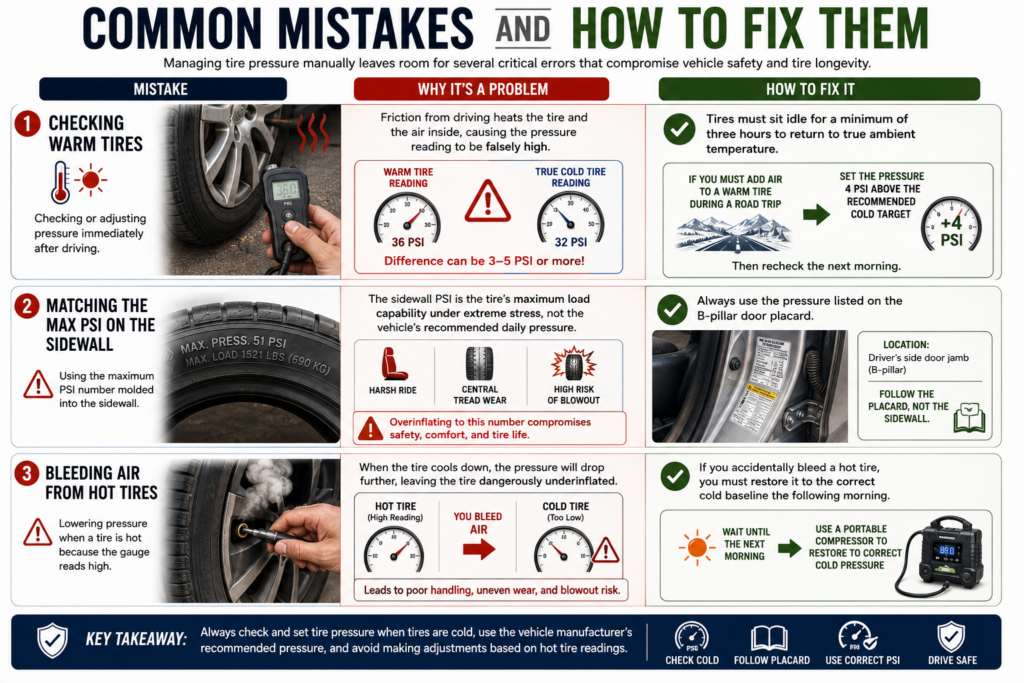
Managing tire pressure manually leaves room for several critical errors that compromise vehicle safety and tire longevity.
Checking Warm Tires Adjusting pressure immediately after driving yields completely inaccurate readings due to friction-induced heat. Tires must sit idle for a minimum of three hours to return to true ambient temperature. If you must add air to a warm tire during a road trip, set the pressure 4 PSI above the recommended cold target, then recheck the next morning.
Matching the Max PSI on the Sidewall The prominent PSI number molded into the rubber sidewall represents the tire’s maximum load capability under extreme stress. It is not the vehicle’s recommended daily operating pressure. Overinflating to this number causes a harsh ride, central tread wear, and a high risk of blowout. Always deflate back to the B-pillar door placard specification.
Bleeding Air from Hot Tires Lowering pressure when a tire is hot feels logical if the gauge reads high, but this is a dangerous mistake. Once the tire eventually cools down to ambient temperature, the pressure will drop drastically, leaving the vehicle dangerously underinflated. If you accidentally bleed a hot tire, you must use a portable compressor to restore it to the correct cold baseline the following morning.
What Does Essential Tire Pressure Equipment Cost?
Investing in proper tools saves time, improves fuel efficiency, and ensures maximum tire longevity.
| Tool Type | Price Range | Accuracy | Best For |
|---|---|---|---|
| Basic Pencil Gauge | $5 to $10 | +/- 3 PSI | Emergency glovebox storage. |
| Digital Pressure Gauge | $15 to $30 | +/- 0.1 PSI | Daily commuters and home mechanics. |
| Analog Dial Gauge (Liquid Filled) | $40 to $80 | +/- 0.5 PSI | Track drivers needing bleed valves and extreme durability. |
| Portable 12V Air Inflator | $30 to $60 | N/A | Roadside adjustments and winter top-offs. |
Expert Recommendations for Specific Drivers
Different driving environments demand different pressure management strategies.
Daily Commuters Check tire pressures once a month using standard compressed air and a reliable digital gauge. Perform this check early in the morning before the sun hits the tires, ensuring the vehicle has sat idle overnight. When autumn approaches, proactively add 2 to 3 PSI to offset the impending winter temperature drops.
Track Day and Performance Drivers Use high-grade liquid-filled analog gauges to measure cold baselines in the paddock. You must account for radical track-temperature spikes by carefully bleeding air to reach a targeted hot operating pressure zone. Document your cold starting pressures, hot pressures off the track, and ambient temperatures in a logbook to build a custom thermal profile for your specific tire compound.
Seasonal Storage Applications If you store a sports car, motorcycle, or RV for the winter, overinflate the tires by 10 to 15 PSI above the recommended cold pressure. The extreme cold will naturally drop the pressure over the winter months, and the intentional overinflation prevents the tires from developing flat spots while sitting stationary on cold concrete.
Frequently Asked Questions
Why is my TPMS light on in the morning but off later? The morning cold reduces your tire pressure just enough to cross the 25 percent warning threshold. As you drive, tire friction generates heat, expanding the internal air and raising the pressure enough to turn the sensor off. You must add air immediately to match the door sticker specs at cold ambient temperatures.
How often should I check my tire pressure? Check your tire pressure once every 30 days and before any major road trip. Tires naturally lose about 1 PSI per month due to normal permeation through the rubber casing, regardless of temperature fluctuations.
Does high humidity affect tire pressure? Yes, high humidity introduces water vapor into the tire casing. Water changes state and expands much more aggressively than dry air when heated. This makes tire pressures spike higher and less predictably on hot days compared to tires filled with dry air or pure nitrogen.
What is the formula for Celsius and Bar? To calculate the metric equivalent, you must convert Celsius to Kelvin by adding 273.15. You must also convert standard Bar pressure to absolute pressure by adding 1.013 Bar (atmospheric pressure at sea level). The core P1/T1=P2/T2 formula then functions identically to the PSI and Fahrenheit calculation.
Can I mix nitrogen and standard air? Yes, mixing nitrogen and standard compressed air is completely safe. Standard atmospheric air is already 78 percent nitrogen. However, introducing standard air into a pure nitrogen-filled tire introduces moisture, immediately negating the thermal stability benefits you paid for.