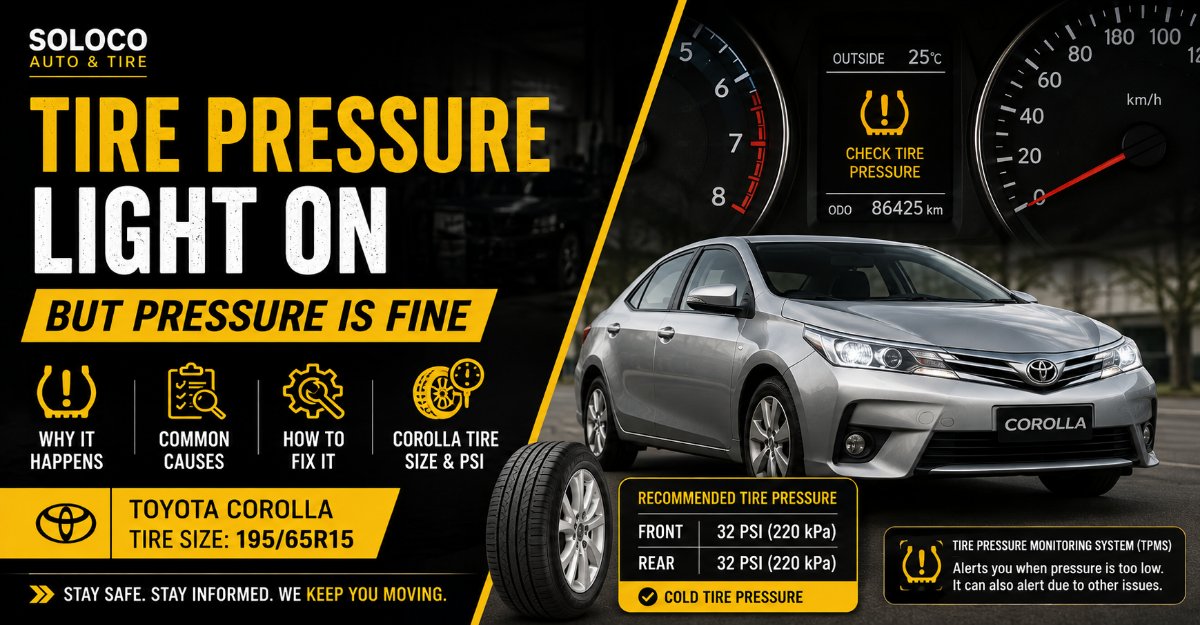
If your Tire Pressure Monitoring System (TPMS) warning light remains active when all four tires are properly inflated, the vehicle is detecting a dead sensor battery, a low spare tire, or requires a system recalibration. You can identify the exact hardware or software fault by observing whether the dashboard light stays solid or flashes upon startup.
Key Facts / At a Glance:
- A flashing TPMS light indicates a system hardware failure, not low tire air pressure.
- Direct TPMS sensor batteries last 5 to 10 years and cannot be replaced independently of the whole sensor unit.
- Many modern SUVs and trucks hide a fifth active sensor inside the spare tire located under the chassis or in the trunk.
- Ambient temperature drops reduce tire pressure by 1 PSI for every 10 degrees Fahrenheit (5.5 degrees Celsius).
- Using standard brass valve cores in aluminum TPMS stems causes galvanic corrosion and permanent sensor damage.
Why Is the TPMS Light On When Tires Are Full?
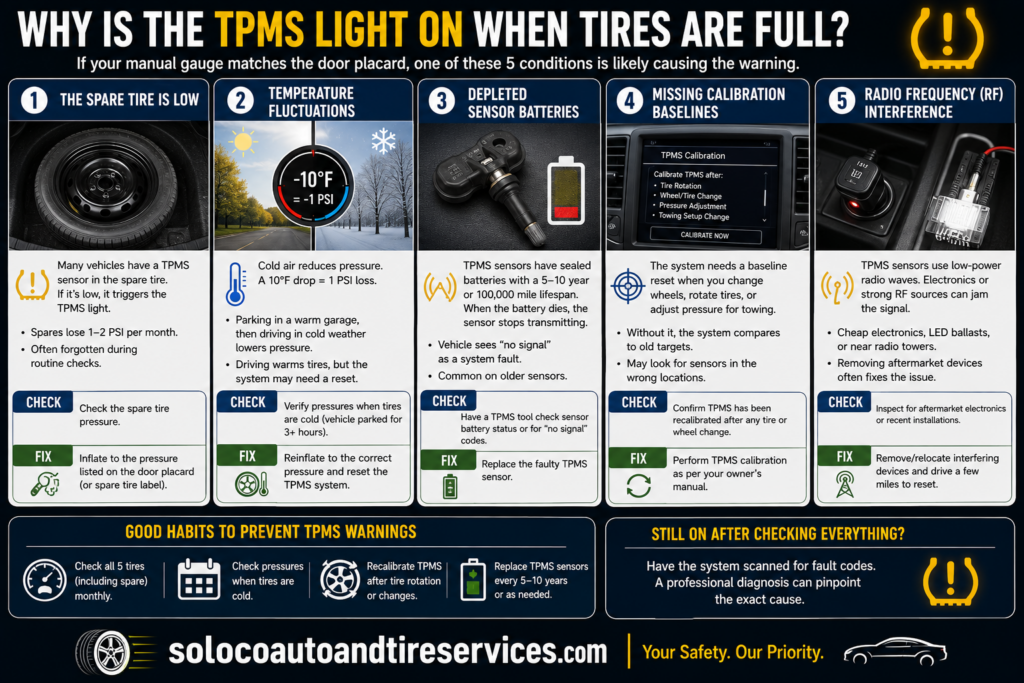
Understanding why a TPMS warning triggers despite correct pressure readings requires checking the system components beyond the four main wheels. If your manual pressure gauge matches the vehicle’s door placard exactly, one of the following five conditions is responsible for the alert.
The Spare Tire is Low Automakers often install a fifth TPMS sensor in full-sized spare tires. Drivers rarely check the spare during routine maintenance. As the spare tire naturally loses 1 to 2 PSI per month in the trunk or under the chassis, it eventually crosses the 25% under-inflation threshold and triggers the dashboard light.
Temperature Fluctuations and Cold Weather Cold air is denser than warm air. For every 10-degree Fahrenheit drop in ambient temperature, tire pressure decreases by exactly 1 PSI. Parking in a heated garage and driving out into freezing temperatures will cause a sudden pressure drop that triggers the sensor. Driving heats the tires and expands the air, but the computer often requires a manual reset to clear the stored fault code even after pressure normalizes.
Depleted Sensor Batteries Direct TPMS sensors rely on internal lithium-ion batteries. These batteries are permanently sealed in potting compound to survive the harsh environment inside a spinning tire. They have a hard lifespan of 5 to 10 years or 100,000 miles. Once a battery dies, the sensor stops broadcasting its 315 MHz or 433 MHz radio frequency, and the vehicle interprets this silence as a critical system fault.
Missing Calibration Baselines Modern vehicle computers require explicit confirmation when you change tire setups. Rotating tires, switching to winter wheels, or adjusting air pressures for towing requires a baseline recalibration. Without this step, the computer looks for sensor signals in the wrong wheel-well locations or compares current pressures against outdated target numbers.
Radio Frequency (RF) Interference TPMS sensors communicate with the car’s receiver using low-power radio waves. Cheap electronic accessories plugged into 12V outlets, low-quality aftermarket LED headlight ballasts, or driving near powerful radio towers can temporarily jam the TPMS signal. Removing aftermarket electronics often instantly restores system functionality.
What Does a Flashing vs. Solid Tire Pressure Light Mean?
Before picking up a tool, watch how the TPMS light behaves the moment you turn the ignition key to the “ON” position. This single diagnostic step dictates your entire troubleshooting path.
| Light Behavior | Technical Meaning | Required Action |
|---|---|---|
| Solid Light Immediately | The system is fully functional, but is reading low pressure in at least one tire (including the spare), or the baseline needs resetting. | Check all pressures with a physical gauge. Perform an electronic relearn process. |
| Flashes 60-90 Seconds, Then Solid | The system has a hardware malfunction. The receiver cannot locate a sensor due to a dead battery, broken stem, or damaged antenna. | Scan the OBD2 port or use a TPMS tool to identify which specific wheel sensor failed. |
How To Fix a False Tire Pressure Warning
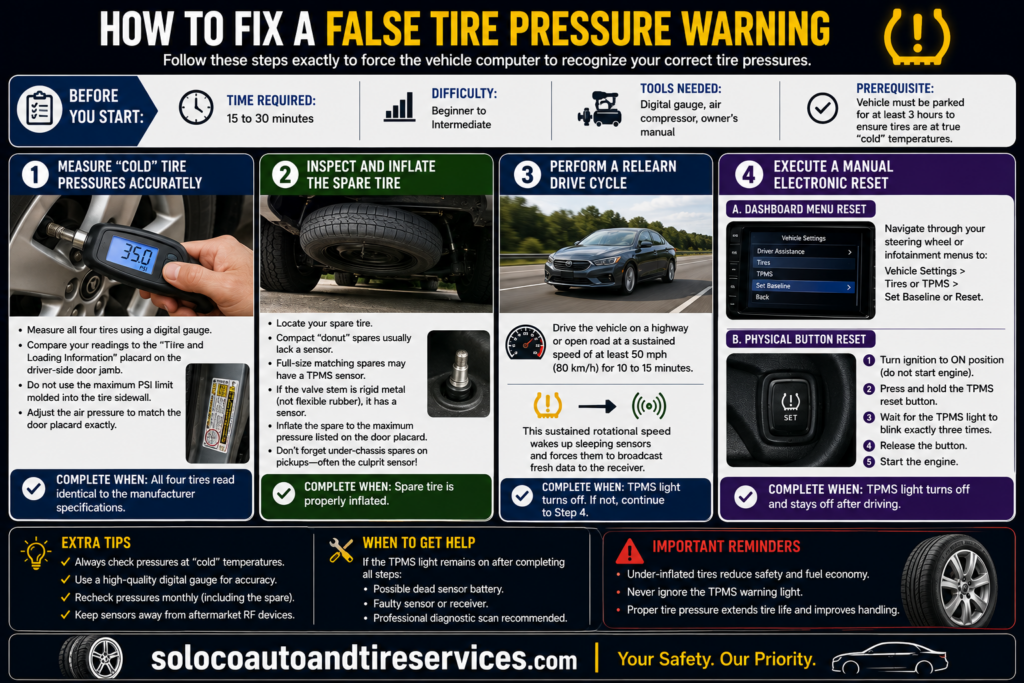
Resolving a persistent TPMS light requires a sequential elimination of variables. Follow these steps exactly to force the vehicle computer to recognize your correct tire pressures.
Before You Start:
- Time Required: 15 to 30 minutes.
- Difficulty: Beginner to Intermediate.
- Tools Needed: High-quality digital pressure gauge, portable air compressor, vehicle owner’s manual.
- Prerequisite: The vehicle must be parked for at least 3 hours to ensure tires are at true “cold” temperatures.
Step 1: Measure “Cold” Tire Pressures Accurately
Start by verifying the baseline. Measure all four tires using a digital gauge. Compare your readings strictly to the “Tire and Loading Information” placard located on the driver-side door jamb. Do not use the maximum PSI limit molded into the tire sidewall. Adjust the air pressure to match the door placard exactly. You will know this step is complete when all four tires read identical to the manufacturer specifications.
Step 2: Inspect and Inflate the Spare Tire
Locate your spare tire. If you have a compact “donut” spare, it usually lacks a sensor. If you have a full-size matching spare, check its valve stem. If the stem is rigid metal rather than flexible rubber, it contains a TPMS sensor. Inflate this spare to the maximum pressure listed on the door placard. A common mistake here is ignoring under-chassis spares on pickup trucks, which frequently house the culprit sensor.
Step 3: Perform a Relearn Drive Cycle
Many vehicles feature auto-relearn capabilities. Drive the vehicle on a highway or open road at a sustained speed of at least 50 mph (80 km/h) for a continuous 10 to 15 minutes. This sustained rotational speed wakes up sleeping sensors and forces them to broadcast fresh data to the receiver.
Step 4: Execute a Manual Electronic Reset
If driving does not clear the light, you must manually reset the computer. The procedure differs significantly by manufacturer.
- Dashboard Menu Reset: Navigate through your steering wheel or infotainment screen menus to “Vehicle Settings,” select “Tires” or “TPMS,” and choose “Set Baseline” or “Reset.”
- Physical Button Reset: Locate the TPMS reset button under the steering column, inside the glovebox, or lower dash panel. Turn the ignition to the “ON” position without starting the engine. Press and hold the button until the TPMS dashboard light blinks exactly three times. Release the button and start the engine.
What Are the Different Types of TPMS Technologies?
When a flashing light forces you to replace hardware, you must understand what system your car uses. The market relies on two fundamental technologies with vastly different maintenance requirements.
Direct TPMS (Physical Sensors) Direct systems use physical pressure transducers mounted inside the wheel, usually attached to the back of the valve stem. These provide exact real-time PSI readings per wheel. While highly accurate, they are expensive to maintain because the internal batteries eventually die, requiring the tire to be physically unseated from the rim for replacement.
Indirect TPMS (Software Based) Indirect systems do not measure air pressure at all. Instead, they use the vehicle’s Anti-lock Braking System (ABS) tone rings to measure wheel rotational speed. An under-inflated tire has a smaller physical diameter, causing it to spin slightly faster than a fully inflated tire. The computer detects this speed variance and triggers the warning. Indirect systems never require battery replacements, but they cannot display specific PSI numbers and will fail to warn you if all four tires lose pressure equally at the same time.
TPMS Replacement Options and Costs
If you must replace a Direct TPMS sensor, you have several tier options.
| Component Type | How It Works | Typical Part Cost | Labor Timeframe |
|---|---|---|---|
| OEM Factory Sensor | Pre-programmed to your specific VIN. | $50 to $150 per wheel | 45 minutes (Requires tire shop) |
| Universal Programmable | Blank aftermarket sensor cloned to your vehicle frequency. | $30 to $60 per wheel | 45 minutes (Requires tire shop) |
| External Cap Add-on | Screws onto the outside of the valve stem. | $30 for a 4-pack kit | 5 minutes (Pure DIY) |
Common TPMS Maintenance Mistakes
Tire shops and vehicle owners frequently cause premature TPMS failures by making easily avoidable installation errors.
Using Brass Valve Cores in Aluminum Stems Direct TPMS sensors often feature aluminum valve stems. If a technician installs a standard brass valve core into an aluminum stem, galvanic corrosion occurs instantly. The two dissimilar metals will weld themselves together. When you try to add air months later, the core will snap off, requiring a total sensor replacement. Always use nickel-plated valve cores with aluminum TPMS stems.
Skipping the TPMS Service Kit When installing new tires, standard practice dictates replacing the TPMS service kit. This kit costs roughly $5 per wheel and includes a new rubber sealing grommet, aluminum retaining nut, valve core, and cap. Reusing five-year-old rubber grommets guarantees a slow air leak that will constantly trigger the pressure warning light.
Matching the Sidewall Max PSI Never inflate your tires to the pressure stamped on the tire rubber (for example, 44 PSI or 51 PSI). That number represents the absolute maximum pressure the casing can safely hold under extreme load. Inflating to this number causes a harsh ride, ruins center tread life, and will trigger high-pressure TPMS warnings on luxury vehicles.
Frequently Asked Questions
Is it safe to drive with the tire pressure light on? It is safe to drive only if you have physically verified with a manual gauge that all four tires are currently at the correct pressure. If the pressure is correct, the vehicle is safe to operate, but you lose the automated safety net if a real puncture occurs during your trip.
Will a car pass state inspection with a TPMS light on? In many jurisdictions, a glowing TPMS dashboard light constitutes an automatic failure for annual vehicle safety inspections. Check your specific local DOT regulations, as laws vary strictly by state and country regarding automated safety systems.
Can I disable the TPMS system permanently? Under federal law in the United States, commercial repair shops are strictly prohibited from disabling a functional TPMS system or bypassing the warning light. While individuals can theoretically pull instrument cluster bulbs or alter the software via aftermarket tuners, it is highly discouraged and creates liability in an accident.
How much does it cost to replace a TPMS sensor? Replacing a single TPMS sensor typically costs between $80 and $200. This includes the cost of the sensor itself ($30 to $150), plus the tire shop labor to break the tire bead, install the part, rebalance the wheel, and electronically pair the new sensor to the vehicle’s computer.