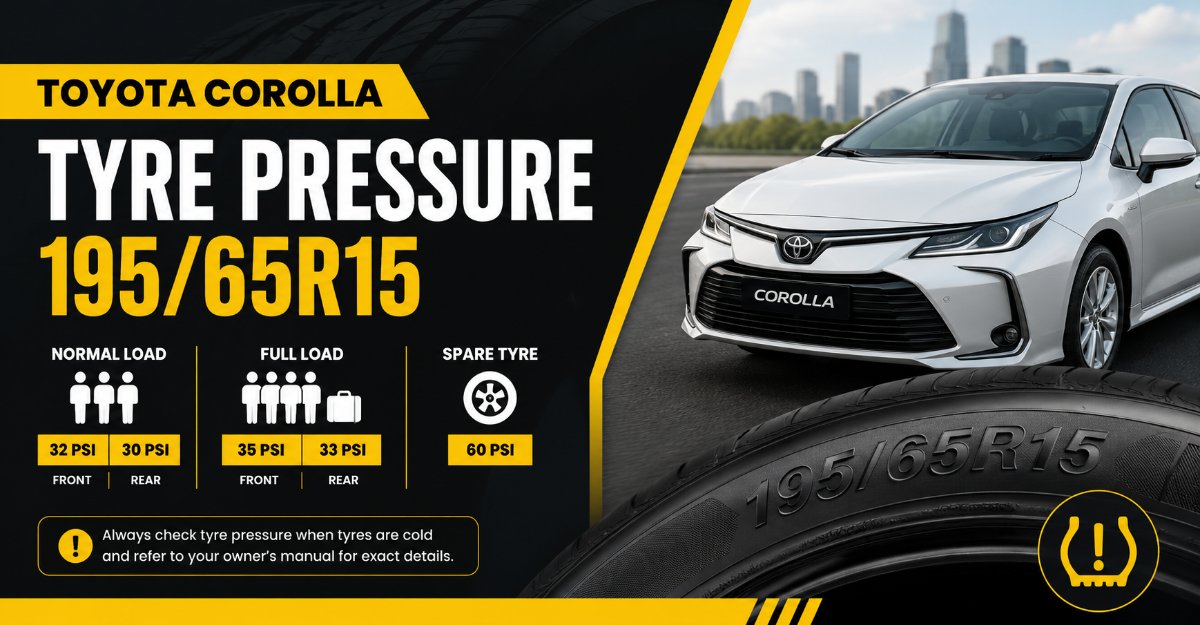
The recommended cold tire pressure for a Toyota Corolla using 195/65R15 tyres is 33 PSI (230 kPa) for the front wheels and 35 PSI (240 kPa) for the rear wheels under normal driving conditions. If you are carrying a full load of passengers and luggage, you should increase the rear tyre pressure to 36 PSI to safely support the additional weight.
Key Facts / At a Glance
- Standard Commuting (Front): 33 PSI (2.3 Bar or 230 kPa).
- Standard Commuting (Rear): 35 PSI (2.4 Bar or 240 kPa).
- Maximum Load Capacity: 36 PSI for both front and rear axles.
- Space-Saver Spare Tyre: 60 PSI (4.2 Bar or 420 kPa).
- Temperature Impact: Tyre pressure fluctuates by 1 PSI for every 10°F (5.6°C) change in ambient temperature.
- Checking Window: Always check pressure when tyres are “cold” (parked for at least three hours).
Core Pressure Specifications for 195/65R15
The specific air pressure your Toyota Corolla requires depends heavily on your driving context. The Toyota Corolla tyre pressure 195/65R15 specification is engineered to balance ride comfort, fuel efficiency, and traction.
The Daily Commuter (Normal Load)
For everyday driving with one or two passengers and minimal cargo, maintaining 33 PSI in the front and 35 PSI in the rear provides the optimal contact patch with the road. This setup ensures maximum fuel efficiency and a smooth ride quality. The slightly higher rear pressure compensates for the vehicle’s suspension geometry and weight transfer during braking.
The Road Tripper (Maximum Load)
When your vehicle is fully loaded with five adults and a trunk full of luggage, the dynamics change. You should inflate all four tyres to 35 or 36 PSI. This higher pressure stiffens the tyre sidewalls, preventing them from flexing excessively under the heavy load. Excessive flexing generates dangerous levels of internal heat that can lead to a tyre blowout at highway speeds.
The Compact Spare Tyre (Donut)
Most Toyota Corolla models equipped with 195/65R15 primary tyres utilize a T125/70D17 compact spare. This space-saver tire requires a massive 60 PSI (420 kPa) to function correctly. A common failure mode for drivers is neglecting the spare tire for years, only to find it completely flat during an emergency. Check the spare tyre every six months.
Where to Find Your Vehicle’s Exact Specifications
You do not have to guess your inflation numbers. Toyota explicitly provides the recommended tyre pressure on a permanent factory sticker known as the tyre information placard.
This placard is universally located on the driver’s side B-pillar (the vertical metal frame you see when you open the driver’s front door). It lists the original equipment tyre sizes, the recommended cold inflation pressures, and the maximum vehicle capacity weight. If this sticker is damaged or missing, the exact specifications are also documented in the “Vehicle Specifications” section of your Toyota Corolla owner’s manual.
Decoding the 195/65R15 Sidewall Markings
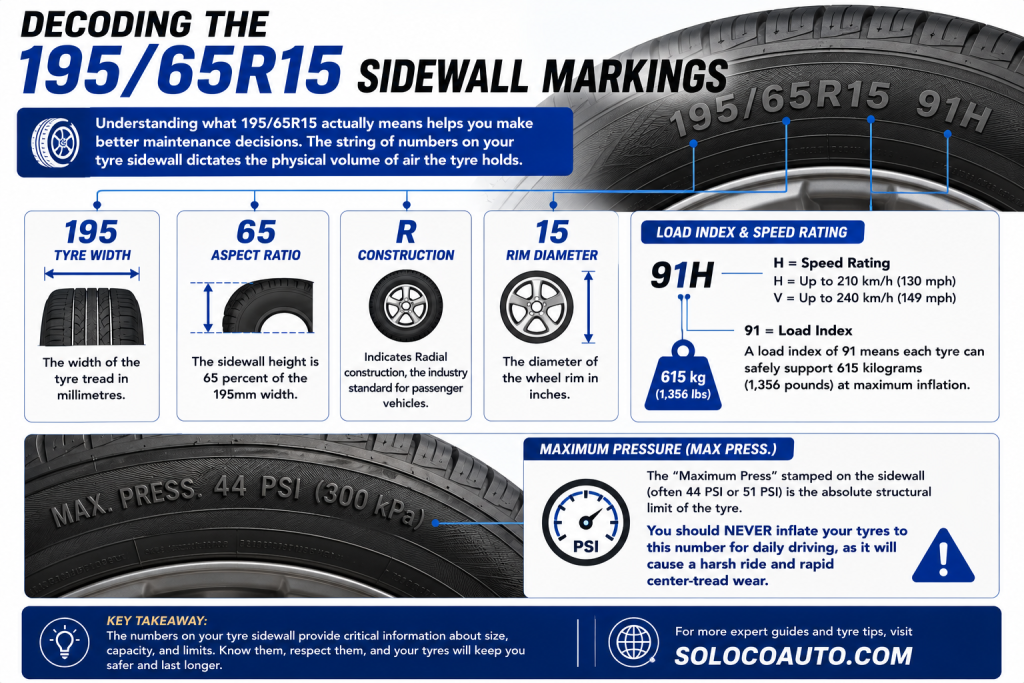
Understanding what 195/65R15 actually means helps you make better maintenance decisions. The string of numbers on your tyre sidewall dictates the physical volume of air the tyre holds.
- 195: The width of the tyre tread in millimetres.
- 65: The aspect ratio. The sidewall height is 65 percent of the 195mm width.
- R: Indicates Radial construction, the industry standard for passenger vehicles.
- 15: The diameter of the wheel rim in inches.
You will also see a Load Index and Speed Rating next to these numbers, typically “91H” or “91V”. A load index of 91 means each tyre can safely support 615 kilograms (1,356 pounds) at maximum inflation. The “Maximum Press” stamped on the sidewall (often 44 PSI or 51 PSI) is the absolute structural limit of the tyre. You should never inflate your tyres to this number for daily driving, as it will cause a harsh ride and rapid center-tread wear.
How Tyre Pressure Impacts Vehicle Performance
Maintaining the correct Toyota Corolla tyre pressure 195/65R15 is not just about extending tyre life. It directly impacts the safety systems and financial efficiency of your vehicle.
Fuel Efficiency and Rolling Resistance
Under-inflated tyres increase rolling resistance. When a tyre lacks sufficient air, more of its rubber surface contacts the asphalt, creating excess friction. The engine must burn more fuel to overcome this drag. A continuous drop of just 3 PSI across all four tyres can reduce your overall fuel economy by 1 to 2 percent, adding measurable costs to your annual fuel budget.
Tread Wear Patterns
The air pressure dictates how the tyre’s tread block presses against the pavement.
- Under-inflation: Causes the edges (shoulders) of the tyre to bear the vehicle’s weight, leading to rapid wear on the outer and inner edges.
- Over-inflation: Causes the tyre to bulge in the center. The middle of the tread wears out prematurely while the edges barely touch the road.
Braking Distance and Handling
Proper pressure ensures an even, flat contact patch. If tyres are over-inflated, the contact patch shrinks, reducing the amount of rubber gripping the road. This significantly increases stopping distances during emergency braking and causes the vehicle to feel unstable or “twitchy” during high-speed cornering.
Environmental Factors and Seasonal Adjustments
Air is a gas that expands when heated and contracts when cooled. Ambient weather conditions continuously alter the pressure inside your tyres.
The universal rule of thermal expansion states that tyre pressure changes by roughly 1 PSI for every 10°F (5.6°C) shift in outside temperature.
If you set your tyres to 33 PSI in the middle of a hot summer day at 90°F (32°C), a sudden autumn cold snap dropping temperatures to 40°F (4°C) will cause your tyres to drop to 28 PSI. For winter driving in freezing climates, many experts recommend adding 1 to 2 PSI above the placard recommendation while parked in a warm garage to pre-empt the inevitable pressure drop when you drive out into the cold air.
Inflation Options: Compressed Air vs. Nitrogen
When filling your 195/65R15 tyres, you can choose between standard compressed air and pure nitrogen. Standard air is 78 percent nitrogen, 21 percent oxygen, and 1 percent other gases including water vapor.
| Feature | Standard Compressed Air | Pure Nitrogen (N2) |
| Availability | Accessible at almost every gas station. | Limited to specialized tyre shops and dealerships. |
| Cost | Free to $2.00 per use. | $5.00 to $10.00 per tyre. |
| Pressure Retention | Loses roughly 1 to 2 PSI per month. | Molecules are larger, leaking at a much slower rate. |
| Moisture Content | Contains water vapor that expands rapidly with heat. | Completely dry gas, ensuring highly stable pressure. |
| Best For | Everyday commuters and budget-conscious drivers. | Track vehicles, heavy towing, or absolute minimal maintenance. |
For a standard Toyota Corolla, compressed air is perfectly adequate provided you check it monthly. Nitrogen offers a slight convenience benefit in pressure stability but provides no measurable improvement to handling or fuel economy for daily commuting.
Step-by-Step Pressure Check Process
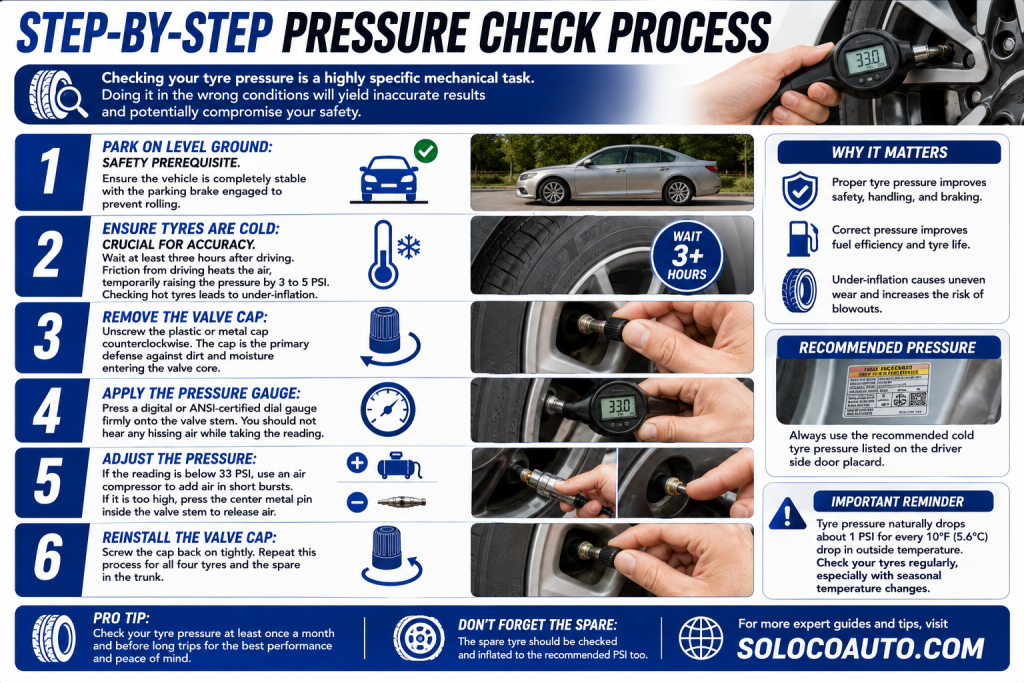
Checking your tyre pressure is a highly specific mechanical task. Doing it in the wrong conditions will yield inaccurate results and potentially compromise your safety.
1.Park on Level Ground:Safety prerequisite.
Ensure the vehicle is completely stable with the parking brake engaged to prevent rolling.
2.Ensure Tyres are Cold:Crucial for accuracy.
Wait at least three hours after driving. Friction from driving heats the air, temporarily raising the pressure by 3 to 5 PSI. Checking hot tyres leads to under-inflation.
3.Remove the Valve Cap:
Unscrew the plastic or metal cap counterclockwise. The cap is the primary defense against dirt and moisture entering the valve core.
4.Apply the Pressure Gauge:
Press a digital or ANSI-certified dial gauge firmly onto the valve stem. You should not hear any hissing air while taking the reading.
5.Adjust the Pressure:
If the reading is below 33 PSI, use an air compressor to add air in short bursts. If it is too high, press the center metal pin inside the valve stem to release air.
6.Reinstall the Valve Cap:
Screw the cap back on tightly. Repeat this process for all four tyres and the spare in the trunk.
Interactive Tyre Maintenance Calculator
To help you manage fluctuating loads and track your maintenance schedule, use this interactive tool to find the exact pressure required for your current driving scenario.
How to Reset the TPMS Light on a Toyota Corolla
The Tyre Pressure Monitoring System (TPMS) alerts you when pressure in any tyre drops 25 percent below the recommended threshold. If your low-pressure warning light (a yellow horseshoe containing an exclamation point) illuminates, you must inspect the tyres immediately.
Once you have inflated all tyres, including the spare, to the correct pressure, the light may stay on. To reset the system on most modern Corollas:
- Turn the ignition switch to the “ON” position without starting the engine.
- Locate the TPMS reset button (usually located under the steering wheel or inside the glove box).
- Press and hold the reset button until the tyre pressure warning light blinks slowly three times.
- Wait a few minutes with the engine running to allow the system to record the new baseline pressures.
If the light blinks for one minute and then stays solid upon startup, there is a malfunction with a sensor battery, and the vehicle requires professional diagnostic scanning.
Common Maintenance Mistakes to Avoid
Even experienced drivers frequently make errors regarding tyre inflation. Avoiding these mistakes extends the life of your 195/65R15 tyres significantly.
- Relying on Visual Inspections: Modern radial tyres have stiff sidewalls. A tyre that is dangerously under-inflated by 10 PSI will often look identical to a fully inflated tyre to the naked eye. Always use a mechanical gauge.
- Ignoring Valve Stem Leaks: The rubber valve stem degrades over time. If you constantly lose 2 PSI a week and find no nails in the tread, spray soapy water on the valve stem. Bubbles indicate a leak that requires stem replacement.
- Mixing Tyre Brands and Pressures: Different manufacturers design varying stiffness into their 195/65R15 tyre models. Running mismatched tyres on the same axle while applying the same pressure can result in unpredictable handling.
Frequently Asked Questions
How often should I check my Toyota Corolla tyre pressure?
You should check your tyre pressure once a month and before any long road trips. Tyres naturally lose about 1 to 2 PSI every month due to permeation through the rubber, regardless of how often you drive.
Is 40 PSI too high for a Toyota Corolla?
Yes, 40 PSI is too high for daily driving. While it is below the absolute maximum burst limit of the tyre, it will cause a harsh ride, accelerate suspension wear, and cause the center of your tread to wear out rapidly. Stick to 33 to 35 PSI.
What happens if I drive with low tyre pressure?
Driving with low pressure creates excessive friction and heat. This can permanently damage the internal structural cords of the tyre, leading to a sudden sidewall blowout. It also reduces your fuel economy and compromises steering responsiveness.
Does my Toyota Corolla TPMS read the spare tyre?
It depends on the model year. Many newer Corollas have a sensor in the full-size spare but not in the temporary “donut” spare. If you cannot get the TPMS light to turn off after filling all four ground tyres, check the trunk spare immediately.
Are 195/65R15 tyres good for winter driving?
Yes, 195/65R15 is an excellent size for winter driving. The relatively narrow 195mm width allows the tyre to cut through deep snow to find traction underneath, rather than “floating” on top of the snow like a wider tyre would.