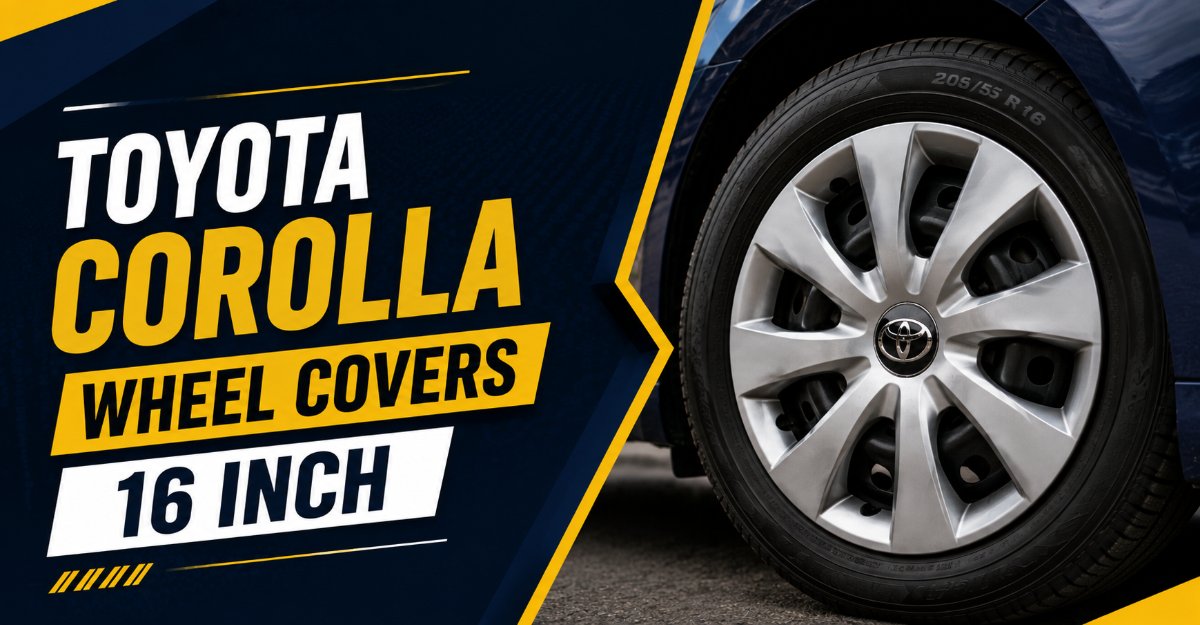
A 16-inch Toyota Corolla wheel cover—frequently referred to as a hubcap—is an engineered exterior trim component manufactured from high-impact ABS thermoplastic that snaps directly onto a 16-inch factory steel wheel rim. These discs serve a dual engineering purpose: they provide an aerodynamic barrier that shields foundational braking components, wheel studs, and lug nuts from road salt, moisture, and debris, while simultaneously delivering the clean aesthetic finish of an alloy wheel at a fraction of the replacement cost. Modern Toyota Corolla models utilizing 16-inch steel wheels—predominantly base LE trims and select mid-tier configurations across recent generations—rely on these covers to protect structural steel from premature surface corrosion while maintaining factory aerodynamic efficiency.
Key Facts / At a Glance
- Exact Sizing Standard: Designed exclusively for 16-inch steel wheels, verified by the R16 designation printed on the tire sidewall.
- Primary Material: Injection-molded ABS thermoplastic reinforced with UV-resistant clear coats to prevent fading and brittleness.
- Retention Mechanism: External radial steel tension rings combined with 8 to 12 flexible polymer retention clips exerting continuous outward radial pressure.
- Typical Cost Range: $40 to $75 for a complete set of four aftermarket replicas; $45 to $70 per single piece for genuine OEM Toyota factory replacements.
- Installation Duration: Under 5 minutes per wheel using manual hand pressure alone—no pneumatic or heavy metal striking tools required.
How Do 16-Inch Toyota Corolla Wheel Covers Work Mechanically?
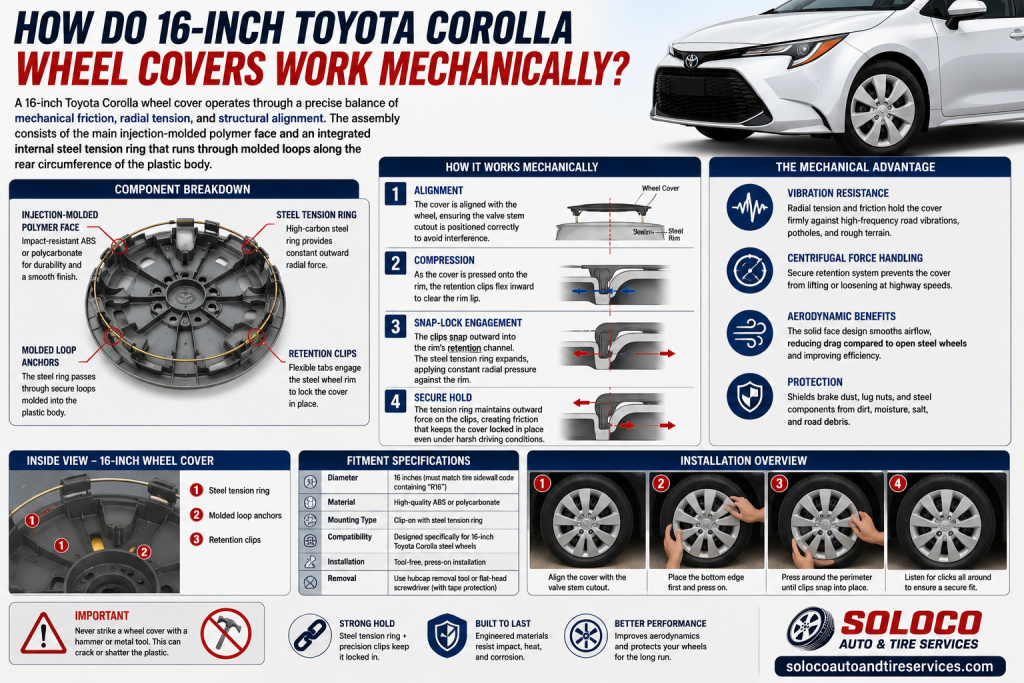
A 16-inch Toyota Corolla wheel cover operates through a precise balance of mechanical friction, radial tension, and structural alignment. The assembly consists of the main injection-molded polymer face and an integrated internal steel tension ring that runs through molded loops along the rear circumference of the plastic body.
When installed, the steel tension ring acts as a constant-force spring. As the user presses the wheel cover into the steel rim, the outer retention clips flex inward slightly before snapping outward into the deep channel of the steel wheel lip. The tension ring forces these plastic tabs outward against the inner diameter of the rim, creating enough static friction to withstand high-frequency road vibrations, potholes, and centrifugal forces at highway speeds. Furthermore, the solid face design minimizes aerodynamic drag by smoothing the turbulent air pocket created by open steel spokes, protecting the underlying brake dust shields and lug nut threads from direct environmental exposure.
What Are the Core Specifications for Toyota Corolla 16-Inch Hubcaps?
Accurate sizing is the single most critical factor when procuring replacement wheel covers for a Toyota Corolla. Buyers frequently make the error of measuring the physical diameter of an existing damaged hubcap with a tape measure, which yields an inaccurate reading of roughly 17.5 inches due to the curved outer flange and overhang.
To guarantee correct fitment, reference the tire sidewall code. Look for a alphanumeric string formatted as P205/55R16 or 195/65R16. The letter R stands for radial construction, and the immediate number 16 denotes the exact wheel rim diameter in inches, which dictates the required wheel cover size. Additionally, technicians must account for the vehicle’s bolt pattern and offset. While snap-on wheel covers attach exclusively to the outer rim lip rather than the lug studs, the center hub clearance must match factory Toyota steel wheel profiles—typically featuring a 54.1mm center bore and clearing 5-lug configurations.
What Are the Main Types of 16-Inch Corolla Wheel Covers Available?
Vehicle owners evaluating replacement options face three distinct categories of products, each possessing unique material compositions, cost profiles, and aesthetic outcomes.
OEM Factory Original Equipment
OEM wheel covers are manufactured directly under Toyota specifications or by Tier-1 OEM suppliers. These units feature high-grade virgin ABS plastics, exact color-matched silver finishes with factory metallic flake, and heavy-gauge steel tension rings. They offer a flawless cosmetic fit and superior longevity against thermal cycling, though individual replacement costs remain high.
Aftermarket Replica Stock Matches
Aftermarket replicas are mass-produced by third-party manufacturers to duplicate the exact visual appearance of factory Corolla wheel covers. Constructed from recycled or blended ABS thermoplastics, they mimic OEM styling at a fraction of the cost. While the outer visual impression is nearly identical, the underlying plastic walls are often slightly thinner, requiring careful handling during seasonal tire rotations.
Custom and Blackout Sport Upgrades
Custom aftermarket wheel covers cater to drivers seeking to alter the vehicle’s aesthetic by replacing traditional silver finishes with matte black, gloss black, or carbon-fiber-textured designs. These universal or vehicle-specific custom designs give base-model Corollas a sportier, modern appearance. However, their retention ring tolerances can vary, necessitating careful verification of tension spring adjustments before sustained highway driving.
How Do You Correctly Install 16-Inch Toyota Corolla Wheel Covers?
Executing a proper installation prevents unexpected hubcap detachment on public roadways. Follow this step-by-step procedure for a secure fit:
- Locate the Valve Stem: Inspect the rear of the wheel cover to identify the specific U-shaped cutout notch designed to clear the tire’s inflation valve stem. Align this notch precisely with the metal valve stem on the steel wheel.
- Position the Lower Base: Set the bottom edge of the wheel cover into the lower lip of the steel rim, ensuring the retention clips are resting squarely against the metal groove rather than overlapping the outer tire bead.
- Align the Tension Ring: Verify that the inner steel tension ring is securely seated within all molded plastic guide loops on the back of the cover, and ensure the ring’s expansion gap is positioned away from the valve stem cutout.
- Apply Uniform Hand Pressure: Working your hands upward along both the left and right sides of the cover, apply firm, even palm pressure until the top retention clips snap audibly into the steel rim channel.
- Verify Security: Grip the outer perimeter of the wheel cover at the 3 o’clock and 9 o’clock positions and pull gently. If the cover shifts or rattles, remove it and adjust the tension ring expansion.
How Do OEM and Aftermarket Wheel Covers Compare?
Choosing between factory original equipment and aftermarket alternatives involves balancing upfront expenditure against long-term durability and aesthetic precision.
| Evaluation Criterion | OEM Factory Original Covers | Aftermarket Replica & Custom Covers |
| Upfront Cost | $45 to $65 per single piece | $40 to $75 for a complete set of four |
| Material Composition | Virgin high-impact ABS polymer | Blended or recycled ABS thermoplastic |
| Aesthetic Accuracy | 100% exact factory paint match and sheen | High accuracy for replicas; styled variations for customs |
| Retention Security | Calibrated factory tension ring with reinforced tabs | Universal tension ring requiring manual calibration |
| UV and Thermal Resistance | Exceptional resistance to fading and winter cracking | Moderate resistance; prone to fading after 3 to 4 years |
| Replacement Availability | Limited to dealerships and specialty distributors | Widely available online and in automotive retail stores |
What Are the Most Common Mistakes During Installation and Sizing?
Even experienced DIY mechanics occasionally encounter pitfalls when replacing Corolla wheel covers. Avoiding these errors saves time and prevents component failure.
- Measuring the Hubcap Face with a Ruler: Using a tape measure across the front face yields a measurement of approximately 17.5 inches due to the decorative lip overhang. Always verify the R16 code on the tire sidewall instead.
- Forcing the Valve Stem Alignment: Jamming the wheel cover onto the rim without aligning the cutout notch with the valve stem bends or shears the rubber valve stem, resulting in immediate air loss and a flat tire.
- Using Metal Hammers for Installation: Striking plastic wheel covers with a steel hammer or heavy rubber mallet shatters brittle ABS retention tabs and cracks the painted finish. Always rely exclusively on bodyweight and palm pressure.
- Ignoring Steel Rim Rust Accumulation: Heavy iron oxide buildup inside the steel wheel rim groove reduces the effective inner diameter, preventing the tension ring from expanding fully and causing the cover to vibrate loose.
How Do You Troubleshoot Loose, Rattling, or Stuck Wheel Covers?
When wheel covers exhibit performance issues, systematic troubleshooting can restore stability without requiring immediate replacement.
Symptom: The Wheel Cover Rattles or Feels Loose at Highway Speeds
Root Cause: The radial steel tension ring has lost its outward expansion force, or the plastic clips have fatigued.
Correction: Remove the wheel cover from the steel rim. Using needle-nose pliers, gently grasp the steel tension ring near the valve stem loop and bend the wire slightly outward to increase its overall diameter. Reinstall the cover to verify a tighter friction fit.
Symptom: The Wheel Cover Will Not Snap Into the Rim Groove
Root Cause: Accumulated brake dust, road grime, or protruding balancing weights are obstructing the retention channel.
Correction: Clean the inner lip of the steel wheel thoroughly using a wire brush and a solvent degreaser. Inspect the placement of wheel-balancing weights; if a weight is positioned directly over a retention slot, a technician may need to relocate it.
Frequently Asked Questions
Can I install 16-inch wheel covers on 15-inch or 17-inch Toyota Corolla wheels?
No. Wheel covers are strictly non-interchangeable across different rim diameters. A 16-inch wheel cover is physically engineered to match the exact inner bead circumference and rim lip depth of a 16-inch steel wheel. Attempting to mount a 16-inch cover onto a 15-inch rim leaves a wide gap where retention clips cannot engage, while a 16-inch cover will not stretch over a 17-inch rim flange.
Are Toyota Corolla wheel covers universal across all model years?
No. While many Toyota Corolla models utilize standard 16-inch steel wheels, styling layouts, spoke counts, and clearance depths vary significantly across generations (such as the E170 from 2014–2019 and the E210 from 2020 onward). Always verify that the replacement cover matches your specific model year design and steel wheel configuration.
Do I need to remove my wheel covers when getting new tires installed?
Yes. Tire technicians must mount, balance, and inspect tires directly on the steel rims. Leaving wheel covers attached during tire changing operations risks damaging the fragile ABS plastic tabs when the tire machine clamps or inflates the assembly. Wheel covers should always be removed prior to service and reinstalled afterward.
What causes wheel covers to fly off while driving?
Wheel covers typically detach due to improper initial seating, a worn or missing steel tension ring, or severe impacts from deep potholes that momentarily deform the steel rim lip. Ensuring that all retention clips are fully snapped into the rim channel and maintaining proper tension ring calibration prevents this issue.
How can I protect my wheel covers from winter road salt and fading?
Applying a high-grade automotive polymer sealant or ceramic coating to the face of the wheel covers protects the paint and clear coat from corrosive magnesium chloride and sodium chloride used in winter road treatments. Regular washing during routine car maintenance also prevents brake dust from baking into the porous plastic finish.