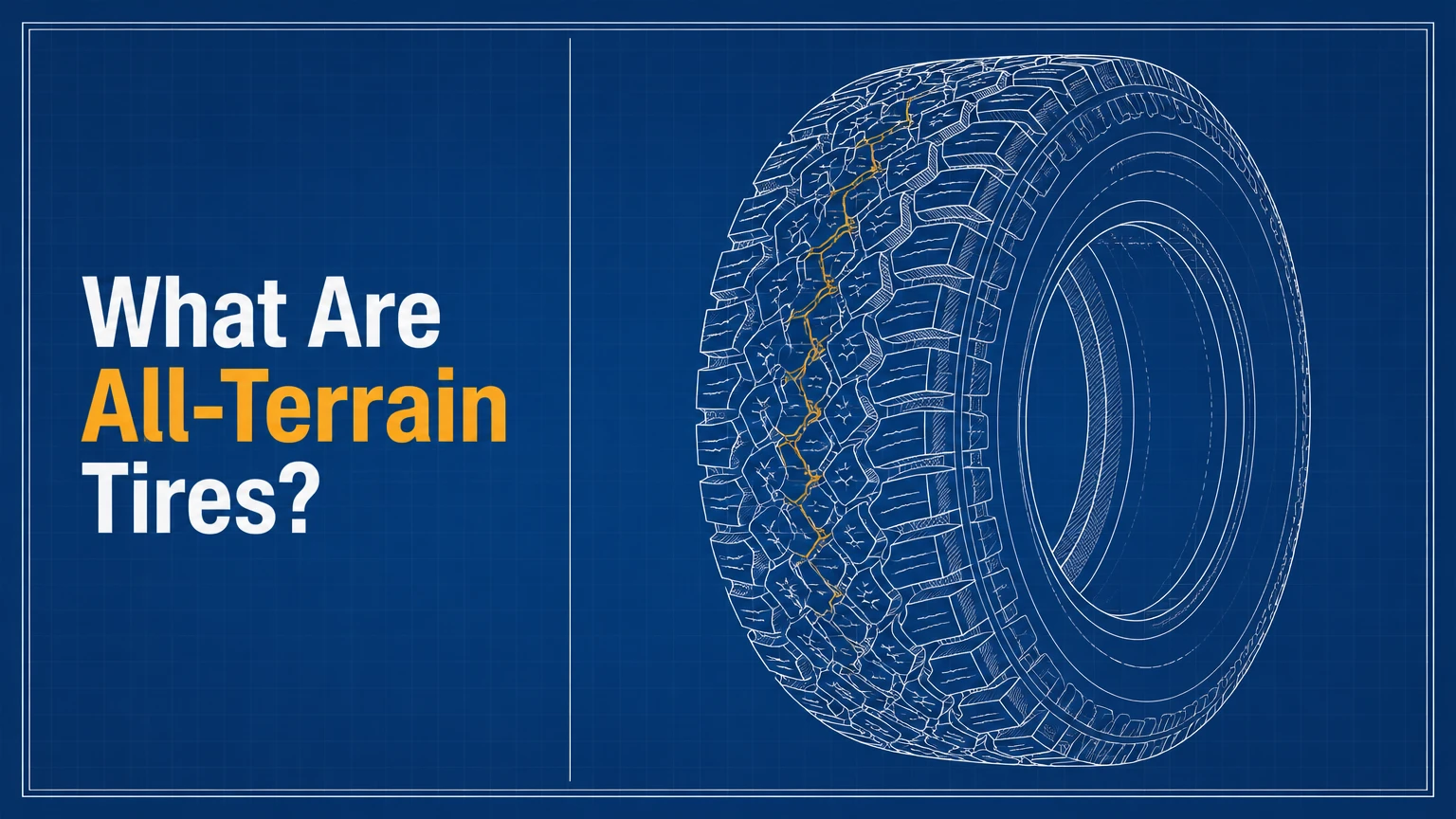
All-terrain tires are hybrid pneumatic vehicle tires engineered to deliver a balanced compromise between comfortable on-road highway driving and reliable off-road traction across dirt, gravel, rocks, and light mud. These tires incorporate reinforced sidewalls, open tread voids, and durable rubber compounds to handle mixed driving environments without sacrificing daily drivability.
At a Glance
- Tread Depth: Typically measures between 10/32 and 14/32 of an inch deep, balancing highway efficiency with off-road bite.
- Mileage Warranty: Most reputable manufacturers back passenger and light-truck variants with treadwear warranties spanning 50,000 to 65,000 miles.
- Compound Hardness: Utilizes a medium durometer compound, generally measuring 60 to 70 Shore A, to resist rock chipping while remaining flexible.
- Fuel Consumption: Expect a 1% to 3% reduction in miles per gallon due to increased rolling resistance and heavier unsprung weight.
- Winter Certification: Premium models carry the Three-Peak Mountain Snowflake symbol, indicating certified performance in severe snow conditions.
What Are the Core Technical Specifications of A/T Tires?
All-terrain tires feature specific engineering metrics that differentiate them from standard highway tires and aggressive mud-terrain tires. Tread depth on a fresh all-terrain tire typically ranges from 10/32 to 14/32 of an inch, sitting directly between highway tires (9/32 to 11/32) and mud-terrain tires (15/32 to 19/32).
Rubber hardness is measured using a medium durometer compound, generally falling between 60 and 70 Shore A. This specific hardness rating strikes a balance by resisting puncture wounds and rock chipping on unpaved trails while retaining enough flexibility to grip uneven pavement. Fuel economy naturally takes a minor hit, with most drivers recording a 1% to 3% drop in miles per gallon compared to factory highway tires due to higher rolling resistance. Additionally, internal air chambers and larger tread blocks generate 2 to 5 decibels more road noise at highway speeds than standard touring tires.
How Is the Structural Design of an All-Terrain Tire Built?
The internal architecture of an all-terrain tire is engineered to withstand impacts from sharp stones, heavy vehicle loads, and rough terrain without sacrificing structural integrity. The void ratio represents the percentage of open space between the tread blocks, balanced carefully to channel away water, gravel, and light mud without trapping stones.
Siping consists of tiny, microscopic slits cut directly into the tread blocks. When the tire makes contact with the ground, these siping edges open up to bite into wet asphalt, packed snow, and thin ice. Reinforced sidewalls utilize a rugged 2-ply or 3-ply polyester casing combined with high-tensile steel belts. This robust layered construction protects the vulnerable sidewall region from punctures caused by sharp tree roots, shale, and jagged rocks during off-road excursions.
What Is the Real-World Performance Limit of A/T Tires in Deep Mud?
Standard all-terrain tires fail instantly when driven through deep, sticky, clay-like mud because their closely spaced tread blocks cannot self-clean fast enough. As the wheel spins, heavy mud packs tightly into the shallow grooves, smoothing out the tread pattern and turning the tire into a slick, tractionless racing tire.
Drivers navigating agricultural fields, thick bogs, or rainy construction sites must understand that conventional all-terrain models lack the massive, wide-scoop void ratios found on dedicated mud-terrain tires. If your regular driving routine involves navigating deep, water-logged mud pits, standard all-terrain tires will leave you stranded. Under those specific conditions, you need a specialized mud-terrain tire or an aggressive hybrid design that forces accumulated mud outward through wide shoulder clearance channels.
How Does Heavy Towing Impact Passenger-Rated Versus Light-Truck A/T Tires?
Towing heavy trailers exceeding 7,000 pounds at maximum payload capacity causes standard passenger-rated (P-metric) all-terrain tires to flex excessively under the dynamic weight load. This extreme sidewall flex generates dangerous trailer sway, erratic steering response, and rapid internal heat buildup that can lead to tread separation.
Vehicle owners who regularly haul heavy livestock trailers, large campers, or commercial equipment must upgrade to Light Truck (LT-metric) E-load rated tires. LT-metric tires feature much thicker sidewall plies and steel bead bundles engineered to safely handle high inflation pressures, often up to 80 PSI. Operating an LT-metric tire at higher pressures stabilizes the contact patch, eliminates lateral squirm, and safely supports heavy tongue weights without structural fatigue.
When Do All-Terrain Tires Fail in Winter Conditions?
Many vehicle owners mistakenly assume that all-terrain tires provide exceptional grip in all winter weather simply because they feature aggressive, chunky tread patterns. In reality, standard all-terrain rubber compounds harden significantly when ambient temperatures drop below 7 degrees Celsius or 45 degrees Fahrenheit, causing the tread blocks to lose elasticity and road grip.
Only all-terrain tires explicitly stamped with the Three-Peak Mountain Snowflake icon feature specialized silica-infused compounds designed to remain pliable in sub-zero environments. Even with this certification, these hybrid tires cannot match the ice-braking performance, stopping distances, and lateral stability provided by dedicated, studless winter tires on packed sheet ice. If you live in a region with severe, icy winters, certified 3PMSF all-terrain tires work well for light snow, but dedicated winter tires remain the safest option.
What Is the Difference Between A/T, M/T, and R/T Tires?
The tire industry addresses the middle ground between highway comfort and extreme off-road capability by offering three distinct categories: All-Terrain (A/T), Mud-Terrain (M/T), and Rugged-Terrain (R/T). Understanding their structural differences prevents costly purchasing mistakes.
- All-Terrain (A/T): Designed for a 70% on-road and 30% off-road split, offering low road noise, long tread life, and balanced wet-weather traction.
- Mud-Terrain (M/T): Built with aggressive, deep scoop-like tread blocks and reinforced puncture-resistant sidewalls engineered specifically for 80% off-road environments.
- Rugged-Terrain (R/T): A hybrid crossover design featuring a tighter, quieter A/T center tread pattern paired with massive, aggressive M/T shoulder lugs for deep mud extraction.
What Is the Weight Penalty and Fuel Economy Impact of Aggressive A/T Tires?
Upgrading from a lightweight factory highway tire to an aggressive LT-metric all-terrain tire adds between 10 and 15 pounds of heavy unsprung weight to each corner of the vehicle. This substantial increase in rotating mass places extra mechanical strain on factory brake rotors, calipers, suspension ball joints, and wheel bearings.
The engine must work harder to overcome this additional mass, resulting in sluggish acceleration response and a noticeable reduction in fuel economy. Beyond the 1% to 3% drop in miles per gallon, the increased unsprung weight changes the vehicle’s suspension frequency. Drivers often notice a firmer, more rigid ride over sharp road bumps because heavier tire constructions resist vertical deflection more aggressively than flexible passenger car tires.
How Do You Prevent Cupping and Irregular Wear on All-Terrain Tires?
All-terrain tires develop uneven tread wear patterns known as cupping or feathering much faster than standard highway tires if routine maintenance schedules are neglected. Because all-terrain treads feature large, independent rubber blocks with deep void spaces, these blocks flex and scrub against the pavement under braking and cornering forces.
To prevent permanent, loud roaring noises and violent steering vibrations, you must rotate your all-terrain tires every 5,000 miles rather than the traditional 7,500-mile interval. Maintaining proper tire inflation pressures, checking wheel alignment annually, and inspecting suspension shock absorbers for damping degradation will ensure even tread wear and maximize the lifespan of your investment.
Can You Run All-Terrain Tires Only on the Rear Axle of a Two-Wheel-Drive Truck?
Running all-terrain tires exclusively on the rear axle of a two-wheel-drive truck creates a dangerous imbalance in vehicle handling dynamics. Mixing different tire constructions alters the friction coefficient and grip balance between the front and rear axles during emergency maneuvers.
If you mount high-grip all-terrain tires on the rear axle while leaving worn highway tires on the front steering axle, your vehicle will suffer from severe understeer during emergency wet braking. The front tires will lose traction and slide straight ahead while the rear tires hold firm, potentially causing the driver to lose steering control. Always install matching tire types and tread designs across all four wheel positions to maintain predictable handling.
Do All-Terrain Tires Lower a Vehicle’s Top Speed Rating?
All-terrain tires typically carry lower maximum speed ratings than standard passenger car tires due to the physics of heat dissipation in larger tread blocks. Most standard passenger vehicle tires carry an H speed rating (up to 130 mph) or a V speed rating (up to 149 mph).
In contrast, all-terrain tires usually carry an S speed rating (up to 112 mph) or a T speed rating (up to 118 mph). The massive rubber blocks on an all-terrain tire flex continuously at high velocities, generating internal mechanical friction and rapid heat buildup. Exceeding the manufacturer speed rating on an all-terrain tire can cause rapid tread separation and catastrophic structural failure.
Why Does the Tire Pressure Warning Light Activate After Switching to LT A/T Tires?
Switching from standard factory passenger P-metric tires to heavy-duty Light Truck (LT-metric) all-terrain tires often triggers the vehicle’s Tire Pressure Monitoring System warning light. P-metric tires achieve their maximum load capacity at a standard 35 PSI inflation pressure.
LT-metric all-terrain tires possess a different internal construction and require much higher inflation pressures—often between 45 and 50 PSI when unloaded—to safely support vehicle weight. Because the factory tire pressure monitoring sensors are programmed to trigger an alert below the original 35 PSI baseline, the system perceives the new tires as under-inflated. A qualified service shop must recalibrate or reprogram your vehicle computer system to recognize the higher baseline operating pressure required by the LT tires.
How Do You Choose the Right All-Terrain Tire Ply Rating for Your Specific Payload?
Selecting the correct ply rating or load range for an all-terrain tire requires matching your vehicle’s Gross Vehicle Weight Rating and actual towing habits to the tire’s specified load index. Standard passenger variants feature a 4-ply rating, while light-truck variants utilize C-load (6-ply), D-load (8-ply), or E-load (10-ply) ratings.
For light-duty daily commuting and occasional gravel road driving, a standard passenger A/T or a C-load tire provides sufficient strength while maintaining a comfortable ride. For heavy-duty work trucks, commercial towing, or frequent travel across sharp rocky terrain, an E-load rated all-terrain tire is mandatory. The heavy 10-ply construction resists sidewall punctures and prevents excessive squirm under heavy payloads.
What Is the Actual Noise Difference Between Highway Tires and All-Terrain Tires?
Road noise generated by all-terrain tires stems directly from the air pumping effect and impact harmonics of large tread blocks striking the pavement surface at speed. Acoustic measurements typically show that all-terrain tires run 2 to 5 decibels louder than standard highway touring tires at 65 miles per hour.
While a 2 to 5 decibel increase sounds small on paper, the human ear perceives decibels logarithmically, making the high-pitched hum or low drone clearly noticeable inside the cabin. Modern tire manufacturers combat this noise by utilizing variable pitch tread blocks, staggering the block sizes to disrupt acoustic frequencies and prevent an annoying rhythmic hum during long highway road trips.
How Do You Read the Three-Peak Mountain Snowflake (3PMSF) Rating Versus Standard M+S Markings?
Decoding winter tire certifications requires understanding the strict regulatory difference between the legacy Mud and Snow (M+S) designation and the modern Three-Peak Mountain Snowflake symbol. The M+S marking is an older, self-certified designation based entirely on physical tread void geometry rather than actual cold-weather testing. A tire can earn an M+S rating if its void ratio meets a specific geometric percentage, regardless of how the rubber compound behaves in freezing temperatures.
Conversely, the Three-Peak Mountain Snowflake symbol requires rigorous, standardized ASTM testing on packed snow. Tires bearing this mountain and snowflake icon must prove they deliver at least 10% better traction efficiency than a reference standard test tire in accelerated snow braking and acceleration tests. Always look for the 3PMSF symbol on the tire sidewall if you live in an area prone to winter snowstorms.
The Bottom Line
All-terrain tires bridge the gap between daily highway comfort and off-road capability by utilizing reinforced sidewalls, balanced void ratios, and versatile tread designs. Selecting the correct tire requires evaluating your actual driving split, payload requirements, and winter climate conditions rather than relying on generic rules of thumb. Prioritize light-truck load ratings if you tow heavy loads, look for the Three-Peak Mountain Snowflake symbol for winter performance, and maintain a strict 5,000-mile tire rotation schedule to prevent uneven cupping wear.