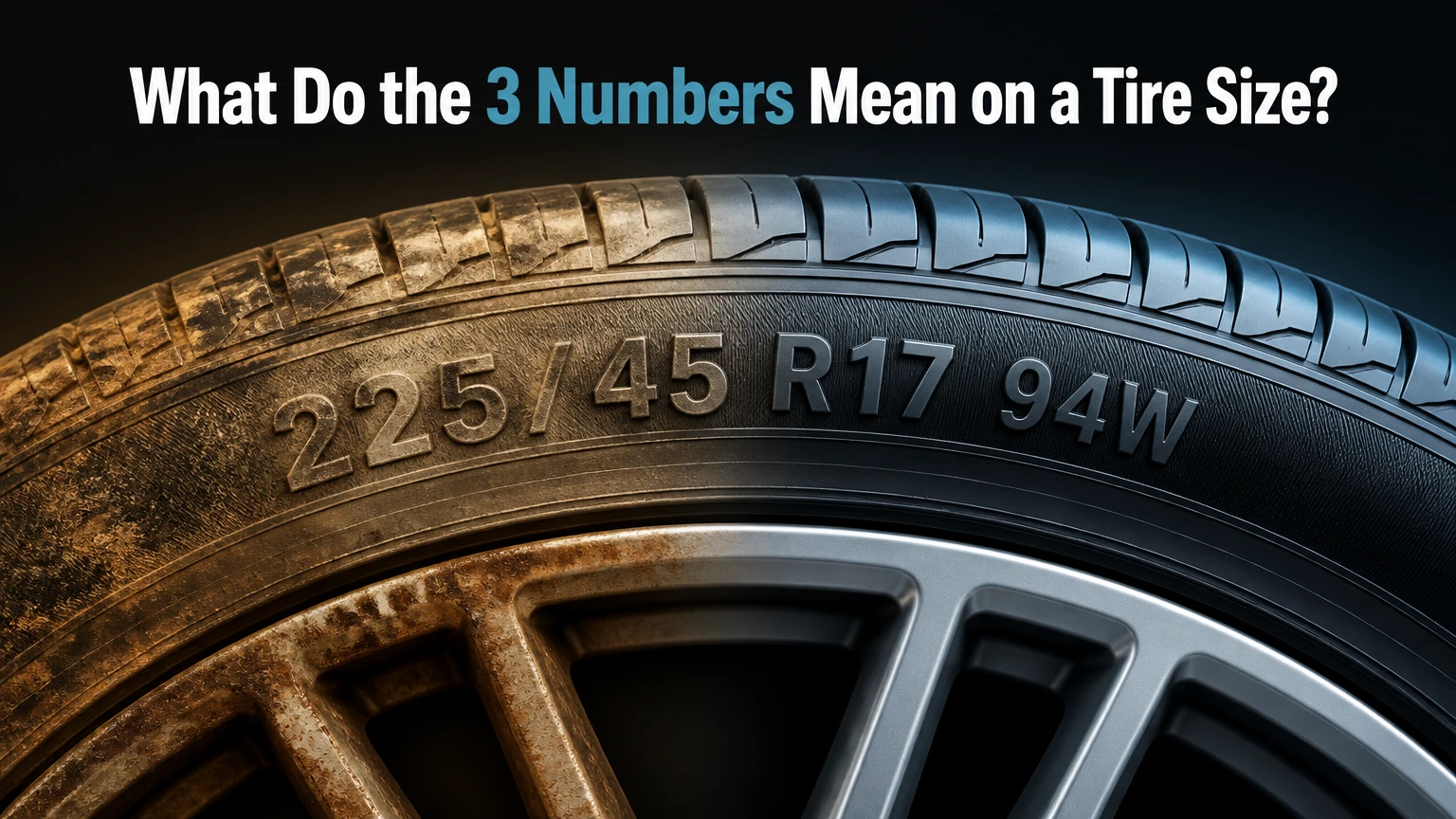
The three primary numbers on a tire size represent the tire section width in millimeters, the aspect ratio as a percentage of that width, and the wheel rim diameter in inches. For example, in a tire marked 225/50R17, 225 is the width, 50 is the aspect ratio, and 17 is the wheel diameter.
At a Glance: Key Tire Size Facts
- The first number indicates the section width of the tire measured in millimeters from sidewall to sidewall.
- The second number represents the aspect ratio, which calculates the sidewall height as a percentage of the width.
- The third number specifies the required wheel rim diameter in inches for proper installation.
- Letters like P, LT, and R indicate vehicle application category and internal radial construction.
- Final suffix numbers and letters denote the maximum load index capacity and safe speed rating.
What is the first number in a tire size?
The first number in a standard tire size string represents the section width of the tire measured in millimeters from the outer sidewall to the inner sidewall. In a code like 225/50R17, the section width is 225 millimeters, which equals approximately 8.85 inches.
This measurement is taken at the widest point of an unladen tire when it is properly mounted on a matching rim, rather than just measuring the flat tread contact patch resting on the pavement. Two tires with the exact same first number can occasionally exhibit different tread widths due to variations in shoulder block design and sidewall curvature. Manufacturers establish this metric to ensure the tire clears suspension components, brake calipers, and wheel wells when the steering wheel is turned to full lock.
What is the second number (aspect ratio) on a tire?
The second number in a tire size sequence is the aspect ratio, which expresses the height of the tire sidewall as a percentage of its section width. For instance, a tire marked with an aspect ratio of 50 features a sidewall height equal to 50 percent of its total section width.
Many drivers mistakenly believe that an aspect ratio number like 50 represents a fixed vertical height in millimeters. Because the aspect ratio is always a direct ratio relative to the section width, two tires with a 50 series can have vastly different actual sidewall heights. A wide tire with a 50 aspect ratio possesses a much taller sidewall than a narrow tire with the same 50 aspect ratio, directly altering ride comfort, cornering responsiveness, and rim protection against potholes.
How do you calculate sidewall height from tire numbers?
You calculate the physical sidewall height of a tire by multiplying the section width in millimeters by the decimal equivalent of the aspect ratio. For example, on a tire sized 225/50R17, you multiply 225 millimeters by 0.50, yielding a sidewall height of 112.5 millimeters, or about 4.42 inches.
To convert this metric output into imperial inches for easier visualization, divide the resulting millimeter value by 25.4. Professional technicians use this mathematical formula whenever they evaluate plus-sizing wheel upgrades or attempt to preserve the exact same overall rolling diameter while altering wheel sizes. Maintaining accurate calculations prevents electronic stability control malfunctions and mechanical rubbing against vehicle liners.
What is the third number on a tire size?
The third number in a tire size string denotes the wheel diameter, indicating the exact size of the metal wheel rim in inches that the tire is engineered to fit. In the example designation 225/50R17, the number 17 specifies that the tire requires a 17-inch wheel rim.
This specific measurement highlights a unique quirk within the automotive tire industry: it combines metric measurements for width and aspect ratio with imperial measurements for wheel diameter. You cannot mount a 17-inch tire onto a 16-inch or 18-inch wheel under any circumstances. Attempting to force a mismatch results in immediate bead seating failure, catastrophic air loss, and severe safety hazards.
What do the letters around the three numbers mean?
The letters interspersed among the numbers on a tire sidewall indicate vehicle classification and internal construction design. The prefix letter at the beginning, such as P for Passenger car or LT for Light Truck, defines the intended vehicle weight category and load threshold.
The letter appearing immediately after the aspect ratio, most commonly an R, stands for Radial. Radial construction dictates that the internal fabric plies and steel belts run perpendicular to the direction of travel, offering superior ride comfort and tread longevity compared to older bias-ply designs. Additional suffix letters at the end of the string, such as V or W, represent the maximum certified speed threshold for that specific product line.
How do you calculate total tire diameter from size numbers?
You calculate the total overall tire diameter by taking the wheel rim diameter in inches, multiplying it by 25.4 to convert it to millimeters, and adding twice the calculated sidewall height. For a 225/50R17 tire, the 17-inch wheel equals 431.8 millimeters, and two sidewalls equal 225 millimeters, resulting in a total outer diameter of 656.8 millimeters, or 25.85 inches.
Knowing the overall diameter is essential when modifying suspension setups or choosing alternative tire sizes. Experienced mechanics rely on this total diameter metric to ensure that speedometer calibrations, transmission shift points, and antilock braking sensors remain synchronized with factory specifications.
Why do different brands of the same tire size look different?
Different tire brands and models with identical three-number size designations frequently display variations in physical dimensions and tread footprints. Manufacturing tolerances, mold designs, shoulder block squareness, and casing stiffness cause two tires labeled as 225/50R17 to differ by several millimeters in actual mounted width and section profile.
This variance happens because tire regulatory bodies permit slight dimensional deviations across different brand lines, and casing materials stretch differently depending on internal ply tension. When fitting tight performance clearance applications or lowered vehicles, professional installers consult specific manufacturer data sheets rather than relying solely on the nominal three-number code.
What happens if you change tire width without changing aspect ratio?
Changing your tire section width without adjusting the aspect ratio changes your overall tire diameter and alters your vehicle dynamics. Because the aspect ratio is a percentage of the width, increasing the first number while keeping the second number identical forces the sidewall height to grow taller.
For example, jumping from a 205/50R17 tire to a 245/50R17 tire increases the section width by 40 millimeters and increases the sidewall height by 20 millimeters. This unintended growth pushes out the total outer diameter of the tire, which can cause severe rubbing against inner fender wells, disrupt electronic traction control calibration, and cause incorrect speedometer readouts.
Can you put a different tire size on factory wheels?
You can install alternative tire sizes on factory wheels provided you stay within strict dimensional safety limits. Experts recommend limiting width adjustments to plus or minus 10 millimeters from the factory specification while adjusting the aspect ratio to keep the overall tire diameter within three percent of the original equipment.
Exceeding these safety margins risks causing the tire bead to unseat from the rim during hard cornering or rapid maneuvers. Furthermore, overly wide tires on narrow factory rims create uneven tread wear patterns, reduce cornering stability, and compromise emergency braking performance in wet weather conditions.
How does changing tire size affect your speedometer and odometer?
Changing your overall tire diameter directly affects your speedometer and odometer accuracy by altering the number of wheel rotations required to travel a specific distance. Installing a taller tire than factory specifications causes your wheels to rotate fewer times per mile, resulting in your speedometer reading slower than your actual vehicle speed.
Conversely, installing a shorter tire causes your wheels to spin faster for a given vehicle speed, making your speedometer read faster than you are actually traveling and accumulating excess mileage on your odometer prematurely. Maintaining a total diameter variance of less than three percent prevents these speed discrepancies from violating legal engineering tolerances.
What do load index and speed rating numbers mean at the end?
The numbers and letters located at the very end of the tire size sequence, such as 98V, indicate the load index and the speed rating. The numeric code 98 corresponds to a maximum weight-carrying capacity of 1,653 pounds per individual tire when inflated to correct operational pressures.
The trailing letter V represents the maximum safe speed rating, which dictates that the tire is certified for sustained speeds up to 149 miles per hour under optimal environmental conditions. Ignoring these terminal service description markers during replacement poses severe safety risks, even if the primary three numbers match your vehicle requirements.
What is the difference between standard metric and flotation tire sizes?
Standard metric tire sizes utilize the conventional three-number code representing width, aspect ratio, and rim diameter, whereas flotation sizes utilized on off-road light trucks rely on a completely imperial measurement system. An off-road tire marked 33 x 12.50 R 15 expresses dimensions entirely in inches.
In a flotation sizing format, the first number 33 represents the total outside diameter in inches, the second number 12.50 represents the section width in inches, and the final number 15 designates the wheel rim diameter in inches. Off-road enthusiasts use flotation sizing to quickly evaluate ground clearance and lift kit compatibility without performing metric conversion equations.
What are the safety risks of lowering the load index or speed rating?
Installing replacement tires with a lower load index or speed rating than the vehicle manufacturer specification creates severe structural safety hazards. A tire with an insufficient load index cannot safely support the gross weight of the vehicle, passenger load, and cargo capacity, leading to excessive internal heat generation and catastrophic tread separation.
Similarly, dropping below the recommended speed rating compromises high-speed stability, cornering grip, and structural integrity during highway driving. Vehicle safety inspections and professional service centers will routinely reject vehicles equipped with mismatched or downgraded service descriptions.
Where should you check for your vehicle’s correct factory tire size?
You should always verify your vehicle’s correct factory tire size by checking the official tire information placard located on the driver-side door jamb or by referencing the owner’s manual. Relying exclusively on the size of the tires currently mounted on your vehicle can lead to errors if a previous owner installed incorrect replacements.
The door placard provides definitive engineering data tailored specifically to your vehicle’s gross vehicle weight rating, specifying exact cold inflation pressures and alternate sizing options approved by the original equipment manufacturer.
The Bottom Line
Understanding the three numbers on a tire size gives you complete control over safety, vehicle performance, and maintenance decisions. By mastering section width, aspect ratio, and wheel diameter calculations, you can select correct replacements, avoid costly mechanical errors, and protect your vehicle from handling instability. Always cross-reference your choices with the manufacturer door placard to ensure safe operations under all driving conditions.