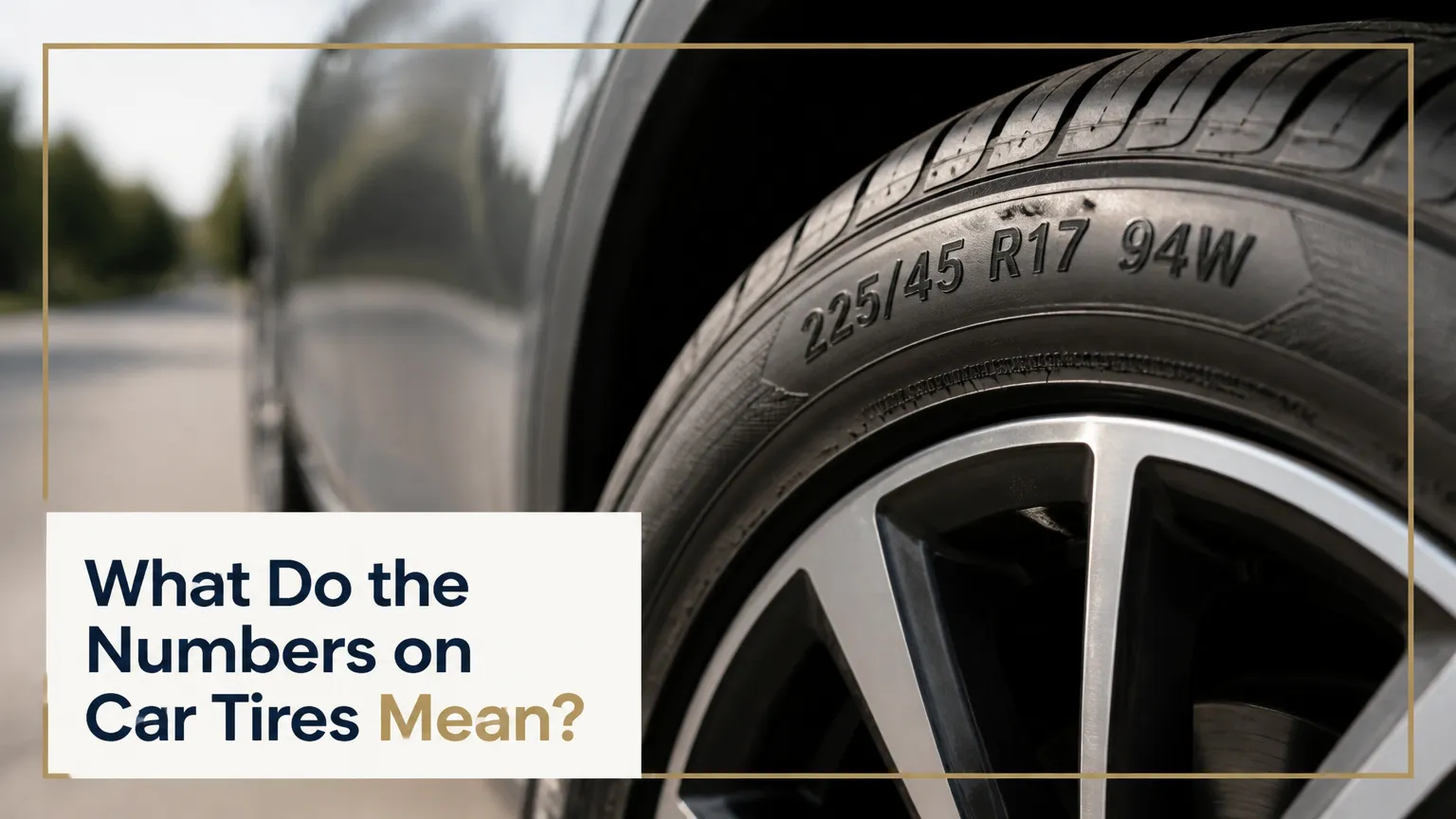
The numbers and letters stamped on a car tire sidewall represent its exact size class, width, aspect ratio, construction type, wheel diameter, load capacity, and maximum safe speed rating. Decoding this standardized alphanumeric sequence ensures proper vehicle handling, safety, and compatibility with factory specifications.
At a Glance:
- Tire codes follow a standardized format like P215/65R15 95H, detailing dimensions and performance thresholds.
- Section width is measured in millimeters from sidewall to sidewall, while wheel diameter is measured in inches.
- The load index and speed rating dictate the maximum weight and velocity the tire can safely support.
- Factory tire specifications are located on a placard inside the driver side door jamb, not just on the current tires.
- Tires degrade chemically over time and should generally be replaced after 6 to 10 years regardless of tread depth.
How Do I Read a Tire Size Code Step by Step?
Reading a tire size code requires breaking down each segment of the alphanumeric string into its designated mechanical category. A standard tire code, such as P215/65R15 95H, is read from left to right across seven distinct parameters.
- Vehicle Class (P): The prefix indicates the vehicle category the tire is engineered to support, such as passenger vehicles or light trucks.
- Section Width (215): The first three digits measure the width of the tire in millimeters from outer sidewall to inner sidewall.
- Aspect Ratio (65): The two digits following the slash express the sidewall height as a percentage of the section width.
- Construction Type (R): The letter denotes how the internal casing plies are arranged, with radial construction being the global standard.
- Wheel Diameter (15): The subsequent number specifies the diameter of the wheel rim in inches that the tire must be mounted on.
- Load Index (95): The two-digit number correlates to an official weight capacity table determining the maximum load per tire.
- Speed Rating (H): The final letter designates the maximum safe operating speed certified under standard test conditions.
What Is the Difference Between P-Metric and Euro-Metric Tire Codes?
P-metric and Euro-metric tire codes differ primarily in their load-carrying capacity calculations and regional engineering standards, even when their physical dimensions are identical. A P-metric tire always begins with the letter P, whereas a Euro-metric tire starts directly with numbers.
Euro-metric tires originate from European Tyre and Rim Technical Organisation standards, which calculate load capacities using a different mathematical formula than the Tire and Rim Association used in North America. For example, a P-metric tire and a Euro-metric tire of size 215/65R15 share the exact same physical dimensions, section width, and aspect ratio. However, under specific inflation pressures, their official load-carrying thresholds can vary slightly. Vehicle manufacturers account for this variance during original equipment production. Drivers replacing tires should always match the exact metric designation and load index specified on the vehicle placard rather than assuming interchangeability without checking load tables.
How Do I Find the Correct Tire Size for My Specific Car?
Finding the correct tire size for a specific vehicle requires locating the official manufacturer placard rather than simply copying the dimensions printed on the currently installed tires. The most accurate size specification is permanently printed on a yellow and white safety certification sticker located on the driver side door jamb or inside the glove box.
If a previous owner installed incorrect aftermarket tires, copying those numbers perpetuates the fitting error. The door placard lists the exact factory-approved tire dimensions, cold inflation pressures, and load requirements designed for that specific chassis weight distribution. Drivers can also verify compatibility by entering their vehicle identification number into online parts catalogs maintained by tire manufacturers or dealerships. Ensuring alignment with the door placard guarantees that the speedometer, transmission shifting points, and electronic stability control systems function according to engineering design parameters.
What Do Tire Load Index Numbers Actually Mean in Pounds?
A tire load index is a standardized two-digit or three-digit numerical code that corresponds to the maximum weight a single tire can safely support when inflated to its proper pressure. The index number does not represent pounds or kilograms directly; instead, it indexes into an industry-standard conversion chart.
For example, a load index of 95 corresponds to a maximum weight capacity of 1,477 pounds (670 kg) per individual tire. Multiplying this single-tire capacity by four yields the total gross vehicle weight limit supported by a full set of tires under ideal conditions. Installing replacement tires with a lower load index than the factory specification compromises the structural integrity of the vehicle under heavy cargo loads or emergency braking. Drivers hauling heavy payloads or towing trailers must always select replacement tires that match or exceed the original load index rating.
What Are Car Tire Speed Ratings and How Fast Can I Drive?
Car tire speed ratings are designated by a terminal letter code that establishes the maximum safe speed a tire can sustain over time without experiencing destructive heat buildup. These ratings are determined through rigorous laboratory testing where a tire is run at set speeds in 6-kilometers-per-hour increments until it passes certification.
Common speed ratings and their corresponding maximum velocity limits include:
- S Rating: Certified for speeds up to 112 mph (180 km/h), typically found on family sedans and minivans.
- T Rating: Certified for speeds up to 118 mph (190 km/h), common on standard passenger cars and light-duty SUVs.
- H Rating: Certified for speeds up to 130 mph (210 km/h), engineered for sports sedans and touring vehicles.
- V Rating: Certified for speeds up to 149 mph (240 km/h), utilized on high-performance passenger vehicles.
- Y Rating: Certified for speeds up to 186 mph (300 km/h), designed for exotic sports cars and high-output performance models.
Exceeding these limits for extended periods causes rubber compound breakdown and catastrophic tread separation. Drivers should never install tires with a lower speed rating than what was originally equipped by the factory.
What Do the Letters ZR Mean on High-Performance Tires?
The letters ZR embedded within a tire code, such as 245/40ZR18, historically indicated that a high-performance tire was engineered to sustain speeds exceeding 149 mph. In modern tire manufacturing, the ZR designation serves as an artifact of older classification systems while maintaining specific structural reinforcement for high-speed stability.
Modern high-performance tire labeling pairs the ZR designation with a complete service description at the end of the code, resulting in a string like 245/40ZR18 97Y. In this combined sequence, the ZR denotes the internal radial construction and high-speed capability of the casing, while the final 97Y explicitly defines the exact load index (97) and speed rating (Y). Drivers operating high-performance sports cars must ensure that any replacement tire featuring a ZR marking also includes the correct complementary load and speed index for their vehicle’s top-end capabilities.
What Do Off-Road Flotation Tire Sizes Mean?
Off-road flotation tire sizes use an imperial measurement system rather than the metric system, formatting dimensions as total outer diameter, section width, and wheel rim diameter. An example of a flotation size is 33×12.50R15.
Each component of a flotation tire size represents a distinct imperial measurement:
- 33: The total outer diameter of the inflated tire measured in inches from tread top to tread bottom.
- 12.50: The section width of the tire measured in inches across its widest point.
- 15: The diameter of the wheel rim in inches that the tire fits onto.
These tires are engineered for trucks, Jeeps, and off-road vehicles requiring high ground clearance and wide contact patches for soft surfaces like sand, mud, or snow. Converting flotation sizes to metric equivalents requires calculating overall rolling circumference to prevent drivetrain rubbing and speedometer calibration errors.
How Do I Read Commercial Truck Tire Codes and Load Ranges?
Commercial truck tire codes and load ranges utilize alphanumeric prefixes and letter grades to dictate structural ply ratings and maximum inflation pressures rather than standard two-digit load indexes. A typical commercial code appears as LT235/85R16 Load Range E.
The prefix LT designates a light truck classification designed for heavy towing and payload hauling. Following the dimensions and radial construction mark, the Load Range E designation indicates the internal ply rating strength of the tire. Commercial load ranges correspond to specific maximum cold inflation pressures and load capacities:
- Load Range C: Equivalent to a 6-ply rating, designed for moderate utility loads.
- Load Range D: Equivalent to an 8-ply rating, suited for medium-duty commercial transport.
- Load Range E: Equivalent to a 10-ply rating, capable of high inflation pressures for heavy-duty towing.
- Load Range F: Equivalent to a 12-ply rating, utilized on heavy commercial pickup trucks and dual-wheel configurations.
Operators must match commercial load ranges to vehicle weight demands to prevent sidewall flexing, excessive heat generation, and premature tire failure.
How Do I Check the Manufacturing Date and Age of a Tire?
Checking the manufacturing date of a tire requires locating the Department of Transportation (DOT) code stamped into the lower sidewall and reading its final four digits. The DOT serial number begins with the letters DOT followed by manufacturing plant codes, culminating in a four-digit date stamp.
For example, a DOT code ending in 2425 indicates that the tire was manufactured during the 24th week of the year 2025. The first two digits represent the production week, while the final two digits designate the production year. Tires undergo chemical degradation, rubber oxidation, and structural weakening over time due to UV exposure and temperature fluctuations, regardless of remaining tread depth. Industry safety guidelines recommend inspecting tires annually after five years of service and replacing all tires once they reach 6 to 10 years from their manufacturing date.
What Is the Difference Between M+S and Three-Peak Mountain Snowflake Symbols?
The difference between an M+S rating and a Three-Peak Mountain Snowflake symbol lies in the rigor of testing required to earn each designation. A tire’s sidewall symbols dictate its true capability in winter weather conditions.
- M+S (Mud and Snow): This marking indicates that the tire features a tread pattern with void areas and slotting designed to clear mud and snow more effectively than a standard summer tire. M+S ratings are based purely on physical tread geometry and do not require passing any standardized cold-weather traction testing.
- Three-Peak Mountain Snowflake (3PMSF): This symbol depicts a mountain with a snowflake inside and proves that the tire has passed rigorous, standardized American Society for Testing and Materials braking tests on packed snow. Tires bearing the 3PMSF symbol deliver certified traction and stopping performance in severe winter weather environments.
Drivers navigating heavy winter climates should prioritize 3PMSF-certified tires rather than relying solely on legacy M+S designations.
Why Should I Ignore the Maximum Pressure Number on the Sidewall?
Drivers should ignore the maximum pressure number printed on the tire sidewall during routine inflation because that figure represents the absolute structural limit of the tire rather than the vehicle’s recommended operating pressure. A sidewall marking such as 44 PSI Max Press indicates the highest pressure the tire can safely contain under maximum load, not the optimal pressure for daily ride comfort, braking traction, and uniform tread wear.
Inflating tires to the maximum sidewall pressure causes over-inflation, reducing the tire’s contact patch, degrading handling performance, creating a harsh ride, and causing premature center tread wear. The correct cold inflation pressure is found exclusively on the vehicle placard located on the driver side door jamb, which typically specifies pressures between 30 and 35 PSI for standard passenger cars.
What Happens If I Install the Wrong Tire Size on My Vehicle?
Installing the wrong tire size on a vehicle disrupts mechanical tolerances, alters rolling circumference, and causes severe secondary vehicle malfunctions. If a replacement tire deviates significantly from factory height specifications, the mechanical and electronic systems of the car experience immediate errors.
Incorrect sizing causes speedometer and odometer inaccuracies, leading to incorrect fuel economy calculations and improper transmission shift timing. Furthermore, oversized tires can rub against inner wheel wells, suspension components, or brake lines during turning maneuvers, leading to structural damage or tire blowouts. Additionally, mismatched overall tire diameters confuse modern anti-lock braking systems and electronic stability control sensors, impairing emergency stopping distances and vehicle stability.
Can I Mix Tires with Different Speed Ratings or Load Indexes?
Mixing tires with different speed ratings or load indexes compromises vehicle handling stability, introduces uneven traction characteristics, and violates safety engineering guidelines. If emergency handling maneuvers require maximum tire grip, mismatched ratings create dangerous handling imbalances between the front and rear axles.
If mixing tires is unavoidable due to an emergency roadside replacement, federal safety guidelines dictate that tires with lower speed ratings or load indexes must be installed on the front axle to maintain rear-end stability during cornering. However, mixing different tire constructions—such as combining radial and bias-ply tires—is strictly prohibited due to erratic vehicle control risks. Best practice dictates replacing all four tires simultaneously, or at minimum, matching exact load indexes and speed ratings across each individual axle.
What Is the “Plus Sizing” Trap When Buying Larger Aftermarket Rims?
The “plus sizing” trap occurs when vehicle owners install larger aftermarket rims without proportionally reducing the tire aspect ratio, altering the overall outer diameter of the wheel assembly. When upgrading to a larger wheel diameter, the tire sidewall must become shorter to keep the total outer circumference identical to factory specifications.
For example, upgrading from a 15-inch rim to a 17-inch rim requires transitioning to a lower aspect ratio tire to prevent overall diameter growth. Failing to adjust the aspect ratio causes the larger assembly to rub against suspension components, disrupts anti-lock braking system calibrations, and throws off transmission shift mapping. Adhering to plus-sizing mathematics ensures that rim upgrades enhance cornering stiffness without compromising safety systems or mechanical clearances.
How Do I Choose the Right Replacement Tires for My Driving Conditions?
Choosing the right replacement tires requires balancing local climate conditions, annual mileage expectations, vehicle drive configuration, and personal driving preferences. Selecting an optimal tire model involves evaluating three primary categories:
- Climate and Temperature: Drivers in regions with ambient temperatures consistently dropping below 45 degrees Fahrenheit require dedicated winter tires or All-Weather tires bearing the 3PMSF symbol. Standard summer or grand touring tires lose rubber compound flexibility and braking traction in freezing temperatures.
- Tread Compound and Lifespan: High-performance summer tires utilize soft rubber compounds for maximum cornering grip but wear out rapidly within 25,000 to 30,000 miles. Conversely, All-Season touring tires utilize hard compounds designed to deliver extended treadwear warranties ranging from 60,000 to 80,000 miles.
- Driving Style and Priority: Drivers prioritizing comfort and quiet highway commuting should select touring tires with optimized pitch sequencing. Performance-oriented drivers should select high-speed-rated tires with stiff shoulder blocks for responsive steering feedback.
Consulting local tire professionals and matching the exact load index and speed rating from your vehicle door placard ensures a safe, balanced driving experience.


