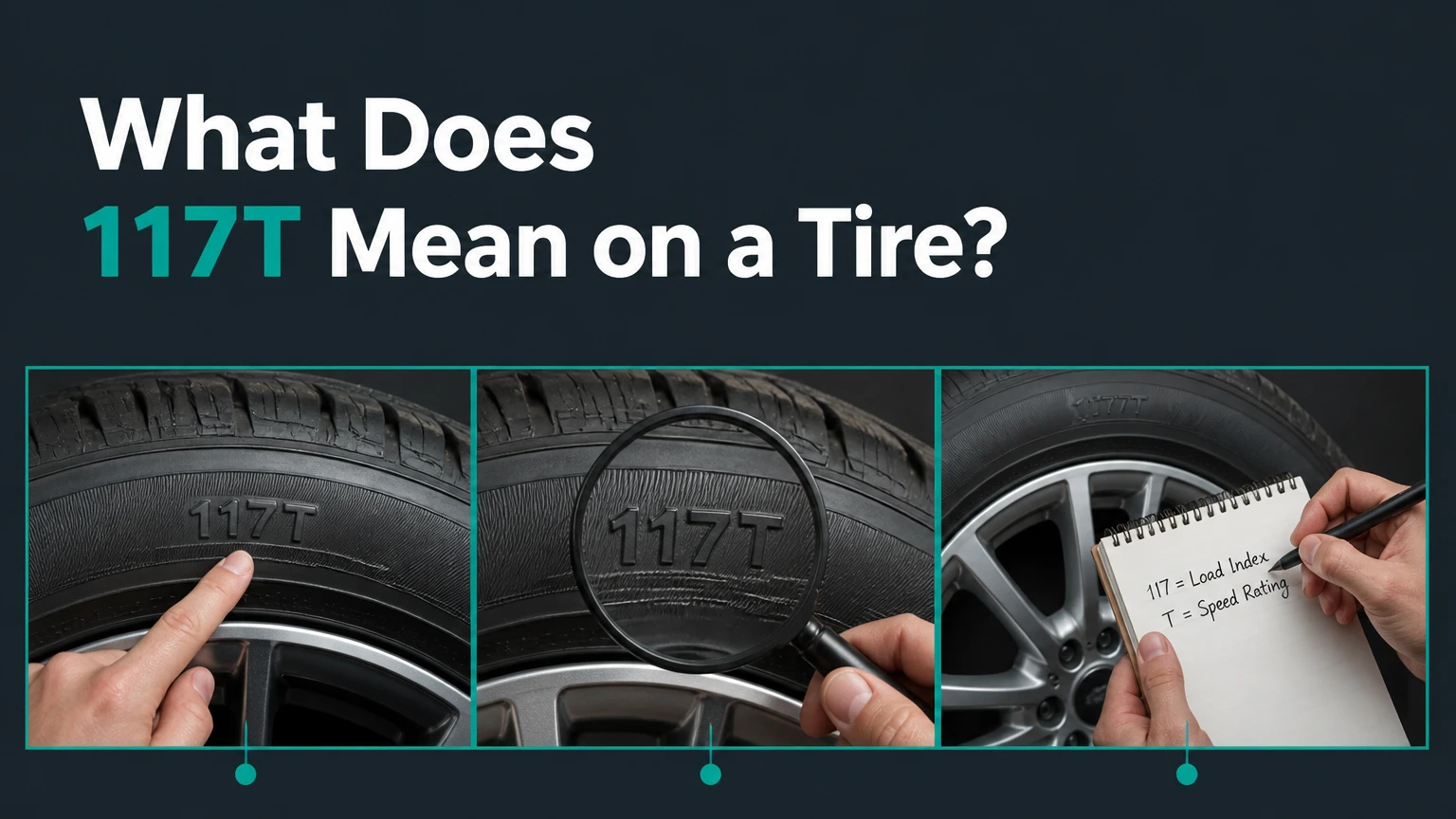
A tire marked with 117T features a standardized service description where 117 represents the load index denoting a maximum capacity of 2,811 pounds per tire, and T represents the speed rating indicating a safe maximum velocity of 118 mph. This specification appears on heavy-duty passenger vehicles, vans, and light trucks.
At a Glance: Key 117T Tire Facts
- Load Index 117: Each individual tire safely supports up to 2,811 lbs (1,275 kg) at maximum rated inflation pressure.
- Speed Rating T: The structure withstands a maximum speed threshold of 118 mph (190 km/h) under standard testing.
- Combined Capacity: A standard four-wheel vehicle fitted with four 117T tires possesses a theoretical maximum gross weight capacity of 11,244 lbs.
- Critical De-rating: Dual-wheel setups require a 9 percent load capacity reduction to account for weight transfer and road crowns.
- Inflation Dependency: Operating below recommended PSI placard levels destroys the certified load capacity of the tire.
What Does the Load Index Number 117 Mean in Pounds and Kilograms?
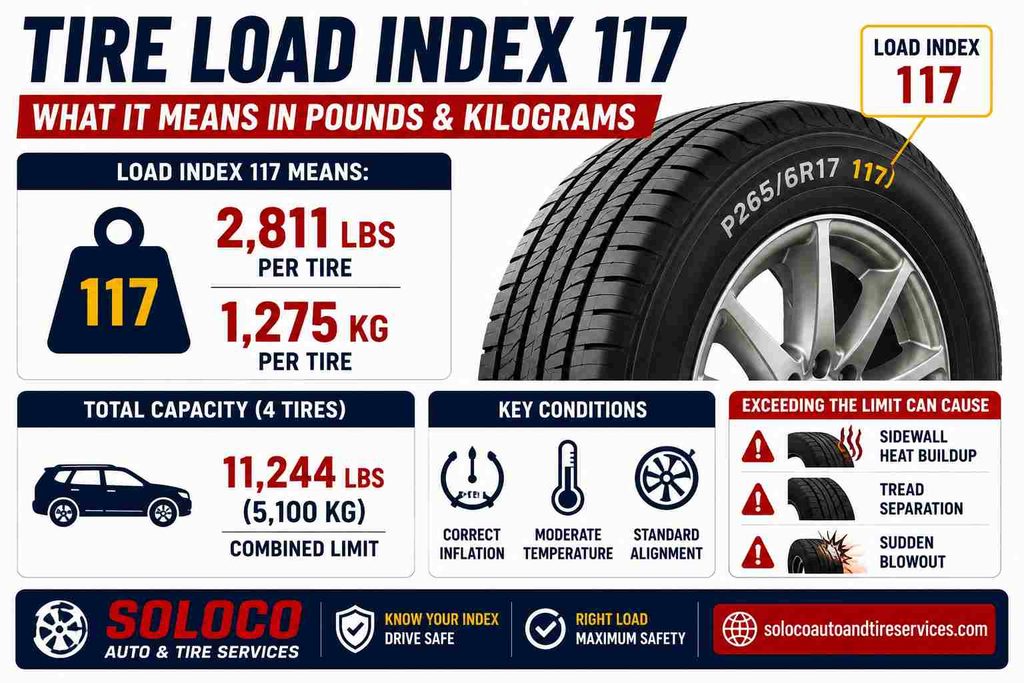
The numerical code 117 specifies the maximum weight an individual tire can safely support when inflated correctly. According to official standardized tire load index charts, a rating of 117 equals 2,811 pounds or 1,275 kilograms per single tire.
Vehicle owners must multiply this individual capacity by the total number of wheels to determine the gross axle weight rating threshold. For a standard four-wheel passenger vehicle or light truck, four tires carrying a 117 index provide a combined structural limit of 11,244 pounds (5,100 kg). This rating assumes the tire operates under optimal inflation pressure, moderate ambient temperatures, and standard alignment geometry. Exceeding this numerical threshold causes internal sidewall heat accumulation, accelerated tread separation, and sudden blowout events.
What Does the T Speed Rating Letter Mean in Miles Per Hour?
The letter T designates the maximum speed capability that a tire can safely sustain while carrying its designated load index weight. A T speed rating signifies a certified limit of 118 miles per hour (190 km/h).
Automotive manufacturers commonly assign T-rated tires to family sedans, crossovers, minivans, and light-duty utility vehicles that require reliable high-way endurance without extreme sports-car performance profiles. This classification results from rigorous laboratory testing where a drum wheel rotates against the tire under regulated conditions. While a T rating easily accommodates legal highway speeds and passing maneuvers, drivers should treat 118 mph as an absolute structural ceiling rather than a recommended cruising velocity.
How Does Dual-Tire De-rating Change the 117 Load Index Capacity?
Installing 117T tires in a dual-assembly configuration on commercial vans or heavy-duty trucks requires an automatic 9 percent load capacity reduction. Mechanics and fleet operators call this process dual-tire de-rating.
The mathematical calculation reduces the single-tire limit of 2,811 pounds down to 2,558 pounds per tire. Dual setups necessitate this adjustment because heavy commercial vehicles experience uneven weight distribution caused by the natural crown of public roadways. Furthermore, de-rating provides a vital safety buffer: if the outer tire on a dual assembly suffers a sudden puncture, the remaining inner tire temporarily absorbs extra load without experiencing catastrophic structural failure.
How Do P-Metric and Euro-Metric Standards Alter 117 Tire Capacity?
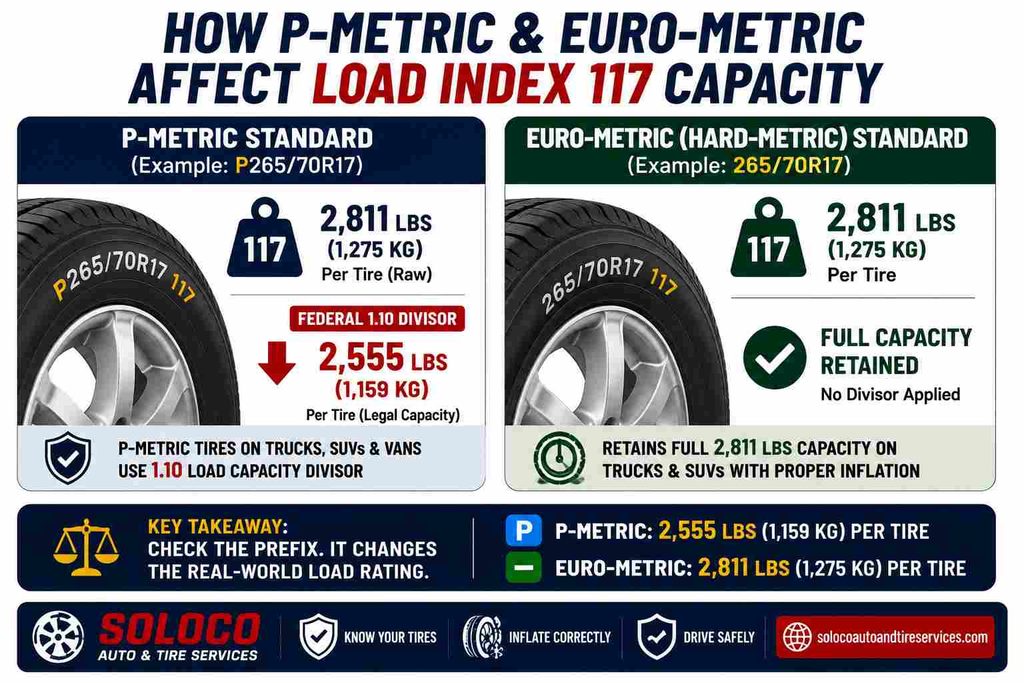
Vehicle owners must examine the prefix letters preceding the tire size string, such as P265/70R17 versus 265/70R17, because sizing standards dictate different legal load boundaries.
P-metric tires installed on light trucks, SUVs, or utility vans are subject to federal safety regulations requiring a 1.10 load capacity divisor. Applying this federal rule to a P-metric tire with a 117 load index drops the capacity from 2,811 pounds down to 2,555 pounds (1,159 kg).
Conversely, Euro-metric or hard-metric tires featuring no leading letter retain their full 2,811 pounds capacity on trucks and SUVs, provided the driver maintains proper inflation pressure matching the vehicle placard.
What Is High-Speed Load Degradation and How Does It Affect 117T Tires?
High-speed load degradation describes the physical phenomenon where continuous operation near a tire speed rating forces a reduction in maximum weight capacity. Although more prominent in ultra-high-performance V, W, or Y tires, T-rated tires also experience structural fatigue during sustained high-velocity driving.
Operating a heavily loaded vehicle near 110 mph on hot summer asphalt generates intense internal hysteresis friction within the rubber compounds. This thermal energy buildup softens the internal polyester and steel cord plies. Consequently, a tire subjected to continuous high-speed heat cannot safely sustain its maximum rated limit of 2,811 pounds. Drivers undertaking long-distance highway travel with heavy cargo should maintain moderate speeds to preserve tire integrity.
Why Does a Tire Fail Its Weight Limit Even When Total Vehicle Weight Is Under Capacity?
A vehicle weighing 10,000 pounds total can still suffer a catastrophic tire blowout on four 117T tires—which possess an 11,244-pound combined limit—due to unequal axle weight distribution.
Real-world weight distribution is rarely split evenly across all four corners. For instance, a pickup truck towing a heavy tongue-weight equipment trailer might place 70 percent of its total mass entirely over the rear axle. In this scenario, the individual rear tires exceed their 2,811-pound threshold even though the overall truck scale weight remains legal. Professional haulers prevent this hazard by weighing individual vehicle axles rather than relying solely on total vehicle mass calculations.
How Does Low Tire Inflation Reduce the Safe Weight Limit of a 117T Tire?
The certified load capacity of 2,811 pounds is valid exclusively when the tire is inflated to its maximum cold pressure rating stamped on the sidewall, which is typically 44 or 50 PSI. Under-inflation drastically diminishes load capability.
If a vehicle placard recommends an operating pressure of 32 PSI and a driver allows pressure to drop to an unmonitored 22 PSI, the load-bearing air volume inside the carcass becomes insufficient. The tire sidewall flexes excessively with every wheel revolution, generating extreme internal heat. A severely under-inflated 117T tire may lose hundreds of pounds of safe load capacity, leading to internal ply separation and tread chunking long before the tread wears out.
How Many Years Before a 117T Tire Loses Its Structural Load and Speed Capability?
A 117T tire loses its certified structural load and speed capability after six years from the manufacturing date, regardless of remaining tread depth. Rubber compound oxidation compromises safety over time.
Mechanics determine the exact manufacturing age by inspecting the four-digit Department of Transportation date code stamped on the tire sidewall (for example, a code of 2423 indicates the tire was built during the 24th week of 2023). As rubber ages past the six-to-eight-year mark, internal oils evaporate, causing micro-fissures in the steel belts and bead wire insulation. An aged 117T tire with pristine tread can still suffer sudden structural failure at highway speeds.
Can I Mix 117T Tires with Different Load or Speed Ratings on the Same Axle?
Mixing 117T tires with tires of different load or speed ratings on the same axle creates severe handling imbalances and instability. Professional technicians strictly prohibit mixing disparate tire constructions.
Different ratings feature distinct sidewall stiffness, tread compound elasticity, and cornering slip angles. Combining a stiff tire with a flexible tire on a single drive axle causes unpredictable steering response, compromised anti-lock braking performance, and Electronic Stability Control calibration errors. In an absolute roadside emergency where mixing axles becomes unavoidable, drivers must mount the higher-rated, safer tires on the rear axle to prevent dangerous oversteer and hydroplaning conditions.
Can I Replace 117T Tires with a Lower Load Index Like 115H?
Replacing factory 117T tires with a lower load index rating like 115H is unsafe and prohibited. Vehicle owners must never downgrade load index specifications during replacement.
While an H speed rating indicates a higher velocity capability of 130 mph compared to a T rating’s 118 mph, the numerical index dictates physical weight limits. A 115 load index reduces capacity from 2,811 pounds down to 2,679 pounds per tire, stripping away 132 pounds of vital load margin per corner. Downsizing load indices violates federal safety guidelines, accelerates mechanical wear, and invalidates standard automotive insurance coverage during an accident investigation.
Is the T Speed Rating Safe for Continuous Cruising at 118 mph?
Treating the T speed rating as a safe cruising velocity for prolonged driving is dangerous and impractical. The 118 mph threshold represents a laboratory test limit rather than a sustained operational recommendation.
Standardized speed ratings are achieved in controlled indoor laboratory settings using pristine steel test drums under perfect ambient temperatures. Real-world driving introduces destructive variables including sharp potholes, road debris, fluctuating asphalt temperatures, wheel misalignment, and aerodynamic drag. Continuous driving at high speeds on summer pavement elevates tire temperatures rapidly, increasing the risk of tread separation. Drivers should keep cruising speeds well below the maximum T rating ceiling.
How Do I Verify if a 117T Tire Matches My Vehicle Placard Requirements?
Verifying proper tire match requires comparing the replacement tire specifications against the official vehicle safety placard located on the driver-side door jamb.
Vehicle owners should open the driver’s door and locate the white and yellow federal certification label. This placard lists the exact original equipment tire size, cold inflation pressure, and minimum acceptable load and speed ratings mandated by the automotive manufacturer. If the placard specifies a 117 load index, the replacement tire must match or exceed that exact numerical value while fitting the specified rim diameter and load range.
The Bottom Line
A 117T tire specification certifies a maximum load capacity of 2,811 pounds and a speed rating limit of 118 mph per tire. Maintaining these structural safety thresholds requires proper cold inflation pressure, strict adherence to single versus dual-axle configuration rules, and avoidance of aged rubber compounds. Always match or exceed original equipment manufacturer placard specifications to ensure optimal vehicle stability and legal compliance.


