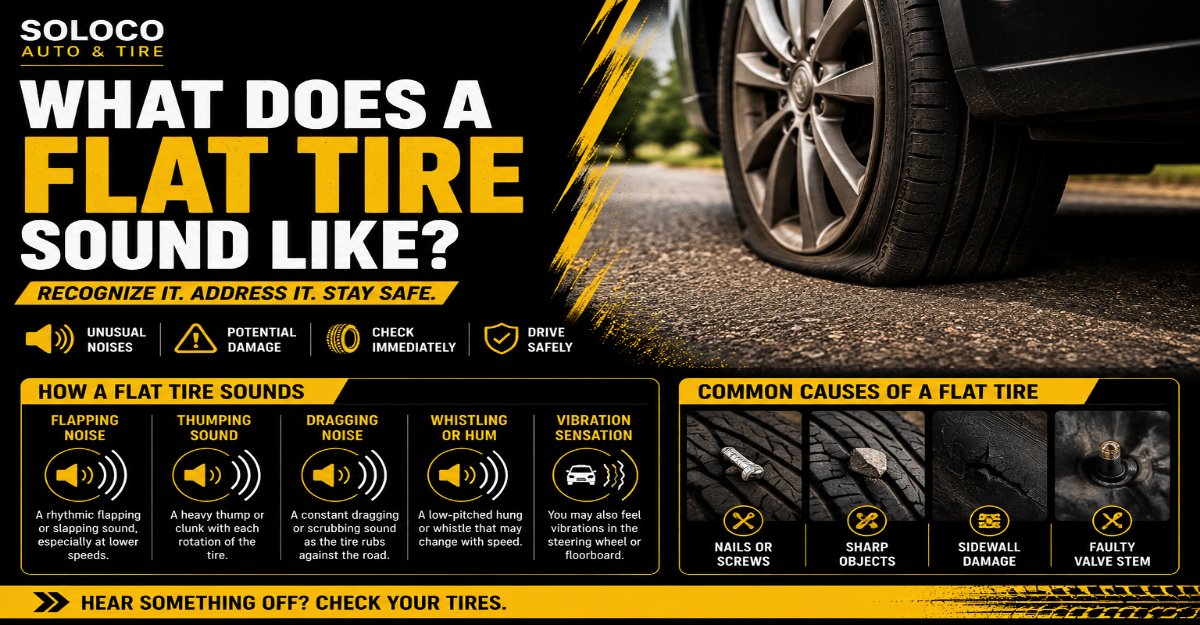
A flat tire produces a rhythmic, low frequency thump or a continuous vibrating hum that changes tempo with your vehicle speed.
At lower speeds it creates a distinct flop flop sound, while highway speeds turn this into a loud drumming vibration caused by the rolling resistance of the deflated sidewall pressing against the asphalt.
At a Glance
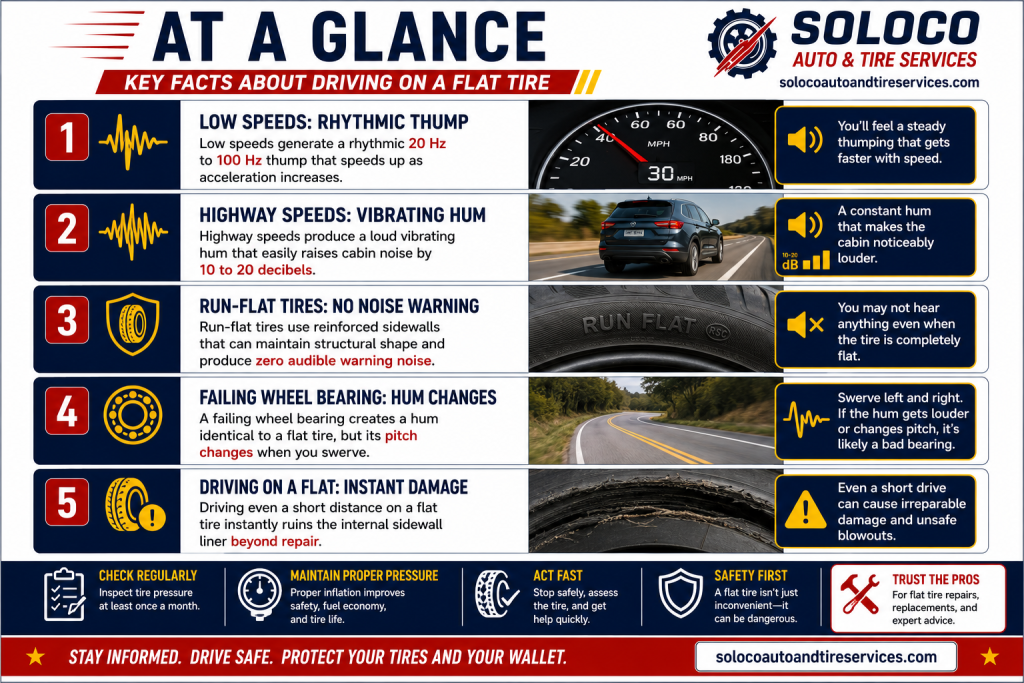
- Low speeds generate a rhythmic 20 Hz to 100 Hz thump that speeds up as acceleration increases.
- Highway speeds produce a loud vibrating hum that easily raises cabin noise by 10 to 20 decibels.
- Run-flat tires use reinforced sidewalls that can maintain structural shape and produce zero audible warning noise.
- A failing wheel bearing creates a hum identical to a flat tire, but its pitch changes when you swerve.
- Driving even a short distance on a flat tire instantly ruins the internal sidewall liner beyond repair.
What Does a Flat Tire Sound Like at Low Speeds vs Highway Speeds?
A flat tire changes acoustic output dramatically based on how fast the vehicle is moving. At low speeds between 10 and 30 kilometers per hour, a deflated tire produces a heavy, rhythmic thump thump thump or flop flop flop that mirrors the exact rotation of the wheel. As you accelerate to highway speeds between 60 and 100 kilometers per hour, that intermittent thumping blurs into a loud, continuous vibrating hum or a deep structural drumming noise. If the tire suffers a sudden structural failure instead of a slow leak, it produces an immediate loud bang followed by a violent flapping sound against the inner fender well.
What Frequency and Decibel Levels Does a Flat Tire Produce?
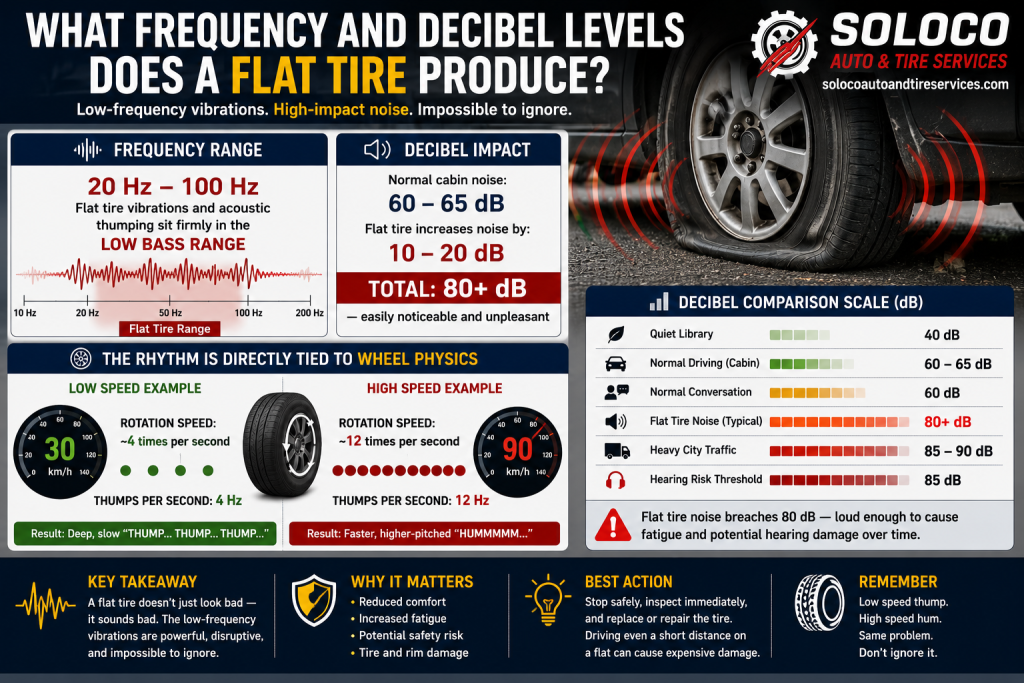
Structural tire vibrations and acoustic thumping sit firmly in the low bass range between 20 Hz and 100 Hz. While a standard vehicle cabin maintains a quiet background noise level around 60 to 65 decibels during normal operation, a flat tire increases interior cabin noise by 10 to 20 decibels. This spike easily breaches 80 decibels, creating an unmistakable acoustic environment.
The rhythm is directly tied to wheel physics. At 30 kilometers per hour, a standard passenger car tire rotates approximately 4 times per second, creating a 4 Hz thump. At 90 kilometers per hour, rotation jumps to roughly 12 times per second, turning the low speed thump into a high frequency 12 Hz hum.
Why Do Run-Flat Tires and High-Profile Tires Make No Sound When Flat?
Certain tire designs completely bypass traditional acoustic warning signs, leaving drivers entirely unaware of a puncture. Run-flat tires feature heavily reinforced sidewalls engineered to support the weight of the vehicle even when internal air pressure drops to zero. Because the rigid sidewall prevents the tire from collapsing flat against the road, these tires produce zero structural sound changes, requiring drivers to rely strictly on their Tire Pressure Monitoring System dashboard alert. Similarly, high-profile tires found on large SUVs and off-road trucks use massive, thick rubber sidewalls and ultra-soft winter rubber compounds that absorb the impact of pressure loss without generating any distinct thumping sound on smooth tarmac.
How Can You Tell the Difference Between a Flat Tire and a Failing Wheel Bearing?
A failing wheel bearing creates a continuous humming or droning sound that directly mimics a flat tire at high speeds, but you can differentiate them through a simple steering test. When a wheel bearing goes bad, the acoustic pitch changes or temporarily disappears when you gently swerve the steering wheel from side to side to shift vehicle weight across the chassis. In contrast, a flat tire sound remains entirely constant regardless of steering angle because the physical deformation of the tire rubber stays the same. Drivers frequently make the mistake of replacing tires when the root cause is actually a worn wheel bearing assembly.
Can Packed Mud or Snow Inside a Wheel Rim Mimic a Flat Tire?
Packed mud, ice, or heavy snow stuck inside the interior cavity of a wheel rim creates a severe rotational weight imbalance that mimics a flat tire. As the wheel spins at high speeds, this localized weight clump generates a heavy low-frequency structural vibration and a repetitive thumping sound through the steering wheel and floorboards. The vehicle behaves acoustically as though it has a flat tire, even though the tire pressure gauge reads normal. Inspecting the inner wheel barrel with a flashlight will quickly reveal whether the vibration stems from a puncture or accumulated winter debris.
Can I Drive 1 Mile on a Flat Tire Without Ruin?
Driving even 400 meters on a completely flat tire will permanently shred the inner sidewall liner and ruin the tire beyond repair. When air pressure drops to zero, the weight of the vehicle crushes the rubber tread directly against the sharp steel wheel rim. As the wheel turns, the metal edge slices through the inner structure of the tire like a cookie cutter, generating intense frictional heat that destroys the structural integrity of the rubber. Attempting to drive a full mile guarantees total tire destruction and risks bending or cracking your expensive alloy wheel rim.
Why Does My Tire Lose Air Pressure Even Though There Is No Nail in the Tread?
A tire can lose air pressure rapidly without any visible nail or screw in the tread pattern due to underlying mechanical seal failures. The most common culprits include a leaking valve stem, a corrosion-induced bead leak where the rubber tire meets the edge of the alloy wheel rim, or a small hairline crack in the alloy wheel itself caused by hitting a deep pothole. Mechanics often find that microscopic oxidation builds up on aluminum wheel lips over time, pushing the rubber away and allowing pressurized air to escape slowly into the atmosphere.
Will a Parked Flat Tire Pop or Explode If Left Sitting?
A stationary flat tire will never pop or explode because there is no internal air pressure or mechanical heat buildup to cause a structural rupture. When a tire loses all its air while parked in a driveway, the rubber simply collapses under the static weight of the vehicle. Explosive tire failures only occur under dynamic driving conditions where high speed, heavy load, and extreme friction generate massive internal heat and pressure spikes. A parked flat tire is entirely stable and safe to leave sitting until you can arrange for a replacement or repair.
What Does a Slow Puncture Sound Like Compared to a Sudden Blowout?
A slow puncture begins as an entirely silent process, gradually introducing a faint, intermittent slapping noise only after air pressure drops low enough for the tread to flex outward. This noise starts subtly on smooth roads and slowly intensifies over several miles as the tire loses structural rigidity. A sudden blowout, by contrast, gives no advance warning. It initiates with a violent explosive bang followed immediately by a harsh, metallic scraping or loud rhythmic flapping as the shredded rubber whips against the vehicle body.
Does a Front Tire Flat Sound Different from a Rear Tire Flat?
A front tire flat sounds significantly louder and feels much more intrusive because it sits directly beneath the engine bay and controls the steering mechanism. When a front tire goes flat, you immediately feel a heavy drag, intense vibrations in the steering wheel, and a strong pull toward the side of the puncture. A rear tire flat produces a more muted, distant thumping sound that resonates through the rear cargo floorboards and seat cushions. The vehicle will feel loose or squishy in the rear, but the steering wheel will remain largely free of direct feedback.
How Does Driving on Coarse Chip-Seal Roads Mask a Flat Tire Sound?
Coarse chip-seal roads feature a heavily textured, rough aggregate surface that generates an extremely loud baseline road noise inside any moving vehicle. This high-decibel ambient roar can completely mask the initial flapping and thumping sounds of a flat tire. Drivers on chip-seal highways often remain completely unaware of a developing flat tire until the rubber begins to shred apart entirely or until the vehicle handling degrades to a dangerous level. You must rely on physical vehicle handling cues rather than audio cues when driving on rough asphalt textures.
What Causes a Rhythmic Flapping Noise That Sounds Like a Flat Tire?
A loose piece of plastic underbody shielding, a broken splash guard, or a torn fender liner will flap violently against the rotating tire at high speeds, perfectly mimicking a flat tire. As wind rushes under the vehicle, it catches the loose plastic component and forces it to strike the tire tread repeatedly. This creates a rhythmic slapping sound that speeds up and slows down with vehicle momentum. Drivers frequently pull over to inspect their tires in a panic, only to find the tires fully inflated while a plastic bumper clip has snapped loose.
How Do You Check for a Flat Tire Without Getting Out of the Car?
You can diagnose a suspected flat tire from the driver seat by observing three distinct vehicle behaviors before opening the door. First, check if the car persistently pulls hard to the left or right when you release the steering wheel on a straight road. Second, monitor your steering wheel for a heavy, uneven vibration or a limp, sluggish response during minor turns. Third, observe your vehicle acceleration curve. A flat tire creates massive rolling resistance, requiring you to press the accelerator pedal down much further than normal just to maintain a steady cruising speed.
What Immediate Mechanical Damage Occurs If You Drive on a Deflated Tire?
Driving on a completely deflated tire triggers a cascade of rapid mechanical failures across multiple vehicle components. First, the friction between the bare metal rim and the road generates extreme heat that melts the rubber beads and permanently warps the tire casing. Second, the impact shock travels directly into the suspension system, damaging ball joints, control arm bushings, and wheel alignment geometry. Finally, the hard metal wheel rim strikes road hazards directly, which easily shatters alloy wheels or bends steel rims beyond repair, turning a simple tire replacement into an expensive suspension overhaul.
The Bottom Line
A flat tire produces a distinct low-frequency thumping or continuous hum that changes tempo with your speed, though certain run-free and high-profile designs make no sound at all. Always cross-reference acoustic clues with steering feel and vehicle pull to separate true punctures from wheel bearing failures or loose body plastic. Never drive on a deflated tire, as doing so instantly ruins the rubber liner and risks severe damage to your wheel rims and suspension components.