Load Range E on a tire indicates a heavy-duty, 10-ply rated construction engineered to carry a maximum weight of up to 3,860 pounds per tire at a maximum cold inflation pressure of 80 psi. These robust tires are specifically manufactured for three-quarter-ton trucks, one-ton trucks, heavy-duty commercial trailers, and large utility vehicles that require exceptional structural integrity under heavy payloads.
At a Glance: Load Range E Core Facts
- Load Range E tires feature a heavy-duty 10-ply rating using high-strength synthetic cords that deliver equivalent structural strength without actual physical layers of heavy fabric.
- The maximum cold inflation pressure for standard North American light truck Load Range E tires is strictly 80 psi or 550 kPa.
- Individual tire load capacities typically range from 3,042 pounds to 3,860 pounds depending on overall wheel diameter and rim sizing.
- Dual rear wheel dually configurations require a mandatory 9% to 10% load capacity derating per tire to account for road crowning and weight shifts.
- Running Load Range E tires completely empty at the maximum 80 psi pressure causes severe center treadwear and a harsh, rigid ride quality.
What Does 10-Ply Rated Mean for a Load Range E Tire?
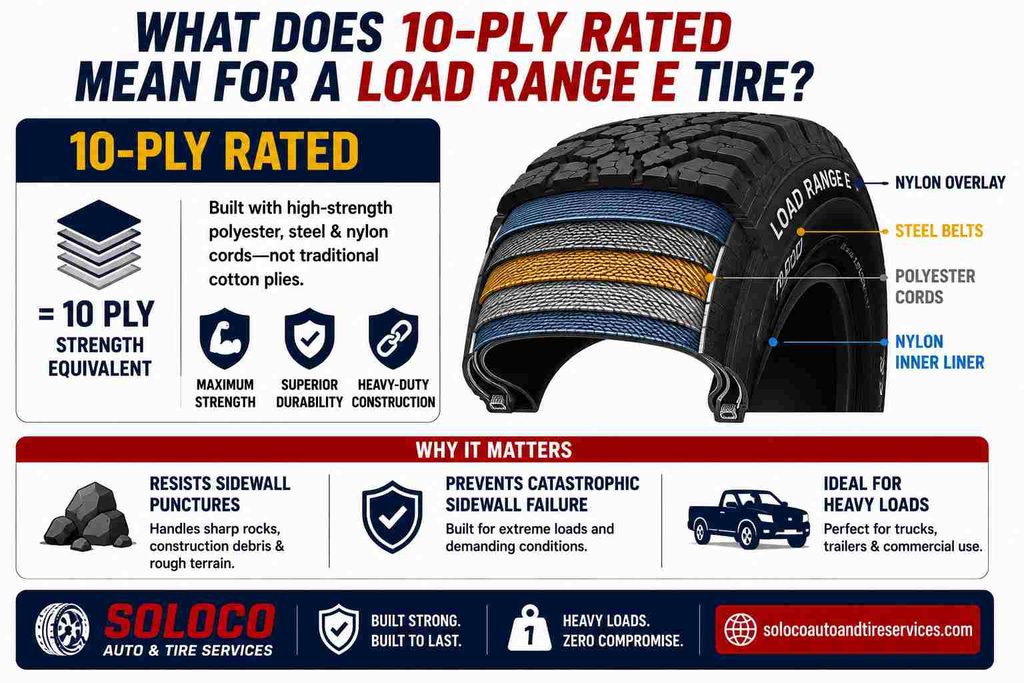
A 10-ply rating designates a structural strength classification equivalent to ten traditional layers of cotton fabric cord, although modern Load Range E tires use high-tensile polyester, steel, and nylon cords.
Modern manufacturing techniques achieve this immense durability through advanced synthetic chemistry rather than stacking physical plies. This heavy-duty internal architecture prevents catastrophic sidewall punctures when traversing sharp rocks, construction debris, or jagged job site terrain.
How Much Weight Can a Load Range E Tire Safely Hold?
Load Range E tires safely support between 3,042 pounds and 3,860 pounds per individual tire when inflated to their maximum threshold. Smaller 15-inch and 16-inch rim diameters generally cap out near the lower end around 3,042 to 3,415 pounds. Larger 17-inch, 18-inch, and 20-inch light truck sizes support up to 3,860 pounds per tire. These impressive weight ratings allow a standard four-wheel setup to carry total gross vehicle weight ratings that exceed 11,000 pounds easily.
What Is the Difference Between Load Range D and Load Range E?
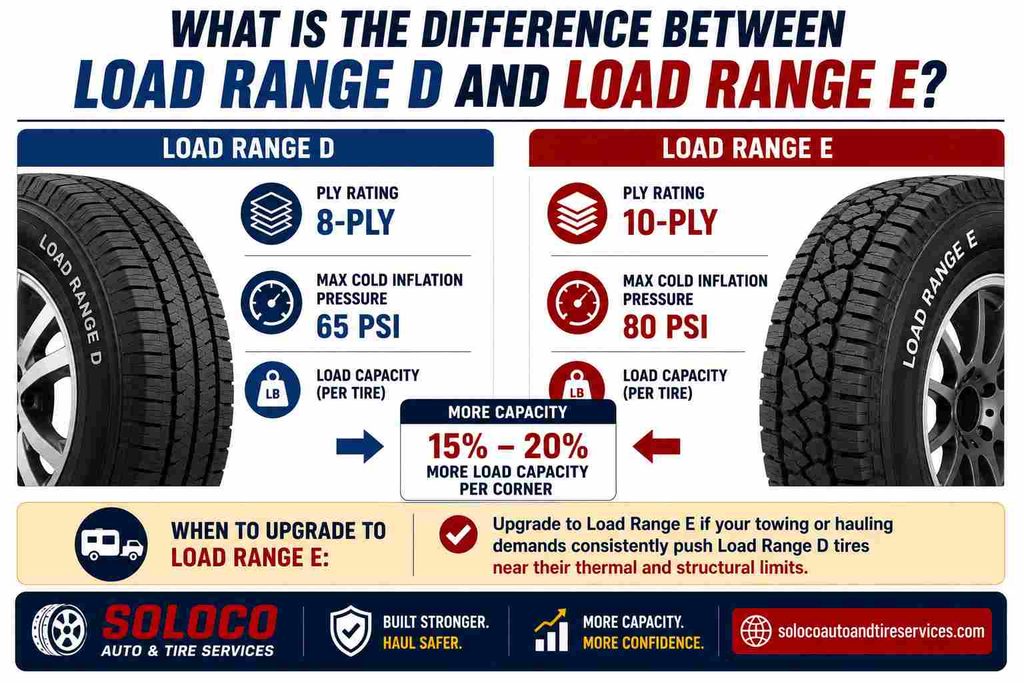
Load Range D tires feature an eight-ply rating and a maximum cold inflation pressure of 65 psi, whereas Load Range E tires feature a ten-ply rating and an 80 psi maximum pressure limit.
Choosing Load Range E over Load Range D increases your maximum load capacity by roughly 15% to 20% per corner. Upgrade to Load Range E if your towing or hauling demands consistently push Load Range D tires near their thermal and structural limits.
Can I Put Load Range E Tires on a Half-Ton Truck?
You can install Load Range E tires on a half-ton truck, but doing so introduces notable trade-offs in ride quality and fuel economy. The heavier casing increases unsprung weight, which slightly reduces fuel efficiency and stiffens suspension feedback. You must lower your cold inflation pressure to roughly 45 to 50 psi when driving unloaded to prevent center tread destruction. Furthermore, your factory wheels must possess a rim structural rating high enough to withstand 50 psi or higher pressures safely.
What Are the Risks of Installing Load Range E Tires on Incompatible Wheels?
Mounting Load Range E tires onto older or light-duty wheel rims not rated for high pressure risks catastrophic wheel failure, rim cracking, or sudden bead unseating. Factory half-ton wheels are frequently engineered for standard passenger car pressures capped at 35 to 44 psi. Pumping a Load Range E tire to 80 psi on an unrated wheel places immense hoop stress on the metal rim flange. Always verify your wheel stamping or manufacturer specification sheet before inflating heavy-duty truck tires past standard thresholds.
Can I Mix Load Range D and Load Range E Tires on the Same Vehicle?
Never mix Load Range D and Load Range E tires on the same axle or across different positions of the same vehicle. Mixing tire load ranges creates severe handling imbalances, unpredictable braking traction, and dangerous yaw dynamics during emergency maneuvers. Different construction ratings flex at entirely different rates under identical loads, which can trick electronic stability control systems and overheat four-wheel-drive transfer cases.
Why Does My Truck Ride So Rough with Load Range E Tires?
Trucks ride harshly with Load Range E tires because the stiff 10-ply sidewalls fail to absorb small road imperfections when inflated to their maximum 80 psi rating while unladen. When a heavy-duty truck bed carries no cargo, the vehicle weight is insufficient to deflect the heavy rubber and steel belts. This lack of deflection transmits every bump directly into the vehicle cabin, creating the infamous kidney-rattler effect. Lowering the inflation pressure according to official vehicle load tables immediately restores ride comfort.
What Is the Correct Tire Pressure for an Unloaded Load Range E Tire?
The correct tire pressure for an unloaded Load Range E tire typically ranges between 40 psi and 50 psi, depending on the specific gross axle weight rating of your vehicle. While the sidewall states an absolute maximum of 80 psi, that figure is only required when carrying maximum rated payloads. Running lower pressures during empty commutes flattens the contact patch across the entire tread width. Consult your vehicle door jamb placard or conduct a physical load test to find the safe minimum pressure for daily driving.
How Do I Perform a Chalk Test to Find Optimal Tire Pressure?
Perform a chalk test by drawing a solid line of chalk across the entire tread width of your Load Range E tire, driving in a straight line for fifty feet, and examining how the chalk wears off. If the chalk wears away only in the center of the tread, your tire is overinflated and you must lower the pressure. If the chalk wears away exclusively on the outer shoulders, your tire is underinflated and requires more air. Adjust your pressure incrementally until the chalk wears off evenly across the entire contact surface.
What Is the Difference Between Light Truck LT and Special Trailer ST Load Range E Tires?
Light Truck LT tires feature flexible sidewalls designed to handle steering forces, engine torque, and braking friction on motorized vehicles, whereas Special Trailer ST tires feature ultra-rigid sidewalls built exclusively for unpowered towable loads. Although both types can carry a Load Range E classification and reach an 80 psi limit, ST tires possess higher load capacities for identical dimensions. Never install Special Trailer tires onto the steering or drive axles of a motorized truck or SUV because their sidewalls lack the structural dynamics needed for cornering control.
Do Load Range E Tires Last Longer Than Standard Passenger Tires?
Load Range E tires outlast standard passenger tires only when operating under heavy-duty hauling conditions or on rough, unpaved terrain. Their deep tread depths and heavy rubber compound formulations resist cuts, punctures, and abrasive wear exceptionally well. However, if driven exclusively empty on paved highways at improper high pressures, the center tread will wear down prematurely, resulting in a shorter overall service life.
How Does Dual Rear Wheel Dually Configuration Affect Load Range E Capacity?
Dual rear wheel dually configurations require a mandatory 9% to 10% load capacity derating per tire to safeguard against uneven load distribution and crowned roadways. For example, a single Load Range E tire rated for 3,417 pounds drops to 3,110 pounds of safe carrying capacity when paired side-by-side on a dually axle. Engineers mandate this reduction because crowned roads force the outer dual tire to carry a disproportionate share of dynamic weight during transit.
What Causes Center Treadwear on Load Range E Tires?
Center treadwear on Load Range E tires is caused by running excessive inflation pressures, such as maintaining 80 psi while the truck bed remains completely empty. Excessive air pressure forces the middle section of the tread to bulge outward and bear the entire weight of the vehicle. This concentrated friction accelerates rubber degradation along the centerline while leaving the outer shoulders untouched. Match your inflation pressure to your actual payload weight to eliminate this premature wear pattern.
The Bottom Line
Understanding what Load Range E means on a tire ensures you safely harness the full 10-ply, 80 psi capacity for heavy towing without sacrificing ride quality or safety. Always match your tire selection to your wheel rim ratings, respect dually weight derating rules, and adjust your operating pressures using the chalk test when driving unloaded. Doing so maximizes tread life, preserves braking performance, and protects your vehicle investment under demanding loads.


