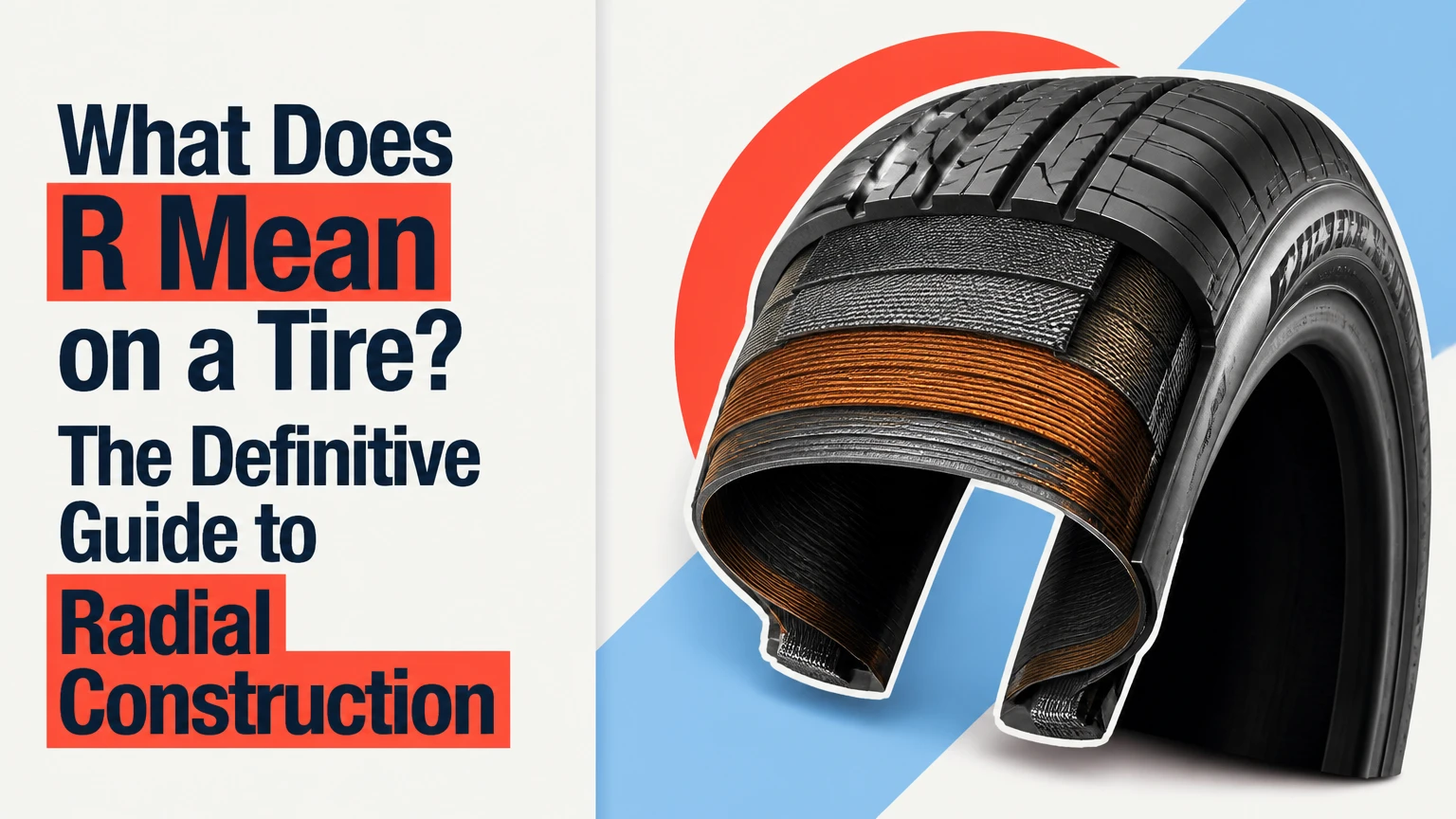
The letter “R” on a tire stands for radial, indicating that the internal fabric cords or plies run at 90 degrees relative to the direction of travel, radiating outward from the center of the wheel. This internal architecture provides flexible sidewalls, superior high-speed durability, and a stable road contact patch for modern passenger vehicles.
- The letter “R” stands strictly for radial ply construction and has nothing to do with rotation direction.
- In standard tire codes like 225/65R17, the “R” sits directly between the aspect ratio and the rim diameter.
- Radial tires feature internal cords running at a 90-degree angle to the tread centerline.
- Over 98 percent of modern passenger vehicle tires utilize radial construction due to lower rolling resistance.
- Mixing radial (“R”) tires with bias-ply (“D”) tires creates severe handling hazards and unpredictable vehicle dynamics.
- An “R” located at the absolute end of a size string indicates a speed rating rather than the internal construction type.
What Does the Letter R Mean on a Tire Sidewall?
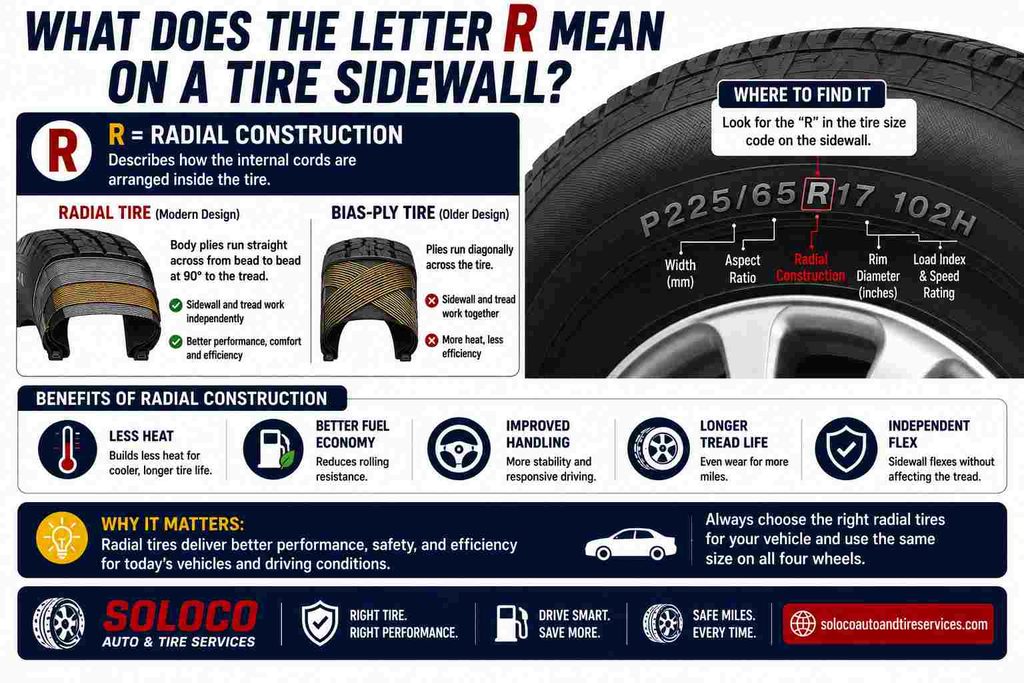
The letter “R” on a tire sidewall denotes a radial construction type, which describes how the internal fabric and steel cords are laid out inside the tire structure. In a radial tire, these body plies run straight across the tire from bead to bead at a 90-degree angle to the centerline of the tread. This specific structural arrangement separates modern radial tires from older bias-ply designs, allowing the sidewall and the tread to function as independent working zones.
When you look at a tire sidewall, you will find this letter embedded inside a alphanumeric sequence such as P225/65R17. The radial design allows the sidewall to flex independently of the tread, which minimizes internal friction, reduces heat buildup during sustained highway driving, and maximizes fuel economy. Understanding this foundational designation helps drivers select appropriate replacement tires and ensures structural compatibility across all four wheel positions.
How Do You Decode the Entire Tire Size Sequence?
A standard tire size code combines metric measurements and imperial units into a single industrial standard printed directly on the sidewall. Using the universal example P225/65R17, each section of the code represents a specific physical dimension of the tire and wheel assembly.
| Tire Code Segment | Measurement Type | Value Example | What It Represents |
| Prefix (P) | Vehicle Application | P | Passenger vehicle service rating |
| First Number (225) | Metric Width | 225 millimeters | Section width from sidewall to sidewall |
| Second Number (65) | Aspect Ratio | 65 percent | Sidewall height as a percentage of section width |
| Construction Letter (R) | Internal Design | Radial | Cords running at 90 degrees to tread centerline |
| Final Number (17) | Imperial Diameter | 17 inches | Wheel rim diameter required for fitting |
This combination of metric width and imperial rim sizing creates a universally recognized standard utilized by every major tire manufacturer worldwide. Drivers must match every single parameter when purchasing replacement tires to ensure proper load distribution, correct speedometer calibration, and safe mechanical clearance within the wheel wells.
What Do Other Letters Like B or D Mean in Place of R?
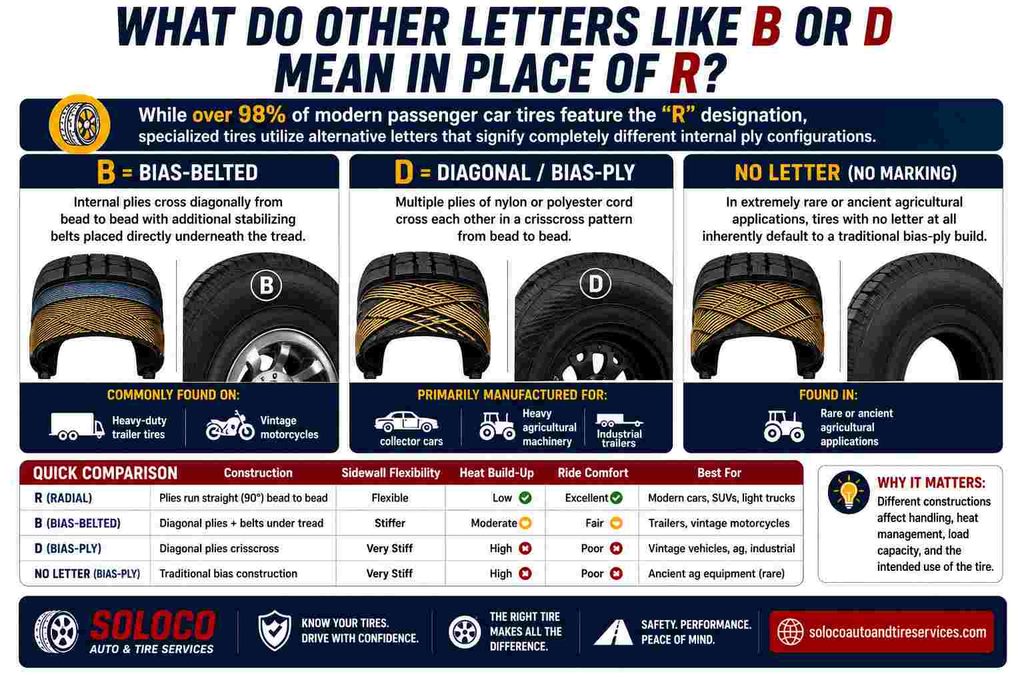
While over 98 percent of modern passenger car tires feature the “R” designation, specialized tires utilize alternative letters that signify completely different internal ply configurations. A “B” on the sidewall stands for bias-belted, meaning the internal fabric plies cross diagonally from bead to bead with additional stabilizing belts placed directly underneath the tread. This construction is commonly found on select heavy-duty trailer tires and vintage motorcycles.
A “D” on the sidewall stands for diagonal or bias-ply construction, where multiple plies of nylon or polyester cord cross each other in a crisscross pattern from bead to bead. Bias-ply tires feature extremely stiff sidewalls and are primarily manufactured today for vintage collector cars, heavy agricultural machinery, and industrial trailers that require high puncture resistance under heavy stationary loads.
In extremely rare or ancient agricultural applications, you may find tires with no letter at all, which inherently defaults to a traditional bias-ply build.
What Does ZR Mean on Older High-Performance Tires?
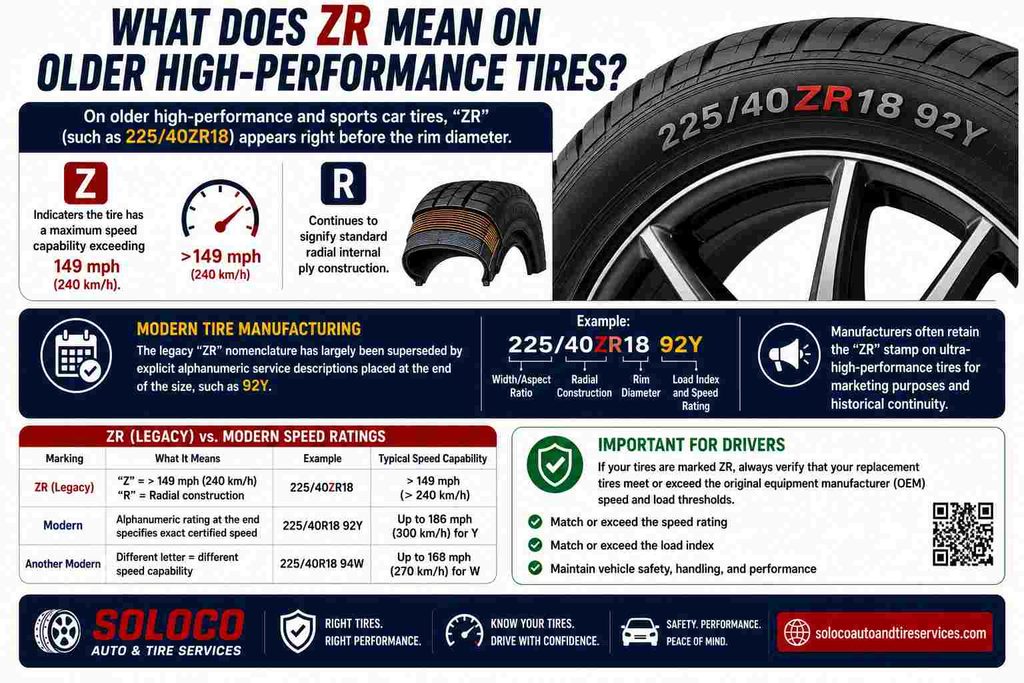
On older high-performance and sports car tires, you may encounter the designation “ZR” (such as 225/40ZR18) positioned right before the rim diameter. The “Z” portion of this marking historically indicated that the tire possessed a maximum speed capability exceeding 149 mph or 240 km/h, while the “R” continued to signify standard radial internal ply construction.
In modern tire manufacturing, this legacy “ZR” nomenclature has largely been superseded by explicit alphanumeric service descriptions placed at the end of the sequence, such as 92Y, where the final letter dictates the exact certified speed threshold. However, manufacturers often retain the “ZR” stamp on ultra-high-performance tires for marketing purposes and historical continuity. Drivers operating vehicles with ZR-marked tires must verify that their replacement selections meet or exceed the original equipment manufacturer speed and load thresholds.
Can I Mix Radial and Bias-Ply Tires on the Same Vehicle?
Mixing radial (“R”) tires and bias-ply (“D”) tires on the same vehicle creates catastrophic handling failures and severe safety risks. Radial tires feature flexible sidewalls and stable footprints, whereas bias-ply tires possess rigid sidewalls that alter vehicle cornering dynamics entirely. Combining these two opposing construction types causes unpredictable weight transfer, severe steering instability, and sudden loss of control during emergency braking or sharp lane changes.
If an absolute roadside emergency forces a mixed-construction scenario, safety protocols dictate that the radial tires must always be installed on the rear axle to prevent sudden oversteer and spinouts. Professional technicians strongly advise against mixing construction types under any normal operating circumstances. Always replace all four tires with matching radial constructions to maintain predictable vehicle handling and prevent suspension component damage.
What Does an R at the Very End of a Tire Code Mean?
An “R” located at the absolute end of a tire size sequence (for example, 91R) does not indicate radial construction, but rather serves as the tire’s official speed rating. In this trailing position, the letter corresponds to a certified maximum safe operating speed established through rigorous laboratory testing.
| Speed Rating Letter | Maximum Certified Speed (MPH) | Maximum Certified Speed (KM/H) | Common Vehicle Applications |
| Q | 99 mph | 159 km/h | Winter snow tires, light trucks |
| R | 106 mph | 170 km/h | Heavy-duty trucks, SUVs, utility vans |
| S | 112 mph | 180 km/h | Family sedans, minivans |
| T | 118 mph | 190 km/h | Standard commuter cars |
| H | 130 mph | 210 km/h | Sport sedans, touring vehicles |
When reading a tire code, context determines meaning completely. An “R” positioned in the middle of the string dictates internal ply construction, whereas an isolated letter at the very end defines the maximum speed threshold.
Can I Put Bias-Ply Tires on My Modern Car?
Installing bias-ply tires on a modern passenger car is unsafe and mechanically destructive. Modern suspension systems, electronic stability control units, and anti-lock braking systems are meticulously calibrated around the flexible sidewall characteristics and large, stable contact patches of radial tires.
Switching to stiff bias-ply tires results in an extremely harsh ride quality, significantly degraded fuel economy due to higher rolling resistance, and unpredictable handling responses during emergency maneuvers. Modern vehicle chassis geometry cannot properly absorb the rigid impact forces transmitted by bias-ply sidewalls. Drivers should strictly adhere to the vehicle manufacturer specification placard located inside the driver-side door jamb.
Why Did Radial Tires Replace Bias-Ply Tires?
Radial tires completely replaced bias-ply tires across the automotive industry because they deliver vastly superior mechanical performance, fuel efficiency, and tread longevity. In a radial tire, the separation of the sidewall function from the tread function allows the tread to remain flat against the pavement regardless of sidewall flexing.
This independent movement yields a contact patch that is up to 20 percent larger than a comparable bias-ply tire, resulting in improved cornering grip and shorter stopping distances. Furthermore, radial tires generate significantly less internal friction, which reduces operating temperatures at sustained highway speeds, prevents tread separation, and lowers rolling resistance to drastically improve vehicle fuel economy.
Does the Letter R Mean the Tire is Directional?
The letter “R” on a tire sidewall does not mean the tire is directional or that it must only rotate to the right side of the vehicle. The designation refers exclusively to radial ply construction and has no bearing on rotational direction.
Directional tires, which are engineered to channel standing water away from the contact patch in only one rolling direction, are clearly marked with an arrow icon and the word “Rotation” molded directly onto the sidewall. Non-directional radial tires can be rotated to any position on the vehicle during routine maintenance intervals, provided the sizing matches the axle requirements.
How Do You Visually Inspect a Tire Sidewall for Construction Type?
Inspecting a tire sidewall for construction type requires locating the primary size block stamped into the rubber casing by the manufacturer. Look directly past the section width and aspect ratio numbers to identify the single capital letter positioned before the rim diameter number.
If the letter is an “R”, the tire features standard radial construction with internal steel cords running perpendicular to the tread. If the letter is a “B” or “D”, inspect the secondary manufacturing stamps for DOT compliance codes and maximum load ratings to confirm whether the tire is engineered for specialized utility, vintage automotive use, or trailer service.
What Happens Structurally If a Radial Tire is Overloaded?
Continuously overloading a radial tire beyond its designated load index causes extreme localized flexing in the sidewall, excessive internal heat generation, and eventual structural delamination. Because radial sidewalls are deliberately engineered to be flexible, excessive weight forces the sidewall to deflect beyond its design limits, fatiguing the internal steel plies.
As internal temperatures rise past critical thresholds, the rubber compounds binding the plies together begin to break down, leading to sudden tread separation or catastrophic blowout. Drivers must always verify that the load index number on the replacement tire meets or exceeds the original vehicle manufacturer specifications, especially when carrying heavy cargo or towing trailers.
How Do Run-Flat Markings Interact with Radial Designations?
Run-flat tires, often designated by markings such as “RF”, “RSC”, or “SSR” on the sidewall, maintain the exact same internal radial ply construction (“R”) as standard tires while incorporating reinforced sidewall inserts. These reinforced load-bearing inserts prevent the tire from collapsing completely when internal air pressure drops to zero following a puncture.
The presence of run-flat markings does not replace the structural “R” in the size sequence. A run-flat tire size is typically written as P225/45RF17 or features an auxiliary manufacturer code, meaning it still relies on a standard radial carcass while offering emergency mobility for up to 50 miles at restricted speeds.
The Bottom Line
The letter “R” on a tire sidewall stands for radial, denoting an internal ply construction where cords run at a 90-degree angle to the tread centerline. This design delivers flexible sidewalls, superior high-speed durability, and optimal fuel economy for modern vehicles. Always match your replacement tires to the exact manufacturer specifications, never mix radial and bias-ply constructions on the same vehicle, and verify that trailing letters at the end of the code represent speed ratings rather than structural types.


