A tire speed rating indicates the maximum safe speed a tire can sustain over a prolonged period when properly inflated and loaded. Represented by a single letter code on the sidewall, this rating is established through rigorous laboratory testing and serves as a strict boundary for vehicle safety and performance handling.
At a Glance: Key Tire Speed Rating Facts
- Tire speed ratings are denoted by a letter code located at the end of the tire size sequence, such as the V in 205/55R16 V.
- The rating scale generally progresses alphabetically from M (81 mph) through Y (186 mph), though historical exceptions like H disrupt the sequence.
- Driving on under-inflated or overloaded tires completely voids the manufacturer speed rating, regardless of the letter printed on the sidewall.
- Winter tires are a recognized exception to the rule, allowing drivers to drop one or two speed ratings safely during cold weather months.
- Higher speed ratings require softer rubber compounds, which typically result in faster tread wear compared to standard touring tires.
How do tire speed ratings work mechanically?
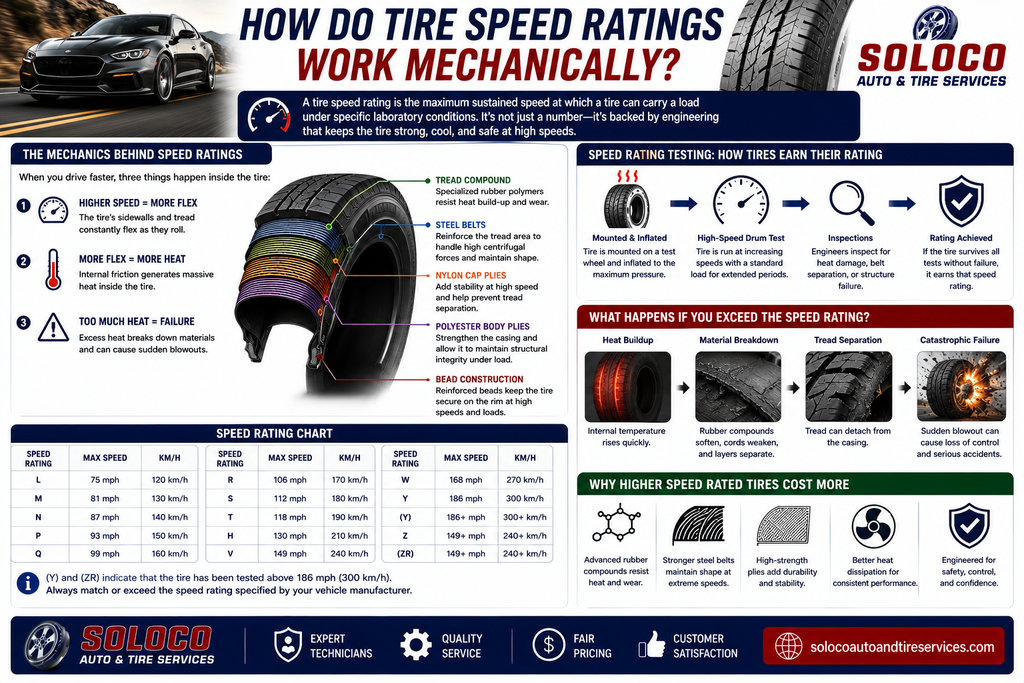
Tire speed ratings work by measuring a tire’s structural integrity, centrifugal force tolerance, and thermal management under heavy loads. When a vehicle travels at high speeds, the tire constantly flexes against the asphalt, generating massive internal friction and heat.
A tire with a higher speed rating utilizes reinforced steel belts, denser nylon cap plies, and specialized synthetic rubber polymers designed to dissipate this thermal energy rapidly. If a vehicle exceeds the threshold of its tire rating, the extreme heat causes the internal rubber compounds to delaminate, leading to catastrophic tread separation and sudden blowout.
What is the complete tire speed rating chart?
The tire speed rating chart defines the maximum sustained speed capability for every letter designation recognized by safety organizations like the United States Department of Transportation and the European Tyre and Rim Technical Organisation.
| Letter Rating | Maximum Sustained Speed (MPH) | Maximum Sustained Speed (KM/H) | Typical Vehicle Class |
| M | 81 mph | 130 km/h | Temporary spare tires |
| N | 87 mph | 140 km/h | Standard spare tires |
| P | 93 mph | 150 km/h | Light trucks and off-road vehicles |
| Q | 99 mph | 160 km/h | Winter studless tires |
| R | 106 mph | 170 km/h | Heavy-duty commercial light trucks |
| S | 112 mph | 180 km/h | Family sedans and minivans |
| T | 118 mph | 190 km/h | Family crossovers and standard sedans |
| H | 130 mph | 210 km/h | Sport sedans and touring coupes |
| V | 149 mph | 240 km/h | High-performance sedans and sports SUVs |
| W | 168 mph | 270 km/h | Exotic sports cars and track vehicles |
| Y | 186 mph | 300 km/h | Ultra-high-performance supercars |
| (Y) | Above 186 mph | Above 300 km/h | Specialized hypercars and track-only builds |
Why is the letter H out of alphabetical order on tire speed ratings?
The letter H sits out of alphabetical order because it was grandfathered into the rating system from a legacy European classification scheme. Originally, European tire manufacturers used letters to designate specific vehicle performance brackets before the modern uniform system was standardized. H historically stood for High Performance, bridging the gap between standard family transport tires and early speed-rated sports car tires. When international standards bodies integrated these metrics into a unified alphabetical scale, shifting H would have confused millions of existing vehicle owners, so it remained permanently positioned between T and V.
What does a (Y) speed rating with parentheses mean?
A speed rating enclosed in parentheses—such as 275/35ZR19 (Y)—indicates that the tire has been tested and certified to safely handle sustained speeds exceeding 186 miles per hour. Standard letter ratings like W or Y denote hard caps at 168 mph and 186 mph respectively. When manufacturers design ultra-high-performance tires for modern hypercars capable of velocity milestones far above standard tracks, they use the parenthetical (Y) designation to show that the structural casing has survived extreme velocity laboratory tests under controlled, manufacturer-specified load conditions.
How does the tire load index affect the speed rating?
The tire load index directly governs and caps the validity of a tire speed rating. The load index is a numerical code that dictates the maximum weight a single tire can support when inflated to proper specifications. If a vehicle exceeds this weight capacity by overloading the trunk or towing heavy cargo, the tire experiences accelerated structural deflection. This physical distortion generates localized heat that degrades the tire long before it reaches its printed speed rating limit. Consequently, maximum speed ratings are only legally and structurally valid when the total vehicle weight remains strictly within the official load index capacity.
What causes a tire to fail below its rated speed?
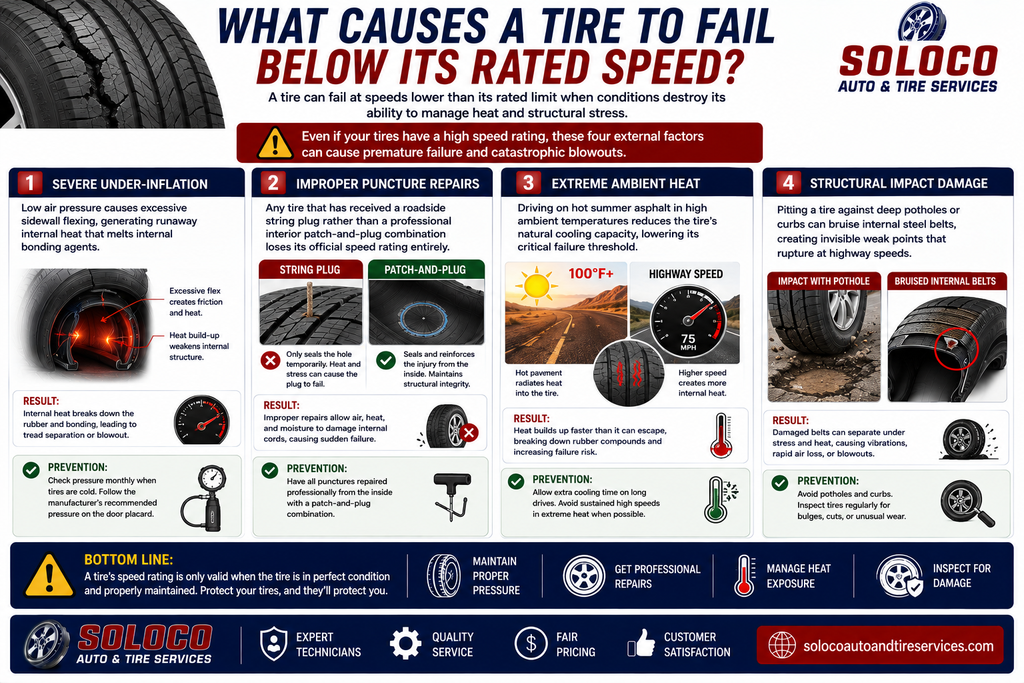
A tire fails below its rated speed when external physical compromises destroy its ability to manage internal heat and structural stress. The four primary catalysts for premature speed rating failure include:
- Severe Under-Inflation: Low air pressure causes excessive sidewall flexing, generating runaway internal heat that melts internal bonding agents.
- Improper Puncture Repairs: Any tire that has received a roadside string plug rather than a professional interior patch-and-plug combination loses its official speed rating entirely.
- Extreme Ambient Heat: Driving on hot summer asphalt in high ambient temperatures reduces the tire’s natural cooling capacity, lowering its critical failure threshold.
- Structural Impact Damage: Pitting a tire against deep potholes or curbs can bruise internal steel belts, creating invisible weak points that rupture at highway speeds.
Does tire age and dry rot degrade the speed rating?
Tire age and dry rot severely degrade a tire’s original speed rating by breaking down the elasticity of the rubber compounds. As rubber ages past five to six years, exposure to ultraviolet light and atmospheric ozone causes the volatile oils within the compound to evaporate. This process creates microscopic surface fissures known as dry cracking. When a compromised, aged tire rotates at high highway velocities, centrifugal forces pull on these brittle micro-fissures, causing the tread blocks to shed or the internal carcass to fragment even if the tire tread depth appears legally sufficient.
Can you mix different tire speed ratings on the same car?
Mixing different tire speed ratings on the same vehicle is strongly discouraged by automotive engineers and tire manufacturers. If a motorist must mix tire ratings due to an emergency replacement, the tires with the lower speed rating must be installed exclusively on the front axle. Placing lower-rated tires on the rear axle can induce severe oversteer during emergency cornering maneuvers, causing the rear end to lose traction unexpectedly. Furthermore, the overall handling capability and maximum legal speed of the vehicle are strictly capped by the lowest-rated tire installed on the chassis.
Can you buy a lower speed rating than factory specifications?
Vehicle owners should never install replacement tires with a lower speed rating than the original equipment specifications established by the vehicle manufacturer. Downgrading to a lower speed rating compromises critical handling attributes, including emergency lane-change stability, steering response precision, and high-speed cornering grip. Insurance providers and vehicle manufacturers design suspension geometry, electronic stability control algorithms, and braking systems around the specific structural stiffness of the factory-specified tire rating. Deviating downward introduces unpredictable vehicle dynamics during emergency maneuvers.
Why are winter tires allowed to have lower speed ratings?
Winter tires are legally and practically permitted to use lower speed ratings—such as Q, R, or S—because seasonal driving environments demand compromises focused purely on grip over velocity. Winter tread compounds feature soft natural rubbers and dense siping designed to bite into snow and ice at low temperatures. Because winter driving conditions inherently limit safe travel speeds due to snow, ice, and reduced visibility, drivers do not require high-speed structural rigidity. Motorists who drop tire speed ratings for winter use must simply remain mindful of their winter tires’ lower maximum velocity limits during clear highway commutes.
Are there legal or insurance consequences for wrong tire speed ratings?
Installing tires with speed ratings significantly below manufacturer specifications can expose vehicle owners to liability risks during insurance claims after an accident. While general daily driving rarely brings passenger vehicles to their maximum speed thresholds, insurance investigators analyze vehicle components during catastrophic high-speed collisions. If an investigator determines that sub-standard or mismatched speed-rated tires contributed to a blowout or loss of control, the insurance provider may deny coverage based on negligence or failure to maintain safe vehicle specifications. Commercial vehicles face even stricter federal enforcement regarding matching tire specifications.
Do higher speed ratings cause tires to wear out faster?
Higher speed ratings frequently result in faster tread wear because they utilize softer, stickier rubber compounds engineered for maximum traction. To maintain grip at high velocities and under aggressive cornering loads, performance tires (such as V, W, and Y ratings) sacrifice tread compound hardness. Softer rubber conforms more readily to road micro-textures, generating superior friction but wearing away at an accelerated rate compared to harder, long-wearing T-rated or H-rated touring tires designed primarily for longevity and fuel economy.
Do car speed limiters make tire speed ratings irrelevant?
Electronic speed limiters do not make tire speed ratings irrelevant, as speed ratings serve safety functions beyond just top speed limits. While factory computers restrict many modern passenger cars to 112 or 130 miles per hour, speed ratings account for dynamic variables like heavy vehicle loads, unexpected emergency maneuvers, abrupt braking stresses, and hot summer road temperatures. A tire with a high speed rating provides a stiffer, more resilient internal structure that resists deformation under heavy loads, ensuring stability even when traveling well within legal highway speed limits.
The Bottom Line
A tire speed rating is a definitive safety boundary indicating the maximum safe velocity a tire can maintain under proper inflation and load conditions. Choosing the correct rating ensures structural stability, predictable handling, and protection against catastrophic heat-related blowouts. Always match or exceed original equipment manufacturer specifications, maintain precise tire pressure monthly, and respect seasonal exceptions to keep your vehicle safe on every journey.