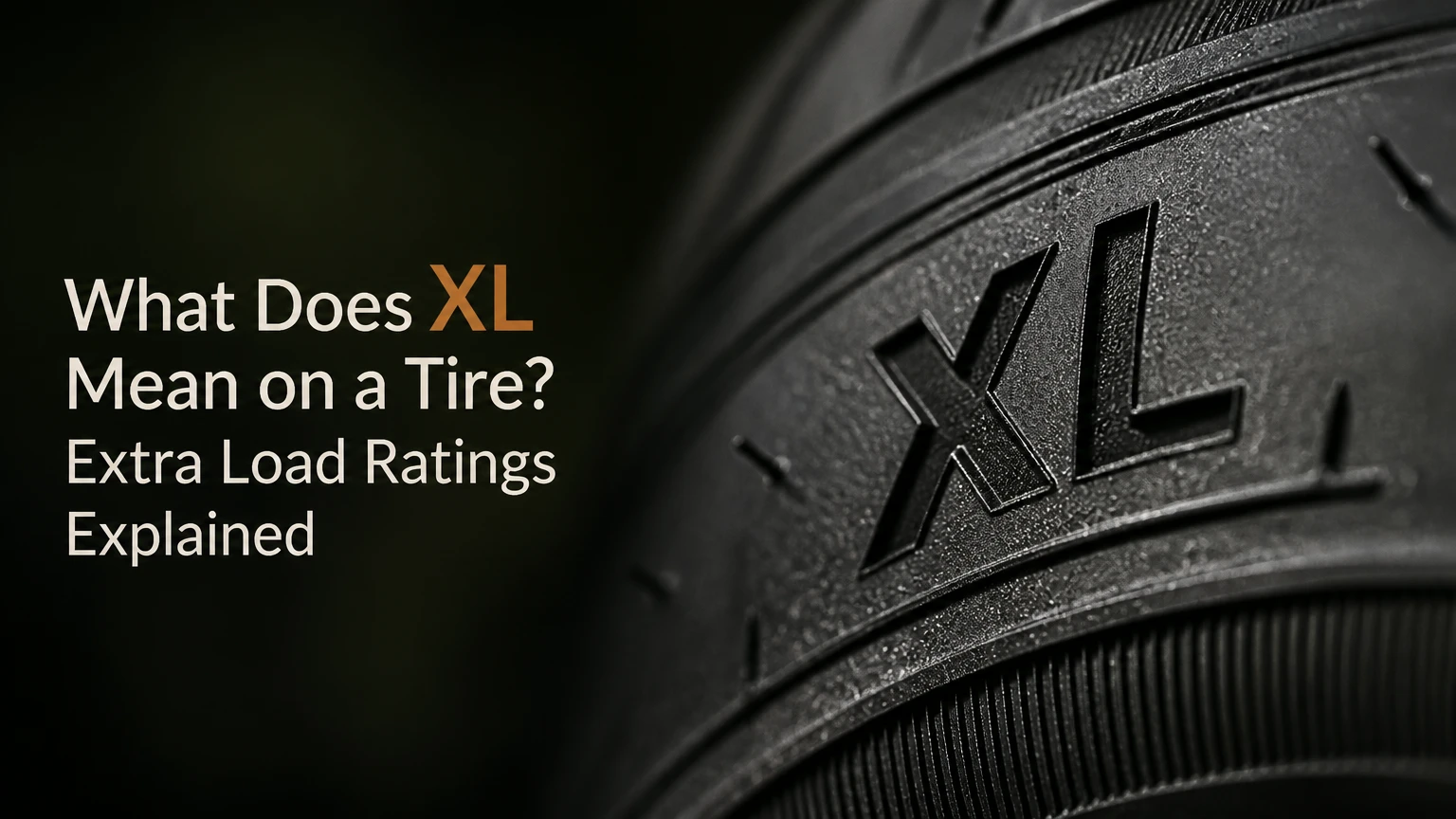
XL stands for Extra Load, indicating a reinforced tire designed to carry heavier weights at higher inflation pressures than standard passenger car tires of the exact same physical size. Extra Load tires utilize strengthened internal carcasses, stronger plies, and reinforced beads to safely support heavier modern vehicles without increasing overall tire dimensions.
At a Glance: Key Facts About XL Tires
- XL stands for Extra Load and signifies a reinforced passenger car tire structure.
- Standard Load tires max out capacity at 35 PSI, while XL tires reach maximum load capacity at 42 PSI.
- An XL designation typically increases a tire’s standard load index by 3 to 4 points.
- Equivalent industry markings for Extra Load include RF, REINF, and EL.
- Electric vehicles and heavy modern sedans frequently require XL or High Load ratings from the factory.
- Mixing XL and SL tires on the same axle creates dangerous handling imbalances and must be avoided.
What Does XL Mean on a Tire?
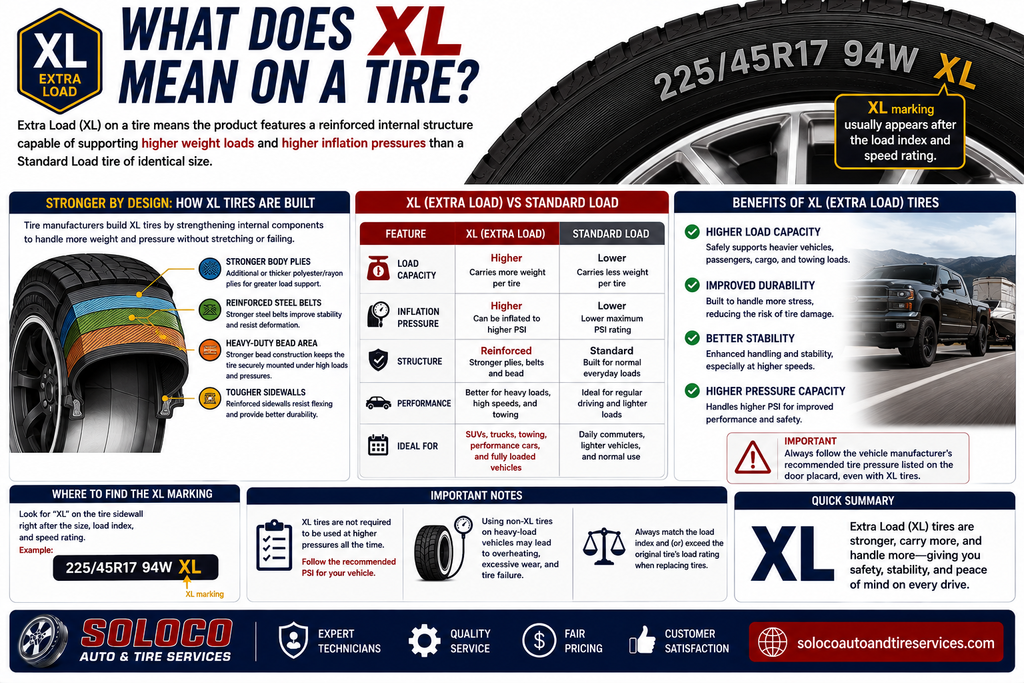
Extra Load (XL) on a tire means the product features a reinforced internal structure capable of supporting higher weight loads and higher inflation pressures than a Standard Load tire of identical size. Tire manufacturers build XL tires by strengthening internal components like polyester or rayon body plies, steel belts, and the bead area. This reinforcement allows the tire to hold a larger volume of compressed air under higher pressure without stretching or failing. You will typically find the XL designation printed right after the size and load index rating on the tire sidewall, such as 225/45R17 94W XL.
What equivalent markings mean the same thing as XL?
Manufacturers use several alternative abbreviations on tire sidewalls to indicate Extra Load capacity. The most common equivalent markings you will encounter include RF for Reinforced, REINF for Reinforced, and EL for Extra Load. Regardless of whether a tire brand stamps XL, RF, REINF, or EL on the outer sidewall, the mechanical engineering standard remains identical. All of these designations point to a reinforced tire carcass designed to operate at higher inflation pressures to achieve a higher load index.
What is the difference between Standard Load (SL) and Extra Load (XL)?
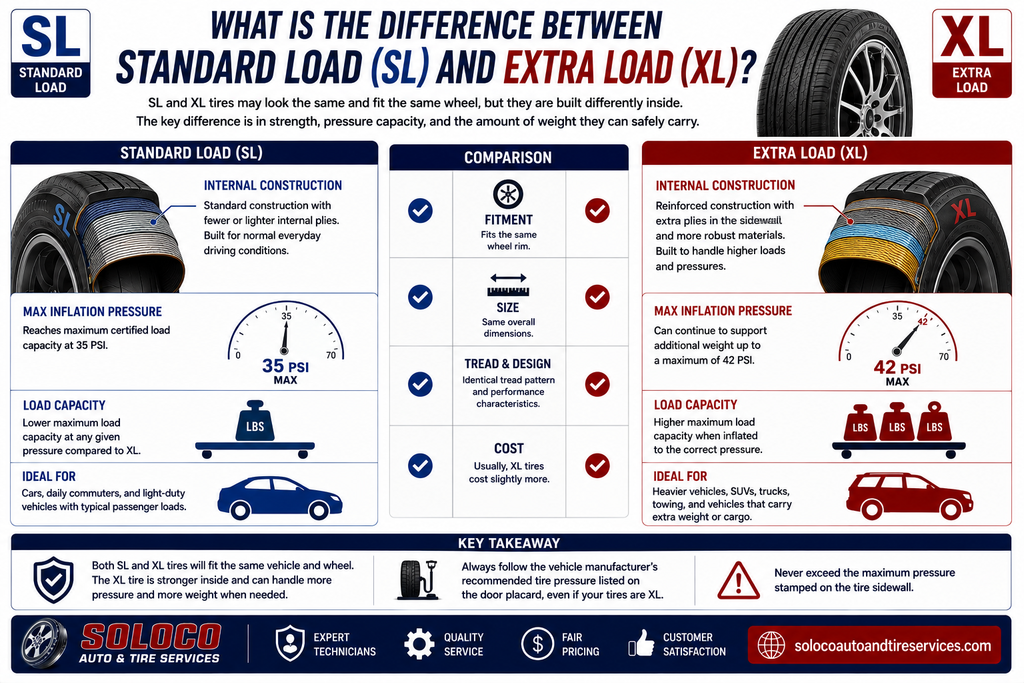
Standard Load (SL) tires and Extra Load (XL) tires differ primarily in their internal reinforcement and maximum safe inflation limits. An SL tire reaches its maximum certified load capacity at an inflation pressure of 35 PSI. An XL tire features reinforced sidewalls and internal plies that allow it to continue absorbing air pressure and supporting additional weight up to a maximum inflation pressure of 42 PSI. While both tires fit the exact same wheel rim and maintain identical outer dimensions, the XL variant can handle heavier loads when inflated correctly.
What is the load index boost of an XL tire?
An XL tire typically increases a tire’s standard load index rating by 3 to 4 points compared to its SL counterpart. For example, a standard passenger tire in size 225/45R17 might carry a load index of 91, which translates to a maximum weight capacity of 615 kilograms or 1,356 pounds per tire. The XL version of that exact same physical tire size features a load index of 94, raising the maximum weight capacity to 670 kilograms or 1,477 pounds per tire. This numerical increase allows the vehicle to safely support heavier axle weights.
How do I read an XL tire sidewall rating?
Reading an XL tire sidewall requires examining the complete alphanumeric service description stamped near the outer rim. For instance, consider the rating 245/40R19 98Y XL. The number 245 represents the section width in millimeters, 40 represents the aspect ratio, R denotes radial construction, and 19 indicates the wheel diameter in inches. The number 98 is the load index, corresponding to a specific maximum weight capacity per tire. The letter Y denotes the maximum speed rating, and the letters XL at the end confirm the Extra Load reinforced construction.
What happens if I inflate an XL tire to the vehicle door placard PSI?
Following the vehicle manufacturer door placard pressure ensures correct ride quality and tire wear if the vehicle originally came equipped with XL tires from the factory. However, if you are retrofitting or upgrading a vehicle from Standard Load tires to Extra Load tires, simply matching the old door sticker might leave the new tires under-inflated for baseline load capacity. In custom upgrade scenarios, technicians often calculate an inflation increase of 4 to 6 PSI above the door placard to ensure the XL tire matches the load-carrying capacity of the original equipment.
How do I calculate the exact PSI adjustment when upgrading from SL to XL tires?
Calculating the exact PSI adjustment requires referencing official load and inflation tables provided by organizations like the Tire and Rim Association. When replacing an SL tire with an XL tire of the same size, the XL tire requires higher air pressure to deliver the exact same load capacity at lower pressures because of how European and American metric standards rate load limits. If your original SL tire required 32 PSI to support a specific corner weight, an equivalent XL tire often requires 35 to 36 PSI to support that exact same weight safely without excessive sidewall flex.
Do electric vehicles (EVs) require XL tires?
Electric vehicles almost always require XL tires or even heavier specialized ratings due to the massive weight of their battery packs. Battery-powered cars frequently weigh hundreds of pounds more than internal combustion engine vehicles of the identical physical size. Because of this concentrated weight, automakers specify XL tires as original equipment to prevent premature tread wear and sidewall failure. Furthermore, the massive instant torque delivered by electric motors places additional mechanical stress on the tire tread, making reinforced XL structures mandatory for durability.
Can I mix XL and SL tires on the same vehicle?
You should never mix Extra Load and Standard Load tires on the same axle of a vehicle. Mixing different load ratings across the same axle causes uneven sidewall flexing rates, which disrupts handling balance, upsets electronic stability control systems, and creates unpredictable vehicle behavior during emergency braking maneuvers. If circumstances force you to mix tire types temporarily, always mount the stronger XL tires on the rear axle to maintain vehicle oversteer stability and prevent dangerous rear-end spinouts on wet roads.
Are XL tires more prone to sidewall punctures or blowout risks?
XL tires are actually less prone to impact damage and sidewall punctures than standard load tires because of their multi-ply reinforced construction. The extra layers of high-tensile cords and thicker rubber compounds in the sidewall protect against common road hazards like potholes, curbs, and sharp debris. While a stiffer sidewall makes the tire more resilient against physical damage, failing to maintain correct inflation pressure can still lead to heat buildup and structural failure over long highway trips.
What are the differences between Euro-Metric and P-Metric standards for XL tires?
European-Tyre and Rim Technical Organisation standards dictate that metric Extra Load tires reach their maximum load capacity at an inflation pressure of 42 PSI. In contrast, traditional American P-Metric Extra Load tire standards often calculate maximum load capacity thresholds at 41 PSI. While this one PSI difference is minor for daily driving, understanding these regional engineering standards helps fleet managers and performance tuners calculate exact inflation pressures when importing specialty tires or servicing foreign performance vehicles.
What is the difference between XL and LT (Light Truck) tires?
XL tires and Light Truck (LT) tires serve completely different vehicle classes and utilize vastly different internal construction methods. XL tires remain passenger car tires designed for everyday sedans, crossovers, and passenger EVs, maxing out inflation pressures around 41 or 42 PSI. LT tires use heavy-duty commercial load ranges like C, D, or E, featuring thick multi-ply sidewalls engineered for heavy pickup trucks, commercial vans, and heavy towing applications, with operating pressures scaling up to 50, 65, or 80 PSI.
Does an XL tire carry more weight at the same lower pressure?
An XL tire does not carry more weight than a Standard Load tire if both are inflated to the same lower pressure level. For example, when inflated to 32 PSI, an XL tire and an SL tire of identical dimensions carry roughly the same amount of weight. The XL tire only delivers its bonus weight-carrying capacity when you inflate it past the standard 35 PSI threshold up to its maximum rating of 42 PSI. Running an XL tire at low pressures sacrifices its extra load benefits and causes excessive heat generation.
Do XL tires always cause a harsh, stiff ride?
Modern XL tires do not automatically cause a harsh or stiff ride compared to standard passenger tires. While older reinforced tire designs relied on rigid, heavy steel layers that compromised ride comfort, contemporary XL tires utilize advanced high-tensile synthetic cords such as aramid, nylon, and specialized polyester blends. These modern materials maintain flexibility at everyday operating pressures, meaning an XL tire often rides identically to an SL tire during normal commuting, only stiffening up to handle heavy cargo loads or high-speed cornering forces.
Do XL tires wear out faster than standard load tires?
XL tires do not inherently wear out faster than standard load tires when maintained at correct inflation pressures and rotated regularly. In fact, because XL tires feature a stiffer tread foundation and reinforced internal blocks, they often resist irregular tread wear better than SL tires when fitted to heavy modern vehicles. However, if an XL tire is chronically under-inflated or mismatched to a lightweight vehicle that cannot flex the stiff carcass, uneven center-tread wear or premature shoulder degradation can occur.
Is it dangerous to switch from XL tires back to SL tires on performance cars?
Switching from factory-specified XL tires back to cheaper Standard Load tires on performance cars or heavy crossovers creates significant safety hazards. Vehicles engineered for XL tires rely on those reinforced sidewalls to manage high cornering loads, rapid lane changes, and heavy vehicle weight. Installing SL tires in their place causes excessive sidewall flexing, which leads to sluggish steering response, high-speed instability, dangerous cornering roll, and rapid overheating that can trigger sudden tread separation.
The Bottom Line
Understanding what XL means on a tire ensures you select the correct replacement rubber for vehicle safety, load management, and handling stability. Extra Load tires provide essential reinforcement and higher maximum pressure thresholds required by modern heavy vehicles and electric cars. Always match or exceed your vehicle manufacturer specifications, maintain precise inflation pressures, and never mix load ratings across the same axle.