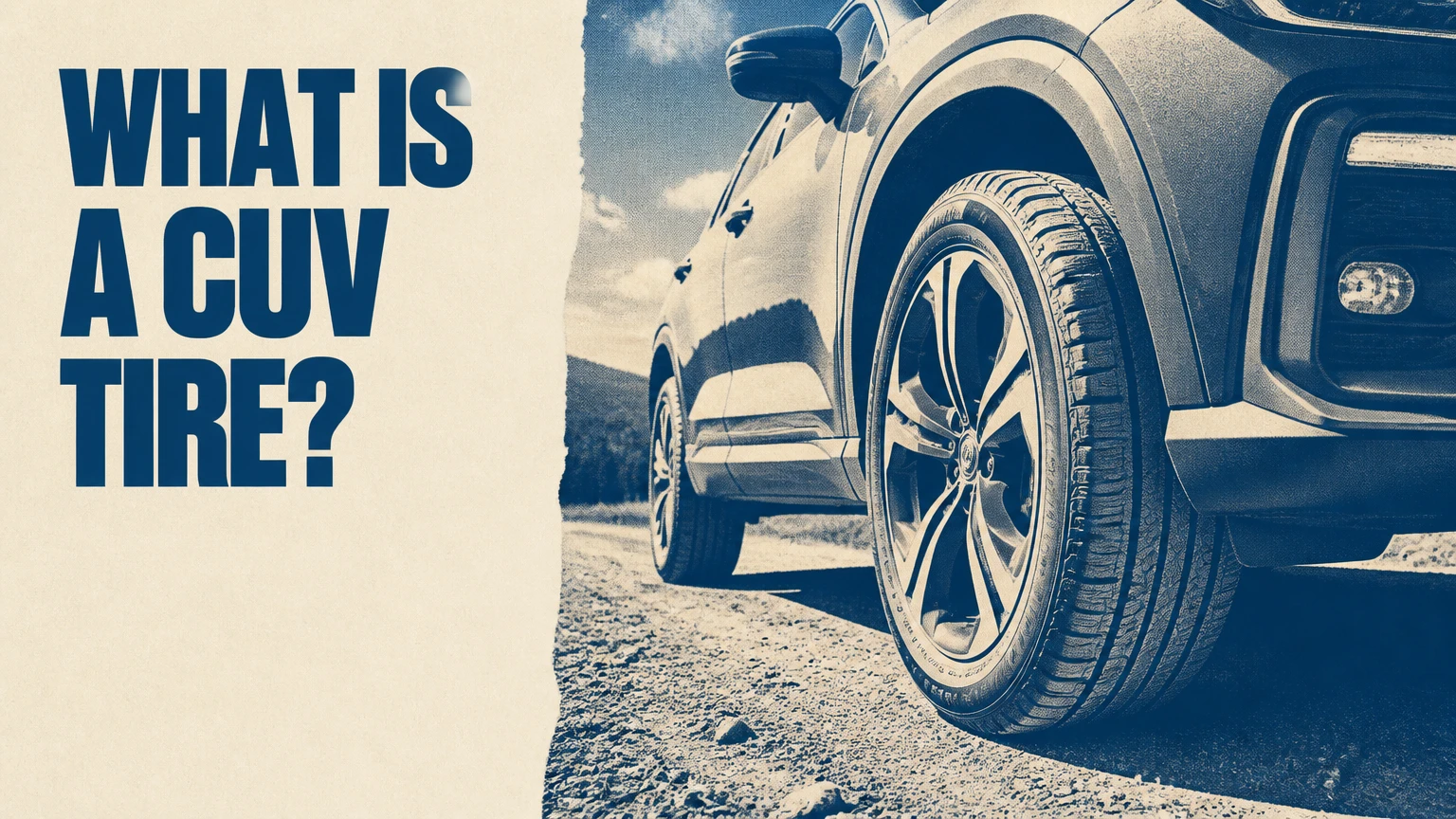
A Crossover Utility Vehicle tire is a specialized pneumatic rubber design engineered exclusively for unibody crossovers. Crossover Utility Vehicle tires bridge the gap between passenger car comfort and rugged sport utility vehicle durability. These tires support higher centers of gravity while maintaining crisp handling on paved highways.
At a Glance:
- Crossover tires weigh 10 to 15 percent less than traditional truck tires.
- Standard speed ratings typically sit at H (130 mph) or V (149 mph).
- Sidewall aspect ratios generally range from 45 to 65 for crisper handling.
- Heavy electric crossovers require High Load or Extra Load rated versions.
- All-season crossover models lose effective grip below 45 degrees Fahrenheit.
How to check if your tires are CUV or passenger rated?
You can identify a CUV-rated tire by locating specific alphanumeric load and size indicators stamped onto the outer rubber sidewall. Manufacturers rarely print the acronym directly on the tire. Instead, you must read the technical specifications to determine the intended vehicle application.
- Locate the size sequence. Look for the string of numbers on the sidewall (for example, 235/55R19).
- Check for a prefix letter. If the sequence begins with a “P” (P235/55R19), it is a P-metric passenger tire designed for lighter vehicles. If there is no letter before the numbers, it is a Euro-metric tire, which often carries a slightly higher load capacity suitable for crossovers.
- Find the load index number. Look at the two or three digits immediately following the rim size (for example, the 101 in 235/55R19 101H). A passenger sedan tire usually sits between 85 and 93. A crossover tire generally displays a load index between 95 and 110.
- Look for extra load markings. Scan the area near the bead for the letters “XL” (Extra Load) or “HL” (High Load). These designations confirm the tire has reinforced internal cords to support a heavier unibody chassis.
Passenger tires prioritize maximum softness over structural rigidity. When installed on a taller vehicle, they lack the internal bracing required to manage body roll during cornering.
What is the difference between an SUV tire and a crossover tire?
An SUV tire features heavy multi-ply construction for body-on-frame trucks, while a crossover tire uses flexible single-ply or lighter dual-ply casings optimized for unibody frames. The physical engineering differences directly reflect the disparate jobs these vehicles perform. Traditional sport utility vehicles tow heavy boats and navigate jagged off-road trails. Crossovers primarily transport families on paved surfaces.
| Feature | CUV Touring Tire | Traditional SUV Tire (LT) |
| Internal Construction | Single or light dual-ply polyester | Multi-ply heavy steel and nylon |
| Sidewall Flexibility | High (prioritizes highway comfort) | Low (prioritizes puncture resistance) |
| Typical Tread Blocks | Closely spaced, ribbed design | Wide voids, aggressive shoulder blocks |
| Primary Engineering Focus | Fuel economy and low road noise | High load capacity and off-road grip |
Manufacturers designate traditional truck-based rubber with an “LT” (Light Truck) prefix. These variants require significantly higher inflation pressures to maintain their shape. Running an LT tire on a lightweight crossover results in a brutally stiff ride and accelerated suspension wear. Conversely, mounting a standard crossover tire on a heavy-duty truck guarantees premature sidewall failure.
How much lighter are crossover tires compared to traditional SUV models?
Crossover tires typically weigh 10 to 15 percent less than their Light Truck equivalent sizes. A standard 18-inch crossover touring tire weighs approximately 28 to 32 pounds. An 18-inch LT-rated all-terrain tire built for a traditional sport utility vehicle often weighs between 38 and 45 pounds.
This weight disparity drastically affects vehicle dynamics. Tires represent unsprung mass. This means their weight sits below the vehicle suspension. When a vehicle hits a pothole, the suspension must push the wheel back down to the pavement. A lighter tire allows the shock absorbers to react instantly. This rapid response keeps the contact patch glued to the road surface.
A heavier tire carries more rotational inertia. It takes more engine power to get a 40-pound mass spinning and more brake force to stop it. Crossover engineers specifically specify lighter rubber compounds and thinner steel belts to maximize fuel efficiency and preserve brake pad life.
Why do crossover utility tires feature shorter sidewalls?
Crossover tires utilize lower aspect ratios to deliver crisper steering response and reduce sidewall flex during cornering. The aspect ratio is the percentage of the tire width that makes up the sidewall height. Traditional truck tires often feature aspect ratios of 70 or 75. Modern crossover tires usually range from 45 to 65.
A taller vehicle possesses a naturally higher center of gravity. When you steer a high-riding vehicle into a sharp curve, the body weight shifts dramatically to the outside wheels. If the tire features a tall, soft sidewall, the rubber will literally fold under the weight. This folding creates a sloppy, delayed steering sensation known as body roll.
By shortening the sidewall and firming up the internal apex (the rubber filler above the bead), manufacturers eliminate this flex. The driver inputs a steering command, and the vehicle changes direction immediately. This is how automotive engineers make a tall family hauler feel like a nimble passenger car from the driver’s seat.
What load index does a crossover utility vehicle need?
A standard crossover utility vehicle requires a tire load index between 95 and 110. This numerical rating dictates the absolute maximum weight a single tire can safely support at maximum cold inflation pressure. According to the Tire and Rim Association (2023) standardized load tables, an index of 95 translates to 1,521 pounds per tire, while an index of 110 supports 2,337 pounds.
You must calculate your requirement based on your specific vehicle’s Gross Vehicle Weight Rating (GVWR). The GVWR includes the vehicle curb weight plus the maximum allowable weight of all passengers and cargo.
To determine the minimum safe index, you divide the GVWR by four. However, vehicle weight is rarely distributed perfectly evenly between the front and rear axles. For this reason, automotive engineers build in a safety margin. You must never replace your factory tires with a set that carries a lower load index than the original equipment. Downgrading the load index compromises the physical integrity of the tire casing under heavy braking.
Are crossover utility tires more expensive than regular car tires?
Yes, crossover tires typically cost 15 to 25 percent more than standard passenger car tires. A set of four premium touring tires for a compact sedan might cost $500 to $600. A comparable set of premium touring tires for a mid-size crossover will generally run between $750 and $950.
The price premium stems primarily from physical dimensions and material volume. Modern crossovers frequently utilize large wheel diameters ranging from 18 to 22 inches to fill out their pronounced wheel arches. Manufacturing a 20-inch tire requires significantly more raw rubber, silica, and steel than producing a 16-inch sedan tire.
Additionally, the reinforced internal construction adds manufacturing complexity. Crossover tires require high-tensile steel belts and specialized apex materials to support the extra chassis weight. While the upfront cost is higher, attempting to save money by mounting cheaper, undersized passenger tires will void your vehicle warranty and create a severe safety hazard.
How long do crossover touring tires actually last?
A high-quality crossover touring tire lasts between 60,000 and 80,000 miles under normal driving conditions. Budget-tier options typically require replacement at the 40,000-mile mark. Actual lifespan depends entirely on the treadwear grade, your maintenance schedule, and the abrasive qualities of your local pavement.
| Tire Category | Expected Practical Lifespan | Manufacturer Warranty Range |
| Premium Touring All-Season | 65,000 – 75,000 miles | 70,000 – 80,000 miles |
| All-Weather (3PMSF Rated) | 50,000 – 60,000 miles | 55,000 – 65,000 miles |
| High-Performance Summer | 20,000 – 30,000 miles | None or up to 20,000 miles |
| Mild All-Terrain (A/T) | 45,000 – 55,000 miles | 50,000 – 60,000 miles |
According to Consumer Reports (2023) tire longevity testing, drivers who neglect routine rotations lose up to 30 percent of their potential tread life. Crossover vehicles place uneven stress on the front and rear axles. The front tires handle all the steering friction and support the heavy engine block. You must rotate your tires every 5,000 to 7,000 miles to distribute this abrasive wear evenly across the entire set.
Do unibody crossover tires wear out faster than sedan tires?
Yes, unibody crossover tires generally wear out 10 to 15 percent faster than the exact same tire compound mounted on a sedan. The accelerated degradation comes down to physics. Crossovers carry more raw mass and position that mass higher off the pavement.
When a sedan takes a highway exit ramp at 40 miles per hour, the lateral force on the shoulder tread is manageable. When a crossover takes that exact same corner at the same speed, the higher center of gravity acts like a lever. This leverage forces the vehicle weight onto the outside edge of the outer tires.
Over thousands of miles, this repeated lateral stress causes the outer tread blocks to scrub against the asphalt. If the suspension alignment is even slightly out of specification, this scrubbing accelerates into a condition called cupping or feathering. The tires will begin to emit a loud, rhythmic humming noise at highway speeds. Strict adherence to alignment checks easily mitigates this issue.
Are standard CUV tires good in the snow?
No, standard factory CUV tires fail to provide adequate traction in moderate to heavy snow. Most new crossovers roll off the assembly line equipped with “M+S” (Mud and Snow) rated all-season touring tires. The M+S designation only guarantees that the tread blocks have wide enough gaps to clear light, slushy dustings.
An M+S tire relies on the rubber remaining pliable. When the pavement freezes, standard all-season rubber hardens into the consistency of a hockey puck. A hard tire cannot conform to the micro-texture of the road surface. This causes the vehicle to slide under braking, regardless of whether you have an advanced All-Wheel Drive system. All-Wheel Drive helps you accelerate, but it does absolutely nothing to help you stop.
For legitimate winter safety, you must install tires carrying the Three-Peak Mountain Snowflake (3PMSF) symbol. This icon proves the tire passed standardized acceleration testing on medium-packed snow. You can find this symbol on dedicated winter tires and on modern All-Weather tires designed for year-round use.
At what temperature do all-season CUV models lose their traction?
Standard all-season CUV tires lose their effective grip when the ambient temperature drops below 45 degrees Fahrenheit (7 degrees Celsius). At this specific thermal threshold, the silica and synthetic polymers inside the tread compound undergo a glass transition phase. The rubber loses its elasticity and becomes dangerously rigid.
Extensive instrumented testing by Edmunds (2022) revealed the real-world consequences of this temperature drop. A crossover traveling at 60 miles per hour on cold, dry pavement required up to 20 additional feet to reach a complete stop on frozen all-season tires compared to properly formulated winter rubber.
This thermal reality catches many drivers off guard during clear, sunny winter days. The road might be completely free of snow and ice, but the cold asphalt alone is enough to compromise braking distance. If your region consistently experiences morning commutes below 45 degrees, you need an All-Weather or dedicated winter compound to maintain safe emergency stopping capabilities.
Should heavy electric crossovers use standard replacement tires?
No, heavy electric crossovers must never use standard passenger or basic CUV replacement tires. Electric vehicles like the Tesla Model Y or Ford Mustang Mach-E weigh significantly more than their gas-powered equivalents due to massive lithium-ion battery packs. You must install tires explicitly branded with an HL (High Load) or XL (Extra Load) designation.
A gas-powered compact crossover might weigh 3,400 pounds. An identical-sized electric crossover frequently tips the scales past 4,400 pounds. According to Michelin (2024) engineering data, electric motors also deliver instantaneous torque directly to the pavement. This violent rotational force literally tears chunks of rubber off standard tire blocks.
If you mount standard touring tires on an electric crossover, the extreme weight will crush the sidewalls, causing catastrophic heat buildup and inevitable blowout. Furthermore, EV-specific tires feature sound-absorbing foam bonded to the inner liner. Because electric vehicles lack engine noise, standard tires will sound deafeningly loud inside the cabin at highway speeds.
Which crossover vehicles require high-performance summer rubber?
High-performance luxury crossovers from German and Italian manufacturers require specialized ultra-high-performance (UHP) summer tires to manage their extreme horsepower outputs. These vehicles feature track-tuned suspensions and braking systems that would instantly overpower a standard high-mileage touring tire.
| Crossover Category | Example Vehicle | Recommended Tire Type | Fitment Style |
| Ultra-High Performance | Porsche Macan GTS | UHP Summer | Staggered |
| Heavy Track SUV | BMW X5 M Competition | UHP Summer | Staggered |
| Sport Hybrid CUV | Audi SQ5 | UHP All-Season | Square |
| Subcompact CUV | Hyundai Kona N | UHP Summer | Square |
Performance crossovers frequently utilize a staggered fitment. This means the rear tires are physically wider than the front tires to maximize acceleration grip. A Porsche Macan, for instance, might wear 265-width tires in the front and massive 295-width tires in the rear.
UHP summer tires utilize incredibly sticky tread compounds that prioritize lateral grip over longevity. You should never expect a UHP summer tire to last beyond 20,000 miles. Furthermore, you must remove them before winter. Driving a UHP summer tire in freezing temperatures will cause the tread blocks to physically crack and shatter.
Which tire variants work best for towing a heavy trailer?
If you frequently tow a trailer with your crossover, you must upgrade to a stiff-sidewall H-rated or V-rated tire with the highest available load index for your rim size. Standard passenger-grade factory tires will compress under the tongue weight of a trailer. This compression creates a dangerous pendulum effect known as trailer sway.
When the rear tires squat under the load, the vehicle’s front tires lift slightly off the pavement. This reduces your steering control and increases your braking distance. An XL-rated (Extra Load) touring tire provides the necessary internal reinforcement to keep the rear axle stable.
You must prioritize structural rigidity over a soft ride. Look for tires marketed as “Crossover/SUV Touring” rather than “Passenger All-Season.” The heavy-duty internal steel belts in a dedicated SUV touring tire prevent lateral flex when a crosswind hits your trailer on the highway. Always inflate your rear tires to the maximum cold pressure listed on the sidewall before hitching up a heavy load.
Can you put standard passenger car tires on a crossover?
No, you cannot safely put standard passenger car tires on a crossover unless the specific load index matches the manufacturer’s exact door placard requirement. While the physical rim diameter might fit perfectly, the internal engineering of the tire will fail under the vehicle’s operational stress.
A passenger car tire is engineered for vehicles sitting low to the ground with a relatively even weight distribution. When installed on a crossover, the higher center of gravity forces the passenger tire to handle lateral loads it was never designed to manage.
The immediate symptom is a vague, unresponsive steering wheel. The long-term consequence is structural failure. The weight of the crossover causes the passenger tire sidewall to flex excessively, generating immense internal heat. At highway speeds, this thermal buildup degrades the adhesive holding the steel belts together, dramatically increasing the risk of a high-speed tread separation.
What happens when you install LT truck tires on a crossover?
Installing a heavy-duty LT (Light Truck) tire on a unibody crossover ruins the vehicle’s ride quality, destroys its fuel economy, and accelerates the wear on suspension components. LT tires require 50 to 80 PSI of inflation pressure to function correctly. Crossover suspensions are engineered to expect tire pressures between 32 and 36 PSI.
The crossover’s lightweight shock absorbers and struts cannot control the massive unsprung weight of a 10-ply truck tire. Every bump, crack, and expansion joint in the road will transfer directly into the passenger cabin. The ride becomes brutally harsh, rattling the interior trim and jarring the passengers.
Furthermore, the aggressive, heavy tread blocks create immense rolling resistance. The crossover engine must work twice as hard to keep the vehicle moving. You will experience a noticeable drop in acceleration power and lose up to 4 miles per gallon in fuel efficiency. Leave the LT tires for the body-on-frame pickup trucks.
How do you prevent sidewall collapse on a fully loaded vehicle?
To prevent dangerous sidewall collapse when loading your crossover to its maximum capacity, you must proactively adjust your cold tire pressures and respect the gross axle weight ratings. A tire only achieves its maximum printed load capacity when inflated to its maximum allowable pressure.
- Check the door placard. Open the driver’s door and locate the factory tire information sticker. Note the recommended pressure for a fully loaded vehicle, which is often higher than the standard daily driving pressure.
- Read the maximum sidewall pressure. Look at the tire sidewall for the absolute maximum cold inflation pressure (usually 44 to 51 PSI). Never exceed this number.
- Inflate when cold. Use an accurate digital gauge to increase tire pressure before driving more than one mile. Driving heats the air inside the tire, resulting in an artificially high reading.
- Inspect the squat. After loading your cargo and passengers, visually inspect the rear tires. If the sidewalls bulge heavily toward the pavement, you are exceeding the safe load capacity of the tire casing.
If you routinely haul heavy cargo or transport six passengers, standard tires will constantly run at their absolute limit. You need to purchase replacement tires with an Extra Load (XL) designation to provide a permanent buffer against sidewall flex and heat blowout.
The Bottom Line
A CUV tire is a specialized hybrid component designed specifically to manage the higher center of gravity of a unibody crossover while delivering the smooth, quiet ride of a passenger sedan. You must never swap them for standard car tires or heavy-duty truck rubber, as doing so fundamentally compromises vehicle handling and safety. Always verify that your replacement tires meet or exceed your vehicle’s factory load index, and upgrade to 3PMSF-rated all-weather options if your winter commute regularly drops below 45 degrees Fahrenheit.