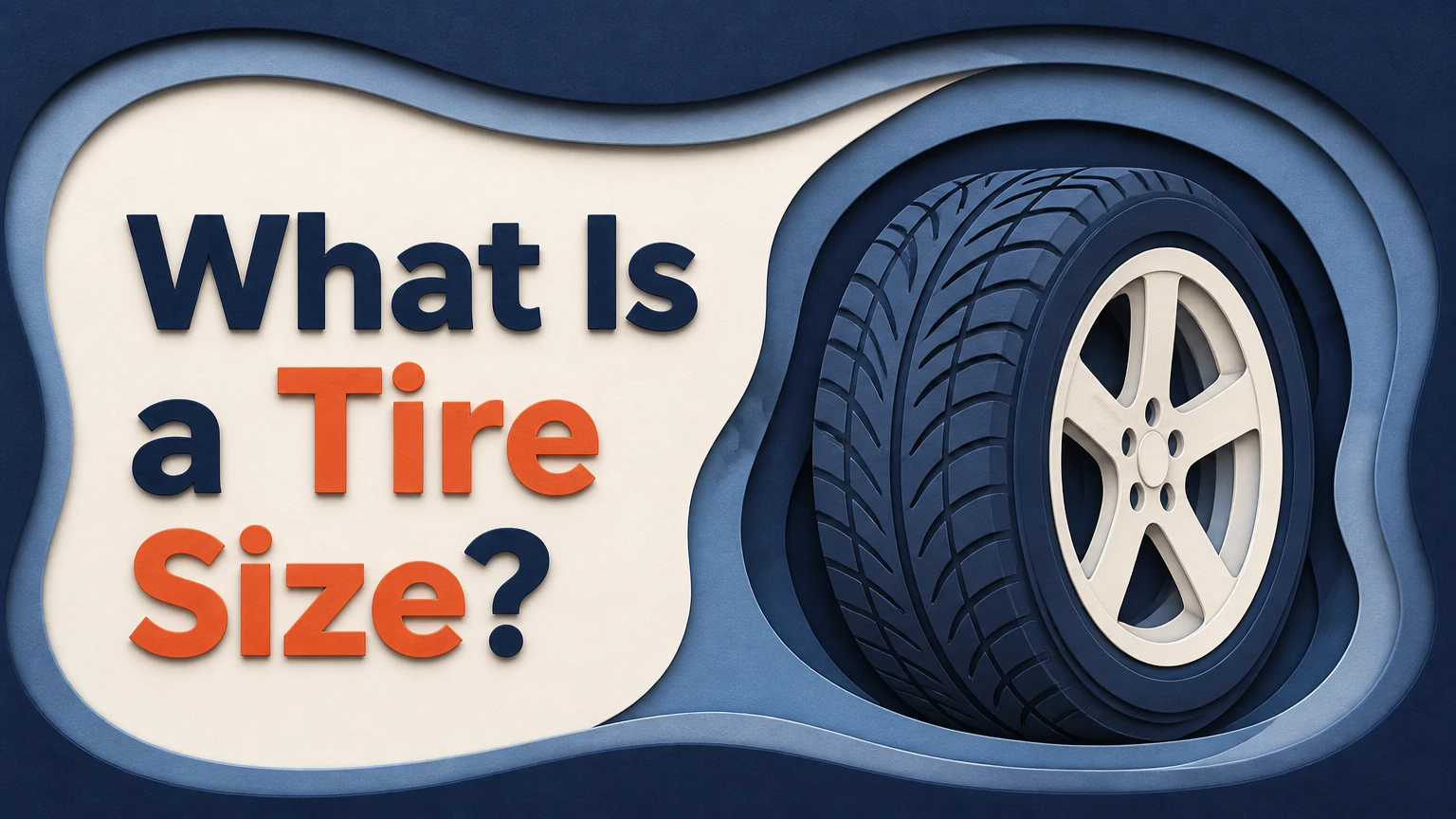
A tire size is an alphanumeric code printed directly on a tire sidewall that specifies its physical dimensions, internal construction type, and performance capabilities. This standardized string of numbers and letters communicates everything from section width and aspect ratio to maximum load capacity and safe speed limits.
At a Glance
- A standard metric tire code breaks down physical dimensions, build type, load capacity, and speed limitations into a single string.
- The sidewall code is the primary reference, but the vehicle manufacturer placard inside the driver door jamb provides the ultimate factory specification.
- Changing tire sizes requires keeping the overall outer diameter within 3 percent of the original factory specification to protect vehicle safety systems.
- Mixing tires with different load ratings, construction types, or speed ratings can compromise vehicle handling and cause dangerous tire overheating.
- All-Wheel Drive vehicles require matching tire sizes and tread depths across all four positions to prevent catastrophic transfer case damage.
How do you read a tire size code?
Reading a tire size code requires analyzing the alphanumeric sequence printed on the outer sidewall of the tire from left to right. This sequence is divided into distinct segments that indicate service type, section width, aspect ratio, construction method, wheel diameter, load index, and speed rating.
To decode any standard metric tire, separate the string into the service description and the primary dimension code. For example, in the code P215/65R15 95H, each character cluster represents a specific manufacturing parameter. Understanding this sequence allows vehicle owners to purchase exact replacements without risking mechanical interference or handling failure.
What do the letters and numbers mean in P215/65R15 95H?
The alphanumeric code P215/65R15 95H designates a passenger vehicle tire with a section width of 215 millimeters, a sidewall aspect ratio of 65 percent, radial internal construction, and a 15-inch wheel diameter, supported by a load index of 95 and an H speed rating.
Each specific character in this standard metric code serves a distinct function:
- P (Service Type): Identifies the vehicle class. P stands for Passenger car, while LT stands for Light Truck.
- 215 (Section Width): Measures the width of the tire in millimeters from sidewall to sidewall.
- 65 (Aspect Ratio): Represents the height of the sidewall as a percentage of the section width. In this example, the profile height is 65 percent of 215 millimeters, equaling 139.75 millimeters.
- R (Internal Construction): Indicates how the tire was manufactured. R stands for Radial, which is the universal standard for modern automobiles.
- 15 (Wheel Diameter): Specifies the diameter of the wheel rim in inches that the tire must fit.
- 95 (Load Index): Acts as a numerical code tied to the maximum weight capacity. A 95 rating supports up to 1,521 pounds per tire.
- H (Speed Rating): Designates a letter code indicating the maximum safe operating speed. An H rating means the tire can sustain speeds up to 130 miles per hour or 210 kilometers per hour.
What are the exceptions to the standard metric tire format?
Not all tires follow the standard metric format, as commercial, vintage, and high-performance applications require specialized sizing codes. Recognizing these exceptions prevents improper installation and premature tire failure.
The most common non-standard tire formats include:
- Flotation and Light Truck Sizes: Formats like 33×12.50R15LT are common on off-road trucks. The numbers use inches instead of millimeters, where 33 is the total tire diameter, 12.50 is the section width, and 15 is the wheel size.
- Euro-Metric Sizes: Formats like 215/65R15 omit the leading P or LT designation. Euro-metric tires often feature distinct load-carrying capacities compared to P-metric tires of identical dimensions.
- ZR Speed Ratings: Formats like 245/40ZR18 place the high-performance Z speed designator for speeds exceeding 149 miles per hour directly before the construction letter R, rather than placing it at the end.
- Temporary Spare Tires: Formats like T125/70D15 use a leading T for temporary space-saver spares, while the D indicates diagonal bias-ply construction instead of standard radial design.
When does standard tire replacement advice fail?
Standard tire-buying advice to simply replace tires with the exact size printed on the current sidewall fails when previous owners installed incorrect sizes, when vehicle owners alter wheel dimensions, or when factory sizes are discontinued. Relying blindly on an existing sidewall can perpetuate costly mechanical errors.
The primary scenarios where standard replacement advice fails include:
- The Previous Owner Changed the Size: If a used car was fitted with an incorrect tire size, copying the sidewall text will perpetuate a mistake that skews speedometers and causes fender rubbing. Always verify the factory specification on the vehicle placard located inside the driver door jamb.
- Plus-Sizing or Minus-Sizing Wheels: If you install aftermarket wheels, such as upgrading from 16-inch to 18-inch rims for aesthetics or downgrading for winter conditions, you cannot keep the original tire dimensions. You must recalculate width and aspect ratio.
- Discontinued Factory Sizes: Owners of classic cars and vintage trucks frequently discover that their exact original tire sizes are no longer manufactured, requiring the use of professional cross-reference charts to source modern metric equivalents.
Where can I find the correct tire size for my specific vehicle?
The correct tire size for any vehicle is located on the manufacturer tire placard situated inside the driver door jamb, as well as in the owner manual and on the current tire sidewall. Consulting the door placard provides the definitive factory specification engineered for vehicle weight and safety systems.
To find your correct tire size, follow these steps:
- Open the driver door and locate the white and yellow certification placard affixed to the door post or door edge.
- Look for the section labeled Tire and Loading Information, which lists the original equipment manufacturer tire size.
- Cross-reference this placard size with the numbers printed on the sidewall of your currently installed tires to check for consistency.
- Verify the correct cold inflation pressure values listed on the same placard to ensure optimal tire wear and vehicle handling.
Can I put wider tires on my factory rims?
Yes, you can usually install tires up to 10 millimeters wider than factory specifications on stock rims, such as moving from 215 to 225 width, provided the aspect ratio decreases proportionally to maintain total outer diameter and the rim width can accommodate the footprint. Exceeding this 10-millimeter threshold without changing rims can cause bead unseating, unstable cornering, and internal suspension rubbing.
When considering wider tires, always evaluate rim width compatibility. A wheel rim must fall within the approved rim-width range specified by the tire manufacturer to ensure the sidewalls do not flex abnormally under heavy loads or sharp cornering maneuvers.
What happens if I use the wrong tire size?
Using the wrong tire size causes inaccurate speedometer and odometer readings, suspension rubbing, electronic stability control errors, and severe tire overheating risks. Even minor dimensional discrepancies can disrupt modern vehicle safety computers.
Specific mechanical consequences of incorrect tire sizing include:
- Speedometer and Odometer Errors: Changing the total outer diameter alters rotational speed relative to vehicle speed, causing your speedometer to display slower or faster speeds than your actual velocity.
- Mechanical Interference: Tires that are too tall or wide will rub against inner wheel wells, struts, control arms, and sway bars during steering turns or suspension compression.
- Load Failure and Blowouts: Installing tires with a lower load index than required by the vehicle manufacturer causes excessive heat accumulation, structural sidewall fatigue, and sudden tire blowouts.
How do I calculate tire outer diameter when plus-sizing wheels?
Calculating tire outer diameter during wheel plus-sizing requires multiplying the section width by the aspect ratio, converting millimeters to inches, multiplying by two for both sidewall sections, and adding the wheel rim diameter. The resulting outer diameter must remain within 3 percent of the original factory specification.
Follow this mathematical formula to calculate total tire outer diameter:
- Multiply the section width in millimeters by the aspect ratio percentage to find the sidewall height in millimeters.
- Divide that sidewall height by 25.4 to convert millimeters into inches.
- Multiply the sidewall height in inches by two, since a tire features a top and bottom sidewall relative to the wheel.
- Add the wheel rim diameter in inches to the total sidewall height to determine the overall outer diameter.
- Compare your new calculated diameter against the original factory tire diameter to verify it stays within the safe 3 percent tolerance window.
What is the difference between P-metric and Euro-metric tire sizes?
P-metric and Euro-metric tire sizes differ primarily in their load-carrying capacity standards and regulatory oversight, even when their dimensional numbers appear identical. Euro-metric tires are engineered according to European Tyre and Rim Technical Organisation standards, whereas P-metric tires follow The Tire and Rim Association standards used primarily in North America.
Euro-metric tires often feature different load capacities at identical inflation pressures compared to P-metric tires. When replacing P-metric tires with Euro-metric alternatives, technicians must verify that the load index meets or exceeds the vehicle manufacturer minimum requirements to prevent overloading the vehicle suspension structure.
Do I have to replace all four tires at the same time?
Yes, on All-Wheel Drive and Four-Wheel Drive vehicles, you must replace all four tires at the same time to ensure equal rolling circumferences. Different tire sizes or uneven tread depths spin at varying rotational speeds, generating continuous friction that can permanently destroy an All-Wheel Drive transfer case or differential.
On front-wheel drive or rear-wheel drive vehicles, you can replace tires in pairs on the same axle. However, new tires should always be installed on the rear axle regardless of drive configuration to prevent vehicle oversteer and loss of control on wet road surfaces.
Can I mix tires with different speed ratings?
Mixing tires with different speed ratings is highly discouraged by automotive safety experts and tire manufacturers. If emergency circumstances require mixing speed ratings, you must install the tires with the higher speed rating on the rear axle to maintain stability, and your maximum vehicle speed is strictly limited by the lowest-rated tire on the vehicle.
Combining different speed ratings creates unbalanced handling characteristics during sudden evasive maneuvers. The lower-rated tire will reach its structural limits before the higher-rated tire, resulting in unpredictable oversteer or understeer dynamics.
How do load index and speed rating affect daily driving safety?
Load index and speed rating determine the maximum weight a tire can safely support and the highest velocity it can sustain without structural degradation. Ignoring these performance metrics invites catastrophic tire failure during highway driving or heavy hauling.
Daily safety depends directly on maintaining these ratings:
- Load Index Compliance: Exceeding a tire load rating causes rubber compounds to overheat, leading to tread separation and sudden deflation. Always match or exceed the original equipment load index.
- Speed Rating Compliance: Operating a vehicle above the maximum speed limit designated by the tire speed rating risks centrifugal tread tearing and sidewall collapse. Ensure replacement tires match the operational speed capabilities of your vehicle.
Why do classic cars require tire cross-reference charts?
Classic cars require tire cross-reference charts because original bias-ply tire dimensions, such as 7.00-15 or E78-14, are no longer produced by modern manufacturers. Cross-reference charts translate vintage sizing standards into modern metric equivalents that fit legacy wheel rims safely.
Attempting to mount modern radial tires on classic wheels without consulting historical conversion charts often results in improper bead seating, clearance issues against vintage leaf springs, and incorrect speedometer calibration. Specialized vintage tire suppliers rely on these verified charts to preserve original vehicle geometry.
What are the hidden risks of ignoring vehicle door jamb tire placards?
Ignoring vehicle door jamb tire placards and relying solely on tire sidewall maximum pressure ratings leads to improper tire inflation, compromised braking distances, accelerated tread wear, and potential vehicle rollover risks. Sidewall markings state maximum limits rather than vehicle-specific recommendations.
The vehicle manufacturer determines optimal tire inflation pressures based on vehicle weight distribution, gross vehicle weight rating, and suspension tuning. Following the door placard ensures your tires maintain the correct contact patch with the road surface for maximum traction in all weather conditions.
The Bottom Line
A tire size is a detailed alphanumeric code that defines a tire physical dimensions, construction type, and performance capabilities. Successfully managing tire selection requires reading sidewall markings accurately, respecting load and speed limitations, and always verifying specifications against the vehicle manufacturer placard inside the driver door jamb.