A tire’s load index is a standardized numerical code stamped on the sidewall that specifies the maximum weight a single tire can safely support when inflated to its maximum allowable air pressure. This rating dictates the structural weight limits for passenger cars, trucks, and SUVs.
At a Glance
- The load index scale typically ranges from 0 to 279, with passenger vehicles generally using ratings between 70 and 126.
- A tire with a load index of 85 safely supports 1,135 pounds, while a load index of 105 supports 2,039 pounds.
- P-metric tires installed on light trucks require their load capacity to be divided by 1.10 for safety compliance.
- Extra Load (XL) tires support higher weight than standard load tires, but only when inflated to higher pressure limits like 42 or 50 PSI.
- Light truck tires with dual-load ratings list two numbers to account for weight distribution in single-wheel versus dually setups.
What Is a Tire Load Index and How Does It Work?
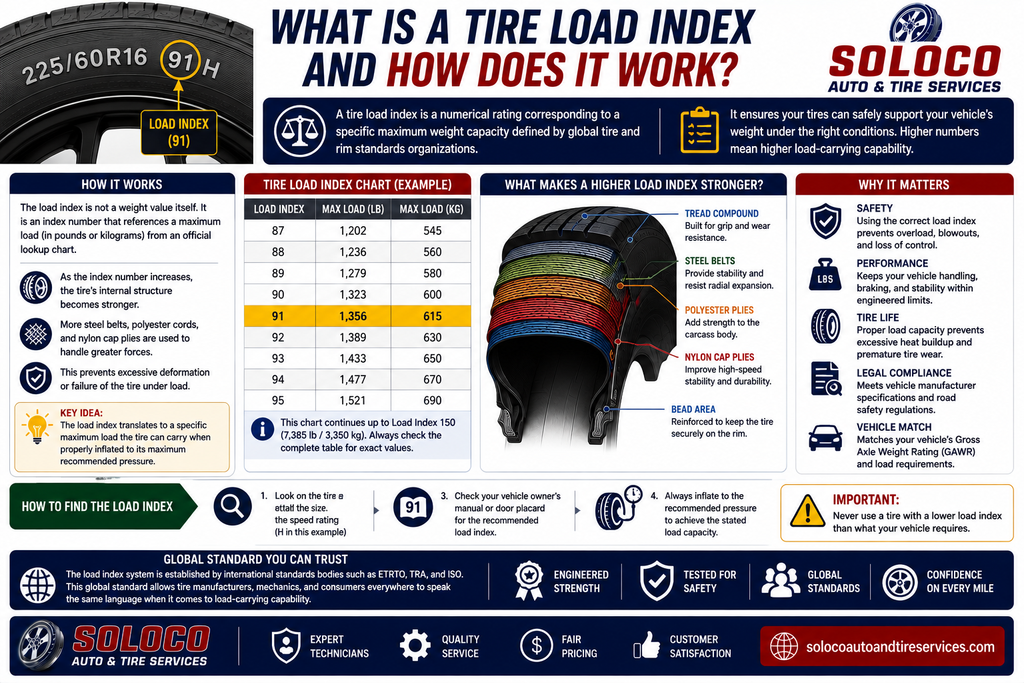
A tire load index is a numerical rating corresponding to a specific maximum weight capacity defined by global tire and rim standards organizations. When a tire carries a load index like 91, that number does not represent pounds or kilograms directly. Instead, it acts as an index value that points to a specific weight threshold listed in engineering lookup charts.
The mechanism relies on structural carcass strength and air volume under maximum pressure. As the numerical index increases, internal steel belts, polyester cords, and nylon cap plies become denser to handle higher compressive forces without catastrophic sidewall failure. Every tire manufacturer worldwide adheres to this standardized scale so consumers and mechanics can match replacement tires to vehicle gross axle weight ratings.
How Is the Numerical Tire Load Index Calculated From Raw Pounds?
The numerical load index is derived from standardized load tables established by organizations like the Tire and Rim Association and the European Tyre and Rim Technical Organisation. Engineers calculate these index numbers based on the inflation pressure required to support a specific weight at a designated test speed, typically 130 miles per hour.
For example, an index of 75 corresponds to 853 pounds or 387 kilograms. An index of 95 represents 1,521 pounds or 690 kilograms. The mathematical progression is non linear because larger tire volumes distribute stress across wider contact patches differently than low-profile tires. Knowing this calculation history helps engineers design tires that prevent structural deformation under heavy vehicle loads.
What Does the Standard Load Index Scale Include?
The standard load index scale spans from index 0 supporting 99 pounds up to index 279 supporting over 180,000 pounds for massive industrial earthmovers. Everyday passenger cars, crossovers, and light commercial vehicles operate within a much narrower band of that global scale.
| Load Index | Max Load Capacity (lbs) | Max Load Capacity (kg) | Typical Vehicle Class |
| 75 | 853 lbs | 387 kg | Subcompact cars |
| 85 | 1,135 lbs | 515 kg | Compact sedans |
| 95 | 1,521 lbs | 690 kg | Midsize sedans, crossovers |
| 105 | 2,039 lbs | 925 kg | Minivans, light SUVs |
| 115 | 2,679 lbs | 1,215 kg | Full-size pickups, large SUVs |
What Are P-Metric Versus Euro-Metric Load Demotions?
P-metric tires require a mandatory 10% load capacity reduction when installed on light trucks, SUVs, or minivans due to differing safety standard calculations. If you install a P-metric tire labeled with a load index rating of 2,000 pounds on a utility vehicle, federal safety regulations mandate that you divide that capacity by 1.10, lowering the safe working limit to 1,818 pounds.
Euro-metric tires, which feature metric sizing without the leading letter P, do not require this mandatory safety demotion. This distinction prevents sudden sidewall flexing and heat buildup when passenger-car tire constructions are subjected to the higher center of gravity and lateral forces typical of light trucks and vans.
How Do Extra Load (XL) Tire Designations Work?
Extra Load tires feature reinforced internal sidewalls and denser cord plies designed to handle higher maximum weights than standard load equivalents of the exact same physical size. An Extra Load tire designated with a suffix like 95V XL achieves its higher weight capacity only when inflated to higher pressure limits, usually reaching 42 or 50 PSI compared to the standard 36 PSI limit of regular load variants.
If you run an XL tire at standard low pressures, you forfeit the extra load capacity entirely because the air volume inside the tire cannot support the additional downward force. Mechanics recommend XL tires for modern electric vehicles and heavy hybrid sedans that carry substantial battery weight within compact frames.
What Is the Dual-Load Rating System for Heavy Trucks?
Light truck tires designed for commercial applications often display two separate load indices separated by a slash, such as 120/116Q. The first numerical rating, 120, specifies the maximum weight capacity when the tire is mounted in a single-wheel configuration. The second numerical rating, 116, specifies the reduced capacity when the tire is used in a dually setup with dual wheels on each side of the axle.
This rating is lowered for dual setups because if one tire experiences a sudden puncture or pressure loss, the remaining single tire must briefly carry the entire axle load without exploding from thermal overload. Fleet operators must account for this dual-rating reduction when calculating maximum payload limits for commercial towing and hauling.
Does Speed Rating Affect Tire Load Capacity?
Tire load capacity degrades at extreme speeds because centrifugal force and internal friction generate massive heat that weakens rubber compounds and structural belts. If a vehicle exceeds 130 miles per hour on V, W, or Y speed-rated tires, actual load capacity drops linearly by 5% to 15% depending on the exact velocity.
If you plan to drive at sustained high speeds on autobahns or race tracks, matching the original equipment manufacturer load index is mathematically unsafe. Drivers must exceed the baseline load index to compensate for high-speed capacity reduction and maintain structural integrity.
How Do Chassis Modifications and Lift Kits Impact Tire Load Capacity?
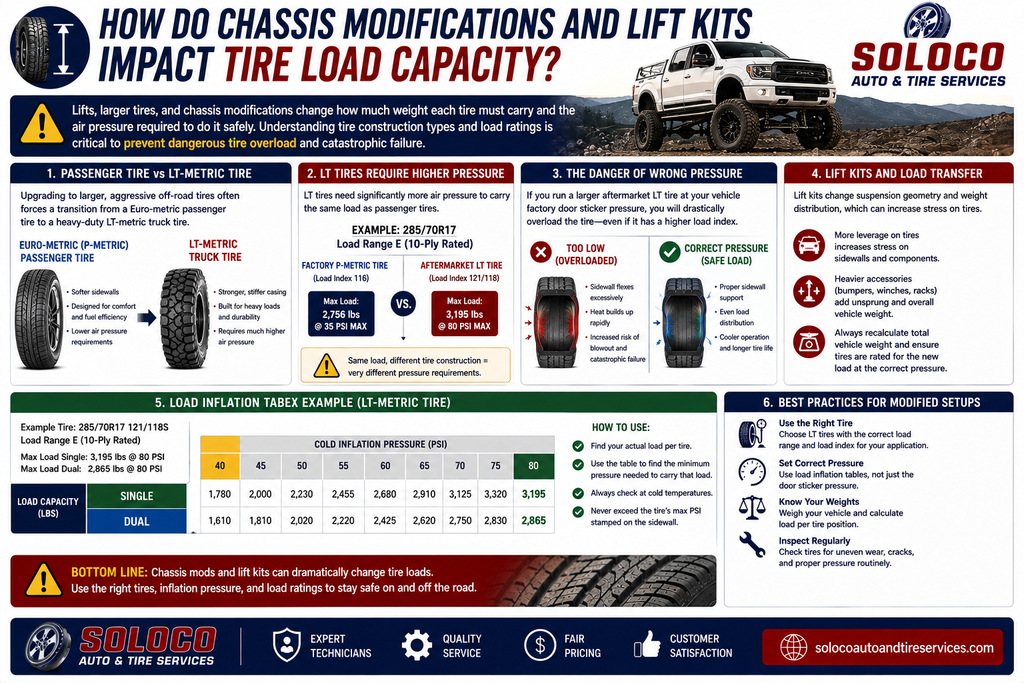
Upgrading to larger, aggressive off-road tires often forces a transition from a Euro-metric passenger tire to a heavy-duty LT-metric truck tire. LT-metric tires require significantly higher air pressures to carry the exact same weight as factory passenger tires due to differences in casing stiffness.
If you run a larger aftermarket LT tire at your vehicle factory door sticker pressure, you will drastically overload the tire despite it displaying a higher numerical load index on the sidewall. Off-road enthusiasts must calculate required inflation pressure adjustments using specialized load inflation tables whenever changing tire construction types.
Can I Mix Different Load Indices on the Same Axle?
Never mix different load indices on the same axle because it causes uneven sidewall flexing, unpredictable handling, and premature drivetrain wear. When tires with differing load ratings share an axle, one side compresses more than the other under cornering forces, creating a persistent pull and erratic braking response.
On all-wheel-drive vehicles, mismatched tire load indices create rolling circumference discrepancies and constant speed variations between left and right wheels. This continuous speed difference overheats the center differential and causes costly mechanical failure in transfer cases.
Is It Safe to Buy a Higher Load Index Than Factory Settings?
Installing replacement tires with a higher load index than factory specifications is entirely safe and often recommended for vehicles used in heavy towing or cargo transport. A higher load index means the tire features a stronger internal carcass with additional ply layers designed to resist heavy weight deformation.
However, the stiffer sidewall construction will noticeably increase ride harshness and can slightly decrease fuel economy due to increased rolling resistance. Drivers prioritizing comfort should weigh the stiffness trade-off against their actual payload requirements before sizing up.
Does a Higher Load Index Make Tires Last Longer?
A higher load index measures structural strength against weight rather than tread wear resistance or rubber compound durability. A heavy-duty commercial truck tire with a massive load rating can wear out just as fast as a passenger sedan tire if the tread compound is formulated for soft grip rather than long mileage.
Tread life depends on factors like tread depth, rubber compound chemistry, wheel alignment, and rotation frequency rather than load index ratings. Selecting a tire with an unnecessarily high load index will not extend tread life and often results in a harsher ride.
Does the Load Index Indicate Correct Tire Pressure?
The tire load index does not indicate correct daily driving pressure because it only specifies weight capacity at the maximum pressure printed on the sidewall. To find the correct daily operating pressure for your vehicle, always reference the placard sticker located inside the driver side door jamb.
The door jamb placard accounts for vehicle weight distribution, suspension geometry, and ride comfort targets determined by the automaker. Relying on maximum sidewall pressure found on the tire casing often results in overinflation, a harsh ride, and reduced center tread contact.
What Happens Structurally to a Tire When It Is Overloaded?
Overloading a tire beyond its load index causes extreme sidewall flexing, excessive internal heat generation, and eventual separation of the tread from the casing belts. As the vehicle weight compresses the tire beyond its structural design limit, the internal polyester and steel cords experience micro-fractures from abnormal bending angles.
This internal heat buildup causes rubber compounds to break down chemically, leading to sudden tread separation or catastrophic blowout conditions at highway speeds. Maintaining proper load indices and inflation pressures prevents this thermal degradation cycle.
How Do Cold Weather and Temperature Drops Impact Tire Load Capacity?
Ambient temperature drops reduce tire air pressure because gases contract as they cool, which temporarily lowers the load-carrying margin of safety until pressure is corrected. For every 10 degrees Fahrenheit drop in ambient temperature, tire pressure decreases by approximately 1 to 2 PSI.
If a tire is already operating near its maximum load index limit during winter conditions, uncorrected low pressure reduces the structural load capacity of the casing. Drivers must check and adjust tire pressures monthly during seasonal temperature shifts to maintain safe load index margins.
What Are the Consequences of Installing Tires With a Lower Load Index?
Installing tires with a lower load index than the vehicle manufacturer specification creates severe safety hazards, handling instability, and potential liability issues during accidents. An undersized load index risks structural blowout under heavy braking or sudden evasive maneuvers when vehicle weight transfers forward onto the front axle.
Furthermore, insurance investigators routinely inspect tire sidewalls after major accidents; discovering mismatched or underrated tires can lead to denied insurance claims due to non-compliance with federal motor vehicle safety standards. Always match or exceed the original equipment load rating.
How Do You Read the Complete Sidewall String to Match Load Index?
Reading a complete sidewall string requires identifying the sequence of numbers and letters, such as P225/65R17 102H. In this standard designation, P indicates the tire type, 225 represents the section width in millimeters, 65 is the aspect ratio, R stands for radial construction, and 17 denotes the rim diameter in inches.
The numbers immediately following the size code, in this case 102, represent the numerical load index indicating a maximum capacity of 1,874 pounds per tire. The trailing letter H represents the speed rating, which dictates the maximum safe velocity for that specific structural build.
What Causes Premature Bead Slip on High Load Index Light Truck Tires?
Premature bead slip on high load index light truck tires typically occurs when running extremely low air pressures for off-road traction without beadlock wheels. Heavy-duty truck tires feature stiff, thick bead bundles designed to lock securely against the wheel rim flange under high inflation pressures.
When operators drop air pressure below 15 PSI for sand or rock crawling, the reduced clamping force allows the heavy tire bead to unseat from the rim lip under lateral cornering loads. Using heavy-duty tires in off-road environments requires careful pressure monitoring to prevent sudden air loss and bead detachment.
The Bottom Line
A tire load index is a critical safety rating that specifies the maximum weight a tire can support at maximum pressure, anchored by global engineering standards. Understanding exceptions like P-metric weight demotions, extra load requirements, and speed rating trade-offs ensures your vehicle remains safe during heavy transport. Always match or exceed original equipment manufacturer load specifications, and rely on your driver-side door jamb placard for correct daily inflation pressures.


