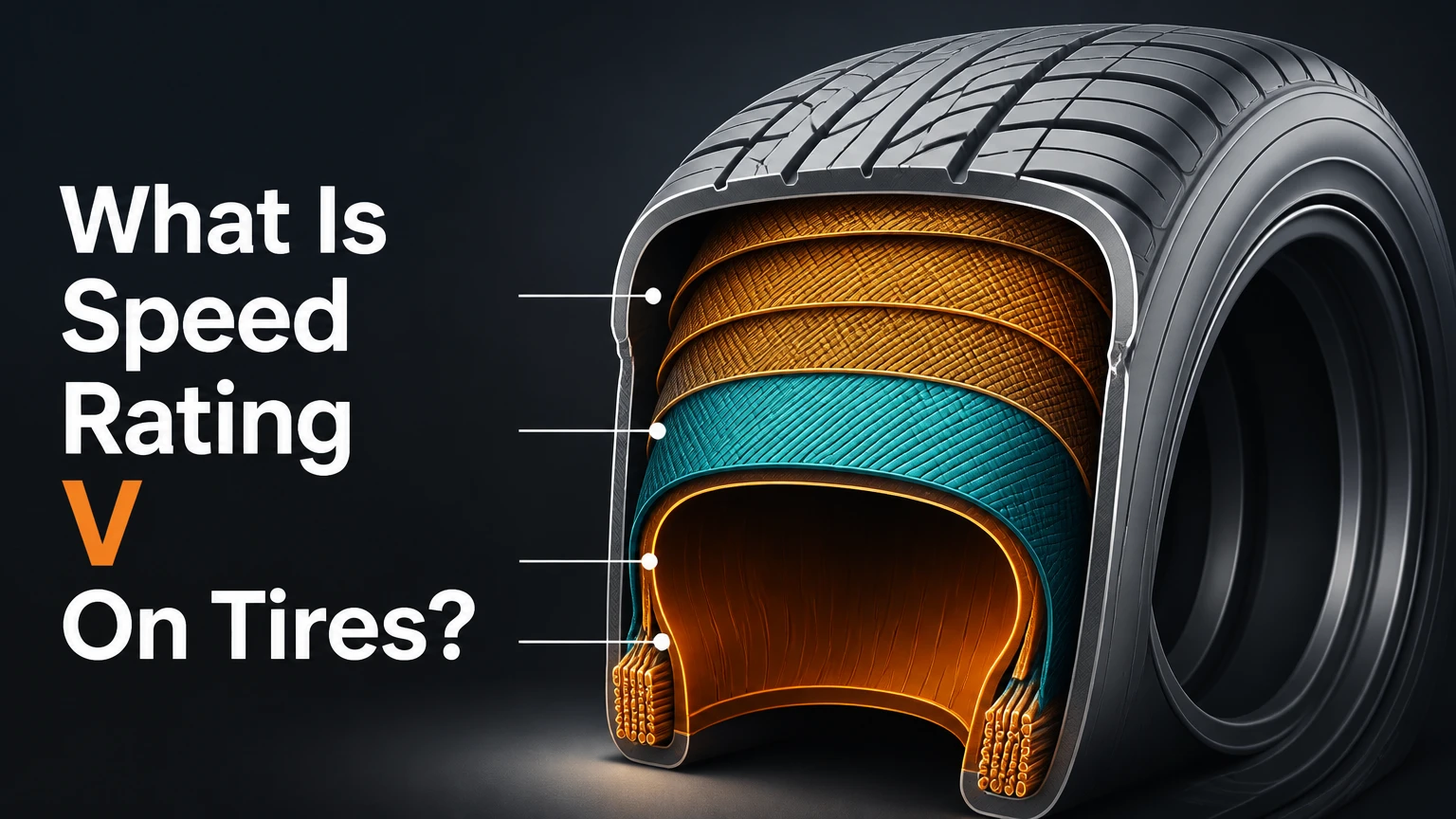
The V speed rating indicates that a tire is certified by regulatory standards to safely carry a load up to a maximum speed of 149 mph or 240 km/h under optimal inflation and load conditions. This performance designation is permanently molded into the tire sidewall as part of the service description, denoting high-speed durability and enhanced structural integrity for performance-oriented passenger vehicles.
At a Glance: Key Facts About V-Speed Rated Tires
- Maximum Speed Capability: V-rated tires are strictly certified for continuous speeds up to 149 mph (240 km/h).
- Load Index Dependency: The speed rating remains valid only if the tire operates within its specified load index limit.
- The 130 mph De-Rating Rule: Unlike lower-rated tires, V tires experience weight capacity reductions at speeds exceeding 130 mph (210 km/h).
- Position in Hierarchy: V sits directly above H-rated tires (130 mph) and below W-rated tires (168 mph).
- Sidewall Construction: V tires feature stiffer internal sidewalls designed to enhance high-speed cornering stability and steering response.
How can I locate the speed rating on my tire’s sidewall?
You can locate the speed rating by finding the alphanumeric service description stamped on the outer sidewall of your tire, typically appearing directly after the tire dimensions, such as 225/45R17 91V. The number 91 represents the load index, while the trailing letter V designates the speed rating. Manufacturers mandate this labeling under federal regulations so drivers and technicians can instantly verify structural limits. Always inspect both front and rear tires, as mixed fitments can sometimes feature varying ratings across different axles.
What is the maximum speed capacity of a V-rated tire?
The maximum speed capacity of a V-rated tire is exactly 149 mph (240 km/h) when tested under standardized laboratory conditions defined by the Department of Transportation and the Economic Commission for Europe. This limit is determined through rigorous drum testing where the tire must sustain high velocities for specific durations without structural degradation or tread separation. Exceeding 149 mph on a V-rated tire introduces extreme thermal stress that can trigger sudden catastrophic failure.
How does the load index affect a V-rated tire’s speed limit?
The speed rating is entirely dependent upon the tire maintaining a load that does not exceed its assigned load index maximum. If a vehicle is loaded beyond its designated weight capacity, the structural integrity of the V-rated tire is compromised, rendering the 149 mph speed rating void and increasing the risk of blowout. Technicians emphasize that speed ratings and load indices function as an inseparable pair; one cannot be maximized without respecting the limitations of the other.
What is the 130 mph load de-rating rule for V tires?
V-rated tires experience a progressive loss in load-carrying capacity at speeds exceeding 130 mph (210 km/h), requiring drivers to reduce vehicle weight to maintain safety margins. While standard passenger tires maintain 100 percent of their load capacity up to their maximum speed, high-performance V tires mandate weight reductions due to extreme centrifugal and thermal forces.
- 130 mph (210 km/h): Carries 100% of its rated load.
- 136 mph (220 km/h): Load capacity drops to 97%.
- 143 mph (230 km/h): Load capacity drops to 94%.
- 149 mph (240 km/h): Load capacity drops to 91%.
Failing to account for this de-rating means that a fully loaded vehicle traveling at 145 mph can overload the tire internally even if static weight limits appear compliant.
How do V-rated tires compare to H, W, and Y speed ratings in the speed hierarchy?
V-rated tires occupy the middle-upper tier of the passenger vehicle speed rating scale, sitting directly between H-rated and W-rated options.
| Speed Rating Letter | Maximum Speed Limit (MPH) | Maximum Speed Limit (KM/H) | Typical Vehicle Application |
| H | 130 mph | 210 km/h | Standard sedans, crossovers, family SUVs |
| V | 149 mph | 240 km/h | Sport sedans, luxury performance vehicles |
| W | 168 mph | 270 km/h | High-performance sports cars, exotics |
| Y | 186 mph | 300 km/h | Ultra-high-performance and supercar models |
Understanding this hierarchy helps drivers select replacements that match or exceed original equipment manufacturer specifications without unnecessary overspending.
How did the historic Z-rating system influence modern V-rated tires?
Before 1990, tire manufacturers used the letter Z inside the size designation (such as 225/45ZR17) as an umbrella term to denote any tire capable of exceeding 149 mph. Because technology rapidly advanced past 149 mph into W and Y territory, the Z designation became too broad for accurate safety compliance. Modern tire engineering resolved this by retaining the Z in the size string for structural context while adding a modern service description like 91V or 94W to specify exact, legally binding speed boundaries.
Can I use winter tires with a lower speed rating than my vehicle’s original V tires?
Yes, you can legally and safely use winter tires with a lower speed rating, such as Q, S, or T, because seasonal weather conditions demand specialized rubber compounds over high-speed capabilities. Regulatory exemptions acknowledge that winter driving speeds are significantly lower due to snow and ice. However, drivers who implement this downgrade must securely place a prominent speed warning sticker within direct view of the driver’s cockpit and must strictly avoid exceeding the lower speed limit of those winter tires.
Why does downgrading from V to H-rated tires affect handling and electronic stability control?
Downgrading from V-rated to H-rated tires degrades handling because V tires incorporate stiffer sidewall constructions engineered to resist lateral roll during aggressive cornering. When vehicle manufacturers design electronic stability control systems, they calibrate wheel speed sensors and yaw rate thresholds based on specific tire carcass rigidity. Installing softer H-rated tires introduces slower steering response and excessive sidewall flex, which can trick stability control computers into unexpected, erratic interventions during emergency lane-change maneuvers.
What happens if you mix H-rated and V-rated tires on the same vehicle?
Mixing H-rated and V-rated tires causes the handling limits of the entire vehicle to default to the lowest rated tire (H, 130 mph), creating dangerous imbalances in vehicle dynamics. Mechanics strictly prohibit mixing different speed ratings across the same axle. If an emergency puncture forces a mixed fitment, the higher-rated V tires must always be installed on the rear axle to prevent sudden oversteer and loss of control on wet or slick road surfaces.
Is a V-rated tire better than an H-rated tire?
A V-rated tire is not inherently better than an H-rated tire for everyday commuting, as the choice depends entirely on driving priorities and vehicle dynamics. V-rated tires provide superior cornering grip, stiffer sidewalls, and better high-speed heat dissipation. Conversely, H-rated tires typically deliver a softer, more comfortable ride quality, absorb road imperfections more effectively, and often yield longer tread life because they utilize slightly more pliable rubber formulations.
Can I put V-rated tires on a car that came with T-rated tires?
Yes, upgrading your vehicle from T-rated tires to V-rated tires is completely safe and mechanically sound. You will immediately experience crisper steering response, reduced cornering roll, and enhanced high-speed stability. The only trade-off is that you may notice a slightly firmer, more responsive ride over sharp road bumps due to the stiffer internal construction of the high-performance V casing.
Do V-rated tires wear out faster than lower speed-rated tires?
V-rated tires often wear out slightly faster than lower speed-rated tires because they frequently utilize softer, high-grip tread compounds designed to maximize traction rather than longevity. While treadwear ratings are primarily governed by the Uniform Tire Quality Grading (UTQG) treadwear number rather than the speed letter alone, the softer rubber chemistry required to achieve a 149 mph speed certification naturally sacrifices some mileage durability compared to hard-compound touring tires.
What causes V-rated tires to generate more heat at high speeds?
V-rated tires generate internal heat through rapid structural flexing and hysteresis as the tread and sidewalls repeatedly compress and recover against the pavement surface. At velocities approaching 149 mph, the frequency of these deformation cycles increases exponentially. Tire engineers counteract this internal heat accumulation by utilizing specialized synthetic reinforcing belts and high-temperature rubber polymers that maintain tensile strength under severe thermal loads.
Are V-rated tires classified as performance or all-season tires?
V-rated tires can be classified as either performance all-season tires or summer performance tires depending on their tread pattern and rubber compound formulation. An all-season V-rated tire features micro-sipes and channels for wet traction, while a summer V-rated tire utilizes smooth tread blocks maximizing dry asphalt contact. Always verify the seasonal labeling on the sidewall alongside the V speed symbol to ensure proper climate suitability.
What are the legal implications of installing tires with a lower speed rating than factory specs?
Installing replacement tires with a speed rating lower than the vehicle manufacturer’s original equipment specification can void parts of your vehicle warranty and, in certain international jurisdictions, violate local vehicle safety inspection laws. While standard passenger vehicle replacements rarely face strict legal enforcement outside of commercial applications, insurance investigators may examine tire specifications following accidents caused by high-speed tire failure. Maintaining factory-recommended speed ratings eliminates these liabilities.
How do proper inflation pressures impact the safe operation of V-rated tires at 149 mph?
Proper inflation pressure is the single most critical factor preventing catastrophic structural failure when operating V-rated tires near their 149 mph limit. Under-inflation causes excessive internal flexing, which skyrockets internal tire temperatures beyond design thresholds, leading to tread separation. Drivers must adjust tire pressures to vehicle manufacturer door-placard specifications, accounting for heavy cargo loads or sustained high-speed autobahn driving conditions.
Can you repair a V-rated tire after a puncture?
You can repair a V-rated tire only if the puncture is located strictly within the tread area and measures less than one-quarter of an inch, using a combination plug-and-patch method applied from the inside. However, industry guidelines from organizations like the U.S. Tire Manufacturers Association strictly dictate that once a tire has been repaired, its maximum speed rating is officially revoked or downgraded. If you frequently drive at high speeds exceeding 130 mph, punctured V-rated tires should be replaced rather than repaired.
The Bottom Line
Understanding what speed rating V on tires means ensures your vehicle maintains optimal safety, handling precision, and legal compliance at speeds up to 149 mph. Always match or exceed your original equipment manufacturer specifications, respect the critical 130 mph load de-rating thresholds, and never mix differing speed ratings across axles. Selecting the correct tire configuration preserves your vehicle’s electronic stability control systems and keeps your travels safe under all driving conditions.


