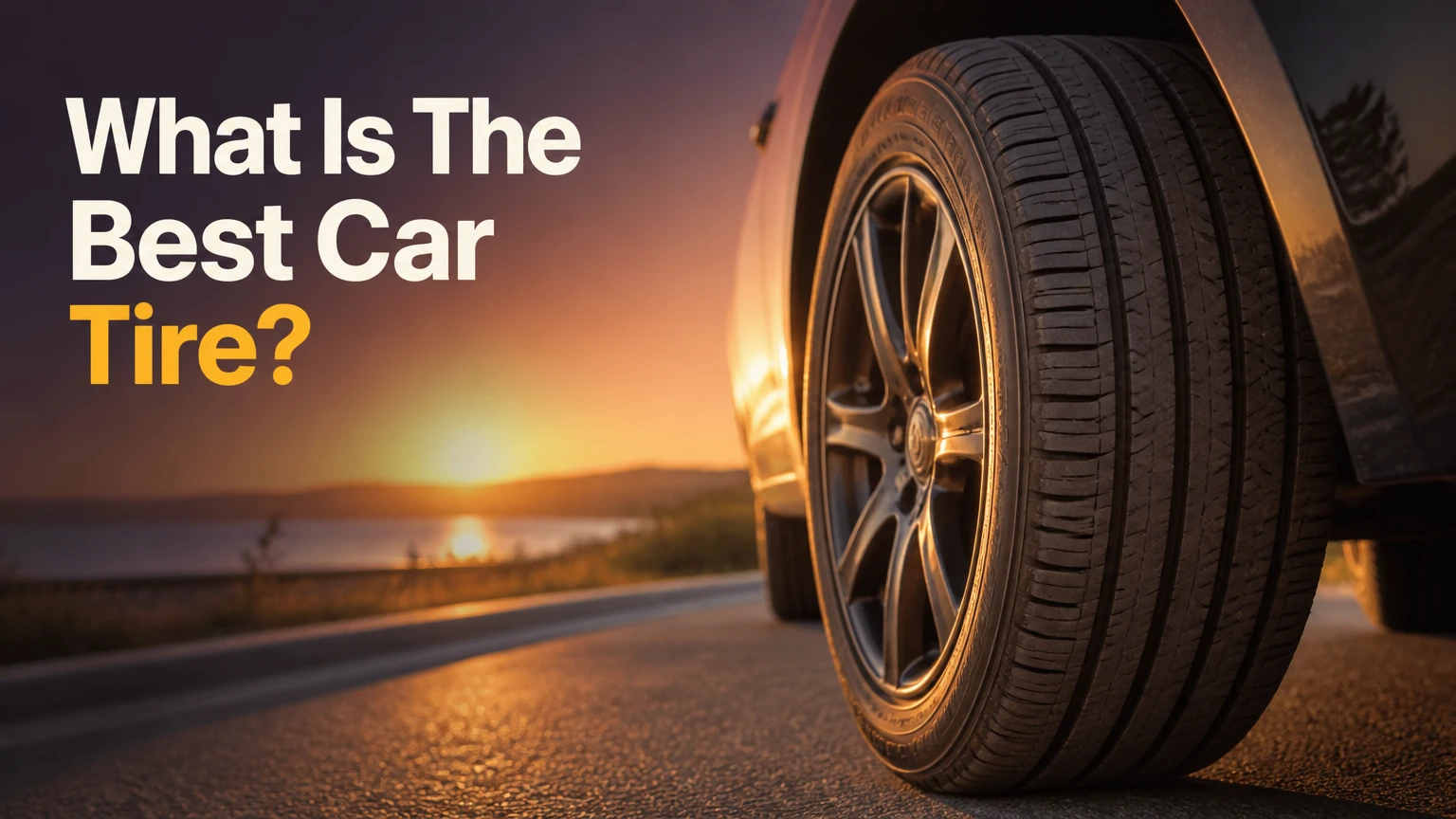
The best car tire depends entirely on your local climate, vehicle type, and daily driving habits. The Michelin CrossClimate 2 leads the market for year-round all-weather versatility. The Continental ExtremeContact DWS06 Plus dominates high-performance handling. The Bridgestone Blizzak WS90 offers unmatched safety on winter ice. No single rubber compound can maximize both snow grip and summer cornering.
At a Glance:
- Standard all-season tires lose significant traction when temperatures drop below 45 degrees Fahrenheit (7 degrees Celsius).
- Premium tires stop significantly shorter in wet conditions compared to budget alternatives.
- Replacing only two tires requires placing the new rubber on the rear axle to prevent high-speed spinouts.
- Heavy electric vehicles require specialized high-load (HL) tires with reinforced sidewalls to prevent premature wear.
- Passenger car tires expire after 10 years regardless of remaining tread depth due to chemical rubber degradation.
- The correct tire pressure is printed on the driver-side door jamb, never on the tire sidewall.
Which all-weather tires perform best in rain and snow?
The Michelin CrossClimate 2 is the top-performing all-weather tire for drivers who face unpredictable rain and moderate snow. It carries the Three-Peak Mountain Snowflake (3PMSF) rating. This certification proves the tire meets strict severe snow traction requirements.
According to Consumer Reports testing in 2025, Michelin ranked first overall among 30 tire brands with a total score of 72 points. The CrossClimate 2 uses a distinct V-shaped directional tread pattern. This geometry channels heavy standing water away from the contact patch rapidly. It prevents hydroplaning at highway speeds while maintaining excellent dry-road handling.
Drivers in regions with heavy rain and occasional snowstorms benefit immensely from this hybrid design. You avoid the cost and hassle of maintaining separate summer and winter wheel sets. Keep in mind that directional tires can only be rotated front to back. You cannot cross them over to opposite sides of the vehicle without dismounting the rubber from the wheels.
What are the top ultra-high-performance (UHP) all-season tires?
The Continental ExtremeContact DWS06 Plus ranks as the top UHP all-season tire for sports sedans and coupes. It balances dry cornering grip with reliable wet weather traction and light snow capability.
Independent track data from Tire Rack reveals exactly how this tire competes against premium rivals like the Michelin Pilot Sport All Season 4. In controlled testing, the Continental ExtremeContact DWS06 Plus stopped 2.6 meters shorter on solid ice from 40 kilometers per hour. It also commands a slightly lower price point.
The Continental features tuned performance indicators stamped directly into the tread block. The letters D, W, and S stand for Dry, Wet, and Snow. When the “S” wears away, the tire is no longer safe for winter conditions. When the “W” disappears, wet traction is compromised. This visual system takes the guesswork out of performance maintenance for aggressive drivers.
Which touring tires deliver the longest tread life?
The Michelin Defender2 provides the longest tread life in the standard touring category. Michelin backs this model with an 80,000-mile treadwear warranty. It uses a proprietary, hardened rubber compound engineered specifically for high-mileage highway commuters.
Durability requires a specific chemical compromise. Harder rubber lasts much longer on dry pavement, but it generally offers slightly less absolute cornering grip than a softer performance tire. The Defender2 solves this by prioritizing low rolling resistance. This design choice maximizes fuel efficiency for standard commuter cars and small SUVs.
J.D. Power customer satisfaction data regularly places Michelin at the top of the passenger and utility categories. Drivers looking to mount a set of tires and forget about them for four to five years will find the highest return on investment with a premium touring option.
What are the best dedicated winter tires for severe ice?
The Bridgestone Blizzak WS90 is the superior choice for dedicated winter driving on glare ice and hard-packed snow. The tire relies on a highly specialized multicell tread compound. This compound acts like a microscopic sponge to absorb and remove the thin layer of surface water that causes vehicles to slide on ice.
Standard rubber turns into rigid plastic in freezing temperatures. The Blizzak WS90 remains soft and pliable well below zero degrees Fahrenheit. Thousands of tiny biting edges (sipes) are cut into the tread blocks to grip snow crystals aggressively.
You must remove dedicated winter tires once spring temperatures consistently stay above 45 degrees Fahrenheit. The ultra-soft winter compound will wear down completely within a few thousand miles on hot summer asphalt.
Are premium tire brands worth the extra cost?
Yes, premium tire brands justify their higher initial cost through longer treadwear warranties, reinforced construction, and significantly shorter emergency stopping distances.
Budget tires often look identical to premium options on the showroom floor. The difference lies inside the chemical compound and the internal steel belt construction. Premium manufacturers spend billions on research to optimize wet braking capability. A mid-range or budget tire might save you 200 dollars at the register, but it could require an extra 15 to 20 feet to stop your vehicle from 60 miles per hour in the rain. That extra distance easily determines whether you stop safely or rear-end the car in front of you.
| Tire Tier | Typical 4-Tire Cost | Average Warranty | Wet Braking Performance |
| Premium (Michelin, Continental) | $800 – $1,100 | 60,000 – 80,000 miles | Excellent (Class-leading) |
| Mid-Range (Hankook, General) | $500 – $750 | 45,000 – 65,000 miles | Very Good |
| Budget / Entry Level | $300 – $450 | 30,000 – 40,000 miles | Average to Poor |
How do you read the numbers on a tire sidewall?
You read tire sidewall numbers by breaking the sequence into width, aspect ratio, construction type, rim diameter, load index, and speed rating.
Consider the common size 225/45R17 94V. The first number (225) represents the section width of the tire in millimeters. The second number (45) is the aspect ratio, meaning the sidewall height is 45 percent of the width. The “R” indicates radial construction, which is standard for modern passenger cars. The “17” dictates the required wheel diameter in inches.
The final sequence (94V) details the performance limits. The load index of 94 means a single tire can safely support 1,477 pounds. The speed rating of “V” indicates the tire can sustain speeds up to 149 miles per hour safely. Never install a tire with a lower load index or speed rating than your vehicle’s factory specification.
| Sidewall Code | What It Measures | Example Value | Meaning of Example |
| Section Width | Width in millimeters | 225 | 225 mm wide |
| Aspect Ratio | Sidewall height percentage | 45 | Height is 45% of 225mm |
| Construction | Internal belt design | R | Radial construction |
| Rim Diameter | Wheel size in inches | 17 | Fits a 17-inch wheel |
| Load Index | Maximum weight capacity | 94 | Supports 1,477 pounds |
| Speed Rating | Maximum safe speed | V | Rated for 149 mph |
What is the difference between standard all-season and all-weather tires?
Standard all-season tires lose traction below 45 degrees Fahrenheit (7 degrees Celsius), while all-weather tires remain flexible and safe in freezing conditions.
The automotive industry relies on confusing terminology here. An “all-season” tire is effectively a three-season tire. It performs admirably in spring, summer, and fall. However, its rubber compound is not chemically designed for freezing temperatures or packed snow.
All-weather tires bridge the gap between summer touring tires and dedicated winter rubber. They feature the Three-Peak Mountain Snowflake symbol stamped on the sidewall. This icon legally certifies that the tire passed specific acceleration tests on medium-packed snow. If you live in a region that sees cold winters but not enough deep snow to justify swapping to dedicated winter tires, all-weather models are the correct choice.
Why do electric vehicles (EVs) require specialized tires?
Electric vehicles require specialized tires to handle 20 to 30 percent heavier curb weights and instant motor torque. Standard passenger tires wear out prematurely when installed on a modern EV.
A battery pack adds hundreds or thousands of pounds to a vehicle chassis. This massive weight crushes standard tire sidewalls under hard cornering. EV-specific tires (like the Hankook iON EVO) carry a High Load (HL) rating. They feature reinforced internal steel belts to support the battery weight without collapsing.
Electric motors also deliver maximum torque the moment you press the accelerator. This instant force shreds standard rubber compounds, reducing a typical 50,000-mile tread life to just 15,000 miles. Furthermore, EV tires incorporate thick layers of acoustic foam glued to the inner liner. Without an engine to mask road noise, this foam is necessary to keep the cabin quiet at highway speeds.
How much does tread depth affect wet stopping distance?
Reducing tread depth from new to 4/32 of an inch increases wet stopping distance by an average of 87 feet at highway speeds.
A 2018 study conducted by AAA revealed a catastrophic drop in safety long before tires reach the legal limit. New tires typically feature 10/32 of an inch of tread. As the tire wears down, the internal grooves become shallower. These grooves are responsible for channeling standing water out from under the tire.
When tread depth drops below 4/32 of an inch, the grooves lose their physical capacity to evacuate water quickly. The water lifts the rubber off the asphalt, causing the vehicle to hydroplane. While the legal minimum tread depth across most of the United States is 2/32 of an inch, safety organizations uniformly recommend replacing your tires well before they reach that bald state.
| Tread Depth | Condition | Wet Braking Performance |
| 10/32″ | New | Maximum water evacuation |
| 6/32″ | Fair | Reliable wet traction |
| 4/32″ | Safety Threshold | Wet stopping distance increases sharply |
| 2/32″ | Legal Minimum | High risk of hydroplaning and failure |
How do you check tire tread depth accurately?
You check tire tread depth most accurately using a dedicated tread depth gauge inserted directly into the primary center grooves.
Press the base of the gauge flat against the surface of the tire and push the measuring pin down until it hits the bottom of the groove. Read the measurement in 32nds of an inch. You should check the depth in the center, the inner edge, and the outer edge to spot uneven wear patterns early.
If you lack a precision gauge, insert a standard US quarter upside down into the tread groove. If you can see the top of George Washington’s head, your tread is at or below 4/32 of an inch. This indicates it is time to shop for replacements. The older “penny test” uses Abraham Lincoln’s head to measure 2/32 of an inch, but waiting until this legal minimum compromises your safety in wet weather.
Can you safely replace just two tires instead of four?
You can safely replace just two tires on a two-wheel-drive vehicle, provided the brand-new tires are installed on the rear axle.
Tire shops face intense arguments from customers over this physical law. Intuition suggests placing new rubber on the front axle to aid steering and braking. Physics demands the opposite. If you put worn tires on the rear and new tires on the front, the rear wheels will lose traction first on wet roads.
When the rear of the vehicle hydroplanes before the front, the car violently spins out (oversteer). The average driver cannot correct this motion. Placing the new, deep-treaded tires on the rear axle ensures the front wheels lose grip first (understeer). Understeer is highly predictable. The car simply plows straight ahead, and the driver naturally slows down to regain control. Note that all-wheel-drive (AWD) vehicles almost always require replacing all four tires simultaneously to prevent burning out the drivetrain differentials.
How old is too old for a passenger car tire?
Six years from the manufacturing date is the threshold where rubber compounds begin structural degradation. Tires must be permanently retired after ten years regardless of how much tread remains.
Rubber is a natural, organic product that slowly oxidizes and dries out. Exposure to ultraviolet light, heat, and ozone turns flexible tread blocks into brittle plastic. A ten-year-old tire with perfect tread depth is a blowout waiting to happen at highway speeds. The internal steel belts delaminate from the hardened rubber, leading to catastrophic failure.
You can determine the exact age of any tire by locating the Department of Transportation (DOT) code printed on the lower sidewall. Look for a four-digit number housed inside a raised oval. The code “3224” indicates the tire was manufactured during the 32nd week of the year 2024. If the DOT code only has three digits, the tire was built before the year 2000 and is extremely dangerous.
What happens if you use winter tires during the summer?
Using winter tires in summer heat accelerates tread wear dramatically and creates sluggish, unpredictable steering response.
Dedicated winter tires are molded from a highly specialized rubber compound rich in silica. This formula is engineered to remain soft and flexible when ambient temperatures drop below freezing. When you drive this soft compound on hot summer asphalt, the rubber essentially melts. A set of expensive winter tires can wear down to the metal belts in a single summer season.
Beyond the financial ruin, driving winter tires in the heat compromises your safety. The deep tread blocks and soft rubber flex wildly under hard cornering or emergency braking in warm weather. This flexing causes the vehicle to wander laterally, significantly increasing dry stopping distances and destroying highway stability.
Why do car tires wear out quickly on the inside edge?
Car tires wear out quickly on the inside edge due to negative camber misalignment or failing suspension components.
When a vehicle’s suspension geometry is out of factory specification, the tire does not sit perfectly flat on the road. Negative camber means the top of the tire tilts inward toward the engine block. This directs the entire weight of the vehicle onto the narrow inner shoulder of the tread. The inner edge will wear down to the steel cords while the outside edge looks brand new.
Worn ball joints, broken tie rods, or sagging springs will also force the tire into incorrect angles. Simply buying the best car tire available will not solve this problem. If you spot severe inside edge wear, you must take the vehicle to a certified technician for a structural suspension inspection followed by a computerized four-wheel alignment.
Do new tires require a wheel alignment?
Yes, installing new tires requires a four-wheel alignment to prevent premature and uneven tread wear.
A vehicle misaligned by a fraction of an inch will scrub the tread off your expensive new tires within 5,000 miles. Misalignment forces the rubber to drag diagonally across the pavement rather than rolling straight forward. This friction generates immense heat and literally sands the rubber off the casing.
Tire manufacturers will completely void your 60,000-mile treadwear warranty if they determine the damage was caused by a mechanical alignment failure. Paying 100 to 150 dollars for an alignment when you purchase a new set of tires acts as a mandatory insurance policy for your investment.
Does filling car tires with nitrogen improve fuel economy?
No, filling passenger car tires with pure nitrogen does not measurably improve fuel economy or road performance.
Atmospheric air is already 78 percent nitrogen. Dealerships often charge a heavy premium to fill tires with 100 percent pure nitrogen, claiming it stops pressure loss and boosts gas mileage. While pure nitrogen molecules are slightly larger and leak through the tire liner at a slower rate than oxygen, the real-world difference for a commuter car is statistically negligible.
Nitrogen inflation is critical for aviation and professional motorsports where extreme heat cycles cause standard air moisture to expand violently. For a Honda Civic driving to the grocery store, checking your tire pressure manually once a month with regular air provides identical safety and fuel economy benefits for free.
How do you find the correct tire pressure for your vehicle?
You find the correct operating tire pressure printed on the white and yellow placard located inside the driver-side door jamb.
Never inflate your tires to the PSI number stamped on the sidewall of the tire itself. That sidewall number represents the absolute maximum pressure the tire casing can physically hold before failing. It has nothing to do with the proper pressure required to carry the weight of your specific vehicle.
Automotive engineers calculate the exact pressure needed to optimize vehicle handling, maximize fuel efficiency, and ensure even tread wear. Under-inflating your tires by just 5 PSI increases rolling resistance, drops your fuel economy, and accelerates wear on the outer shoulders of the tread. Over-inflating creates a harsh ride and concentrates all the wear on the center of the tire. Check your pressure in the morning before the vehicle is driven, as driving heats up the internal air and temporarily inflates the pressure reading.
The Bottom Line
Identifying the best car tire for your vehicle comes down to matching the rubber compound directly to your regional climate and payload. The Michelin CrossClimate 2 serves as the ultimate all-weather solution for regions with moderate snow, while the Continental ExtremeContact DWS06 Plus excels in high-performance handling. Always maintain your tires correctly by tracking tread depth with a gauge, aligning your suspension upon installation, and adhering to the exact PSI listed inside your driver-side door jamb. Protect your investment by replacing old, degraded rubber before it fails, and always prioritize premium wet-braking performance to keep your family safe on the road.