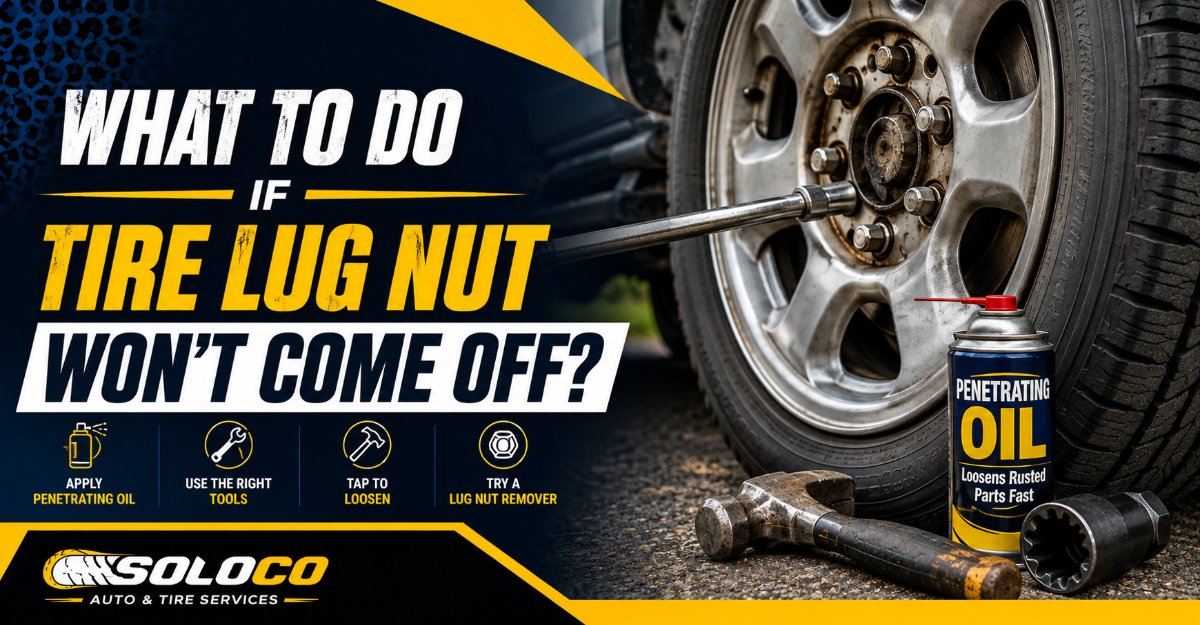
Stopping the application of chaotic brute force is the critical first step to prevent snapping the wheel stud when a tire lug nut is seized. Vehicle owners must systematically transition through mechanical leverage, chemical penetrants, controlled thermal expansion, and impact force before attempting any destructive extraction methods.
At a Glance
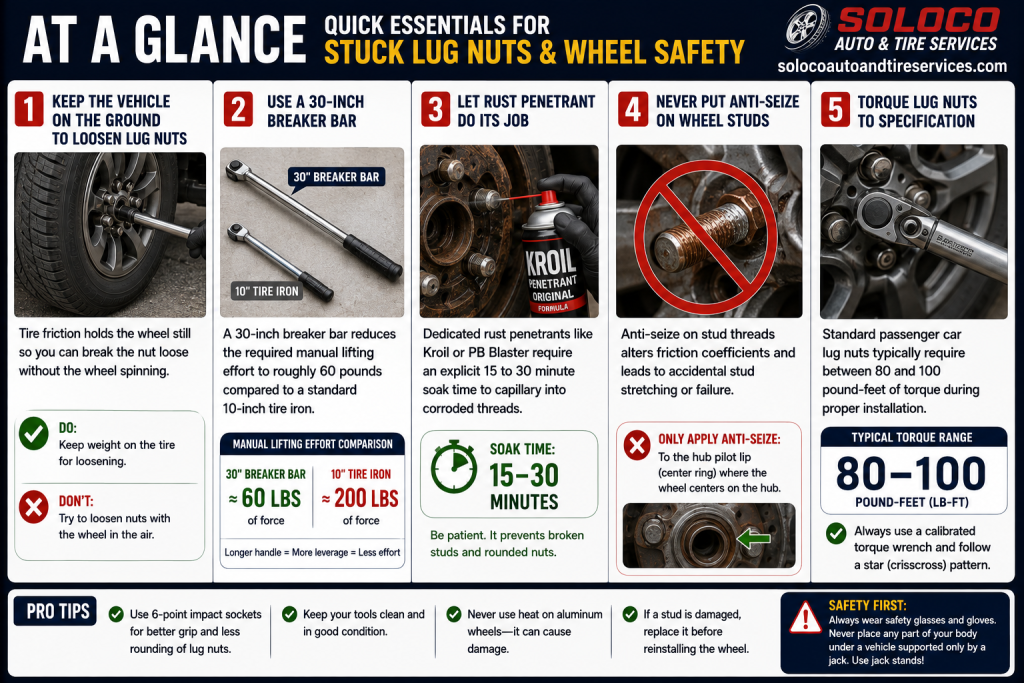
- Keep the vehicle firmly on the ground while attempting to loosen a stuck lug nut so tire friction prevents the wheel from spinning.
- A 30-inch breaker bar reduces the required manual lifting effort to roughly 60 pounds compared to a standard 10-inch tire iron.
- Dedicated rust penetrants like Kroil or PB Blaster require an explicit 15 to 30 minute soak time to capillary into corroded threads.
- Never apply anti-seize lubricant to wheel stud threads, as it alters friction coefficients and leads to accidental stud stretching.
- Standard passenger car lug nuts typically require between 80 and 100 pound-feet of torque during proper installation.
How does a breaker bar provide enough leverage to remove a stuck lug nut?
A breaker bar provides mechanical advantage by extending the distance between the point of applied force and the fastener pivot point. A standard 10-inch tire iron requires approximately 180 pounds of continuous manual force to generate 150 pound-feet of torque, which exceeds normal human capability. Upgrading to a 30-inch breaker bar multiplies the mechanical radius, reducing the required manual effort to just 60 pounds.
Operators should keep the vehicle firmly on the ground with the parking brake engaged when applying this force. Lifting the vehicle onto a jack before cracking the nuts loose allows the wheel to spin freely, neutralizing leverage entirely. Stand perpendicular to the breaker bar and push downward using body weight rather than pulling upward to maintain control if the tool suddenly slips.
What are the best chemical penetrants for rusted wheel lug nuts?
Dedicated low-viscosity synthetic rust penetrants like Kroil, PB Blaster, and Liquid Wrench provide superior creeping action compared to general-purpose water displacers. These formulations utilize low surface tension to travel deep into microscopic thread gaps where iron oxide has bonded the nut to the stud.
Standard consumer sprays like WD-40 fail in this application because they are primarily designed to displace moisture rather than dissolve heavy corrosion. For extreme industrial-level rust, professional mechanics frequently utilize a homemade 50-50 mixture of acetone and automatic transmission fluid (ATF), which outperforms many commercial alternatives in breaking surface tension.
How long should you let penetrating oil soak into a seized lug nut?
Penetrating oil requires an absolute minimum of 15 to 30 minutes of undisturbed dwell time to fully migrate through corroded thread pitches. Spraying the fastener and immediately applying a wrench wastes the chemical because the fluid has no time to travel down the threaded helix.
To accelerate this chemical process, tap the face of the lug nut gently five to ten times with a heavy brass hammer or ball-peen hammer immediately after application. The resulting mechanical shock waves create microscopic fractures in the brittle rust crust, allowing the penetrant to sink significantly deeper into the friction zones.
Is it safe to use a propane torch or heat gun on a stuck lug nut?
Applying controlled heat using a propane torch or a specialized magnetic induction heater is safe for steel wheels, but requires extreme caution around aluminum alloy wheels and rubber tire components. Direct flame exposure must be targeted exclusively at the steel nut for 45 to 60 seconds without contacting the surrounding wheel paint or the rubber valve stem.
Heat causes the outer lug nut to expand slightly faster than the inner threaded stud due to thermal dynamics, effectively crushing the brittle rust bridge holding them together. Operators must keep a water bottle or fire extinguisher nearby and allow the assembly to cool slightly before applying tools to prevent burning skin.
What size impact wrench is needed to remove a stubborn lug nut?
Removing a stubborn, rusted lug nut requires a high-torque 1/2-inch drive pneumatic or cordless electric impact wrench rated for at least 400 to 600 pound-feet of loosening torque. Lower-powered compact impact drivers lack the rotational hammering mass required to shock a corroded fastener loose.
The rapid internal hammering action of a heavy-duty impact wrench delivers thousands of percussive blows per minute. This high-frequency impact breaks the crystalline rust bond without transferring continuous rotational shear stress to the wheel stud, minimizing the mechanical risk of snapping the fastener inside the hub.
What is the standard factory torque specification for passenger car lug nuts?
Standard passenger car and light sedan wheel lug nuts typically require a tightening torque specification between 80 and 100 pound-feet. Larger SUVs, heavy-duty pickup trucks, and commercial passenger vehicles require a significantly higher clamping force ranging from 120 to 150 pound-feet.
Exceeding these specifications during installation stretches the underlying wheel studs beyond their elastic limit. Mechanics use a calibrated click-type torque wrench during final assembly to ensure uniform clamping pressure across every stud, preventing warped brake rotors and loose wheels.
Why won’t my standard socket fit my Ford or Chrysler lug nut?
Modern vehicles manufactured by Ford, Chrysler, and Toyota frequently utilize a two-piece decorative lug nut featuring a hardened steel core wrapped in a decorative chrome or aluminum cap. Moisture routinely infiltrates the microscopic gap between these two layers, causing internal aluminum oxidation that swells the outer dimension by 0.5mm to 1.0mm.
This dimensional expansion prevents a standard metric or imperial socket from seating properly over the fastener. Forcing a standard socket onto a swollen nut rounds off the soft outer cap, leaving the wheel temporarily locked to the vehicle.
How do you remove a swollen two-piece wheel lug nut?
Removing a swollen two-piece lug nut requires specialized half-size automotive flip sockets, such as an 18.5mm or 19.5mm thin-wall socket designed to grip distorted cap dimensions. If a half-size socket is unavailable, technicians deliberately hammer a slightly undersized sacrificial 12-point socket directly over the deformed chrome cap.
The forceful hammering action deforms the socket into the damaged metal, providing enough mechanical bite to spin the nut off the stud. Once removed, the ruined lug nut must be immediately discarded and replaced with a solid one-piece aftermarket alternative.
How do you know if your vehicle has left-hand thread wheel studs?
Vintage vehicles manufactured prior to the 1970s, such as older Chrysler, Dodge, and Plymouth models, often feature left-hand reverse threads on the driver side of the vehicle. These reverse threads were engineered by manufacturers to prevent rotational forces from backing the nuts off while the vehicle moved forward.
Inspect the flat face of the wheel stud or the outer tip of the lug nut for a stamped letter “L” indicating left-hand thread configuration. Attempting to remove a left-hand threaded nut counterclockwise increases tightening torque, which instantly shears the stud in half. Turn these specific fasteners clockwise to loosen them.
How do you remove a stripped or rounded-off lug nut?
Extracting a stripped or completely rounded-off lug nut requires a specialized reverse-tapered extractor socket equipped with internal helical cutting teeth. Drive this extractor socket directly over the damaged hex head using a heavy three-pound hammer to bite deep into the exterior metal wall.
As the technician turns the ratchet or breaker bar counterclockwise, the internal reverse threads of the extractor bite tighter into the exterior walls of the fastener. This specialized gripping mechanism converts rotational loosening force into increased radial clamping pressure, forcing the damaged nut to break free.
What destructive methods work when all else fails to remove a lug nut?
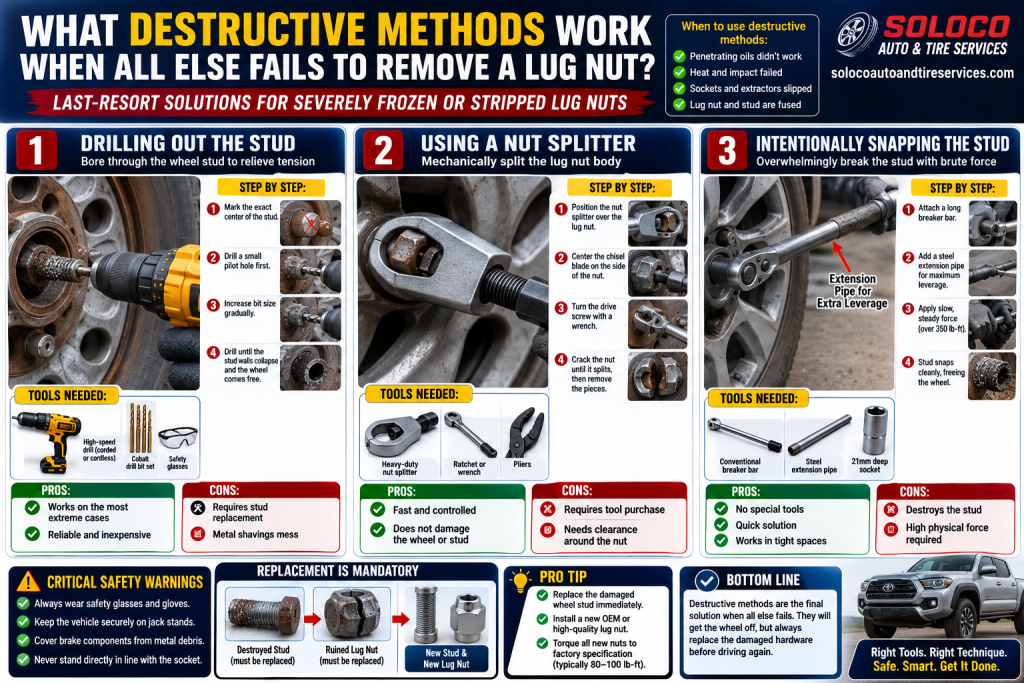
When chemical penetrants, heating cycles, impact wrenches, and extractors fail, the lug nut and stud are mechanically fused into a single unit requiring destructive removal.
- Drilling Out the Stud: Mount a high-speed cobalt drill bit into a power drill and bore a pilot hole straight through the exact center of the wheel stud. Gradually increase the drill bit diameter until the remaining structural walls of the stud collapse inward, relieving tension and freeing the wheel.
- Using a Nut Splitter: Position a mechanical nut splitter tool around the exterior body of the lug nut in the wheel recess. Turn the drive screw with a wrench to press a hardened steel chisel blade into the side of the nut until it splits apart.
- Intentionally Snapping the Stud: Attach a massive breaker bar paired with a steel extension pipe and apply over 350 pound-feet of manual leverage until the wheel stud snaps cleanly in half.
Any destructive extraction method requires the immediate replacement of both the damaged wheel stud and the ruined lug nut before driving the vehicle again.
Is it safe to drive with one missing or broken wheel lug nut?
Operating a motor vehicle with a single missing or broken wheel lug nut is acceptable only for a very short emergency distance of under 20 miles at reduced speeds below 40 mph. This exception applies strictly if the remaining four out of five lug nuts (or three out of four) are properly torqued to factory specifications.
Never drive on high-speed interstate highways, rough terrain, or with multiple missing lugs on a single wheel assembly. The missing fastener places severe asymmetrical fatigue stress on the adjacent remaining studs, which can cause them to snap sequentially and result in catastrophic wheel detachment.
Why should you never use anti-seize lubricant on wheel lug nuts?
Vehicle manufacturers explicitly prohibit the application of anti-seize lubricant, grease, or oil onto wheel stud threads during installation. Factory torque specifications are engineered exclusively for clean, dry metal-on-metal friction coefficients.
Applying lubricating compounds drastically reduces thread friction, meaning a standard torque wrench will apply significantly more clamping force than intended at the same setting. This hidden over-torque condition stretches the wheel studs past their elastic yield point, causing them to fracture under normal driving loads. Keep all wheel hardware completely clean, dry, and free of foreign lubricants.
Can driving on over-torqued lug nuts warp brake rotors?
Over-tightening wheel lug nuts beyond factory specifications introduces uneven clamping pressure across the wheel hub mounting surface. This excessive localized clamping force distorts the underlying cast iron brake rotor hat, causing lateral runout as the rotor spins against the brake pads.
Drivers experience this distortion as an aggressive pulsation or vibration transmitted through the steering wheel and brake pedal when slowing down from highway speeds. Correcting this issue requires removing the wheel, cleaning the hub face, replacing damaged studs, and resurfacing or replacing the warped brake rotors.
What causes wheel lug nuts to seize or weld themselves to the stud in the first place?
Wheel lug nuts seize primarily due to galvanic corrosion caused by dissimilar metal contact between steel studs and aluminum wheels, combined with road salt and moisture intrusion. When winter road chemicals infiltrate the threaded assembly, an electrochemical reaction creates iron oxide rust crystals that expand inside the thread pitch.
Over-tightening fasteners with pneumatic impact wrenches during routine tire rotations exacerbates this issue by galling the metal threads together. Regular cleaning of mating surfaces and strict adherence to correct torque limits prevents this destructive metallurgical bonding.
How do you properly clean wheel stud threads after removing a rusted lug nut?
Cleaning wheel stud threads after removing a severely rusted lug nut requires a dedicated stainless steel wire brush, specialized thread-chasing dies, and a quick-drying aerosol brake cleaner. Scrub the exposed threads vigorously with the wire brush to dislodge loose scale and embedded iron oxide flakes.
Spray the area with brake cleaner to flush away debris and old chemical penetrants from the root of the threads. For damaged threads, thread a matching steel die nut over the stud to restore flattened thread pitches before installing a brand-new factory replacement lug nut.
The Bottom Line
Removing a stubborn tire lug nut requires a disciplined progression starting with a long breaker bar and vehicle weight friction, followed by dedicated penetrating fluid and controlled thermal expansion. Skipping brute-force mistakes prevents sheared wheel studs and costly hub replacements. Always install clean, dry fasteners to exact factory torque specifications to ensure long-term roadside safety.