Vehicle owners must replace passenger car tires when their tread depth wears down to 2/32 of an inch, which represents the absolute legal minimum safety limit across most jurisdictions. However, professional automotive safety standards dictate that drivers should proactively replace tires at 4/32 of an inch for optimal wet weather traction and hydroplaning resistance, and at 5/32 of an inch for reliable stopping performance in heavy winter snow.
At a Glance: Tire Tread Safety Facts
- Brand-new passenger car tires typically start with 10/32 to 12/32 of an inch of usable tread depth.
- Driving on tires worn down to 4/32 of an inch doubles stopping distances on wet, rain-slicked roadways compared to new rubber.
- The traditional penny test only indicates the legal limit of 2/32″, whereas the quarter test checks for the safer 4/32″ rain threshold.
- Rubber compound degradation requires replacing tires after 6 to 10 years, regardless of how much tread depth remains.
- Uneven tread wear requires measuring the shallowest groove across the entire width of the tire, not taking an average.
What Tread Depth to Replace Tires?
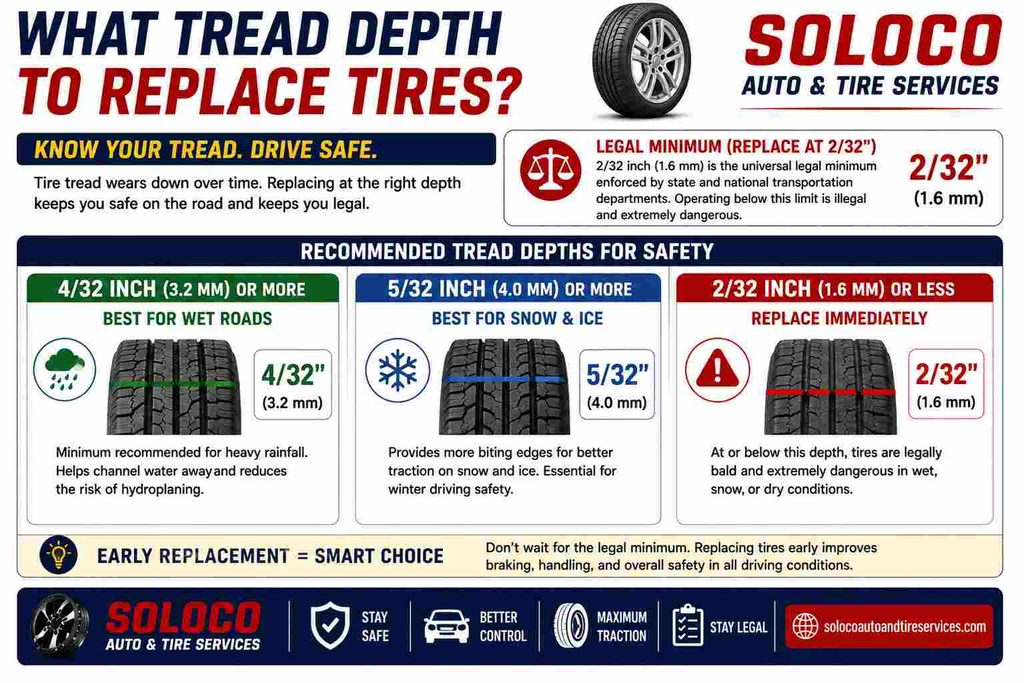
Vehicle owners must replace passenger car tires when the remaining tread groove depth reaches 2/32 of an inch, or 1.6 millimeters. This 2/32 threshold serves as the universal legal minimum enforced by state and national transportation departments. Operating a motor vehicle below this limit creates severe legal liability and risks catastrophic loss of traction.
Practical safety considerations often demand early replacement long before reaching that legal minimum. Wet asphalt and winter weather significantly compromise vehicle control as rubber channels wear down. Drivers navigating heavy seasonal rainfall require a minimum of 4/32 of an inch of tread to effectively displace water and prevent dangerous hydroplaning. Drivers operating vehicles in snowy regions need at least 5/32 of an inch to maintain adequate biting edges in packed snow and ice.
What Do the Different Tread Depth Measurements Mean in Inches and Millimeters?
Automotive tread depth is measured in thirty-seconds of an inch in the United States and in millimeters internationally. Understanding these specific depth tiers helps motorists evaluate remaining tire life with precision.
Brand-new passenger car tires typically feature 10/32 to 12/32 of an inch of usable rubber depth. Tires with 6/32 of an inch possess sufficient depth to provide standard, reliable performance across dry and light-duty conditions. At 5/32 of an inch, the tire reaches the minimum recommended threshold for safe driving in heavy snow. At 4/32 of an inch, the tire hits the critical boundary required to maintain hydroplaning resistance during heavy rainstorms. Finally, 2/32 of an inch marks the absolute legal minimum where tires are completely worn out, legally bald, and hazardous.
How Do I Check Tread Depth Using a Tire Depth Gauge or Ruler?
Motorists can accurately measure tire wear by using a dedicated mechanical tread depth gauge or a standard metal ruler calibrated in fractions of an inch or millimeters.
To check tread depth using a dedicated tool, insert the metal probe into the deepest principal tread groove across the center face of the tire. Press the base of the gauge flat against the rubber block to push the measuring scale upward, then read the exact measurement. Mechanics recommend taking measurements at multiple points across the inner, center, and outer circumferences of each tire. If any single groove reads at or below 4/32 of an inch for rain or 2/32 of an inch for legal limits, the tire requires immediate replacement scheduling.
How Do the Penny Test and Quarter Test Work for Measuring Tire Wear?
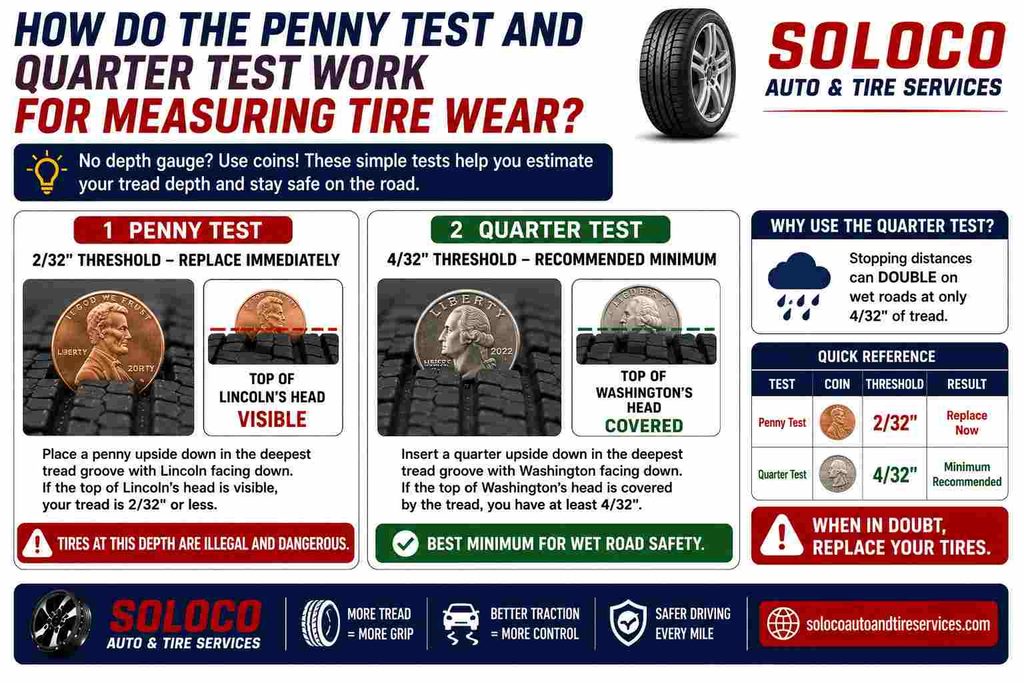
Drivers without a digital depth gauge can utilize United States currency coins as a quick field test to estimate remaining tread depth.
The traditional penny test requires placing a US penny upside down into the deepest tread groove with Abraham Lincoln facing downward. If the top of Lincoln’s head remains completely visible above the tread rubber, the tire has worn down to 2/32 of an inch or less and must be replaced immediately.
However, because stopping distances double on wet roads at 4/32 of an inch, experts recommend the quarter test instead. Inserting a US quarter upside down with George Washington’s head facing downward indicates the 4/32 threshold; if the top of Washington’s head is visible, the tire has lost its optimal wet-weather rain protection and should be scheduled for replacement.
At What Tread Depth Do You Need to Replace Winter and High-Performance Summer Tires?
Specialized tire categories utilize unique rubber compounds and tread patterns that require distinct replacement thresholds compared to standard all-season passenger tires.
High-performance summer tires use ultra-soft rubber compounds engineered for maximum dry grip, but they degrade rapidly and lose wet traction severely once worn below 4/32 of an inch. Dedicated winter and snow tires lose their specialized micro-sipes and snow-biting capabilities long before reaching the 2/32 legal limit, typically becoming ineffective in deep snow at 6/32 to 5/32 of an inch. Many high-end winter tire manufacturers incorporate secondary tread wear indicator bars inside the grooves that appear when 50 percent of the winter-specific tread depth is depleted, signaling that the tire has transitioned from a dedicated snow tire into an ordinary compromised all-season tire.
Why Is My Tire Wearing Unevenly on the Edges or Center, and What Does It Mean?
Uneven tire wear patterns indicate mechanical issues within the vehicle suspension, steering system, or improper inflation practices that destroy tire life prematurely.
When a tire displays baldness along only the inner or outer edge while maintaining adequate depth in the center, it signifies a severe wheel alignment or suspension component failure, such as excessive camber or toe misalignment. Conversely, excessive wear concentrated entirely across the middle of the tread face indicates chronic over-inflation, where the tire balloons outward and rides exclusively on its center ribs. Rapid wear on both outer shoulders simultaneously points to chronic under-inflation, where the tire sags and forces the outer edges to bear the entire load of the vehicle weight. Vehicle owners must measure the shallowest groove across the tire rather than taking an average, as edge wear invalidates healthy center measurements.
How Does Improper Tire Pressure and Lack of Rotation Cause Accelerated Tread Wear?
Tire maintenance directly dictates the rate at which tread rubber wears away, influencing whether a set of tires reaches its manufacturer-estimated mileage warranty.
Maintaining incorrect inflation pressures alters the contact patch footprint between the rubber and the road surface, generating localized friction hotspots that chew through tread blocks unevenly. Front-wheel-drive vehicles naturally wear front tires approximately twice as fast as rear tires due to steering forces and engine braking loads. Neglecting routine tire rotations every 5,000 to 7,000 miles prevents tires from sharing wear evenly across all four wheel positions, leading to premature localized bald spots and forcing costly early replacements.
Should I Replace Two Tires or All Four Tires at Once on My Vehicle?
Vehicle drivetrain configuration dictates whether motorists can replace a single pair of tires or must purchase a complete set of four new tires simultaneously.
All-wheel-drive and four-wheel-drive vehicles require replacing all four tires at the same time to prevent catastrophic mechanical damage to the transfer case, differentials, and transmission components caused by rolling diameter discrepancies. Front-wheel-drive and rear-wheel-drive vehicles permit replacing just two tires at a time, provided the new tires match the vehicle’s load index and speed rating specifications. Motorists replacing only two tires must always install the new tires on the rear axle, regardless of whether the vehicle is front-wheel drive or rear-wheel drive, to maintain superior rear stability and prevent dangerous oversteer skids on wet highways.
If Replacing Only Two Tires, Should New Tires Go on the Front or Rear Axle?
Installing new tires on the rear axle remains a strict industry standard mandated by tire manufacturers and safety organizations to safeguard vehicle handling stability.
Newer tires possess deeper tread grooves capable of displacing standing water efficiently, whereas older tires hydroplane much earlier during emergency braking and cornering maneuvers. Placing worn tires on the front axle allows drivers to steer out of minor slips, but placing worn tires on the rear axle creates high-speed oversteer where the rear end swings outward uncontrollably on slick roads. Rear-axle hydroplaning is nearly impossible for the average driver to recover from, making rear placement of new tires a vital safety protocol.
Is It Safe to Mix Different Tire Brands, Models, or Tread Patterns on the Same Vehicle?
Mixing different tire brands, construction types, or aggressive tread patterns across a vehicle creates unpredictable handling dynamics and compromised safety margins.
Automotive engineers strongly advise against mixing radial and bias-ply tires, or pairing aggressive mud-terrain tires with quiet highway touring tires on the same axle. Significant differences in rubber compound stiffness, cornering grip, and water evacuation rates between mixed tires cause the vehicle to handle unevenly during emergency lane changes or sudden braking. If budget constraints require mixing brands on different axles, motorists must ensure that tires on the same axle match in size, load rating, construction, and tread design.
Can a Wheel Alignment or Tire Balancing Restore Worn-Out Tread Depth?
Wheel alignments, tire rotations, and dynamic wheel balancing cannot restore rubber depth that has already worn away from road friction.
Wheel alignments adjust suspension angles back to factory specifications to prevent future uneven tire wear, but they have zero capability to regenerate lost tread rubber. Once a tire’s tread depth drops below safe operating limits due to normal friction or mechanical misalignment, the only corrective action is purchasing new replacement tires. Performing a wheel alignment immediately after installing new tires is essential to protect the fresh investment from immediate abnormal wear.
When Do Tires Need to Be Replaced Due to Age, Even If They Have Good Tread Depth?
Environmental exposure and chemical degradation require tire replacement based on chronological age, even when the tread depth appears thick and healthy.
Rubber compounds naturally degrade over time as volatile chemical oils evaporate, accelerated by continuous exposure to ultraviolet solar radiation, ozone, and extreme temperature fluctuations. Industry experts and vehicle manufacturers universally mandate replacing tires once they reach 6 to 10 years from their Department of Transportation manufacturing date stamp, regardless of remaining tread depth. Motorists can locate this age by reading the 4-digit DOT code on the sidewall, where the first two digits represent the manufacturing week and the last two digits represent the manufacturing year. Visual inspection for dry rot, fine sidewall cracking, and rubber hardening confirms when aging tires pose structural blowout risks.
How Can I Calculate Remaining Tire Life and Estimate When I Will Need Replacements?
Drivers can mathematically project future tire replacement timelines by tracking mileage accumulation against ongoing tread depth measurements.
To calculate remaining tire life, establish the starting tread depth of the new tire model, subtract the minimum safe limit of 4/32 of an inch, and divide by the total mileage driven over a specific observation period. For example, if a tire loses 2/32 of an inch of tread over 15,000 miles of driving, the motorist can reliably estimate how many remaining thirty-seconds of an inch will sustain them until reaching the replacement threshold. Monitoring driving habits, such as aggressive cornering, heavy payload towing, and harsh braking, helps refine these mileage estimates.
What Are the Legal, Financial, and Safety Risks of Driving on Bald Tires Below 2/32″?
Operating a motor vehicle on bald tires below the legal minimum threshold of 2/32 of an inch exposes drivers to severe legal penalties, insurance liabilities, and crash risks.
Law enforcement officers issue citations and traffic fines for operating vehicles with bald tires, and state vehicle inspection stations routinely fail unroadworthy cars. Insurance investigators review tire condition following collisions; discovering bald tires can result in claim denials or contested fault assignments due to negligence. From a physics perspective, bald tires eliminate friction channels, multiplying stopping distances exponentially on wet pavement and increasing the statistical likelihood of fatal hydroplaning accidents.
How Do Driving Habits and Local Road Conditions Dictate Your Personal Tire Replacement Threshold?
Individual driving environments and operating behaviors create unique wear trajectories that require customized tire replacement decision-making.
Frequent highway commuting on smooth asphalt preserves tread life significantly longer than navigating abrasive gravel roads, pothole-laden urban streets, or mountainous winding switchbacks. Aggressive driving styles characterized by rapid acceleration, hard cornering, and sudden threshold braking generate high friction levels that strip rubber off tread blocks at double the normal rate. Motorists residing in rainy climates or regions prone to heavy winter snow should adopt a conservative 4/32 or 5/32 replacement threshold to safeguard against localized weather hazards, prioritizing traction security over squeezing final miles out of worn rubber.
The Bottom Line
Knowing what tread depth to replace tires is essential for maintaining vehicle control and preventing dangerous hydroplaning on wet roads. While 2/32 of an inch serves as the absolute legal minimum, safety professionals recommend replacing tires at 4/32 for rain and 5/32 for snow. Always measure the shallowest groove, account for tire age up to 10 years, and prioritize rear axle grip when installing new replacement sets.