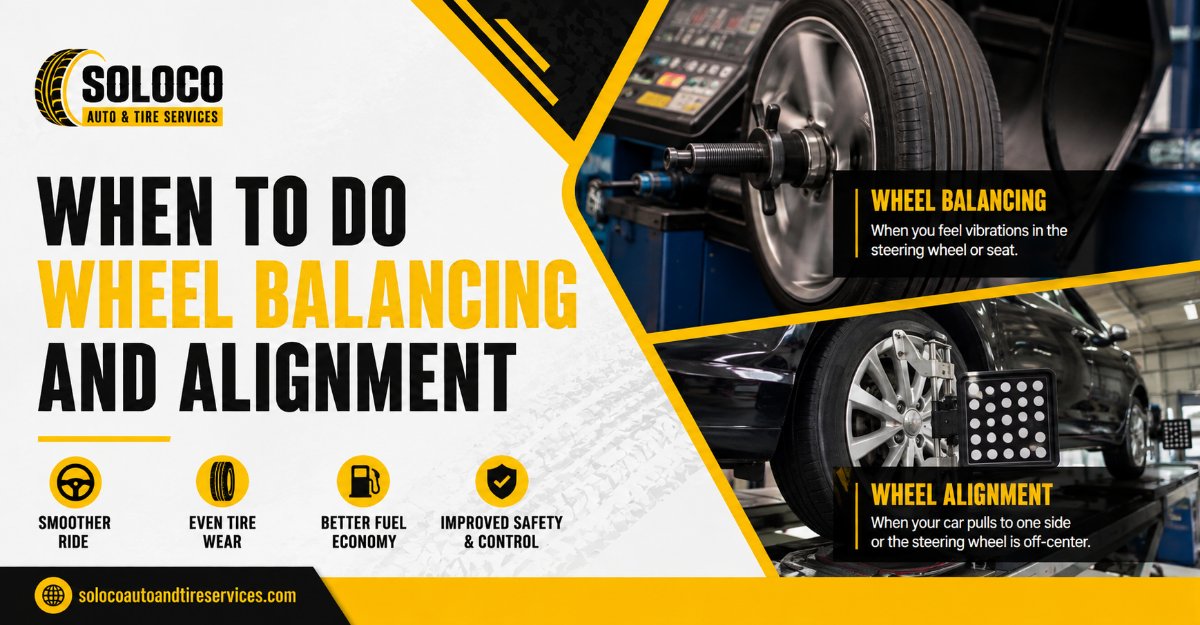
Motorists must balance wheels every 6,000 to 8,000 miles to correct uneven weight distribution and perform a wheel alignment every 10,000 to 12,000 miles to restore suspension geometry.
Drivers must also execute both services immediately after installing new tires, hitting deep potholes, or experiencing steering wheel vibrations.
At a Glance
- Wheel balancing fixes internal weight distribution using small lead or zinc weights.
- Wheel alignment adjusts suspension components (camber, caster, and toe angles) to ensure optimal road contact.
- A weight variance as small as 0.25 ounces requires a professional wheel rebalance.
- An angle misalignment of just 0.08 degrees mandates a suspension adjustment.
- Unbalanced wheels cause highway-speed vibrations, while poor alignment causes steering pull and rapid tread wear.
What is the difference between wheel balancing and alignment?
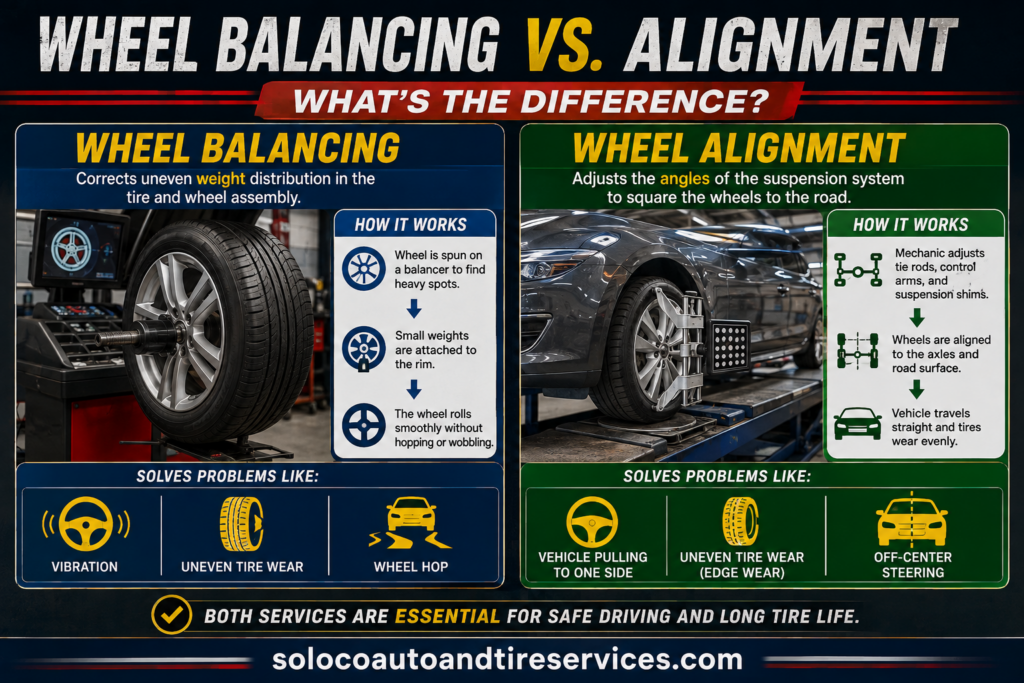
Wheel balancing corrects uneven weight distribution within the tire and rim assembly, whereas wheel alignment adjusts the physical angles of the vehicle suspension system. Both services ensure optimal tire performance but address entirely different mechanical systems.
When a technician performs a wheel balance, the technician places the wheel on a spin balancer to find heavy spots. The technician then attaches small weights to the rim to counterbalance those heavy spots. This process guarantees the wheel rolls smoothly without hopping or wobbling.
Conversely, an alignment does not touch the wheel itself. The mechanic adjusts the tie rods, control arms, and suspension shims under the vehicle. The goal of an alignment is to square the vehicle’s wheels to the axles and the road surface, ensuring the vehicle travels perfectly straight.
How does an alignment fix suspension geometry?
An alignment fixes suspension geometry by resetting three primary angles back to the original factory specifications: camber, caster, and toe. Adjusting these three specific angles maximizes the contact patch between the rubber tread and the asphalt.
Camber measures the inward or outward tilt of the tire when viewed from the front of the vehicle. Negative camber means the top of the tire leans toward the engine, which improves cornering but wears out the inside edge of the tread. Toe measures whether the front of the tires point inward toward each other or outward away from each other. Severe toe misalignment acts like sandpaper and scrubs the rubber away instantly. Caster measures the forward or backward slope of the steering axis. Correct caster ensures the steering wheel naturally returns to the center position after completing a turn.
How often should you balance and align wheels?
Drivers should schedule wheel balancing every 6,000 to 8,000 miles and arrange a wheel alignment every 10,000 to 12,000 miles. Following these exact mileage intervals prevents premature tire degradation and protects expensive suspension linkages.
For convenience, most automotive professionals recommend pairing wheel balancing with every other oil change. Performing an alignment once a year is sufficient for vehicles driven on well-maintained suburban roads. However, off-road vehicles or trucks driven through deep mud require more frequent attention. Heavy mud packs into the wheel barrel to create a severe temporary imbalance. Furthermore, hard off-roading frequently shifts suspension shims. Owners of 4×4 vehicles should schedule alignments every 5,000 miles to compensate for aggressive terrain impacts.
Do new tires need balancing and alignment?
Yes, new tires strictly require balancing at the time of installation and highly benefit from an immediate alignment. Skipping these services immediately compromises the structural integrity of the newly purchased rubber.
Manufacturing imperfections mean no new tire is perfectly round or perfectly weighted. Mounting a new tire onto an old rim compounds these weight discrepancies. Balancing the assembly is mandatory before the vehicle leaves the shop. Furthermore, investing in an alignment protects the new tire warranty. If the vehicle has pre-existing suspension issues, the misaligned angles will permanently ruin the new tread pattern within the first few thousand miles of driving.
Should wheels be balanced during tire rotations?
Yes, technicians highly recommend rebalancing wheel assemblies during a routine tire rotation. Moving a tire from the rear axle to the front axle changes how the driver perceives minor imbalances.
A wheel on the rear axle might have a slight weight discrepancy that goes entirely unnoticed by the driver. When the mechanic moves that exact same wheel to the front steering axle during a rotation, the driver will suddenly feel a severe vibration in the steering column. Rebalancing the tires while they are already detached from the vehicle eliminates this risk and ensures a perfectly smooth ride.
How often do electric vehicles need alignments?
Electric vehicle owners must check their suspension alignment every 8,000 miles to prevent rapid tread wear. Electric vehicles require more aggressive maintenance schedules than gas-powered cars due to extreme battery weight and instant motor torque.
The heavy battery packs in electric vehicles place immense continuous strain on the control arms and tie rods. Combined with the instant torque delivery of electric motors, this physical stress accelerates tire wear by up to 30 percent compared to internal combustion vehicles. Misalignment on an electric vehicle destroys tires at a highly accelerated rate. Drivers of heavy electric vehicles must treat alignments as strict preventative maintenance rather than an optional service.
How long does a four-wheel alignment take?
A standard four-wheel alignment takes exactly 45 to 60 minutes for a professional technician to complete. This timeframe assumes the vehicle has no rusted suspension bolts or severely bent control arms.
The process involves driving the vehicle onto a specialized hydraulic rack, attaching laser-guided optical sensors to all four wheels, and reading the current geometry on a computer screen. If the vehicle requires extensive adjustments, or if the technician must use a blowtorch to loosen seized tie rods, the service time can easily extend to two hours.
What causes a steering wheel to vibrate at highway speeds?
An unbalanced wheel assembly is the primary mechanical cause of a steering wheel vibrating at speeds between 55 and 70 mph. When a tire has a heavy spot, rotational forces amplify that extra weight as vehicle speed increases.
At low speeds, a heavy spot weighing just 0.5 ounces barely registers in the cabin. However, when the vehicle reaches 65 mph, centrifugal force turns that tiny half-ounce discrepancy into several pounds of rhythmic force slamming into the suspension. If the driver feels the vibration exclusively in the steering wheel, the imbalance is located on the front axle. If the vibration shakes the driver’s seat, the imbalanced wheel is located on the rear axle.
What is radial force variation in tires?
Radial force variation refers to hidden structural defects or hard spots inside the tire sidewall that cause the wheel to hop under load. A tire suffering from radial force variation will vibrate violently on the highway even if a standard spin balancer reads perfectly zero.
Standard balancers only measure weight distribution in the air. They fail to account for how the tire flexes when pressed against the pavement. The only solution for radial force variation is a Road Force Measurement system, specifically the Hunter Road Force Balancer. This advanced machine presses a heavy metal roller against the spinning tire to simulate the exact weight of the vehicle. It detects internal belt separations and structural defects that traditional balancing machines completely miss.
Can a bad alignment cause vehicle vibration?
No, a bad alignment rarely causes cyclic vehicle vibrations at highway speeds. A misaligned suspension primarily causes uneven tire wear, a crooked steering wheel, and directional pulling.
If a vehicle vibrates, drivers should instantly suspect an unbalanced wheel, a bent aluminum rim, or worn-out suspension components. A failed control arm bushing can create a clunking vibration, but the alignment geometry itself does not generate a rhythmic shaking sensation. Drivers must avoid paying for an alignment to fix a vibration problem, as this misdiagnosis wastes money without solving the root mechanical failure.
What symptoms mean your car needs an alignment?
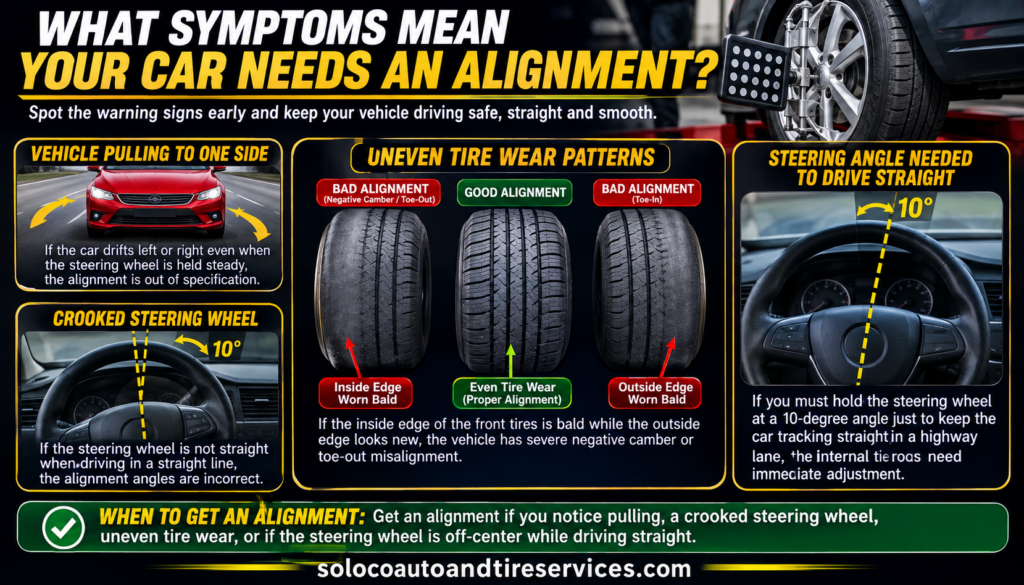
The most definitive symptoms of bad alignment include the vehicle pulling sharply to the left or right, a crooked steering wheel when driving straight, and rapid asymmetrical wear on the tire edges.
Drivers should inspect their tire tread visually once a month. If the inside edge of the front tires is completely bald while the outside edge looks brand new, the vehicle is suffering from severe negative camber or toe-out misalignment. Additionally, if the driver must hold the steering wheel at a 10-degree angle just to keep the car tracking straight in a highway lane, the internal tie rods require immediate adjustment.
Why does a car pull after a professional alignment?
A car will continue to pull after a successful alignment if the technician failed to account for the radial road crown. Most public roads feature a deliberate slope sloping toward the shoulder to drain rainwater.
If a mechanic aligns a vehicle to perfectly neutral zero-degree specifications, the car will naturally drift downhill toward the drainage ditch due to gravity. Expert technicians must deliberately adjust the caster or camber angles slightly to compensate for this road slope. By giving the vehicle a microscopic engineered pull to the left, the technician cancels out the rightward slope of the road, allowing the car to track straight.
How does tire conicity mimic bad alignment?
Tire conicity occurs when the internal steel belts of a tire shift off-center during manufacturing, causing the tire to roll like a cone rather than a cylinder. This structural defect creates a severe directional pull that mimics a bad alignment perfectly.
General troubleshooting rules dictate that a pulling vehicle needs an alignment. However, conicity will force the vehicle to pull even if the suspension angles are geometrically flawless. To diagnose this, technicians swap the two front tires from left to right. If the vehicle suddenly pulls in the exact opposite direction after the swap, the problem is tire conicity rather than a suspension misalignment. The defective tire must be completely replaced.
How do edge cases change standard maintenance?
Standard maintenance intervals fail when dealing with specialized equipment like staggered wheel fitments or aftermarket hub assemblies. High-performance modifications require custom maintenance schedules and specialized balancing hardware to prevent mechanical failures.
Performance sports cars, lifted off-road trucks, and vehicles with aftermarket aesthetic rims do not follow the standard 10,000-mile rules. The geometry of these vehicles places unique stress on standard wheel bearings. Owners of heavily modified vehicles must consult specialty shops to determine accurate service intervals based on their exact suspension geometry.
Why do aftermarket wheels cause persistent vibrations?
Aftermarket wheels cause persistent vibrations if they do not perfectly match the exact hub diameter of the vehicle’s axle. Most aftermarket wheels are manufactured with oversized center bores to fit as many different vehicle brands as possible.
If a driver installs these wheels without using hub-centric rings, the lug nuts alone must bear the weight of centering the wheel. This never works perfectly. The wheel will always sit slightly off-center on the axle, producing a severe, persistent vibration at all speeds. Standard wheel balancing cannot fix this issue. The driver must purchase and install custom plastic or aluminum hub-centric rings to fill the gap between the axle hub and the wheel bore.
How often should staggered wheel fitments be balanced?
Owners of high-performance cars with staggered wheel fitments must balance their wheels every 4,000 miles. A staggered fitment means the rear tires are significantly wider and larger than the front tires.
Because the rear tires are a different size, mechanics cannot rotate the tires from front to back to even out the tread wear. The tires are locked into their specific axle positions for their entire lifespan. Due to this limitation, slight balancing errors will cause rapid, localized tread destruction. Balancing these specific assemblies at a strict 4,000-mile interval is the only way to maximize the lifespan of expensive performance rubber.
How do potholes impact suspension geometry?
Potholes permanently alter suspension geometry by instantly bending delicate tie rods or forcefully shifting the rubber control arm bushings upon high-speed impact. The violent kinetic energy transfers directly into the steering linkages.
A single deep pothole strike at 40 mph generates enough force to bend a steel steering knuckle by a fraction of a millimeter. This microscopic deformation instantly throws the toe angle completely out of specification. Following a severe pothole impact, drivers usually notice the steering wheel immediately sits crooked. The vehicle requires an emergency wheel alignment to manually readjust the threaded tie rods and compensate for the bent components.
What are the risks of ignoring tire maintenance?
Ignoring wheel balancing and alignment schedules results in catastrophic tire blowouts, compromised wet-weather braking, and the premature destruction of expensive suspension hardware.
Tires act as the single contact point between a heavy vehicle and the road. When misalignment scrubs the tread down to the steel cords, the tire loses its ability to channel standing water. This drastically increases the risk of high-speed hydroplaning. Delaying basic maintenance turns a cheap balancing service into a highly expensive complete suspension rebuild.
Is it safe to drive with an unbalanced wheel?
No, it is only safe to drive with an unbalanced wheel for very short distances at low city speeds. Driving long distances at highway speeds with an unbalanced wheel subjects the vehicle to severe mechanical stress.
An unbalanced wheel acts like a hammer. It delivers thousands of rhythmic impacts per minute directly into the wheel bearings, shock absorbers, and steering rack. Over a period of months, this cyclic vibration shatters the internal seals of the shock absorbers and grinds the wheel bearings down to metal shavings.
How much does wheel alignment and balancing cost?
A standard four-wheel alignment typically costs between $100 and $150, while wheel balancing generally costs $15 to $25 per tire. European luxury vehicles and lifted trucks often require specialized labor that pushes alignment costs closer to $200.
Requesting a Road Force balance utilizing a Hunter machine increases the balancing cost to roughly $40 per tire. While Road Force balancing is more expensive than standard spin balancing, the diagnostic accuracy prevents drivers from replacing perfectly good suspension components while chasing a mystery vibration.
The Bottom Line
Wheel balancing is necessary every 6,000 to 8,000 miles to fix vibration issues, while wheel alignment is required every 10,000 to 12,000 miles to correct steering pull and uneven tire wear. Drivers must immediately seek out Road Force balancing if a steering vibration persists after a standard balancing service. Furthermore, motorists who hit severe potholes or install brand new tires must schedule an alignment instantly to protect their vehicle’s handling and safety.


