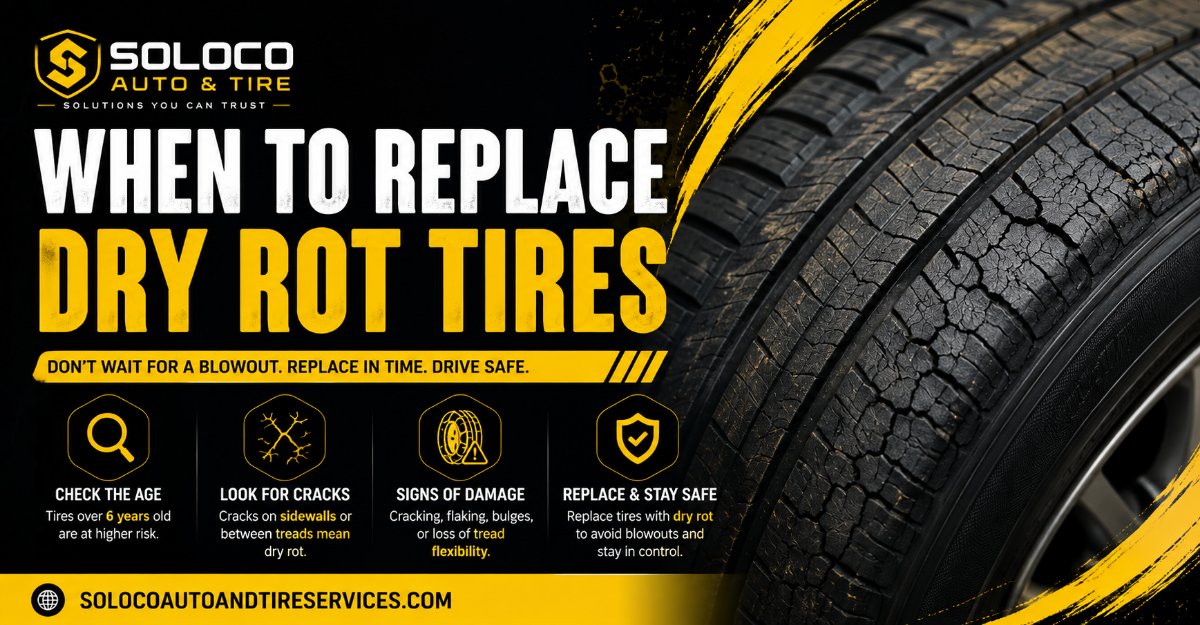
You must replace dry rot tires immediately if cracks reach 1.5 millimeters deep into the rubber, if structural cords become visible, or if deep fissures appear anywhere on the sidewall. Vehicle owners must also replace any tire older than 10 years regardless of visual condition, as internal rubber degradation compromises structural integrity.
At a Glance: Critical Tire Safety Thresholds
- The 1.5 Millimeter Limit: Any crack reaching 1.5 millimeters (1/16 inch) deep demands immediate tire replacement.
- The Age Limit: Tires expire after 10 years from the manufacture date printed on the sidewall, even with perfect tread.
- The Flex Test Warning: Cracks that widen to reveal internal lighter rubber when pushed by hand indicate a structurally compromised tire.
- The Tread Illusion: Tires with completely full tread can still suffer catastrophic blowouts if the underlying rubber compound is dry rotted.
- The Chemical Risk: Silicone-based tire shines accelerate dry rot by stripping away natural protective waxes.
What Does Tire Dry Rot Look Like in Early Stages?
Tire dry rot initially looks like tiny web-like fissures forming on the outermost surface of the rubber sidewall. These early stage cracks are often called weather checking or micro-cracking. Early stage dry rot appears grayish and dull, lacking the rich black sheen of healthy vulcanized rubber.
Drivers will typically spot these superficial cracks near the rim edge or around the raised lettering on the tire sidewall. Superficial micro-cracking under 1 millimeter deep is generally cosmetic and does not require immediate action. However, this visual cue signals that the essential volatile oils inside the rubber compound are beginning to evaporate. Once these oils evaporate, the rubber loses its elasticity. Drivers seeing early stage micro-cracking should begin monitoring their tires monthly for deeper structural degradation.
How Deep Must Cracks Be to Require Replacement?
Cracks must reach a depth of 1.5 millimeters (1/16 inch) or deeper to require immediate tire replacement. Superficial scratches or shallow surface webbing under 1 millimeter do not compromise the structural integrity of the tire carcass. Once a crack penetrates 1.5 millimeters into the compound, the fissure has breached the protective outer layer and exposed the internal casing to moisture and oxygen.
Professional mechanics use tread depth gauges or specialized measuring tools to check crack depth. A simple household test involves the edge of a standard penny. If the edge of a penny can slot into the crack and stay lodged there, the fissure has surpassed the safe depth limit. Any cracking that exposes the white nylon, steel belts, or fabric cords underneath the black rubber dictates absolute and immediate replacement. Driving on tires with exposed structural cords invites an instant and catastrophic blowout at highway speeds.
How Can I Test Tire Sidewall Cracking at Home?
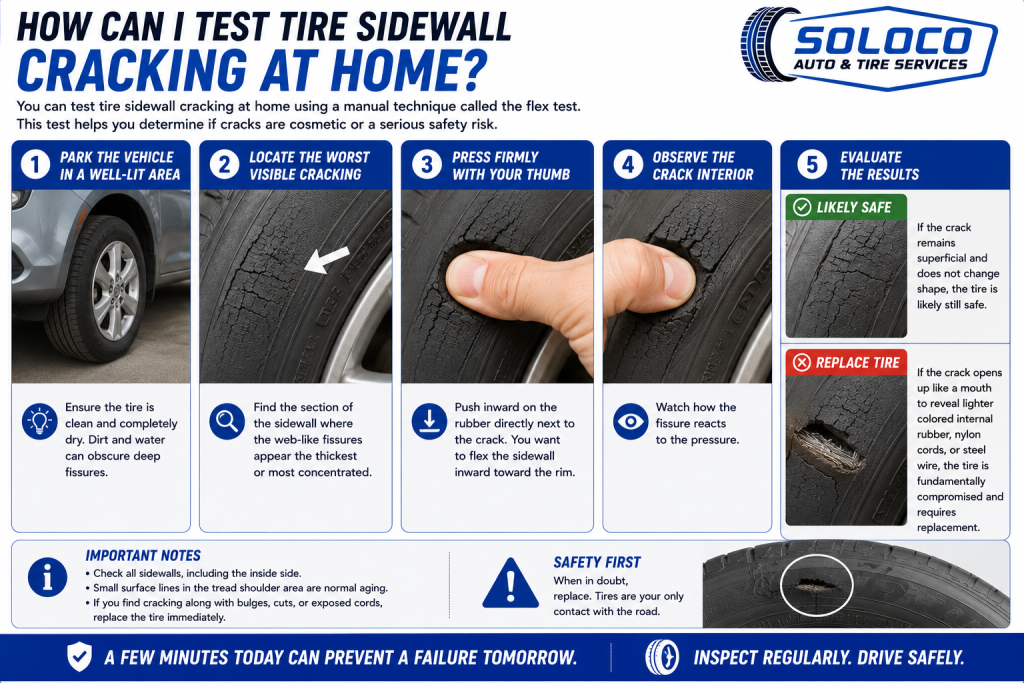
You can test tire sidewall cracking at home using a manual technique called the flex test. The flex test helps vehicle owners differentiate between harmless cosmetic surface checking and dangerous structural failure.
- Park the vehicle in a well-lit area: Ensure the tire is clean and completely dry. Dirt and water can obscure deep fissures.
- Locate the worst visible cracking: Find the section of the sidewall where the web-like fissures appear the thickest or most concentrated.
- Press firmly with your thumb: Push inward on the rubber directly next to the crack. You want to flex the sidewall inward toward the rim.
- Observe the crack interior: Watch how the fissure reacts to the pressure.
- Evaluate the results: If the crack remains superficial and does not change shape, the tire is likely still safe. If the crack opens up like a mouth to reveal lighter colored internal rubber, nylon cords, or steel wire, the tire is fundamentally compromised and requires replacement.
What Causes Tire Dry Rot in the First Place?
Tire dry rot is caused by the evaporation of volatile oils and protective waxes from the vulcanized rubber compound. Tire manufacturers blend these oils and anti-ozonant chemicals into the rubber to keep the tire flexible. When the tire rolls down the road, the mechanical flexing pushes these protective chemicals to the surface, continuously shielding the tire.
When a vehicle sits idle for long periods, this mechanical flexing stops. The protective waxes cannot reach the surface. Environmental factors then attack the unprotected rubber. Ultraviolet radiation from direct sunlight bakes the tire and breaks down molecular bonds. Ozone gas from the atmosphere actively attacks the polymers in the rubber, causing the material to become brittle. Extreme temperature fluctuations expand and contract the brittle rubber, eventually splitting the surface and creating the cracks known as dry rot.
How Fast Does Rubber Degradation Progress?
Rubber degradation progresses in 6 to 12 months in hot and sunny climates, while the same process might take 3 to 4 years in cool and shielded environments. The speed of tire dry rot depends entirely on environmental exposure and vehicle usage patterns.
In states like Arizona or Florida, extreme UV exposure and high surface temperatures accelerate the evaporation of protective oils. A tire parked outside in these conditions can transition from superficial micro-cracking to dangerous, deep fissures in less than one year. Conversely, a vehicle parked in a climate-controlled garage in a mild region like the Pacific Northwest will experience a very slow degradation process. The natural aging of the rubber still occurs, but the lack of direct sunlight and ozone exposure keeps the compound flexible for much longer.
Can Good Tread Hide Dangerous Tire Dry Rot?
Yes, excellent tread depth routinely hides dangerous tire dry rot, creating a false sense of security known as the perfect tread illusion. Deep tread does not equal safety. A tire can have 100 percent of its tread intact but still suffer a catastrophic blowout failure due to dry rot brittleness in the tread grooves or internal belts.
This scenario frequently happens with low-mileage vehicles, classic cars, or spare tires. The owner looks at the thick tread blocks and assumes the tire is practically new. However, the rubber compound holding those tread blocks together has turned brittle from age and inactivity. When the driver finally takes the vehicle on the highway, the brittle rubber cannot withstand the heat and centrifugal force. Entire sections of perfect tread can detach from the tire carcass in an event called tread separation, destroying the vehicle wheel well and causing a sudden loss of control.
Does Tire Age Matter Even Without Visible Cracks?
Yes, tire age matters critically because tires lose their essential volatile oils over time regardless of visual appearance. The automotive industry enforces a strict 6-year inspection rule and a maximum 10-year expiration limit for all passenger tires.
Tires should be thoroughly inspected yearly after they reach 5 years of age. Once a tire reaches 10 years old, you must replace the tire even if it looks brand new and shows zero visible dry rot. Drivers can verify tire age by checking the Department of Transportation (DOT) code on the sidewall. The last four digits of this code indicate the manufacture date. A code reading “3221” means the factory built the tire during the 32nd week of the year 2021. Any tire with a date code older than 10 years is legally expired and unsafe for highway use.
Can I Fix or Seal a Dry Rot Tire?
No, you cannot fix or seal a dry rot tire. There is no chemical, sealant, or rejuvenator that can restore lost volatile oils or repair broken molecular bonds in vulcanized rubber. Any product claiming to fix dry rot is merely a cosmetic cover-up.
Applying thick tire shines or rubber sealants only masks the problem by filling the cracks with shiny silicone. The structural damage remains underneath. The internal belts are still exposed to moisture, and the brittle rubber will still fail under load. Because the chemical degradation of polymers is a one-way street, the only way to fix a dry rot tire is to dismount the tire from the wheel and replace it with fresh rubber.
Do RV and Trailer Tires Need Earlier Replacement?
Yes, RV and trailer tires require replacement far earlier than passenger car tires due to severe load demands and extended periods of inactivity. Heavy RVs sit idle for months at a time, often baking in the sun on asphalt or sinking into moist soil. This combination of inactivity, heavy static weight, and environmental exposure destroys trailer tires rapidly.
| Scenario | Risk Level | Assessment & Action |
| Heavy RVs & Loaded Trailers | Critical Risk | High Blowout Risk. Dry rot causes the tread to separate entirely under heavy loads. Replace tires every 3 to 5 years regardless of tread depth. |
| The Trunk Spare Tire | Medium Risk | The False Security. A trunk-stored spare dries out without flexing. A 10-year-old unused spare can shred within miles of use. Replace at 10 years. |
| Low-Speed Farm Equipment | Low Risk | Acceptable Risk. Tractors operating under 25 kilometers per hour can run on mildly rotted tires until they fail to hold air, as blowouts pose minimal danger. |
Dry rot on heavy loads causes the tread to separate violently. RV owners must adopt a zero-tolerance policy for deep sidewall cracks.
Is It Safe to Drive on Dry Rot Tires at Low City Speeds?
It is never safe to drive on dry rot tires on public roads, even at low city speeds. While the centrifugal forces are lower at 30 miles per hour compared to highway speeds, the risk of sudden structural failure remains dangerously high for any passenger vehicle.
City driving involves sharp turns, sudden braking, and impacts with potholes or curbs. A brittle, dry rotted sidewall lacks the elasticity to absorb these impacts. Striking a moderate pothole at 25 miles per hour with a heavily weather-checked tire can easily rupture the weakened sidewall, causing an immediate blowout. The only exception to this rule applies strictly to off-road farm equipment or yard trailers operating at crawling speeds on private property, where sudden deflation does not risk a multi-vehicle traffic collision.
Does Weather Checking Happen Inside the Tire Cavity?
Yes, weather checking and internal rot happen inside the tire cavity, destroying the tire from the inside out. External visual inspection might show clean rubber on the outer sidewall, while the inner halogenated butyl liner is actively disintegrating into a brittle powder.
Internal rot primarily occurs when tires are run severely underinflated or when air compressors pump moisture-heavy air into the tire cavity. The trapped moisture attacks the internal steel belts, causing them to rust and expand. This expansion cracks the internal rubber liner. Furthermore, a tire that sits flat for months will develop severe internal creasing and cracking at the point where the rubber folds under the weight of the vehicle. A mechanic must dismount the tire to verify internal rot, making age-based replacement even more critical.
Can Tire Shine Products Cause or Hide Dry Rot?
Yes, using cheap, silicone-based tire shines will accelerate and hide dry rot simultaneously. Petroleum distillates and silicone oils make old, degraded rubber look dark, wet, and perfectly healthy. In reality, these aggressive chemicals actually cause dry rot by actively stripping the tire of its natural anti-ozonant waxes.
When vehicle detailers apply heavy silicone dressings, the dressing solvent dissolves the protective wax barrier baked into the tire by the manufacturer. Once the temporary shine washes away, the rubber is left completely naked and vulnerable to UV radiation and ozone gas. The tire then degrades much faster than an untreated tire. Drivers seeking to protect their tires should exclusively use water-based protectants that do not contain petroleum solvents, or simply clean the tires with mild soap and water.
Which Climate Conditions Accelerate Rubber Degradation?
Hot, arid, and high-elevation climate conditions accelerate rubber degradation the fastest. Ultraviolet radiation and ozone concentration serve as the primary catalysts for breaking down polymer bonds in vulcanized rubber.
| Climate Type | Degradation Speed | Primary Threat to Rubber |
| Desert (Hot & Arid) | Extremely Fast | Extreme UV radiation and high surface temperatures bake out volatile oils. |
| High Altitude | Fast | Thinner atmosphere allows intense UV penetration, accelerating cracking. |
| Coastal (Humid & Salty) | Moderate | Salt spray attacks steel belts if micro-cracks exist, causing internal rust. |
| Temperate (Mild & Overcast) | Slow | Low UV exposure and mild temperatures preserve rubber flexibility for years. |
Drivers living in the American Southwest or high-altitude regions like Colorado must inspect their tires for dry rot twice as often as drivers in the cloudy Northeast.
How Can I Prevent Premature Tire Dry Rot in Storage?
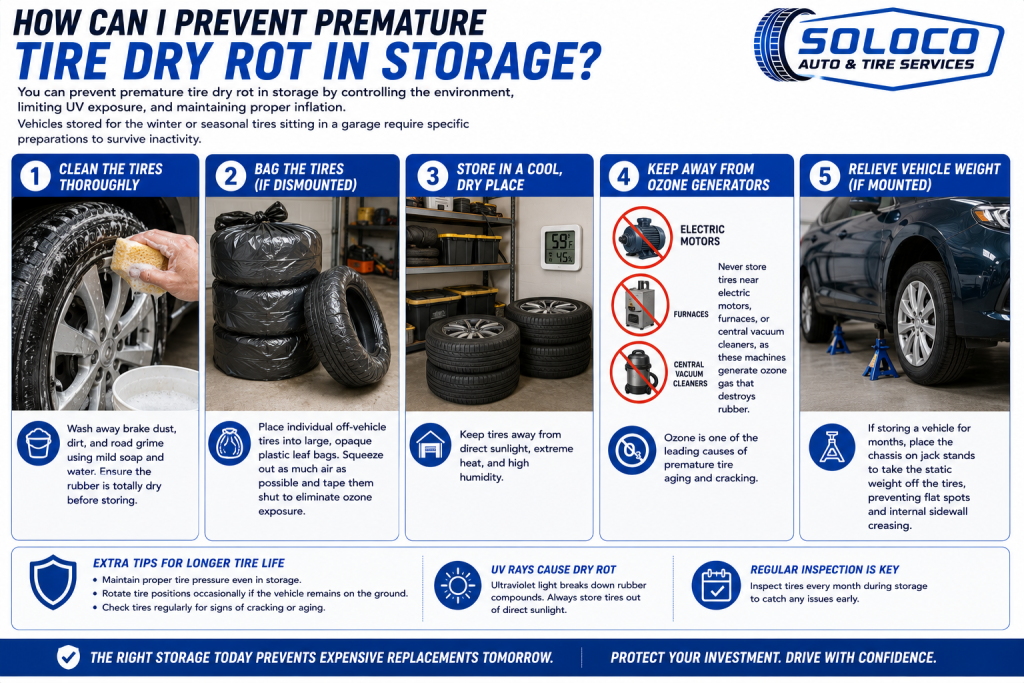
You can prevent premature tire dry rot in storage by controlling the environment, limiting UV exposure, and maintaining proper inflation. Vehicles stored for the winter or seasonal tires sitting in a garage require specific preparations to survive inactivity.
- Clean the tires thoroughly: Wash away brake dust, dirt, and road grime using mild soap and water. Ensure the rubber is totally dry before storing.
- Bag the tires (if dismounted): Place individual off-vehicle tires into large, opaque plastic leaf bags. Squeeze out as much air as possible and tape them shut to eliminate ozone exposure.
- Store in a cool, dry place: Keep tires away from direct sunlight, extreme heat, and high humidity.
- Keep away from ozone generators: Never store tires near electric motors, furnaces, or central vacuum cleaners, as these machines generate ozone gas that destroys rubber.
- Relieve vehicle weight (if mounted): If storing a vehicle for months, place the chassis on jack stands to take the static weight off the tires, preventing flat spots and internal sidewall creasing.
Should I Buy Used Tires With Minor Weather Checking?
You should never buy used tires with any degree of weather checking or dry rot. Purchasing used tires with visible micro-cracking is a false economy that puts your vehicle and safety at severe risk.
When evaluating a used tire, you have no baseline knowledge of its history. You do not know if the previous owner drove it underinflated, stored it in a hot field, or coated it in damaging silicone chemicals. Even if the cracks look superficial, the presence of weather checking indicates the rubber compound is actively failing and the protective oils are depleted. The tire could suffer a massive tread separation on your first highway trip. Always prioritize newer date codes over deeper tread depth when shopping for used tires.
Is Tire Dry Rot Covered Under Manufacturer Warranty?
Tire dry rot is usually not covered under manufacturer warranties unless the severe cracking occurs within the first 1 to 2 years from the original manufacture date. Most tire brands explicitly exclude dry rot from their long-term defect coverage.
Manufacturers classify weather checking and dry rot as environmental conditions or maintenance issues rather than factory defects. They argue that UV exposure, lack of driving, improper storage, and chemical exposure are entirely outside the factory control. If a tire develops deep fissures at 4 years old, the manufacturer will almost certainly deny the warranty claim, citing environmental wear and tear. Therefore, vehicle owners bear the full financial responsibility for replacing dry rotted tires in almost all scenarios.
The Bottom Line
You must replace dry rot tires the moment cracks reach 1.5 millimeters deep or whenever you can see the structural cords beneath the rubber. Surface webbing under 1 millimeter serves as an early warning sign to monitor the tire, but deeper fissures compromise the structural casing and invite deadly highway blowouts. Furthermore, deep tread offers absolutely no protection if the underlying rubber has turned brittle from age or UV exposure. Ultimately, drivers must respect the strict 10-year expiration rule and discard old tires immediately, regardless of how perfect the outside surface appears.


