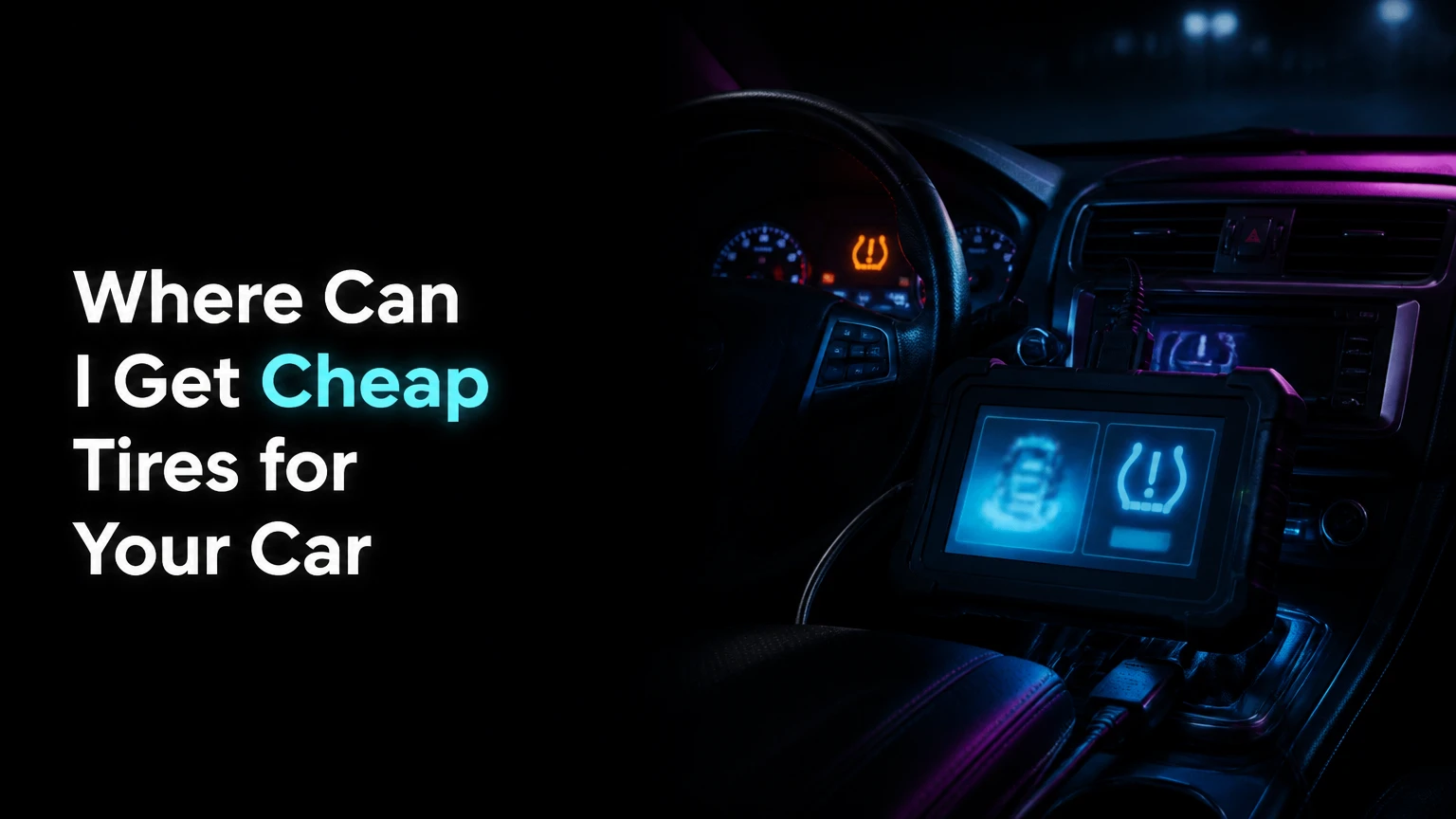
The cheapest places to buy new car tires are high-volume online marketplaces like Walmart and Amazon for budget brands, or wholesale giants like Tire Rack and Discount Tire utilizing price-match guarantees. True affordability depends on total out-of-pocket expenses, including mandatory local mounting, balancing, and environmental disposal fees.
At a Glance
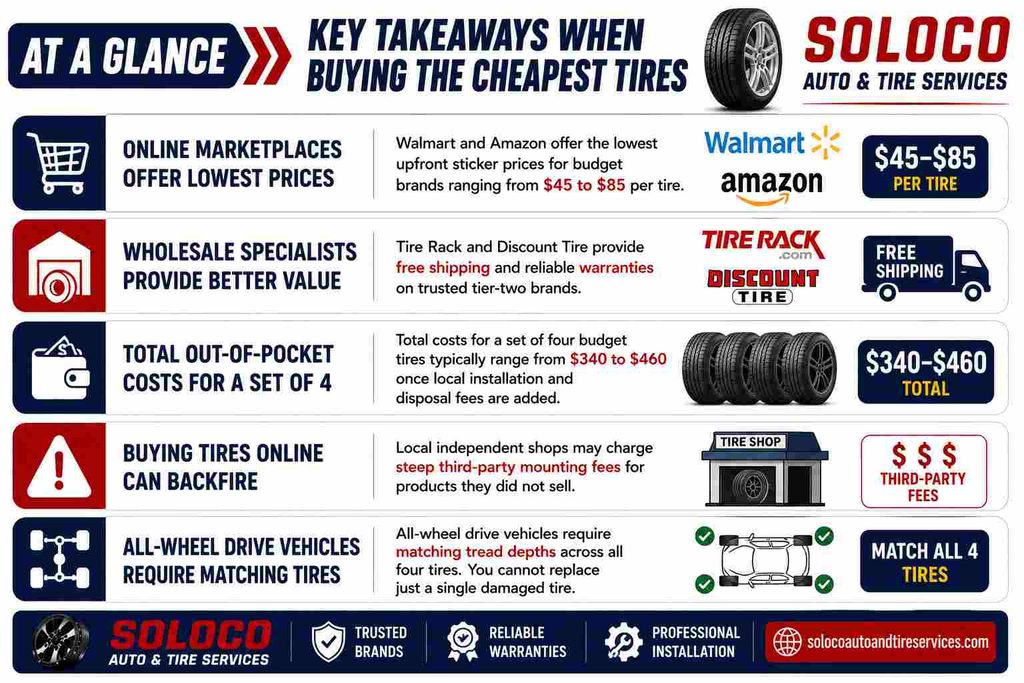
- Online marketplaces like Walmart and Amazon offer the lowest upfront sticker prices for budget brands ranging from $45 to $85 per tire.
- Wholesale specialists like Tire Rack and Discount Tire provide free shipping and reliable warranties on trusted tier-two brands.
- Total out-of-pocket costs for a set of four budget tires typically range from $340 to $460 once local installation and disposal fees are added.
- Buying tires online can backfire if local independent shops charge steep third-party mounting fees for products they did not sell.
- All-wheel drive vehicles require matching tread depths across all four tires, eliminating the option to replace just a single damaged tire.
How Much Do Cheap Car Tires Actually Cost Out-of-Pocket?
Buying cheap car tires involves paying both the upfront sticker price and mandatory local service fees at the shop. Sticker prices for budget sedan and compact tires typically range from $45 to $85 per tire, while larger SUV and truck tires cost between $95 and $150 per tire.
Mandatory installation, balancing, rubber valve stems, and state environmental disposal fees add an extra $30 to $60 per tire. For example, purchasing a set of four budget sedan tires online for $55 each results in a $220 product cost, but local shop fees push the final out-of-pocket total between $340 and $460. Ignoring these backend service fees creates unrealistic budget expectations.
Which Retailers Have the Absolute Lowest Prices on Budget Tires?
Retailers fall into three distinct categories, each offering specific advantages and catches for budget-conscious drivers.
| Retailer Category | Top Options | Best For | The Catch |
|---|---|---|---|
| Online Marketplaces | Walmart and Amazon | Finding obscure, rock-bottom budget brands priced from $45 to $60 per tire. | You must arrange installation separately or ship to an unvetted local partner. |
| Wholesale Specialists | Tire Rack and Priority Tire | Tier-two trusted brands like Kumho, Hankook, and Cooper with free shipping and included warranties. | Upfront product costs are slightly higher than no-name imports. |
| Brick-and-Mortar Chains | Discount Tire and Costco | Immediate local availability, lifetime tire rotations, and explicit price-matching policies. | Costco requires an annual membership; Discount Tire aggressively upsells premium protection plans. |
Is It Better to Buy Tires Online or From a Local Shop?
Buying tires online makes sense if you secure free shipping and utilize a pre-arranged local installation partner with flat-rate pricing. Local brick-and-mortar shops are better if they offer all-inclusive promotional pricing that bundles free mounting and balancing into the purchase price of the tire.
Online savings vanish quickly if you purchase a $50 tire online only to discover that local mechanics charge a $45 standalone mounting fee. Always calculate the total cost of online product delivery combined with local labor before finalizing a purchase.
What Are the Hidden Costs of Buying Cheap Tires Online?
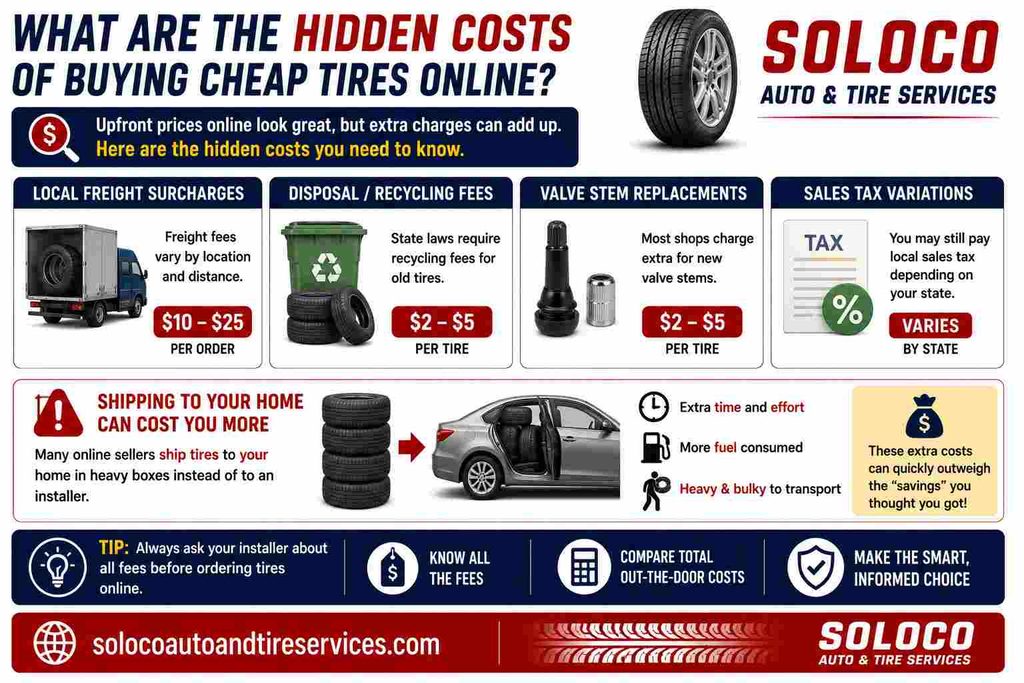
Hidden costs associated with online tire purchases include local freight surcharges, commercial disposal taxes, and mandatory valve stem replacements. State environmental laws require recycling fees ranging from $2 to $5 per tire regardless of where you buy them.
Furthermore, many online vendors ship tires directly to your home in heavy cardboard boxes rather than to an installer, forcing you to transport four bulky tires in the back seat of your car to a mechanic, which consumes both time and fuel.
How Do I Avoid High Mounting Fees When Buying Tires Online?
Avoiding high mounting fees requires contacting local independent service shops before purchasing tires online to confirm their standalone installation rates. Many wholesale distributors like Tire Rack maintain networks of recommended installers with pre-negotiated, fixed labor rates that prevent surprise charges.
Selecting a mobile tire installation service that drives directly to your home or office also eliminates traditional shop markups while keeping convenience high.
Are Cheap No-Name Import Tires Safe to Buy?
Ultra-low-end no-name import tires manufactured by unvetted overseas companies pose significant safety risks during heavy rain and emergency braking maneuvers. These budget tires frequently utilize exceptionally hard rubber compounds designed strictly for high mileage, which sacrifices wet traction and stopping distance.
Additionally, these cheap tires often lack treadwear mileage warranties, forcing vehicle owners to replace them after just 15,000 miles and eliminating any initial financial savings.
Should I Buy Used Tires to Save Money?
Buying used tires to save money is generally a risky financial and safety gamble due to invisible structural damage, degraded rubber compounds, and unknown repair histories. Many cheap used tires sold on the secondary market are imported cores that failed strict international safety inspections or contain hidden internal belt separations.
A used tire with 50 percent tread remaining that blows out on the highway creates a financial and physical hazard that far outweighs the initial savings of a $30 purchase.
Is Road Hazard Insurance Worth the Extra Money on Cheap Tires?
Road hazard insurance is worth purchasing for expensive tires priced above $180 each, but it should be skipped for budget tires priced around $50 to $60. Paying an extra $15 per tire for insurance protection on a $50 tire provides a poor mathematical return on investment.
Furthermore, standard road hazard certificates rarely cover local mounting and balancing labor fees when a replacement claim is processed.
How Does the Tire Rack and Discount Tire Warranty Trick Work?
Tire Rack includes a free, two-year non-prorated road hazard warranty with online purchases, whereas Discount Tire offers a prorated warranty and charges an extra $30 to $50 per tire for premium replacement certificates. Savvy car owners take advantage of a specific corporate synergy by ordering tires through Tire Rack and shipping them to a physical Discount Tire location for installation.
Because Discount Tire owns Tire Rack, customers receive Tire Rack’s superior free full-replacement warranty coverage alongside the physical convenience of a local storefront if a tire needs service.
Can I Replace Just Two Tires Instead of All Four?
Replacing just two tires instead of all four is acceptable, but the two new tires must always be installed on the rear axle regardless of whether the vehicle is front-wheel drive or rear-wheel drive. Placing new tires on the rear axle prevents dangerous oversteer, hydroplaning, and fishtailing on wet or slick road surfaces.
If your vehicle has uneven tire wear, putting superior traction on the rear wheels maintains vehicle stability during emergency steering maneuvers.
Why Do All-Wheel Drive Vehicles Require Matching Tire Tread Depths?
All-wheel drive vehicles require matching tire tread depths across all four tires to prevent permanent, catastrophic damage to the vehicle’s center differential. A difference in tread depth greater than 2/32nds of an inch forces the drivetrain components to rotate at different speeds continuously, generating excessive heat and mechanical wear.
A single unrepairable flat tire on an all-wheel drive system often requires purchasing an entirely new set of four matching tires to protect the transmission.
What Happens If a Cheap Tire Fails Under Warranty and the Price Has Gone Up?
Online tire distributors only cover the original purchase price of a tire when fulfilling a prorated or defective warranty claim. If the exact tire model has increased in price by $40 or has been discontinued entirely since the initial purchase date, the vehicle owner must pay the difference out of pocket to secure a replacement.
This unexpected price surge trap means budget tire warranties offer less financial protection than premium brand alternatives during high inflation periods.
How Can I Get a Single Tire Shaved Down for an AWD Vehicle?
Getting a single tire shaved down to match existing tread depths requires ordering the replacement through specialized online distributors like Tire Rack that offer professional tire shaving services. Technicians use specialized machinery to grind away rubber from the brand-new tire tread until it matches the precise 2/32-inch depth of the remaining three tires.
Paying a $25 to $30 shaving fee prevents the destruction of an expensive all-wheel drive transmission system.
What Are the Best Budget Tire Brands That Offer Decent Mileage?
The best budget tire brands that balance low cost with acceptable tread life include Milestar, General Tire, Kumho, and Laufenn. These tier-two and tier-three manufacturers operate under strict quality control standards owned by major parent corporations, ensuring reliable dry and wet performance.
Purchasing a reputable budget brand prevents the rapid tread degradation common among unbranded overseas imports while keeping upfront expenses low.
The Bottom Line
Getting cheap car tires safely requires looking past the initial sticker price to calculate total installation, balancing, and environmental disposal fees. Online marketplaces and wholesale giants provide the lowest product costs, but local service requirements and vehicle drivetrain specifications dictate the final out-of-pocket expense. Prioritize trusted budget brands and verify installer fees beforehand to maximize true financial savings.