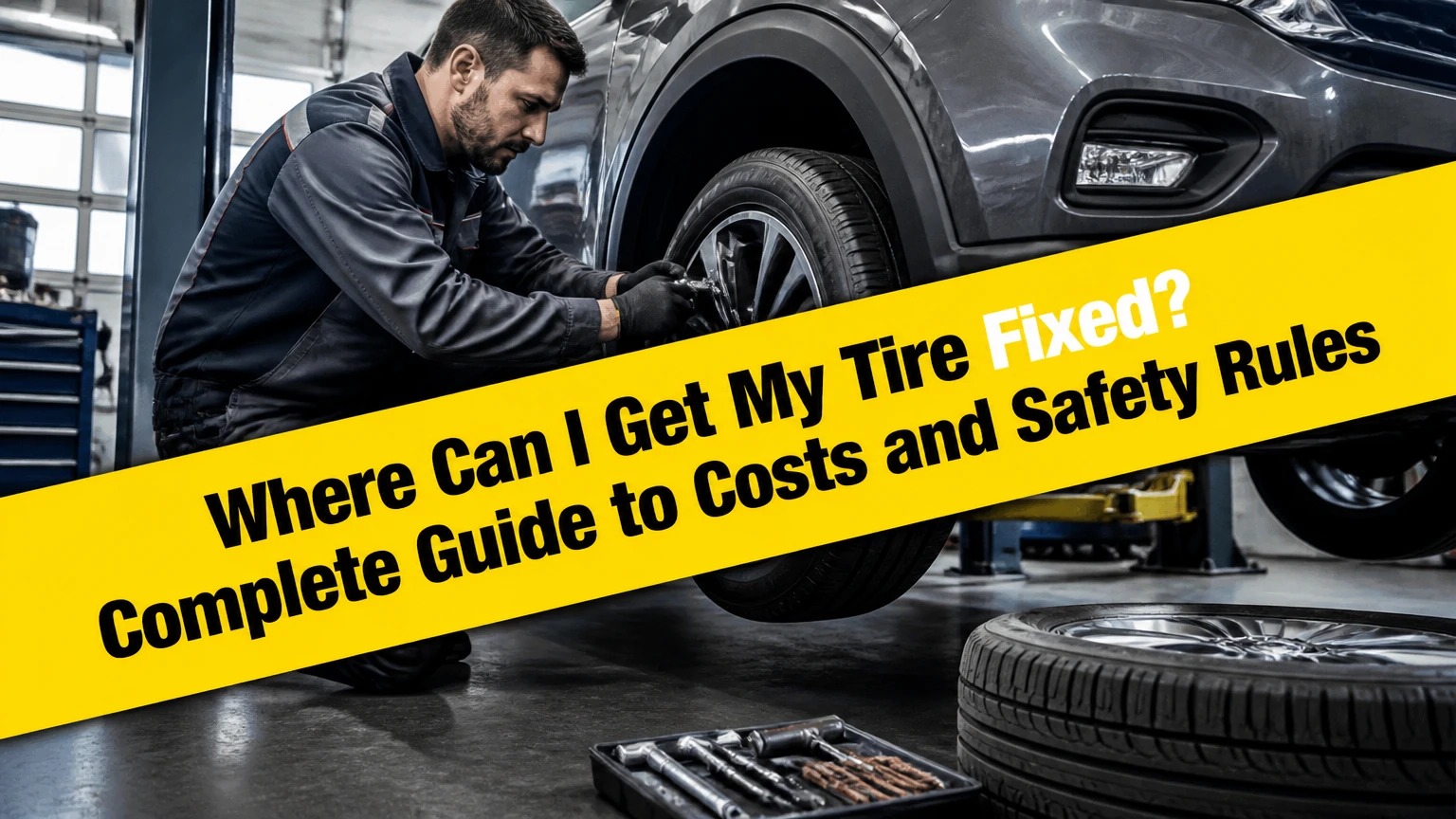
You can get a tire fixed at national auto repair chains, local independent tire shops, car dealerships, or by calling a mobile tire repair service. Your ideal choice depends on your budget, whether you need a free service, your physical location, and whether your vehicle is an all-wheel-drive car or an electric vehicle with foam-lined tires.
At a Glance: Key Tire Repair Facts
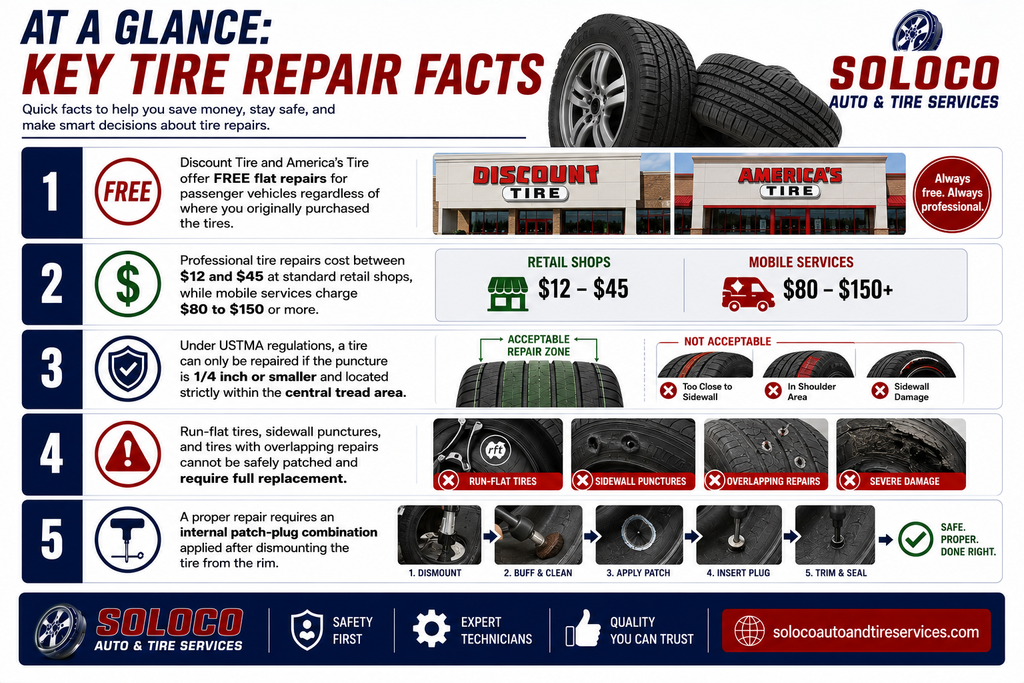
- Discount Tire and America’s Tire offer free flat repairs for passenger vehicles regardless of where you originally purchased the tires.
- Professional tire repairs cost between $12 and $45 at standard retail shops, while mobile services charge $80 to $150 or more.
- Under USTMA regulations, a tire can only be repaired if the puncture is 1/4 inch or smaller and located strictly within the central tread area.
- Run-flat tires, sidewall punctures, and tires with overlapping repairs cannot be safely patched and require full replacement.
- A proper repair requires an internal patch-plug combination applied after dismounting the tire from the rim.
Where Can I Get My Tire Fixed?
You can get your tire fixed at specialized national tire chains, big-box membership warehouses, local independent garages, authorized car dealerships, or directly at your roadside location via mobile mechanics. Each option provides different trade-offs regarding wait times, pricing structures, membership requirements, and geographic coverage.
National retail chains such as Firestone Complete Auto Care, Goodyear Auto Service, and Pep Boys offer widespread availability with structured warranties. Local independent garages often provide the fastest walk-in service for stranded motorists. Big-box stores like Costco Wholesale provide low-cost repairs exclusively for members who purchased their tires directly through them. Mobile tire services drive directly to your home, office, or roadside location to perform the service on-site for an added convenience fee.
Which Tire Shops Fix Tires for Free?
Discount Tire and America’s Tire offer completely free flat tire repairs for standard passenger cars and light trucks. This complimentary service applies regardless of whether you originally bought the tires at their store or through a completely different retailer.
This policy serves as a major customer acquisition strategy for the brand. When you arrive with a flat, technicians inspect the damage for free. If the puncture meets safety standards, they dismount the tire, apply an internal patch-plug, balance the wheel, and reinstall it without charging for labor. If the tire cannot be safely repaired, they provide transparent quotes for replacement options without pressuring you, though you are free to take your vehicle elsewhere.
How Much Does a Professional Tire Repair Cost at Major Shops?
Professional tire repair costs range from free to $150 depending entirely on the service provider and your location. Budget-conscious drivers can choose from several distinct pricing tiers across the automotive service industry.
- Discount Tire / America’s Tire: $0 (Free for all passenger vehicles, regardless of purchase origin).
- Costco Wholesale: $12 to $15 per repair (Strictly restricted to tires purchased at Costco warehouses).
- Local Independent Tire Shops: $15 to $30 per repair (Often the fastest option for walk-ins with immediate availability).
- National Chains (Firestone, Goodyear, Pep Boys): $20 to $45 per repair (Includes standard workmanship warranties).
- Mobile Tire Repair Services: $80 to $150+ (Includes travel and dispatch fees to fix the tire at your location).
Can I Drive on a Tire with a Screw in It?
You should not drive long distances on a tire with a screw embedded in it, though you can drive a short distance at low speeds to reach a nearby repair shop if the tire is maintaining pressure. If the tire is actively deflating, driving on it will destroy the internal sidewalls within blocks.
Leaving a screw in place temporarily often prevents the tire from leaking air instantly because the screw acts as a temporary plug. However, every mile driven causes the screw head to flex, widen the puncture hole, and drive deeper into the steel belts. If you notice a screw in your tread, check your tire pressure monitoring system immediately. If pressure is stable, drive carefully to the nearest tire shop. If pressure is dropping, install your spare tire or call roadside assistance.
What Are the Legal Safety Rules for Repairing a Car Tire?
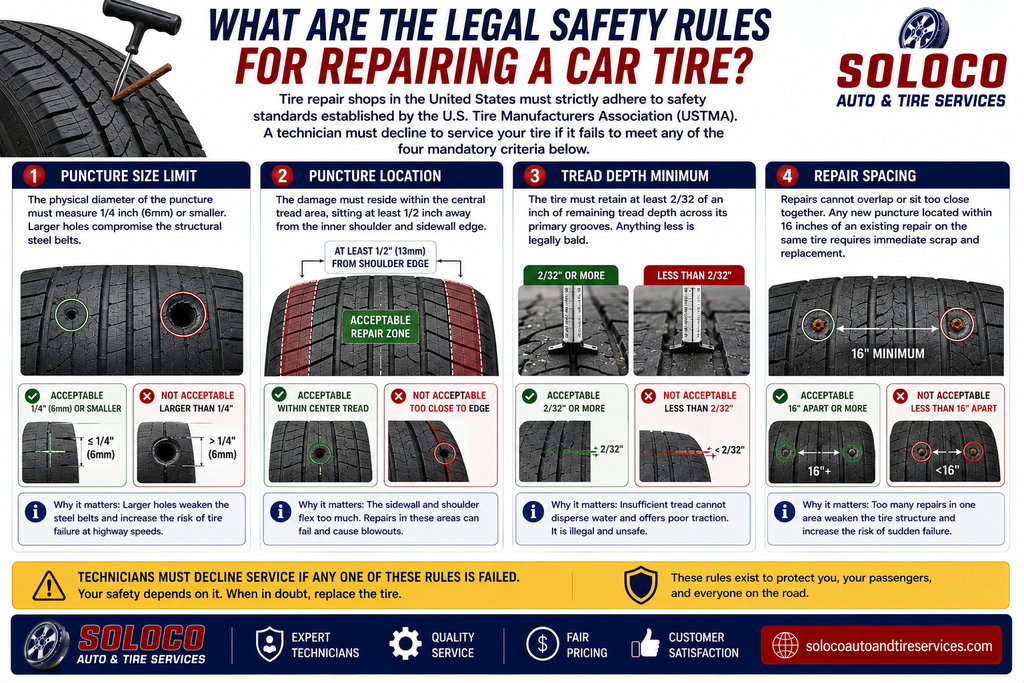
Tire repair shops in the United States must strictly adhere to safety standards established by the U.S. Tire Manufacturers Association. A technician must decline to service your tire if it fails to meet any of the four mandatory criteria.
- Puncture Size Limit: The physical diameter of the puncture must measure 1/4 inch or 6mm smaller. Larger holes compromise the structural steel belts.
- Puncture Location: The damage must reside within the central tread area, sitting at least 1/2 inch away from the inner shoulder and sidewall edge.
- Tread Depth Minimum: The tire must retain at least 2/32 of an inch of remaining tread depth across its primary grooves. Anything less is legally bald.
- Repair Spacing: Repairs cannot overlap or sit too close together. Any new puncture located within 16 inches of an existing repair on the same tire requires immediate scrap and replacement.
Why Do Tire Shops Refuse to Fix a Puncture on the Sidewall?
Tire shops refuse to repair sidewall punctures because the sidewall experiences extreme cyclical flexing, high structural stress, and contains no reinforcing steel belts to hold a patch in place. Punctures in this zone create catastrophic blowout risks at highway speeds.
The structural integrity of a tire relies heavily on its internal casing plies and sidewall rubber. When an object pierces the sidewall, the constant bending motion under the weight of the vehicle prevents any chemical patch or plug from forming a permanent bond. Liability laws and industry safety standards prohibit technicians from attempting sidewall repairs, meaning any damage outside the central tread area mandates a full tire replacement.
Can Run-Flat Tires Be Patched or Performed?
Run-flat tires often cannot be repaired if they were driven on while completely deflated. Many major manufacturers including Pirelli, Continental, and Bridgestone strictly forbid repairing run-flat tires once they have operated under zero pressure for any extended distance.
Run-flat tires feature reinforced sidewalls designed to support the vehicle’s weight temporarily after a puncture. When a motorist drives on a deflated run-flat tire for miles, the internal rubber lining and structural cords crush and degrade internally. Even if the outer tread puncture measures under 1/4 inch, internal structural failure renders the tire dangerous to patch, requiring a brand-new replacement.
How Does an AWD Vehicle Change Tire Repair Rules?
All-Wheel Drive vehicles require matching tire diameters across all four wheels to prevent permanent, catastrophic damage to the center differential and transfer case. If a tire cannot be safely repaired and requires replacement, you cannot simply buy one new tire if the remaining three are heavily worn.
Drivetrains on AWD systems measure rotational speed differences constantly. Introducing a brand-new tire with full tread depth next to three tires worn down to 4/32 of an inch forces the differential gears to spin at mismatched speeds constantly, generating intense heat and destroying internal mechanical components. If your tread depth differential exceeds 2/32 of an inch, you must either buy a complete set of four new tires, purchase two tires for the same axle, or pay a specialized shop to shave a new tire down to match your existing wear level.
Why Do Electric Vehicle Tires Cost More or Get Refused for Repair?
Electric vehicle tires feature specialized acoustic sound-dampening foam glued to the inner liner, which many traditional repair shops refuse to service because removing and re-gluing the foam requires specialized tools, extra labor time, and specific chemical sealants.
EVs are significantly heavier than gas-powered cars due to heavy battery packs, and they produce instant torque that wears down rubber faster. When an EV tire gets a nail in the tread, a technician must carefully scrape away the interior sound-absorption foam to apply an internal patch-plug combo, then re-adhere the foam precisely to maintain wheel balance. Many standard walk-in shops lack these materials or training, leading them to turn EV owners away or recommend full replacements.
Are Temporary Plug Kits from Auto Parts Stores Safe to Use?
Temporary string plug kits sold at auto parts stores are designed exclusively for emergency roadside fixes to get you to a proper service station, not as a permanent, long-term solution. Relying on an external plug indefinitely invites sudden air loss and tread separation.
An external plug relies strictly on friction and rubber cement jammed into the hole from the outside without inspecting internal damage. If the object entered at an angle or caused internal liner delamination, an external plug will fail. A safe, legal repair requires dismounting the tire completely so a technician can inspect the inner casing, clean the wound, and install a vulcanized rubber patch-plug combination from the inside out.
Do Temporary Tire Sealants Like Fix-a-Flat Ruin Your Tires?
Aerosol can sealants like Fix-a-Flat successfully provide a temporary emergency seal to get you off a dangerous highway, but they coat the interior of the tire and wheel with a messy liquid chemical compound that most tire shops charge extra to clean out.
Many professional tire technicians dislike aerosol sealants because the liquid latex or chemical sludge interferes with proper internal patch adhesion. When you bring a tire filled with canned sealant to a shop, technicians must clean out the wet, sticky residue with chemical solvents before they can inspect or patch the hole. Furthermore, these sealants frequently clog and permanently ruin expensive TPMS wheel sensors, adding extra replacement costs to your repair bill.
Can a Tire with a Speed Rating of V, W, or Y Still Be Repaired?
Tires with high-performance speed ratings such as V (up to 149 mph), W (up to 168 mph), or Y (up to 186 mph) can technically be repaired if the puncture meets standard USTMA safety guidelines, but many sports car manufacturers and specialty race shops advise against repairing tires subjected to extreme track speeds.
High-performance tires utilize specialized compound structures and high-speed nylon caps. Once a high-speed tire sustains a puncture, its high-speed rating is technically compromised in the eyes of performance purists. While standard commuter tire shops will patch a V-rated tire normally, track day organizations and exotic car dealerships will automatically fail technical inspection and mandate immediate tire replacement if a high-speed tire has been punctured and patched.
Will a Tire Shop Break My TPMS Sensor During a Repair?
Professional tire shops rarely break Tire Pressure Monitoring System sensors during routine flat repairs, but older sensors with corroded brass valve stems or snap-in rubber stems face a legitimate risk of snapping when technicians dismount the tire bead.
Modern vehicles use electronic sensors mounted directly to the back of the valve stem. If your car is more than five or six years old, the plastic housing and rubber seals on the TPMS sensor become brittle from heat cycles and road salts. Reputable shops will inform you beforehand if your TPMS nut is seized or corroded, and while they carry liability for negligence, you may occasionally have to pay for a replacement sensor service kit (grommet, valve core, and nut) during a repair.
How Long Does a Professional Tire Repair Take?
A standard professional tire repair takes between 30 and 45 minutes once the vehicle is safely raised on the service lift. However, actual total wait times at commercial tire centers often stretch from 1 to 3 hours during busy weekend rushes or peak seasonal changeover months.
The physical repair process follows a strict mechanical sequence: inspecting the tread, lifting the vehicle, dismounting the tire from the metal wheel rim using a specialized machine, cleaning and buffing the inner liner, applying vulcanizing cement, pulling a patch-plug combination through the puncture hole, rolling it flat, re-mounting the tire, reinflating it, and balancing the wheel assembly on a spin balancer.
How Long Can I Drive on a Properly Repaired Tire?
A properly executed internal patch-plug repair lasts for the entire remaining lifespan of the tire tread. Once vulcanized to the inner casing, the repair becomes a permanent structural part of the tire and will endure normal highway speeds until the tread wears down to the 2/32 legal minimum.
The longevity of the repair depends entirely on the quality of the initial installation. A professional repair that seals both the inner air liner (preventing air loss) and fills the steel belt channel (preventing moisture from rusting the internal steel cords) ensures structural safety for tens of thousands of miles.
What Should I Do If My Tire Is Losing Air But Has No Visible Puncture?
If your tire steadily loses air pressure but shows no visible nails or screws in the tread, the leak is likely caused by a failing valve stem, a bent wheel rim edge, corrosion along the bead seat, or a leaky TPMS sensor seal.
Spray soapy water around the valve stem, wheel rim edges, and the entire tread surface to locate the source of escaping air by watching for forming bubbles. If the wheel bead is leaking due to aluminum corrosion, a tire shop must dismount the tire, wire-brush the metal rim clean, and apply a specialized bead-sealer compound. If the valve core is loose, tightening it with a simple valve tool will instantly resolve the slow leak.
The Bottom Line
Getting your tire fixed quickly and safely requires understanding where to go, what costs to expect, and which safety rules apply. Discount Tire offers free repairs for budget savings, while national chains and local shops charge up to $45 for reliable, guaranteed service. Always ensure your puncture is under 1/4 inch, located strictly within the central tread, and serviced via an internal patch-plug combination rather than an unsafe roadside string plug.