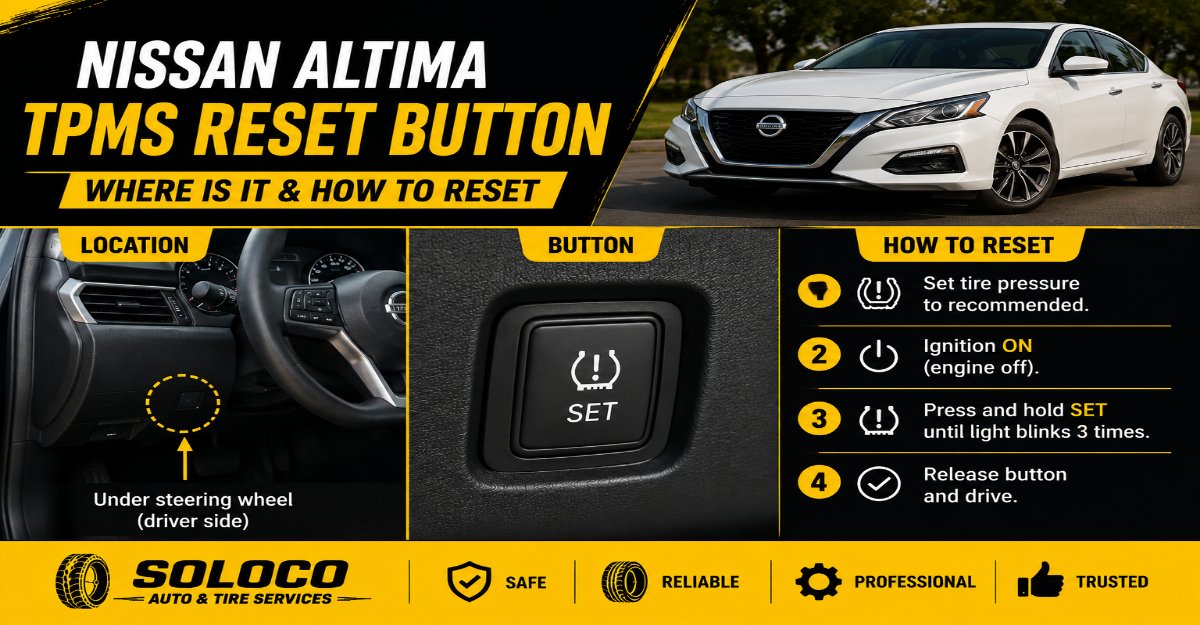
On most Nissan Altima models, there is no physical Tire Pressure Monitoring System reset button. Instead, the vehicle relies on an automatic drive-to-relearn calibration method or a digital menu adjustment housed within the instrument cluster. If your specific model year features a physical switch, it is located underneath the dashboard panel to the left of the steering column or inside the glove box.
At a Glance
- Modern Nissan Altima models (2019 to present) require a digital menu reset via steering wheel controls followed by a 10 to 15 minute drive at or above 16 mph.
- Generation 4 and 5 models (2007 to 2018) use an automatic calibration protocol that clears once vehicle speed exceeds 16 mph for 10 continuous minutes.
- A flashing TPMS dashboard light that blinks for 60 seconds before turning solid indicates a dead internal sensor battery requiring hardware replacement.
- The diagnostic paper clip method forces manual relearn modes on older 2002 to 2012 Altimas by grounding a single-pin connector beneath the steering column.
- Ambient temperature drops of 10°F cause a 1 PSI loss across all four tires, which frequently triggers false low-pressure warnings during seasonal transitions.
Does My Specific Year Nissan Altima Have a Physical Reset Button?
Nissan Altima models built between 2007 and the present day rarely feature a dedicated physical reset button. Manufacturers transitioned away from physical buttons because automated Body Control Modules handle sensor tracking dynamically.
Drivers looking for a tactile switch will only find one on select legacy trims, imported configurations, or specific early-2000s builds. On those rare vehicles, the physical reset switch is tucked away underneath the lower dashboard panel near the driver’s left knee or inside the glove box compartment. If your dashboard features a digital driver information screen, your reset procedure is entirely software-based.
How Do I Reset the TPMS on a 2019 to Present Nissan Altima?
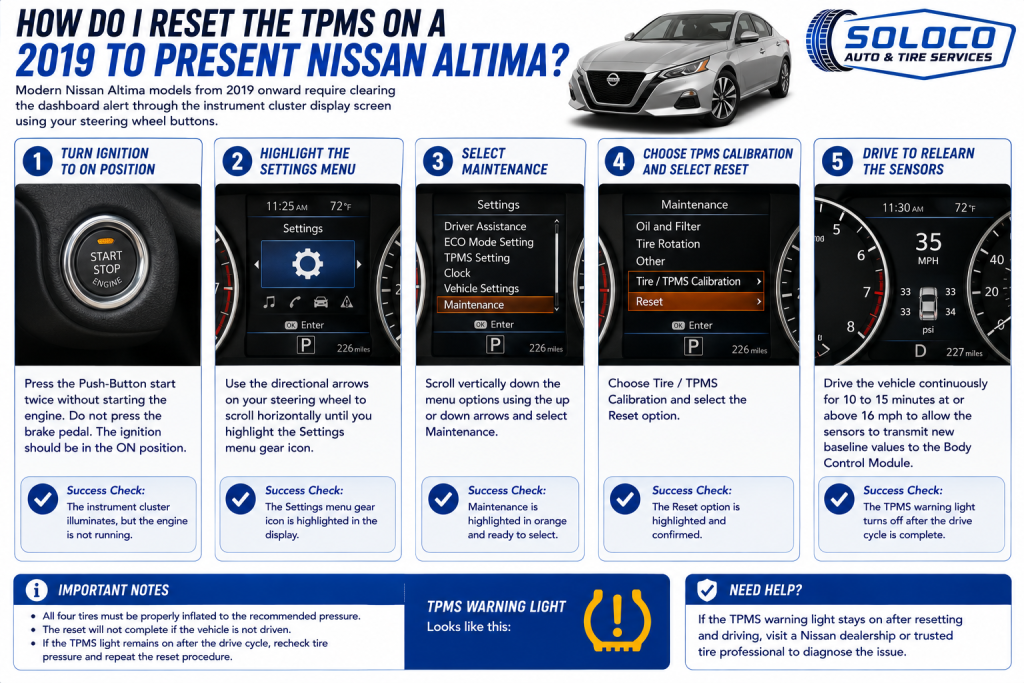
Modern Nissan Altima models from 2019 onward require clearing the dashboard alert through the instrument cluster display screen using your steering wheel buttons.
- Turn the ignition to the ON position without starting the engine by pressing the Push-Button start twice without touching the brake pedal.
- Use the directional arrows on your steering wheel to scroll horizontally until you highlight the Settings menu gear icon.
- Scroll vertically down the menu options and select Maintenance.
- Choose Tire or TPMS Calibration and select the Reset option.
- Drive the vehicle continuously for 10 to 15 minutes at or above 16 mph to allow the sensors to transmit new baseline values to the Body Control Module.
How Do Automatic TPMS Relearn Systems Work on 2007 to 2018 Altimas?
Model years spanning 2007 to 2018 are engineered to auto-detect pressure corrections without requiring any physical button or menu interaction.
- Fill all four tires to the exact specification displayed on your driver-side door jamb placard, which is typically 32 to 35 PSI.
- Start the vehicle engine and drive at a sustained speed of at least 16 mph.
- The Body Control Module will automatically update and clear the warning light within 10 continuous minutes of driving as wheel rotational speeds validate pressure integrity.
What Is the Paper Clip Method for Older Nissan Altima TPMS Systems?
When the computer hangs or you switch to non-OEM wheels on 2002 to 2012 Altimas, a white, single-pin TPMS test connector can be found taped to the OBD2 wiring harness underneath the driver-side dash panel. Professional technicians use this connector to force manual relearn sequences.
| Step | Action Required | Target Specification |
| 1 | Set staggered tire pressures | Front Left: 34 PSI, Front Right: 31 PSI, Right Rear: 29 PSI, Left Rear: 26 PSI |
| 2 | Insert jumper tool | Insert a paper clip or a short wire into the white diagnostic terminal |
| 3 | Power cycle | Turn the ignition switch to the ON position with the engine off |
| 4 | Grounding sequence | Tap the loose end of the paper clip to a bare metal chassis ground 6 times within 10 seconds |
| 5 | Final calibration | Drive the car immediately over 20 mph for 10 minutes, then reinflate all tires to standard placard specifications |
How Does the 3-PSI Refill Over-Inflation Loophole Fix Stuck TPMS Alerts?
The Nissan Altima TPMS software can occasionally get stuck on historical low-pressure alerts due to cached volatile memory in the Body Control Module. To force the computer to register a definitive change, pump all four tires exactly 3 PSI above the recommended manufacturer level.
For example, if your door placard mandates 32 PSI, inflate every tire to 35 PSI. Drive the vehicle for 10 minutes at highway speeds, park, and turn off the engine. Finally, bleed the excess air out of each tire until they match the door jamb sticker perfectly. This sharp delta forces the sensor to transmit a fresh state-of-charge and pressure packet.
Can an OBD2 Scanner Reset or Program Nissan Altima Tire Sensors Directly?
Advanced bidirectional OBD2 scanners equipped with TPMS service capabilities can communicate directly with the Nissan Body Control Module to read sensor IDs, clear fault codes, and trigger relearn procedures. Basic code readers that only scan engine emissions cannot access chassis modules.
If you own a dedicated TPMS programming tool, you can trigger individual wheel sensors using radio frequency bursts while the ignition is in the ON position. This method bypasses the need for extended test drives, making it useful when diagnosing stubborn dashboard lights in a stationary garage environment.
How Do Aftermarket Sensors Affect the Altima BCM Automatic Calibration?
Aftermarket TPMS sensors often operate on different radio frequencies or use non-standard protocol handshakes compared to original equipment manufacturer Nissan parts. When replacement sensors are installed without proper cloning or programming, the Altima Body Control Module may fail to recognize the unique sensor identification codes during the automatic drive cycle.
Universal aftermarket sensors must be programmed with a dedicated handheld activation tool prior to installation so they mimic the specific broadcast frequency required by your generation of Nissan Altima.
Why Is My Nissan Altima TPMS Light Flashing for 60 Seconds on Startup?
A TPMS dashboard light that flashes for roughly 60 seconds every time you start the car before staying solid indicates a hardware fault rather than low tire pressure. One or more of your internal wheel sensor batteries is completely dead or experiencing internal electronic failure.
These integrated lithium batteries last roughly 7 to 10 years or 100,000 miles. No physical button press, menu reset, or air pressure adjustment can fix a dead sensor battery; the entire physical sensor unit must be unmounted and replaced.
Can a Spare Tire Cause the Nissan Altima Tire Pressure Light to Stay On?
If your Altima trim level features a full-size matching spare tire housed in the trunk, it likely contains an active internal TPMS sensor. If that trunk-bound spare tire drops below the minimum safety threshold of 28 PSI, your dashboard light will stay permanently active no matter how many times you inflate your active driving wheels.
Checking and adjusting the pressure of your hidden spare tire solves this persistent warning light issue when all other four tires register correct psi values.
How Does Cold Weather Trigger the Nissan Altima Tire Pressure Warning?
Ambient temperature fluctuations directly impact internal tire pressure according to the ideal gas law. A 10°F drop in outside weather creates approximately a 1 PSI loss inside your rubber tires.
A sudden cold winter morning will drop all four tires past the safety threshold simultaneously, triggering the yellow warning light even if your tires experienced no physical punctures. Reinflating the tires back to placard specs during the first warm afternoon usually resolves the issue.
Why Does My Altima TPMS Light Stay Solid Despite Correct Tire Pressure?
A solid warning light that refuses to turn off after you have accurately inflated all four tires points to a stored error code within the Body Control Module memory cache or a newly failed sensor element.
When tire pressures drop below the warning threshold, the module locks that alert state until a successful vehicle speed threshold is met or a diagnostic clear command is executed. If your driving routine consists entirely of short low-speed city trips under 15 mph, the automatic calibration cycle will never initiate.
Do I Need a Special Tool or Dealer Visit After a Tire Rotation on an Altima?
No special tool or professional dealer visit is required after performing a standard tire rotation on a Nissan Altima. The vehicle’s Body Control Module automatically picks up and reassigns the new physical positions of the wheel sensors after you drive continuously above 16 mph for roughly 10 minutes.
The system maps signal strengths and rotational telemetry to determine whether a sensor belongs to the front or rear axle without manual reprogramming.
Can I Permanently Disable or Pull a Fuse for the Nissan Altima TPMS System?
There is no dedicated fuse solely controlling the TPMS that can be pulled safely without disabling other critical safety systems, such as the Anti-lock Braking System or electronic stability control modules.
Federal automotive safety regulations prohibit disabling safety monitoring systems. Attempting to bypass the system by removing fuses will trigger multiple secondary dashboard warnings and can cause vehicle inspection failures.
Can I Perform a Hard Reset by Disconnecting the Car Battery?
Disconnecting the positive car battery cable and holding down your vehicle’s horn for 3 seconds temporarily discharges stored electrical capacitance across onboard computer modules and clears out volatile cache memory.
While this technique clears temporary software glitches, it will not permanently eliminate a TPMS warning if low pressure or a dead sensor battery persists. Once the vehicle travels 5 to 10 miles after a battery reconnection, the system will re-poll the sensors and illuminate the light again if the underlying fault remains.
How Can You Test if an Altima TPMS Sensor Is Dead Without Dismounting the Tire?
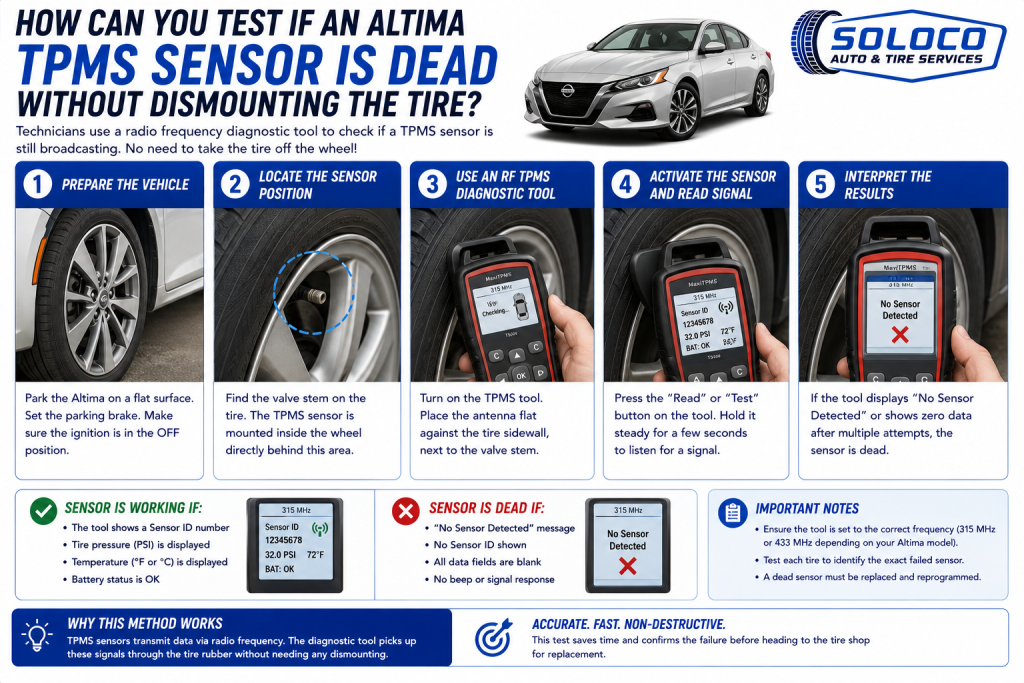
Technicians use a dedicated radio frequency diagnostic tool held against the outer sidewall near the valve stem to verify whether an individual sensor is broadcasting data.
If the handheld tool registers zero signal response across multiple attempts while pulsing at the standard 315 MHz or 433 MHz frequency, the internal sensor is confirmed dead. This diagnostic verification allows owners to identify exact hardware failures before visiting a tire shop for physical tire unmounting and replacement.
The Bottom Line
Resetting the tire pressure monitoring system on a Nissan Altima depends entirely on your vehicle’s model year, ranging from simple digital menu navigation on modern builds to automated drive cycles on mid-generation editions.
Always verify that all four primary tires—and your full-size spare—are inflated to the exact door placard specification before attempting any calibration sequence. Remember that persistent flashing dashboard lights indicate dead internal batteries that require mechanical sensor replacement rather than a software reset.


