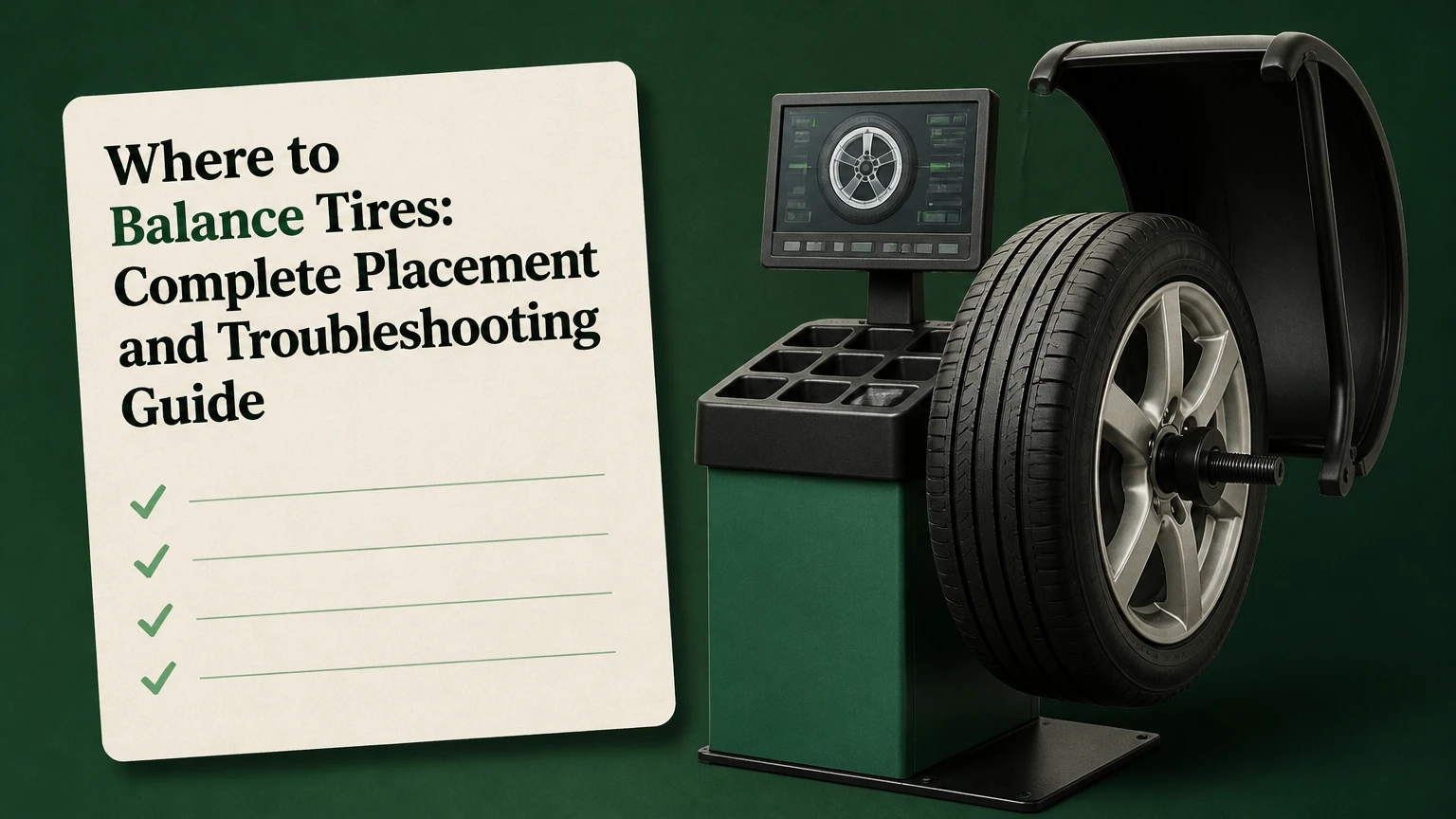
Tires are balanced by placing clip-on or adhesive weights directly onto the inner and outer lips of the wheel rim, or hidden behind the spokes, using a specialized spin-balancing machine to distribute mass evenly. Proper balancing eliminates dangerous high-speed steering wheel oscillations and ensures even tread wear across all four positions.
At a Glance
- Standard passenger car wheels require between 0.25 oz and 2.0 oz of weight per wheel assembly.
- Any single wheel requiring more than 3.0 oz of total weight indicates a severe structural defect in the tire or rim.
- Traditional steel wheels utilize clip-on metal weights hammered onto the absolute edge of the inner and outer flanges.
- Modern alloy wheels require adhesive stick-on weights positioned on the flat inner barrel behind the wheel spokes.
- Tires must be balanced every 5,000 to 7,500 miles, perfectly coinciding with routine multi-tire rotation schedules.
Where to Balance Tires on the Wheel Assembly
Tires are balanced by placing calibrated lead, zinc, or steel weights at precise spots calculated by a spin-balancing machine to counteract heavy spots in the tire and wheel assembly. The exact location depends entirely on whether the wheel design features an outer lip or a smooth alloy face.
Traditional steel wheels receive metallic clip-on weights hammered directly onto the outer and inner rim flanges. Modern alloy wheels cannot use clip-on weights on the outer aesthetic face without scratching the finish; instead, technicians apply adhesive stick-on weights directly to the flat inner barrel of the rim behind the spokes. This dual-plane placement ensures dynamic balance without compromising custom wheel cosmetics or clipping brake calipers.
What Are the Exact Weight Limits Before a Wheel is Defective?
Tire balancing requires precise weight measurement in ounces or grams, with standard passenger vehicles usually requiring between 0.25 oz and 2.0 oz per wheel. Any wheel assembly requiring more than 3.0 oz of total weight indicates a severe manufacturing defect in the tire or a structural bend in the rim.
When a balancing machine calls for excessive weight exceeding 3.0 oz, professional technicians will unseat the tire and rotate it 180 degrees on the rim to offset the heavy spots of both components. If the high weight requirement persists after this match-mounting procedure, the tire must be replaced due to internal belt distortion, or the aluminum rim must be repaired or swapped out.
Why Do Large Off-Road Tires Use Internal Balancing Beads?
Standard spin balancers cannot accurately balance massive off-road tires measuring 35 inches or larger due to their extreme weight, aggressive tread voids, and heavy sidewall construction. Technicians instead rely on internal balancing beads made of ceramic or glass pellets poured directly into the tire cavity during mounting.
These internal beads dynamically distribute themselves via centrifugal force and physics opposing the heavy spots of the tire while the vehicle rolls down the highway. As speed increases, the ceramic pellets migrate to areas lacking mass, creating a self-adjusting, vibration-free ride that external clip-on weights cannot achieve on oversized truck tires.
How Do Closed-Center Rims and Dual-PCD Custom Wheels Change Balancing?
Closed-center rims and custom dual-PCD alloy wheels lack traditional mounting features, requiring specialty equipment and mounting adapters to achieve an accurate balance. Vintage French vehicles and certain sports cars feature closed-center rims with no center hub hole, making standard spin-balancing shafts completely useless.
These unique assemblies require specialized finger-adapter plates that clamp onto the lug nut holes or bolt patterns of the wheel. Similarly, custom aftermarket alloy wheels featuring multiple bolt patterns or deep-dish designs require tape-weights only, positioned precisely on inner barrel planes to clear aftermarket big brake kits while preventing weight detachment under high centrifugal forces.
Should I Balance Front Tires, Rear Tires, or All Four?
Vehicle owners should always balance all four tires simultaneously during regular maintenance intervals rather than servicing only the front axle. Unbalanced front tires transmit violent vibrations directly up through the steering column, making the vehicle exhausting to steer at highway speeds.
Unbalanced rear tires cause heavy cabin vibrations, shake the driver’s seat, and induce severe cupping and patchy tread wear across the rear axle. Servicing all four tire assemblies together guarantees smooth power transfer, eliminates harmonic chassis resonance, and extends overall tread life significantly.
How Often Should I Get My Tires Balanced?
Drivers should get their tires balanced every 5,000 to 7,500 miles to prevent uneven wear and maintain peak ride comfort. Aligning the balancing schedule with regular tire rotations saves labor time and ensures that newly repositioned tires maintain optimal weight distribution across different corners of the car.
Drivers must also get their tires rebalanced immediately if they strike a deep pothole, clip a concrete curb, or notice a sudden steering wheel shake. Hitting road hazards often knocks off adhesive weights or bends the inner rim flange, instantly ruining the delicate weight calibration.
What Is the Difference Between Alignment and Balancing?
Wheel balancing corrects the weight distribution inside the individual tire and wheel assembly to stop high-speed mechanical vibrations. Wheel alignment adjusts the vehicle suspension angles—specifically camber, caster, and toe—so the tires sit completely parallel and flat against the road surface.
A car can have perfectly balanced wheels that roll without vibration, yet still pull aggressively to the left or right due to a misaligned front end. Conversely, a vehicle with a perfect suspension alignment can vibrate violently at 65 miles per hour if a single wheel weight falls off. Both services address entirely different mechanical anomalies.
Can I Balance a Tire with a Flat Spot or a Bent Rim?
Adding balance weights to a physically bent rim or a flat-spotted tire caused by lock-up braking will not fix the mechanical skip or vertical hop. The underlying structural damage creates a geometric irregularity that weight distribution cannot correct.
If a rim is bent, it must be professionally straightened on a lathe or replaced with a new wheel before balancing can occur. If a tire has developed a permanent flat spot from an emergency skid or prolonged parking, the tire rubber itself is compromised and must be replaced entirely.
What Causes Steering Wheel Vibration Even After a Wheel Balance?
A wheel can balance out perfectly on a standard spin-balancing machine yet still vibrate violently when bolted to the vehicle due to three hidden mechanical factors. Standard balancers assume the tire and wheel assembly is a uniform circle, ignoring complex real-world variables.
These hidden vibration sources include radial force variations in the tire rubber, loose hub-to-wheel clearances, and bead slip conditions that occur during hard braking events. Identifying these anomalies requires advanced diagnostic procedures beyond traditional static and dynamic balancing.
How Does Road Force Balancing Fix Radial Force Variation?
Road force balancing uses a heavy steel roller that presses against the spinning tire with up to 1,200 pounds of force to simulate vehicle weight on asphalt. This diagnostic technique detects radial force variation, uncovering hard spots in the internal steel belts and polyester casing that weigh the exact same as soft spots.
When radial force variation exceeds 20 pounds of resistance, the technician performs match-mounting by unseating the tire, rotating it relative to the wheel rim, and remounting it to cancel out structural high points. This process transforms a harsh highway ride into a smooth experience when standard balancing fails.
What Are Wheel-to-Hub Match Boxing and Tire Bead Slip?
Wheel-to-hub match boxing occurs when a wheel balances correctly on the standalone machine but vibrates on the car because the center bore does not tightly match the vehicle hub pilot. This microscopic play is extremely common with universal aftermarket alloy wheels, allowing the wheel to center itself off-center relative to the axle.
Technicians fix this by installing plastic or aluminum hub-centric rings that eliminate the gap around the lug nuts. Additionally, tire bead slip happens when high-performance tires rotate slightly against the rim during aggressive initial braking, ruining the balance; shops prevent this by using specialized bead lubricants and proper curing times.
How Much Does Tire Balancing Typically Cost at a Professional Shop?
Professional tire balancing typically costs between $15 and $45 per individual wheel, or $60 to $150 for a complete set of four tires at a standard service center. Independent auto repair shops generally charge lower rates, while specialized performance shops charging for high-end road force balancing may bill $40 to $75 per wheel.
Many tire retailers offer free lifetime balancing and rotation services if the tires were originally purchased from their location. Drivers should always verify whether balancing is bundled into new tire purchase packages to avoid paying separate labor fees.
Can You Balance Tires Yourself at Home Without a Machine?
Motorists cannot accurately balance modern automotive tires at home without a specialized spin-balancing machine or bubble balancer. While static bubble balancers can be purchased for DIY garage use, they only measure static balance and fail to detect couple imbalance or dynamic side-to-side weight disparities.
Attempting to balance modern low-profile passenger car tires without electronic spin-balancing equipment leads to persistent high-speed vibration and accelerated suspension wear. Professional shops use calibration equipment that spins assemblies at high RPMs to catch micro-ounces of imbalance.
What Are the Distinct Signs That Your Car Needs a Rebalance Immediately?
Drivers can identify an urgent need for a tire rebalance through several distinct physical feedback loops while driving at highway speeds. A rhythmic steering wheel vibration that intensifies specifically between 55 and 75 miles per hour indicates an unbalanced front axle.
Other clear warning signs include a vibrating driver’s seat base, a humming road noise that sounds like a failing wheel bearing, and visible cupping wear patterns on the tire tread blocks. Catching these symptoms early prevents premature suspension component failure and ruined tire tread.
The Bottom Line
Knowing where to balance tires involves understanding standard clip-on and adhesive weight placements across wheel flanges and inner barrels. While standard spin balancing resolves most mass distribution issues, advanced anomalies like radial force variation or hub mismatches require road force diagnostics and hub-centric rings. Maintaining balanced tires every 5,000 to 7,500 miles ensures maximum ride comfort, even tread wear, and safe vehicle handling at all speeds.


