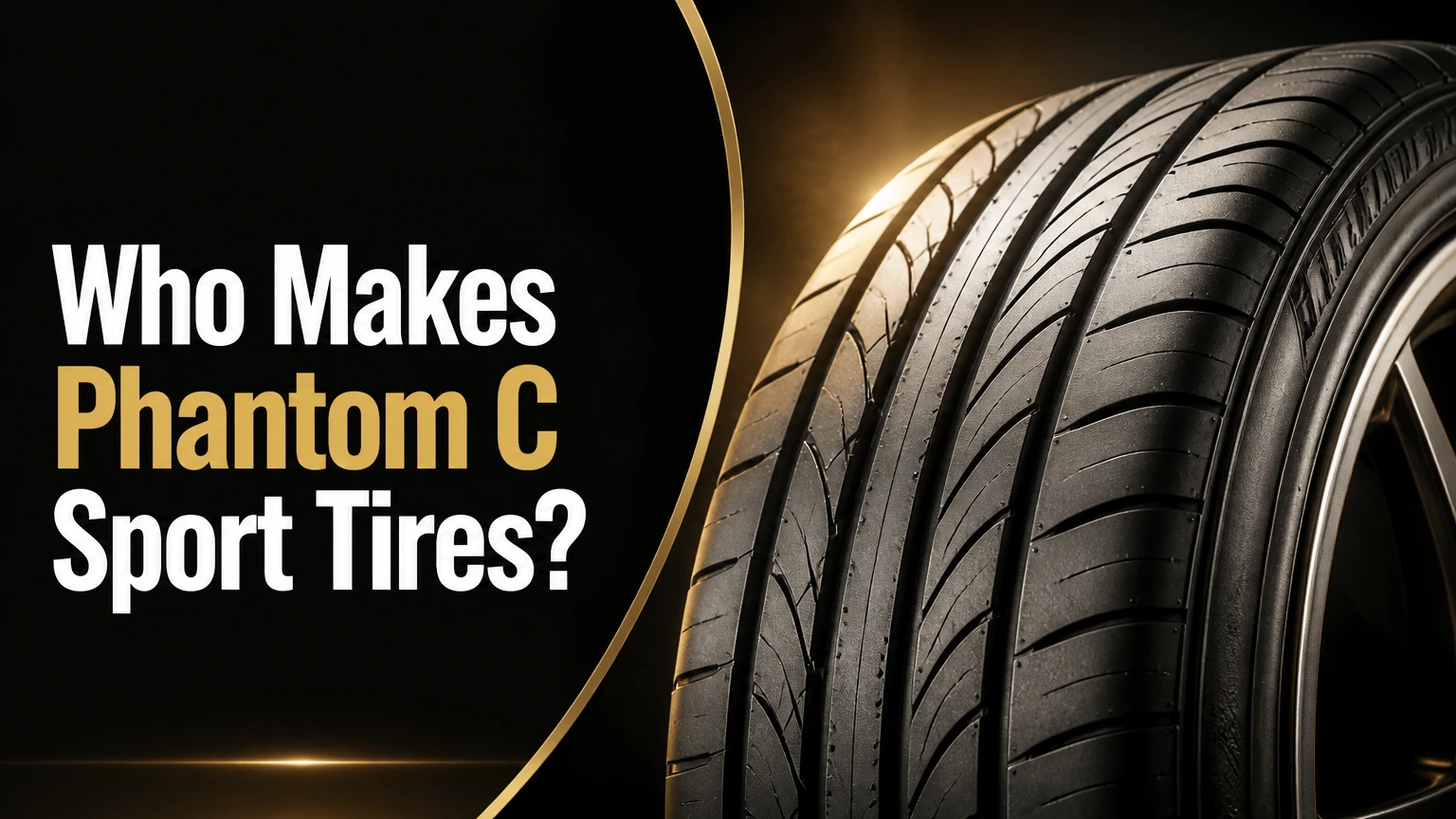
If you are researching who makes phantom c sport tires, the answer comes down to a direct retail contract. The Phantom C-Sport tire line is manufactured exclusively by Kumho Tire. Kumho produces the Phantom brand as a private-label product specifically for Discount Tire. While the Phantom trademark has historical ties to Michelin, the modern engineering, rubber compounds, and supply chain belong entirely to Kumho.
At a Glance:
- Kumho Tire manufactures the Phantom C-Sport line exclusively for Discount Tire and America’s Tire retail locations.
- A typical C-Sport tire costs between $90 and $153 depending on the rim diameter.
- The manufacturer provides a 50,000-mile treadwear warranty, though real-world lifespan averages 37,000 to 43,000 miles.
- These tires carry a Uniform Tire Quality Grading (UTQG) of 600 A A.
- Snow traction rates poorly, scoring roughly 2.5 out of 5 in independent technician evaluations.
- Heavy electric vehicles degrade the soft tread compound significantly faster than internal combustion cars.
Are Phantom Tires Made By Michelin?
Michelin does not manufacture modern Phantom tires. Kumho Tire builds every new Phantom C-Sport on the market today. The confusion stems from a historical technicality regarding corporate trademarks.
Michelin acquired the rights to the parent “Phantom” brand name through its acquisition of the Uniroyal Goodrich tire company decades ago. Some online listings grab this trademark data and falsely label the current products as Michelin-made tires. Buying these tires expecting Michelin’s proprietary rubber compounds, specialized sidewall construction, or premium ride compliance will result in severe disappointment.
The Phantom C-Sport is built strictly to Kumho’s tier-three budget manufacturing standards. The internal steel belts, the carbon-black synthetic rubber blends, and the curing processes all originate in Kumho factories. Retailers use the historical trademark connection as a marketing technicality, but mechanically, the product contains zero Michelin engineering.
What Is the UTQG Rating on the C-Sport Model?
The Phantom C-Sport carries a Uniform Tire Quality Grading (UTQG) of 600 A A. The United States Department of Transportation requires this rating system to give consumers a standardized baseline for comparing treadwear, traction, and temperature resistance across different brands.
The “600” treadwear grade indicates that the tire should theoretically last six times longer than the government’s standard control tire. The first “A” represents the traction grade, meaning the tire demonstrates excellent ability to stop on wet pavement during straight-line braking tests. The second “A” represents the highest possible temperature rating, indicating that the tire effectively dissipates heat at sustained highway speeds without risking a blowout. Brand new C-Sport tires begin with a factory tread depth ranging from 9.5/32 to 10/32 of an inch depending on the exact section width.
| Specification Category | Factory Claim | Real-World Practitioner Average |
| Treadwear Grade | 600 | 450 Equivalent |
| Temperature Rating | Grade A | Grade A |
| Starting Tread Depth | 10.0/32 inch | 9.5/32 inch |
| Expected Lifespan | 50,000 miles | 37,000 to 43,000 miles |
How Many Miles Will a Set Actually Last?
Drivers typically get between 37,000 and 43,000 miles out of a Phantom C-Sport set before needing replacements. This real-world consumer data tracks noticeably short of the advertised 50,000-mile projection.
Tire technicians generally observe roughly 2/32 of an inch of tread wear for every 10,000 miles driven under normal commuting conditions. Once the tire reaches the legal minimum depth of 2/32 of an inch, it completely loses its ability to channel water and must be discarded. If you drive 12,000 miles per year, you should expect to replace these tires every three to three-and-a-half years. Aggressive braking, failure to rotate the tires regularly, or driving on rough aggregate pavement will push that lifespan closer to the 30,000-mile mark.
How Much Do They Cost Compared to Premium Brands?
A single Phantom C-Sport tire costs roughly $90 to $153 depending on your specific wheel size. Buyers can frequently purchase a complete set of four C-Sport tires for the exact same price as two top-tier touring tires.
The primary selling point of the C-Sport line is its extreme budget value. It aggressively undercuts premium options like the Michelin CrossClimate 2 or the Goodyear Assurance WeatherReady. While you sacrifice longevity and severe-weather grip, the upfront cash savings make this brand highly appealing for drivers needing immediate replacements on a tight budget. Installation, mounting, and balancing fees generally add another $80 to $100 to the total out-the-door price at the tire shop.
| Tire Market Tier | Brand and Model Example | Average Price Per Tire | Total Installed Set Cost |
| Tier 3 Budget | Phantom C-Sport | $90 to $153 | $450 to $700 |
| Tier 2 Mid-Range | Cooper CS5 Grand Touring | $145 to $185 | $700 to $900 |
| Tier 1 Premium | Michelin CrossClimate 2 | $210 to $265 | $1,000 to $1,300 |
Are They Quiet on the Highway?
Yes, the Phantom C-Sport remains surprisingly quiet at sustained highway speeds. Kumho engineered the tire using computer-optimized noise-cancelling tread patterns that disrupt sound frequencies before they enter the vehicle cabin.
The design incorporates specialized shoulder groove dams. These small rubber blocks sit inside the outer tread voids and trap air before it can compress and generate a whining noise against the pavement. Drivers consistently note that the cabin road noise is remarkably low for a tier-three budget tire. However, the internal casing is relatively stiff. While you will not hear loud road droning, you will feel the physical impact of potholes and bridge expansion joints more harshly than you would with a premium touring tire.
How Do They Handle Heavy Rain and Standing Water?
The Phantom C-Sport handles average rain showers well, but the tire slips significantly faster than premium alternatives when hitting deep standing water. The tread utilizes a V-channel water evacuation groove layout combined with 3D interlocking sipes to push water away from the contact patch.
During normal precipitation, these grooves easily clear the water. However, when encountering sudden heavy braking situations in torrential downpours, the budget rubber compound struggles to maintain structural rigidity. The tread blocks flex too much under extreme pressure, causing the tire to ride up onto the water surface. Drivers utilizing these tires in wet climates must leave a larger braking buffer zone between themselves and the car ahead.
Can You Drive This Tire in Winter Snow?
No, you should actively avoid driving the Phantom C-Sport in winter snow conditions. Despite carrying an “All-Season” label on the sidewall, its cold-weather performance is incredibly poor. On an objective 1-to-5 scoring scale used by tire technicians, the C-Sport scores a meager 2.5 in snow traction.
The synthetic rubber compound lacks the specialized silica required to remain pliable in freezing temperatures. When the thermometer drops below 40 degrees Fahrenheit, the tire hardens into the consistency of hard plastic. Users frequently note that even vehicles equipped with advanced All-Wheel Drive (AWD) systems struggle to maintain grip on light snow with these tires installed. If you live in a region that gets regular winter accumulation, buying these tires to save money is a dangerous miscalculation.
Are These Budget Tires Safe for Heavy Electric Vehicles?
The Phantom C-Sport fails to support the extreme weight and instant torque delivery of modern electric vehicles. Drivers attempting to put these tires on heavy crossover EVs, such as a Kia EV6 or a Tesla Model Y, will find that the soft compound degrades rapidly.
Electric vehicles typically weigh 1,000 to 1,500 pounds more than their gas-powered counterparts due to the battery packs. This extra mass creates massive friction against the pavement. EV owners using the C-Sport often see the tread wear out completely in under 20,000 miles, nullifying any initial cost savings. Furthermore, electric vehicles require tires with ultra-low rolling resistance to maximize battery range. The Phantom tread design grips the road inefficiently, which forces the electric motors to work harder and drains the battery faster.
How Do They Compare in Emergency Stopping Distances?
Premium benchmark tires stop roughly 11 feet shorter in wet conditions and 5 feet shorter in dry conditions than the Phantom C-Sport. When traveling at 60 miles per hour, those extra feet easily represent the difference between a safe stop and a severe rear-end collision.
In direct track testing, high-end touring tires utilize advanced chemical grip to bite into the pavement during panic stops. The Kumho-manufactured Phantom relies entirely on mechanical grip from its tread pattern. Once the anti-lock braking system engages, the budget tire skids slightly further before regaining traction. Drivers must account for this performance gap by increasing their following distance on the highway.
| Testing Condition (60-0 mph) | Premium Touring Tire Average | Phantom C-Sport Average | Stopping Distance Penalty |
| Dry Asphalt | 120 feet | 125 feet | 5 extra feet |
| Wet Pavement | 135 feet | 146 feet | 11 extra feet |
| Light Snow Accumulation | 165 feet | 192 feet | 27 extra feet |
What Vehicle Types Match This Tread Design Best?
The ideal vehicles for the Phantom C-Sport are lightweight commuter sedans and compact crossovers driven in warm, dry climates. Cars like the Honda Civic, Toyota RAV4, or Nissan Sentra extract the best absolute value from this budget rubber compound.
These vehicles do not generate enough torque or carry enough physical weight to stress the tire’s internal steel belts. When mounted on a lightweight car, the tire tracks straight, remains quiet, and wears evenly. Conversely, mounting these tires on heavy three-row SUVs or powerful sports sedans will overwhelm the sidewall construction. This leads to a spongy steering feel, unpredictable cornering, and rapid edge wear.
| Vehicle Class Type | Specific Model Examples | Compatibility Rating | Practitioner Notes |
| Compact Commuter Sedans | Honda Civic, Toyota Corolla | Excellent | Low weight preserves tread life perfectly. |
| Mid-Size Crossovers | Toyota RAV4, Ford Escape | Acceptable | Requires strict rotation every 5,000 miles. |
| Heavy Three-Row SUVs | Chevrolet Tahoe, Ford Explorer | Poor | Sidewall flex causes uncomfortable highway swaying. |
| Battery Electric Vehicles | Tesla Model 3, Kia EV6 | Not Recommended | Instant torque destroys tread blocks rapidly. |
Does the 50,000-Mile Warranty Cover Uneven Tread Wear?
The manufacturer warranty explicitly excludes uneven tread wear caused by poor vehicle alignment, broken suspension components, or skipped tire rotations. The 50,000-mile guarantee only applies if the tire wears down completely evenly across all four tread grooves.
Discount Tire requires documented proof of regular rotations (typically every 5,000 to 7,000 miles) to honor any mileage prorations. If your front tires wear out at 30,000 miles because your vehicle needs an alignment, you will not receive any warranty credit toward a replacement set. Furthermore, warranty credits only apply to the purchase of another set of tires from the same retailer, locking you into their ecosystem.
Why Do Some Vehicles Lose Fuel Economy After Installation?
The budget rubber compound found in the Phantom C-Sport possesses higher rolling resistance than low-friction touring alternatives. Independent shop data typically shows a notable drop in fuel efficiency, with some internal combustion vehicles dropping from a historical 38 miles per gallon down to an average of 26 to 32 miles per gallon after installation.
Rolling resistance measures how much energy a vehicle must expend to keep the tires moving forward. Premium tires incorporate silica to maintain flexibility without sticking to the pavement. The carbon-black compound in the C-Sport sticks slightly more to the road surface as it heats up. The engine must burn more fuel to overcome this sticky friction. Over a span of 40,000 miles, the extra money spent on gasoline can sometimes erase the money saved by buying a budget tire in the first place.
What Wheel Sizes Are Available for This Specific Model?
Discount Tire stocks the Phantom C-Sport primarily for 15-inch through 20-inch wheel diameters. This specific size range safely covers nearly 85 percent of all standard passenger cars, minivans, and light crossover vehicles currently on American roads.
The manufacturer prioritizes high-volume commuter sizes rather than low-profile sports car sizes or massive truck dimensions. You will easily find replacements for a standard 16-inch Honda Accord wheel, but you will not find a C-Sport model designed to fit a 22-inch luxury SUV wheel or an off-road truck requiring specialized load ratings. The available width profiles range from narrow 185-millimeter eco-car sizes up to standard 245-millimeter crossover widths.
Where Can You Buy Replacement Phantom Tires?
You can only purchase new Phantom C-Sport tires directly through Discount Tire or their regional subsidiary America’s Tire. Because this is a proprietary house brand contracted strictly between the retail giant and Kumho, the inventory never reaches outside distribution channels.
Independent mechanics, local repair shops, and competing big-box tire centers cannot order these tires from wholesale distributors. If you damage a tire on a cross-country road trip and need a single replacement, you must find a Discount Tire location. The massive volume of single or batch listings found on secondary sites like eBay consists almost entirely of used tires or dealer take-offs rather than fresh factory inventory.
The Bottom Line
The Phantom C-Sport offers an acceptable, high-value alternative for budget-focused drivers who need immediate replacements for a standard commuter vehicle. It delivers surprisingly low highway noise and adequate dry handling at a price point that aggressively undercuts premium market options. However, drivers living in snowy climates or those operating heavy electric vehicles must avoid this tire, as the budget compound completely fails under extreme winter conditions and heavy vehicle weight.