
Rotating your tires directly disrupts the Tire Pressure Monitoring System (TPMS) by scrambling the physical locations of the wheel sensors relative to the vehicle computer’s programmed layout. While a routine tire rotation does not physically harm the sensors, the central computer continues to track them according to their previous positions, causing dashboard alerts to display pressure readings for the wrong wheels until a system relearn is completed.
Key Facts at a Glance
- Direct Impact: Physical sensors change positions (e.g., front-left moves to rear-right), misaligning data coordinates in the car computer.
- Warning Indicator: A solid yellow, horseshoe-shaped dashboard icon illuminates when pressure drops 25% below the placard specification.
- Required Action: A TPMS relearn procedure (Auto-Learn, Manual sequence, or OBD-II tool scan) is required after every rotation on direct systems.
- Battery Lifespan: Direct TPMS sensor batteries last 5 to 10 years and cannot be replaced individually; the entire valve sensor must be swapped.
- Service Cost: Relearn services range from zero dollars (often free with rotation at shops like Discount Tire) to fifty dollars.
What is a Tire Pressure Monitoring System and How Does It Work?
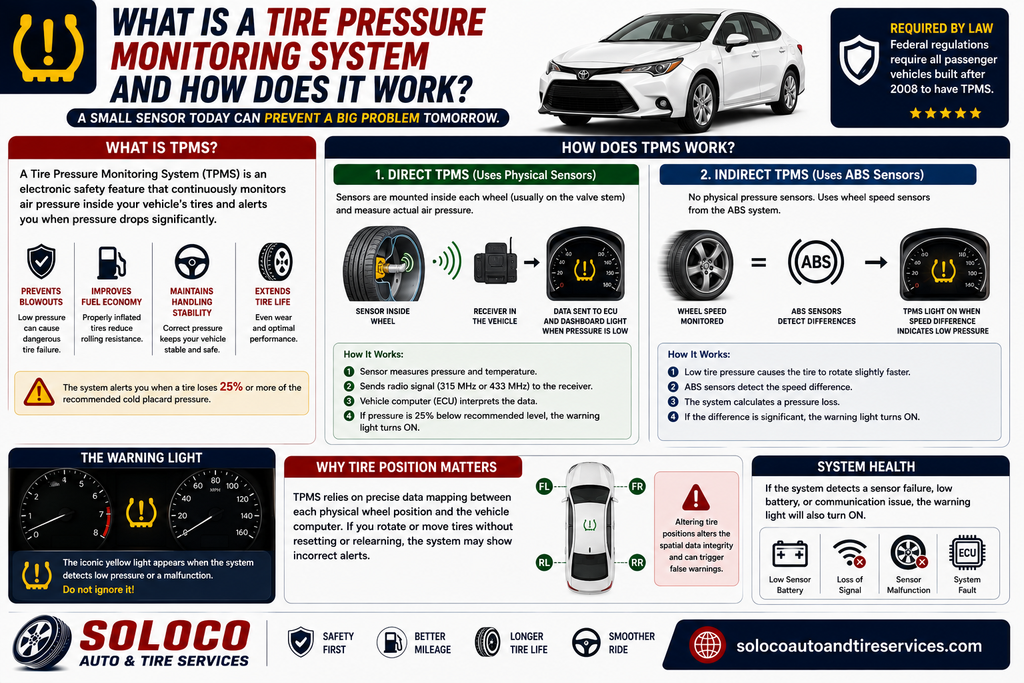
A Tire Pressure Monitoring System is an electronic safety feature designed to track real-time air pressure inside pneumatic tires and alert drivers when pressure drops significantly. Federal regulations require modern passenger vehicles manufactured after 2008 to feature this technology to prevent blowouts, improve fuel economy, and maintain vehicle handling stability.
The system relies on either direct physical sensors mounted inside each wheel assembly or indirect software algorithms measuring wheel speed via the Anti-lock Braking System (ABS). When a tire loses 25% or more of its recommended cold placard pressure, the system completes an electrical or algorithmic warning circuit, triggering the iconic yellow dashboard light. Because this system depends on precise data mapping between the physical wheel and the vehicle computer, altering tire positions alters the spatial data integrity.
Why Does Rotating Tires Confuse the Car Computer?
The vehicle computer maps tire pressure data based on a static spatial coordinate system established during the last system programming. When you rotate your tires—whether moving them in a rear-forward cross, X-pattern, or front-to-back configuration—the physical sensors change their physical location on the vehicle chassis.
For example, if your front-left tire moves to the rear-right position during a standard rotation, the physical sensor travels across the vehicle. However, the car computer’s memory still expects sensor data from the front-left identification code to originate at the front-left wheel arch. When a pressure drop occurs, the dashboard warning light will illuminate, but the display will point you to the wrong corner of the car, creating confusion during diagnostics and inflation.
How Do Direct TPMS and Indirect TPMS Differ in Rotation Response?
Understanding how your specific vehicle architecture handles tire pressure monitoring determines whether you need a complex scan tool or a simple dashboard button reset after a service.
| Feature | Direct TPMS (dTPMS) | Indirect TPMS (iTPMS) |
|---|---|---|
| Tracking Method | Physical radio-frequency pressure sensor valve inside each wheel. | Uses ABS wheel speed sensors to calculate rolling radius. |
| Data Measured | Exact PSI or Bar pressure and internal wheel temperature. | Relative rotational speed differences and vibration harmonics. |
| Affected by Rotation? | Yes. Physical sensors change positions on the car body. | Yes. Tire wear variations change effective rolling circumferences. |
| Relearn Method | Electronic tool scan, manual ignition sequence, or auto-drive. | Simple initialization button in the dashboard or infotainment menu. |
| Component Lifespan | 5 to 10 years before sealed internal batteries fail permanently. | Unlimited lifespan since no internal wheel sensors are used. |
| Replacement Cost | $30 to $100 per sensor plus mounting and balancing labor. | Zero hardware replacement costs during vehicle ownership. |
What Are the Three Main TPMS Relearn Methods?
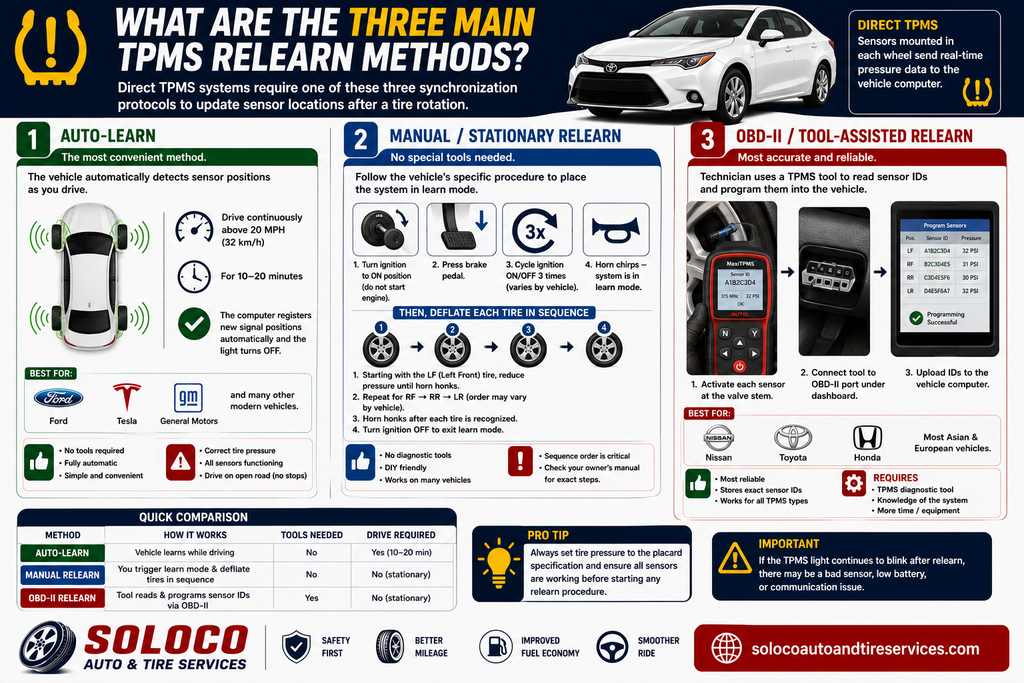
Vehicles equipped with Direct TPMS require one of three synchronization protocols to update sensor locations after a tire rotation.
1. Auto-Learn
Auto-learn is the most convenient relearn method, utilized by modern vehicle manufacturers like Ford, Tesla, and General Motors. The car uses multiple internal radio-frequency antennae mounted near each wheel well to automatically detect sensor positions as the vehicle moves. The process requires driving continuously above 20 miles per hour for 10 to 20 minutes until the computer registers the new signal positions.
2. Manual and Stationary Relearn
Manual relearn protocols allow technicians or DIYers to sync sensors without specialized diagnostic hardware. This method typically involves accessing a specific vehicle menu or executing an ignition sequence, such as turning the key to the ON position three times while pressing the brake pedal. Once the horn chirps to indicate learning mode, you let air out of each tire sequentially in a specified order until the horn honks again for each wheel.
3. OBD-II and Tool-Assisted Relearn
OBD-II tool-assisted relearns are common on Asian and European imports like Nissan, Toyota, and Honda. A technician uses a specialized handheld TPMS activation tool to scan the unique identification code of the sensor at each valve stem. The tool collects all four IDs and uploads the complete data layout directly into the vehicle computer through the OBD-II diagnostic port beneath the dashboard.
How Do You Perform a TPMS Relearn After a Tire Rotation?
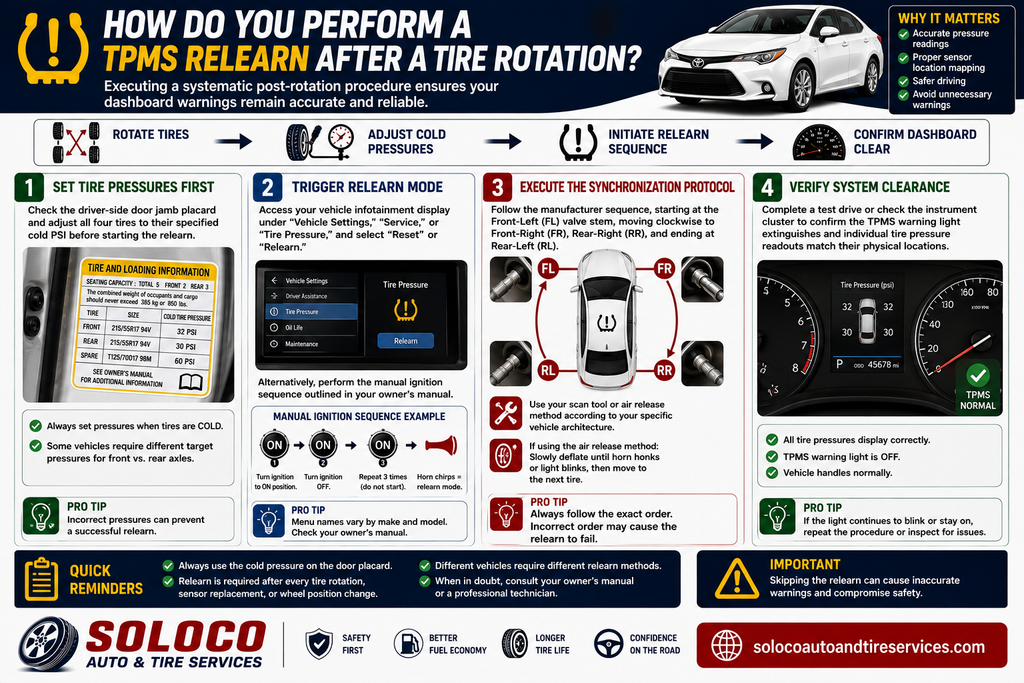
Executing a systematic post-rotation procedure ensures your dashboard warnings remain accurate and reliable.
[Rotate Tires] ➔ [Adjust Cold Pressures] ➔ [Initiate Relearn Sequence] ➔ [Confirm Dashboard Clear]
- Set Tire Pressures First: Check the driver-side door jamb placard and adjust all four tires to their specified cold PSI before starting the relearn. Remember that many vehicles require different target pressures for front versus rear axles.
- Trigger Relearn Mode: Access your vehicle infotainment display under “Vehicle Settings,” “Service,” or “Tire Pressure,” and select “Reset” or “Relearn.” Alternatively, perform the manual ignition sequence outlined in your owner’s manual.
- Execute the Synchronization Protocol: Follow the manufacturer sequence, starting at the Front-Left (FL) valve stem, moving clockwise to Front-Right (FR), Rear-Right (RR), and ending at Rear-Left (RL). Use your scan tool or air release method according to your specific vehicle architecture.
- Verify System Clearance: Complete a test drive or check the instrument cluster to confirm the TPMS warning light extinguishes and individual tire pressure readouts match their physical locations.
What Mistakes Should You Avoid During a Tire Rotation?
Preventing damage and persistent dashboard errors requires careful attention to specific vehicle engineering details during service.
- Ignoring Front and Rear Pressure Differentials: Many light trucks, sports cars, and heavy SUVs require higher air pressure in the rear tires than the front tires. Rotating tires without adjusting inflation pressures will immediately trigger a TPMS warning light.
- Omitting the Spare Tire in 5-Tile Rotations: Certain off-road vehicles and older SUVs, such as the Jeep Wrangler, incorporate a physical TPMS sensor inside the spare tire. Omitting the spare during a rotation cycle leaves a registered sensor out of range, causing a persistent system fault.
- Damaging Sensor Stems with Tire Changers: Careless positioning of tire-changing machine bead-breakers can snap delicate metal or rubber TPMS valve stems, resulting in an immediate air leak and a $50 replacement cost per broken sensor.
How Do You Troubleshoot TPMS Warning Lights After a Rotation?
Diagnosing dashboard indicator behavior helps separate calibration errors from genuine hardware failures.
Why does the TPMS light blink for 60 seconds and then stay solid?
A blinking TPMS light that transitions to a solid state indicates an electronic system malfunction rather than low tire pressure. This symptom typically points to a dead internal sensor battery or a sensor damaged during the rotation process. A diagnostic scan tool is required to identify the failed sensor identification code.
Why does the TPMS light stay solid immediately after a rotation?
A solid warning light immediately following service means the tire pressures are mismatched to the placard specifications or the vehicle computer requires a manual reset. Verify cold PSI against the door jamb sticker and complete an auto-learn drive cycle or manual reset procedure.
Why is the wrong tire location lighting up on the dashboard during a flat?
If your dashboard shows low pressure in the front-left tire when the rear-right tire is flat, the tires were rotated successfully, but the relearn procedure was skipped. Perform a tool-assisted or manual relearn immediately to remap the sensor locations.
Frequently Asked Questions
Can I drive my car with the TPMS light on after a tire rotation?
You can safely drive your car after a rotation if you have manually verified with a reliable handheld pressure gauge that all four tires are inflated to their correct cold PSI. The warning light in this scenario is merely indicating a misaligned computer map rather than an actual loss of air pressure. However, you should complete a relearn procedure as soon as possible to ensure future safety alerts function correctly.
Do TPMS sensors need to be reprogrammed every time tires are rotated?
Direct TPMS systems require reprogramming or a relearn procedure every single time tires are rotated to realign sensor identification codes with their new physical wheel positions. Indirect TPMS systems do not require reprogramming with a tool, but they do require a simple button reset or infotainment menu reinitialization to baseline the new wheel speed relationships.
How much does it cost to reset TPMS sensors after a rotation?
Many national tire service chains, such as Discount Tire, Costco, and America’s Tire, include TPMS relearn services entirely free of charge when you purchase tires or perform a tire rotation with them. Dealerships or independent mechanic shops that charge standalone labor typically bill between $20 and $50 to connect an OBD-II scan tool and execute the synchronization protocol.
Why do direct TPMS sensor batteries die, and can they be replaced?
Direct TPMS sensors run on sealed internal lithium-ion coin cell batteries designed to power the radio transmitter for 5 to 10 years. Because these batteries are hermetically sealed inside the plastic and metal housing to protect against moisture, vibration, and road salt, they cannot be replaced individually. When the battery voltage drops below operational thresholds, the entire sensor unit must be discarded and replaced.
What tools do I need to perform a DIY TPMS relearn at home?
If your vehicle does not feature an automatic self-learning drive cycle, you will need a budget-friendly universal TPMS activation and programming tool, which typically costs between $20 and $50 online. These handheld devices allow you to trigger individual wheel sensors, read internal battery health, and clone or program replacement sensor identification codes directly in your garage without visiting a dealership.


