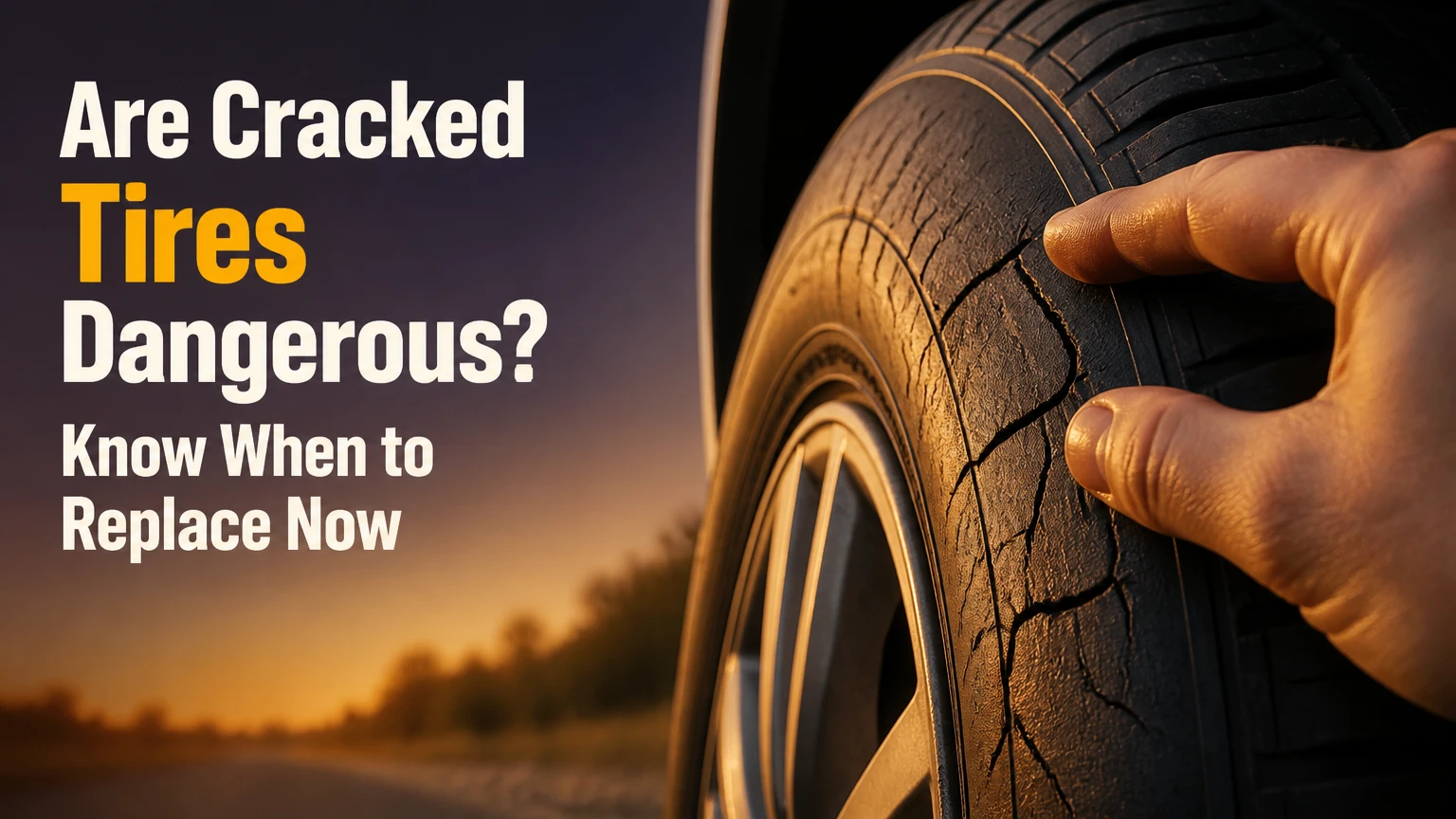
Yes, cracked tires can be dangerous because cracking signals rubber degradation that may reduce flexibility and weaken the tire’s sidewall, tread base, or bead area. Shallow surface crazing may warrant monitoring, but cracks that widen under flexing, expose fabric, appear on a sidewall, or accompany air loss require prompt professional inspection and usually replacement.
Key Facts at a Glance
A deep sidewall crack is a replacement concern even when tread depth remains legal.
Tire age is measured from the four-digit DOT manufacture date, not the purchase date.
A DOT code ending in 2321 means the tire was made in week 23 of 2021.
Michelin advises removing tires from service 10 years after manufacture, while inspection and replacement policies vary by manufacturer and jurisdiction.
Tire dressing, sealant, and rubber conditioner cannot rebuild degraded casing or steel-belt adhesion.
A tire with visible fabric, a bulge, rapid pressure loss, or a crack that opens under flexing should not be driven at highway speed.
What Does Tire Cracking Mean?
Tire cracking, often called dry rot or weather checking, is surface or internal deterioration caused by heat, oxygen, ozone, ultraviolet exposure, flexing, and time. The rubber compound gradually loses elasticity, so normal inflation, cornering, and road impacts place greater stress on weakened areas.
The phrase “dry rot” is useful for consumers but does not identify one precise failure depth. A tire can show fine ozone checking without immediate structural failure, while a visually modest crack near the bead or inner sidewall can create a serious air-retention or casing problem.
Tire cracking differs from a puncture. A puncture creates a localized hole from an object such as a nail; aging creates fissures in the rubber itself. A puncture may be repairable in the central tread under approved conditions, but structural weathering is not repaired by inserting a plug or patch.
Why Does Rubber Become Brittle?
Rubber becomes brittle when oxidation and ozone attack polymer chains faster than the tire’s protective additives can protect them. Heat accelerates the reaction, and repeated flexing then enlarges small fissures until the casing, belt edge, or air seal becomes compromised.
Tire manufacturers add antioxidants, antiozonants, and protective waxes to rubber compounds. Rolling helps distribute some protective materials toward the surface, but driving is not a cure for an already aged tire. Long-term outdoor storage, high temperatures, low inflation, and sunlight can consume protective capacity faster than mileage alone suggests.
The National Highway Traffic Safety Administration, in its tire-aging research and consumer guidance, has not established one universal replacement age for every tire. NHTSA advises following the tire maker’s recommendations and inspecting tires regularly. Michelin’s consumer guidance states: “Tires should be removed from service ten years from the date of manufacture,” but that is manufacturer guidance, not a universal federal expiration law.
Are Cracked Tires Dangerous at Highway Speed?
Cracked tires are especially dangerous at highway speed because heat, centrifugal force, cornering load, and casing flexing intensify as speed rises. A degraded tire may lose air, separate internally, or fail suddenly, leaving the driver with reduced steering and braking control.
A tire failure does not always begin as a dramatic blowout. A small crack can allow moisture and oxygen to reach internal materials, weaken the rubber-to-cord bond, or create a slow leak. Under heavy load, the weakened area may then expand rapidly.
The practical risk rises with several conditions:
- Sidewall cracking rather than superficial tread-surface checking
- Speeds above 55 mph
- Heavy cargo, towing, or a fully occupied SUV
- Hot pavement and long highway travel
- Underinflation or repeated pressure loss
- Cracks that open when the tire is flexed
- Visible cords, fabric, belt edges, bulges, or tread separation
Do not test a visibly damaged tire by taking it onto the highway. If the tire has a bulge, exposed cord, severe sidewall fissure, or rapid pressure loss, fit the spare or request roadside assistance.
Which Tire Cracks Are Most Serious?
The crack’s location, depth, movement, and relationship to the tire’s internal structure determine urgency. Sidewall, bead, and deep tread-base cracking generally deserve more concern than fine, stable surface lines on an otherwise young tire.
| Crack location | Typical appearance | Recommended action |
|---|---|---|
| Sidewall | Radial or circumferential fissures on the smooth sidewall | Replace or obtain same-day tire-shop inspection |
| Tread grooves | Splits at the base of grooves or between tread blocks | Stop highway use and arrange professional inspection |
| Bead area | Cracks beside the rim flange or lower sidewall | Replace if air loss, exposed material, or seal damage exists |
| Surface ozone checking | Fine spiderweb lines under 1 mm deep | Monitor closely and request inspection at the next service |
| Inner sidewall | Cracking hidden behind the wheel or suspension | Inspect with a light; replace if deep, open, or fabric is visible |
| Shoulder | Cracks where tread transitions into sidewall | Treat as high concern because the shoulder flexes heavily |
A crack’s depth cannot be measured reliably with a thumbnail or household tool. A tire technician can inspect the inner liner, bead, sidewall, tread base, and belt area after removing the wheel when necessary.
Does Tread-Groove Cracking Mean Immediate Replacement?
Deep cracking at the bottom of tread grooves usually means the tire needs replacement, particularly when cracks widen under load or expose textile material. Tread depth measures remaining tread rubber, not the condition of the casing, belt bond, or rubber beneath the grooves.
A tire with 7/32 inch of tread can still be unsafe if its rubber has hardened or its internal bond has deteriorated. Conversely, very fine lines confined to the outer surface of tread blocks may not require immediate removal, although they indicate aging and deserve documentation.
How Can You Tell Whether Cracking Is Unsafe?
Unsafe cracking commonly has one or more visible warning signs: open fissures, widening during flexing, exposed cords, a bulge, localized distortion, tread separation, or unexplained pressure loss. Fine lines that remain closed and shallow are less urgent, but only a professional can confirm structural condition.
Use the following inspection sequence while the vehicle is parked on level ground:
- Read the tire’s cold pressure with a gauge and compare it with the door-jamb specification.
- Turn the steering wheel to expose the front tires’ inner sidewalls.
- Use a flashlight to inspect the inner sidewall, bead, shoulder, and tread grooves.
- Look for cracks that continue around the circumference or spread across multiple areas.
- Press the tread blocks by hand. Do not use a screwdriver or sharp object.
- Check for bulges, exposed cords, belt movement, uneven wear, and embedded objects.
- Record the DOT date code and photograph each damaged area.
- Ask a tire professional whether the wheel must be removed for an inside inspection.
Stop driving the vehicle if the tire loses pressure repeatedly, shows cord or fabric, has a sidewall bulge, or produces vibration, thumping, or visible tread movement. A TPMS warning can identify pressure loss, but a normal TPMS reading cannot certify rubber age or casing integrity.
| Condition found during inspection | Highway decision | Next action |
|---|---|---|
| Fine closed surface lines, no pressure loss | Avoid unnecessary long trips | Schedule inspection within days or weeks |
| Cracks open when tread is flexed | Do not use at highway speed | Replace or have the tire removed and assessed |
| Sidewall crack with bulge or exposed fabric | Do not drive | Install spare or call roadside assistance |
| Bead cracking with 2-5 psi loss over several weeks | Limit movement to repair facility only | Replace tire and inspect rim sealing surface |
| Tread separation, vibration, or belt movement | Do not drive | Arrange towing or mobile tire service |
How Old Are My Tires?
The tire’s four-digit DOT date code identifies the week and year of manufacture. The first two digits represent the production week, and the final two digits represent the year, so code 3223 means week 32 of 2023.
The full DOT Tire Identification Number may appear on only one sidewall. If the visible side does not show the date, inspect the opposite side or ask a tire shop to read it. Do not use the vehicle registration date, installation date, or purchase receipt as the tire’s manufacturing age.
| DOT code example | Manufacture date | Age in March 2026 |
|---|---|---|
| 1019 | Week 10 of 2019 | About 7 years |
| 4821 | Week 48 of 2021 | About 4 years and 3 months |
| 2323 | Week 23 of 2023 | About 2 years and 9 months |
| 0525 | Week 5 of 2025 | About 1 year and 1 month |
Age is a risk factor, not a complete diagnosis. A five-year-old tire stored outdoors in hot sunlight may be in worse condition than a seven-year-old tire kept indoors, although neither age should be ignored. Load history, inflation, climate, ozone exposure, and storage position all affect deterioration.
Many manufacturers recommend annual professional inspection after five years in service. Several manufacturers recommend replacement at 10 years from manufacture regardless of tread, while some advise shorter limits for particular products or applications. Check the sidewall, owner’s manual, tire maker, and local inspection rules.
Can You Drive on Slightly Cracked Tires?
A driver may sometimes make a short, low-speed trip on tires showing only shallow, closed surface weathering, but that decision is temporary and should follow a tire professional’s assessment. Slight cracking is not a safety guarantee, and highway travel, heavy loads, or wet conditions increase the consequence of a failure.
The safest route is to photograph the cracks, verify cold pressure, and arrange inspection before routine driving. If a shop is nearby and no bulge, exposed cord, tread separation, or active leak exists, a short trip at moderate speed may be reasonable, but the technician should make the final judgment.
Do not drive on cracked tires when:
- The crack is on the sidewall and visibly deep
- The fissure opens with ordinary hand flexing
- Air pressure falls between checks
- The tire is more than 10 years old
- Fabric, steel, or inner material is visible
- The vehicle will tow, carry heavy cargo, or travel at sustained highway speed
- A vibration, thump, pull, or tread movement has appeared
“Looks okay” is a weak standard for aged rubber. A tire can pass a casual visual check while failing an internal inspection.
Can Dry-Rotted Tires Be Repaired?
Dry-rotted tires cannot be structurally repaired because a repair does not restore the rubber compound, casing strength, bead integrity, or bond between tread and internal belts. Plugs and patches address suitable punctures; they do not reverse thermo-oxidative degradation.
Tire shine can temporarily darken pale rubber and make small cracks harder to see. Petroleum-based products, solvents, and aggressive cleaning can damage or remove protective surface compounds, so appearance treatment should never be used to judge safety.
| Problem | Potential remedy | Why replacement may still be required |
|---|---|---|
| Nail in repairable central tread | Internal patch-plug by a qualified shop | Only works when casing and age are acceptable |
| Slow bead leak | Rim and bead inspection | Cracked bead rubber may not seal reliably |
| Fine surface weathering | Cleaning and monitoring | Cosmetic treatment cannot restore elasticity |
| Deep sidewall fissure | No approved structural repair | Sidewall flexing makes patching unsafe |
| Tread-base cracking | Tire replacement | Internal belt and casing condition remain unknown |
A shop may reject a puncture repair if the tire is aged, underinflated, previously driven flat, or visibly cracked. Repair standards also depend on puncture location, size, speed rating, and tire manufacturer instructions.
How Much Does Tire Replacement Cost?
Typical replacement costs range from about $400 to $1,200 for four passenger-car tires, including common installation charges, while large SUVs, performance tires, run-flats, and premium brands can exceed $1,500. Exact pricing depends on tire size, speed rating, wheel diameter, taxes, disposal fees, alignment, and local labor rates.
A single replacement may cost approximately $100-$300 for a standard passenger tire, $150-$400 for a crossover or light SUV tire, and $250-$600 or more for a run-flat or performance tire. These are typical retail ranges, not a guaranteed quote.
| Vehicle and tire type | Typical tire price each | Typical installed set |
|---|---|---|
| Compact sedan, 15-16 inch all-season | $80-$160 | $360-$750 |
| Midsize sedan, 17-18 inch all-season | $120-$250 | $550-$1,150 |
| Crossover or light SUV, 18-20 inch | $150-$350 | $700-$1,600 |
| Performance or run-flat, 19-22 inch | $250-$600 | $1,150-$2,700 |
An alignment may add $90-$180, and tire disposal or TPMS service may add $5-$25 per wheel. If the vehicle uses all-wheel drive, replacing only one tire can create tread-depth differences that stress the drivetrain. Follow the owner’s manual and ask whether the shop should replace two, four, or one tire after measuring tread depth.
What Causes Cracked Tires to Age Faster?
Sunlight, ozone, heat, underinflation, long storage, and harsh chemicals accelerate tire cracking. Low mileage does not protect a tire because time, temperature, and oxygen continue to affect rubber while the vehicle is parked.
Common accelerating conditions include:
- Parking outdoors without shade in hot climates
- Storing a vehicle for months with tires exposed to UV radiation
- Operating below the door-jamb inflation specification
- Carrying loads beyond the tire or vehicle rating
- Repeated curb impacts that damage the sidewall
- Using solvent-rich or petroleum-based tire dressings
- Parking near electric motors or ozone-generating equipment
- Allowing mud, salt, and moisture to remain around the inner sidewall
A parked collector car can age tires faster than a daily commuter if it sits on one contact patch for long periods and receives little inspection. Tire covers can reduce sunlight exposure, but they cannot reverse existing cracking or substitute for correct inflation.
How Should Tires Be Stored?
Store tires indoors in a cool, dry, dark area away from electric motors, chemicals, and direct sunlight. For a vehicle that remains parked, maintain the manufacturer’s inflation specification, move the car periodically when practical, and inspect the inner sidewalls before returning to service.
Do not place tires directly against heating pipes or use wood blocks as a substitute for proper vehicle support. If a vehicle is lifted, use rated stands and follow the vehicle maker’s support points. Tire cradles can reduce localized deformation, but they do not prevent age-related oxidation.
What Should Used-Car Buyers Check?
Used-car buyers should inspect all four tires, the spare, the DOT date codes, tread depth, pressure, sidewalls, and service history before purchase. A car with low mileage may still need immediate tire replacement if its original tires are aged or cracked.
Check whether all tires share the correct size, load index, speed rating, and compatible tread pattern. Inspect for fresh silicone dressing that may temporarily conceal whitening or fine cracks, and request that the vehicle be raised if the inner sidewalls are inaccessible.
Ask the seller to provide:
- The tire manufacture dates and installation dates
- Recent invoices for tire purchase and alignment
- Evidence of pressure-loss repairs
- Confirmation that the spare is inflated and within its age limit
- A written tire-shop inspection if cracks are visible
Budget replacement into the purchase price rather than treating tire condition as cosmetic. Four aged tires can represent more than $1,000 on a crossover, and a damaged spare can leave the vehicle without a usable emergency option.
Common Inspection Mistakes
Mistake: Judging safety by tread depth
Tread depth indicates wear at the tread surface, not the flexibility of the sidewall or condition of the belt bond. Measure tread, but inspect age, cracking, bulges, pressure retention, and vibration separately.
Mistake: Flexing the tire with a sharp object
A screwdriver can puncture or cut rubber and create damage that was not present. Use hand pressure only for a basic check, then let a technician examine questionable areas.
Mistake: Treating every crack as harmless
Fine surface crazing and deep sidewall fissures do not carry the same risk. Location, depth, movement, age, and air loss determine urgency.
Mistake: Treating every crack as an immediate blowout
Visual cracking does not prove that a tire will fail on the next trip. A qualified inspection can distinguish superficial weathering from structural damage, but the uncertainty is a reason to avoid high-speed use until inspection.
Mistake: Replacing only the visibly worst tire
The other tires may have the same age, climate exposure, and compound deterioration. Compare all four DOT codes and tread depths before choosing one, two, or four replacements.
The Bottom Line
Are cracked tires dangerous? They can be, especially when cracks affect the sidewall, bead, shoulder, or base of the tread, widen under flexing, expose internal material, or accompany pressure loss. Shallow surface weathering on a young, properly inflated tire may allow limited use while awaiting inspection, but it should not be concealed or treated as repaired.
Use the DOT code to establish age, inspect both sidewalls and tread grooves, and follow the tire manufacturer’s replacement guidance. Replace tires with structural cracks, bulges, exposed cords, tread separation, or persistent leaks before highway driving.
Frequently Asked Questions
Are cracked tires illegal?
Cracked tires may fail a vehicle safety inspection when damage is deep, exposes cords, affects the bead, or compromises air retention, but laws vary by country, state, and inspection program. There is no single universal rule that makes every visible surface line illegal. Check the local inspection standard and have a qualified tire shop assess the damage.
Can tire pressure make cracking worse?
Yes. Underinflation increases sidewall flexing and heat, which accelerates fatigue and can enlarge existing fissures. Overinflation can reduce the contact patch and increase impact stress. Set cold pressure to the vehicle manufacturer’s door-jamb specification, not the maximum pressure molded into the tire sidewall.
Are tires with cracks between tread blocks safe?
Cracks between tread blocks require inspection because deep fissures can reach the tread base and weaken the casing. Fine, shallow lines limited to the outer rubber may be monitored on a young tire, but cracks that open under flexing, show fabric, or accompany vibration require replacement.
Should I replace all four cracked tires?
Replace all four when the tires are similarly aged or show comparable cracking. Replace fewer only after measuring tread depth, checking drivetrain requirements, and confirming that the remaining tires have acceptable age and condition. All-wheel-drive vehicles often require closely matched rolling circumference.
Can tire shine hide dry rot?
Tire shine can darken or wet the surface and make fine cracks less visible, but it cannot repair dry rot or restore elasticity. Avoid petroleum-based dressings and harsh solvents. Clean tires with mild soap and water, let them dry, and inspect the untreated rubber in strong light.
How long can cracked tires last?
No reliable mileage or time guarantee exists for a cracked tire because crack depth, location, age, heat exposure, load, and pressure determine failure risk. A tire with deep sidewall cracking should be removed immediately, while minor surface weathering still requires a professional condition assessment rather than a predicted lifespan.