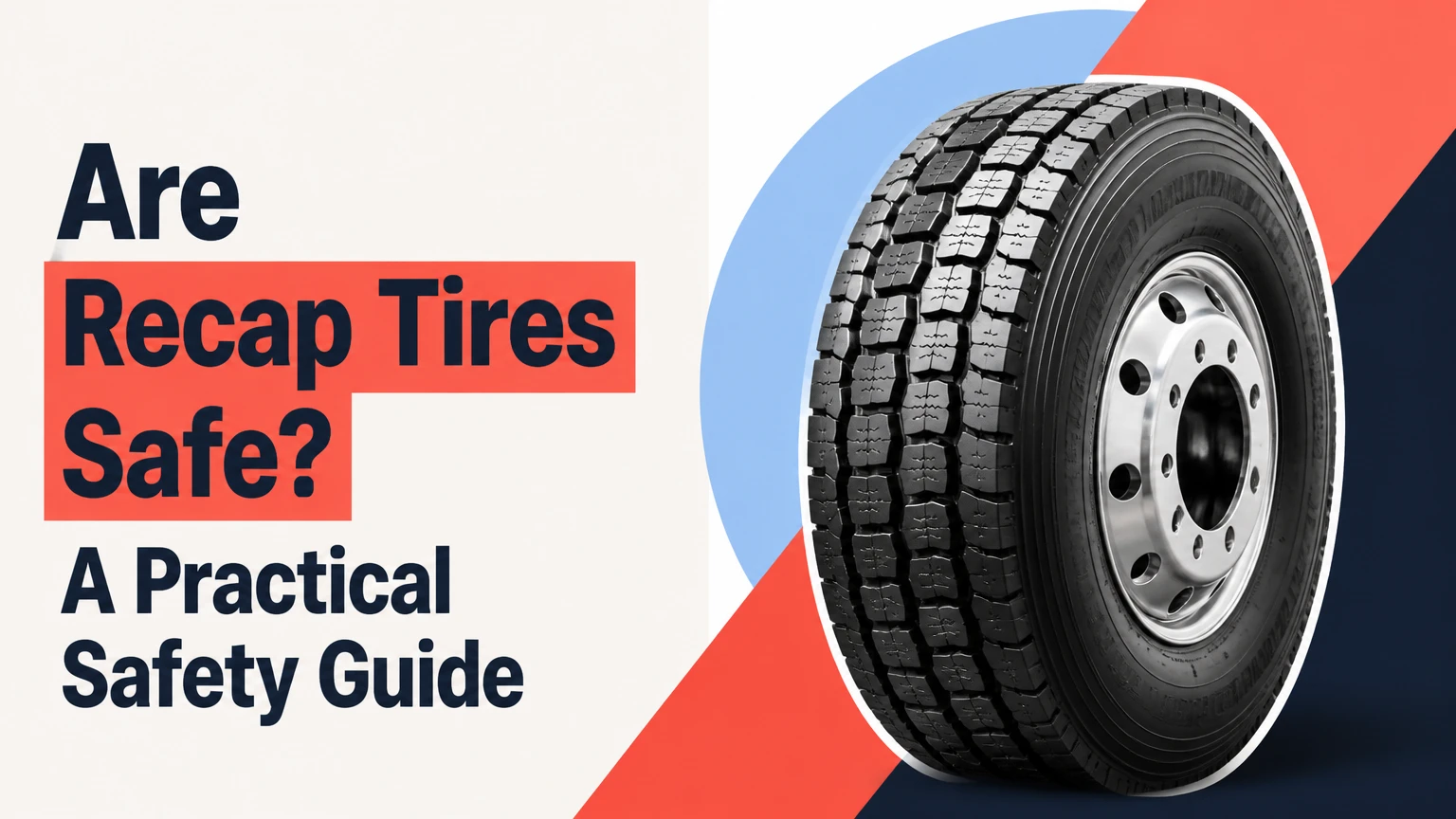
Recap tires, also called retread tires, are safe when a qualified retreader uses a sound casing and the tire is correctly matched to its load, pressure, speed, and wheel position. Recaps are not automatically safer or less safe than new tires; manufacturing controls, casing history, maintenance, and operating conditions determine the real risk.
Key facts at a glance
A recap tire reuses a structurally sound casing and replaces its worn tread.
A certified retreader rejects casings with hidden belt, bead, fatigue, or separation damage.
Underinflation and overloading create heat that can damage new and retreaded tires.
Commercial retreads commonly cost 30-50% less than comparable new tires.
Federal rules differ by vehicle and wheel position, especially for buses and steer axles.
A sidewall bulge, exposed cord, sudden vibration, or bond-line separation requires immediate removal.
Are Recap Tires Safe?
Yes, quality recap tires are safe for their approved application, but “recap” alone does not identify quality. A professionally retreaded truck tire can deliver service comparable to a new tire when its casing passes inspection, the tread is correctly bonded, and the operator maintains specified inflation and axle loads.
The National Highway Traffic Safety Administration’s TireWise guidance states, “Tires are the only thing that connects your vehicle to the road.” That principle applies to both virgin and retreaded tires. A new tire with chronic underinflation can fail, while a properly selected retread can operate reliably for another tread life.
The U.S. Tire Manufacturers Association and commercial tire manufacturers support retreading as a normal part of fleet tire management. Aircraft operators, school-bus fleets, military organizations, emergency services, and trucking companies use retreads because the process preserves usable casing structure while replacing consumable tread rubber. Those applications do not make every used tire safe, however. They demonstrate that controlled retreading is an established engineering practice.
The safety verdict changes when a tire has unknown damage, an unsuitable load rating, poor repairs, excessive age, mismatched duals, or an installation defect. Treat the casing as a safety-critical component, not as disposable packaging.
What Is a Recap Tire?
A recap tire is an existing tire casing with its worn tread removed and a new tread layer bonded to the prepared casing. “Recap,” “retread,” and “remold” are related terms, although manufacturers and markets may use them differently.
The casing contains the bead, inner liner, sidewalls, steel belts, body plies, and other structural components. The tread contains the road-contact rubber, grooves, ribs, and traction pattern. Retreading reuses the casing because that structure may still have substantial engineered life after the original tread wears away.
A casing’s prior service matters. Heat cycles, curb impacts, punctures, overloads, alignment problems, and low-pressure operation can weaken internal components without leaving an obvious external mark. Professional retread plants therefore inspect the casing before applying rubber rather than assuming that adequate tread depth proves safety.
What does the retread process replace?
Retreading replaces the worn tread and, when required, repairs limited casing injuries approved by the retreader’s procedures. It does not restore a casing with belt separation, severe bead damage, major sidewall fatigue, or unrepaired structural injury.
The casing often represents roughly 70-80% of a commercial tire’s original material and manufacturing value. The exact percentage varies by tire size and accounting method, but the economic principle is consistent: reusing a viable casing avoids manufacturing an entirely new structural body.
How Are Recap Tires Manufactured?
Professional retreading usually involves eight controlled stages: initial inspection, nondestructive testing, precision buffing, injury repair, cushion application, tread building, curing, and final inspection. The quality checkpoint is the casing inspection, because no curing method can make a structurally failed casing reliable.
Technicians first clean and visually examine the tire for cuts, penetrations, bulges, exposed cords, irregular wear, bead damage, and contamination. The inflated casing may then undergo shearography, electronic inspection, or another nondestructive method that reveals separations and air pockets hidden below the surface.
A computerized buffer removes the old tread to a specified diameter and texture. Technicians inspect the newly exposed rubber, because buffing can reveal injuries that were hidden beneath the original tread. Approved minor injuries may be skived, cleaned, filled, and repaired; major structural damage leads to rejection.
A cushion rubber layer is placed between the casing and replacement tread. In a precure process, a cured tread strip is wrapped around the casing and sealed. In a mold-cure process, uncured rubber is applied before the assembly enters a tread mold. Heat and pressure vulcanize the rubber and create the bond.
Final inspection includes visual checks, inflation testing, dimensional checks, and procedures required by the retreader’s quality system. A buyer should be able to identify the retreader, tread specification, casing information, and applicable compliance markings.
Which Retread Process Is Safer?
Pre-cure and mold-cure retreads can both be safe when produced correctly; neither process automatically wins on safety. Pre-cure systems use a finished tread strip, while mold-cure systems shape raw rubber directly on the casing, so application, plant controls, tread design, and casing condition matter more than the label.
| Attribute | Pre-cure retread | Mold-cure retread | Practical effect |
|---|---|---|---|
| Tread material | Fully cured strip | Uncured rubber | Different production control points |
| Typical cure environment | Approximately 210-250°F | Approximately 300-320°F | Heat and pressure profile varies |
| Tread selection | Many application-specific patterns | Mold-specific patterns | Useful for highway, winter, or vocational work |
| Appearance | Possible shoulder splice or seam | More uniform molded finish | Appearance does not prove structural quality |
| Common use | Commercial fleets and mixed casing programs | High-scrub or dedicated designs | Choose for route and axle demands |
Pre-cure retreads are versatile because a plant can apply selected tread designs to compatible casings from different manufacturers. A correctly sealed splice is a designed feature, not automatically a defect. Mold-cure retreads can provide a continuous molded appearance and may protect shoulders with a wrapped tread design.
For severe curb exposure, refuse collection, construction access roads, or repeated tight turns, the tread compound and shoulder design deserve more attention than the cure category. For long-haul use, rolling resistance, casing compatibility, heat management, and tread mileage may carry greater weight.
Are Recaps Legal on Every Wheel Position?
No. Retread legality depends on jurisdiction, vehicle class, and wheel position, and fleet policies may be stricter than the legal minimum. In the United States, federal rules restrict certain retreaded or regrooved tires on the front wheels of buses, while commercial truck operators must also follow applicable Federal Motor Carrier Safety Regulations, state rules, and tire manufacturer instructions.
A common mistake is treating “legal” as equivalent to “recommended.” A rule may permit a configuration that a fleet excludes because a steer-axle failure has more immediate control consequences than a failure on a multi-axle trailer. Operators should verify the exact tire marking, vehicle category, axle rating, and current regulation before installation.
| Wheel position | Typical commercial use | Main safety concern | Buying decision |
|---|---|---|---|
| Steer axle | Truck front axle | Directional control after failure | Verify federal, state, OEM, and fleet rules |
| Drive axle | Powered truck axle | Torque, traction, casing heat | Match tread compound and torque demands |
| Trailer axle | Nonpowered trailer axle | Scrub, irregular wear, load | Use trailer-rated construction and pressure |
| Bus front axle | Passenger bus steering axle | Passenger control and regulation | Check specific legal prohibition before use |
The safest operational rule is simple: use only a retread explicitly approved for the vehicle, axle, load, speed, and service. Never transfer a tire between wheel positions merely because its size fits.
How Long Do Recap Tires Last?
A commercial recap commonly lasts one additional tread life, often about three to four years in regional service, but mileage and calendar life vary widely. A premium casing may be retreaded two or three times, while severe service, damage, age, or a poor maintenance history can reduce the casing to one cycle.
There is no universal lifespan that overrides the casing manufacturer’s limits. Bridgestone’s commercial guidance, for example, emphasizes tire age and application controls rather than tread depth alone. Many operators retire casings around six to ten years, but that range is a policy or manufacturer-dependent threshold, not a single federal expiration rule for every tire.
| Factor | Typical range or threshold | Effect on service life | Operator action |
|---|---|---|---|
| Regional recap service | 3-4 years | Moderate heat and scrub | Record mileage and inspections |
| Retread cycles | 2-3 cycles | Depends on casing quality | Track casing history |
| Local delivery cycles | Up to 5 cycles in favorable programs | Lower speed, higher scrub | Use vocational tread design |
| Casing retirement policies | Often 6-10 years | Age can increase cracking and fatigue | Follow manufacturer date guidance |
| Inflation inspection | Before each route or daily | Prevents heat-related damage | Measure cold pressure with a gauge |
Tread depth cannot reveal all casing risks. A tire with ample tread may still have fatigue damage, ozone cracking, or an internal separation. Casing serial numbers and turn-in records provide stronger evidence than a visual estimate alone.
What Causes Retread Failure?
Retread failure usually involves casing damage, heat, impact, overloading, underinflation, improper repair, or a bonding and manufacturing defect. Highway debris commonly called a “road gator” is evidence of a tire failure, but the debris alone cannot identify whether the tire was new or retreaded or establish the original cause.
Underinflation increases sidewall flexing and heat generation. Overloading increases stress in the casing and raises operating temperature. A puncture can allow moisture or air migration into structural layers, while misalignment can create irregular wear that weakens the tread and casing interface.
Professional retread plants reduce manufacturing risk through inspection and process control, but they cannot correct damage created after installation. A retreaded tire therefore needs the same pressure checks, load discipline, wheel inspection, and alignment maintenance as a new tire.
Which warning signs require immediate removal?
A sidewall bulge, exposed cord, deep cut, sudden vibration, repeated air loss, visible separation, or a raised tread section requires immediate removal from service. Do not continue driving to “see whether it settles,” because internal damage can progress while external symptoms remain small.
| Symptom | Likely cause | Immediate response | Do not do |
|---|---|---|---|
| Sidewall bulge | Ply or casing separation | Remove and have inspected | Do not inflate beside the tire |
| Raised tread or gap | Bond failure or casing damage | Stop using the tire | Do not glue or stitch it |
| Rapid shoulder wear | Low pressure or misalignment | Check pressure and alignment | Do not rotate without diagnosis |
| Repeated air loss | Puncture, valve, or liner issue | Remove for leak inspection | Do not rely on daily topping-up |
| Fine dry cracks | Ozone aging or heat exposure | Ask a retread specialist to assess | Do not judge safety by tread depth |
A qualified technician should make the final disposition. Tire repairs, especially on commercial casings, require procedures matched to injury size, location, construction, and manufacturer limits.
Are Recaps Suitable for Passenger Cars?
Passenger-car and light-SUV retreads exist, but new tires are usually the more practical choice for everyday drivers. New passenger tires are widely available across speed ratings, wet-grip categories, noise levels, and vehicle-specific sizes, while the price difference between a low-cost new tire and a quality remold may be relatively small.
Commercial fleets gain more from retreading because truck casings are expensive, designed for multiple tread lives, and managed through inspection and casing programs. Passenger drivers often lack reliable casing history, controlled storage, and a retreader familiar with the exact application.
Passenger-car owners should be especially cautious about high-speed use, winter conditions, mismatched tires, and unknown remold provenance. A remold from a traceable manufacturer may be legitimate, but an unmarked or cheaply repaired used tire is a different risk category.
| User situation | Better default | Reason | Main exception |
|---|---|---|---|
| Family sedan, mixed weather | New tire | Broad size and performance availability | Traceable specialist remold |
| Light SUV, highway travel | New tire | Speed and wet-grip selection | Fleet-managed commercial application |
| Delivery van, urban routes | Application-approved retread | High annual mileage and casing economics | Severe curb or overload history |
| Heavy truck, trailer axle | Quality commercial retread | Strong casing value and controlled maintenance | Unknown casing history |
| Agricultural or off-road equipment | Specialized retread or new tire | Pattern and compound dominate | Confirm equipment manufacturer limits |
Recaps are not a shortcut around correct tire selection. A cheaper tire becomes expensive if it produces downtime, irregular wear, roadside service, or vehicle damage.
How Do Recaps Compare With New Tires?
Retreads generally win on purchase cost and resource use, while new tires win on casing history, product availability, and predictable specification. Safety is comparable only when the retreaded casing is sound and the operating conditions stay within the tire’s design limits.
| Decision factor | Commercial recap | New commercial tire | What changes the result |
|---|---|---|---|
| Typical purchase saving | 30-50% | Baseline price | Size, brand, tread, and market |
| Typical commercial price | $150-$300 | $250-$600 | Region and tire specification |
| Casing history | 1-3 prior service cycles possible | No prior road service | Traceability and inspection quality |
| Crude-oil use | About 7 gallons often cited | About 22 gallons often cited | Tire size and accounting boundary |
| Tread-life opportunity | One additional tread life | Original tread life | Casing and maintenance |
| Environmental benefit | Reuses casing and reduces waste | Uses new casing materials | End-of-life recovery system |
The frequently cited seven-gallon versus 22-gallon oil comparison comes from commercial retreading industry sources and varies by tire size and calculation method. It is directionally useful, not a universal measurement for every tire.
A new tire also fails under abuse. A recap does not create a unique immunity to punctures, heat, impact, or poor maintenance. The meaningful comparison is a professionally produced, correctly maintained recap versus a comparable new tire in the same service, not a verified retread versus an unknown used tire.
What Do Recap Tires Cost?
Commercial recap tires typically cost about $150-$300, compared with roughly $250-$600 for a comparable new commercial tire, producing a common 30-50% purchase saving. Passenger-car prices vary too widely for that commercial range to apply, especially where remolds are uncommon or installation costs dominate.
The total-cost calculation should include casing ownership, freight, mounting, balancing, inspection, downtime, removal, and warranty terms. A fleet that turns in its own premium casings can obtain more predictable economics than a buyer purchasing unidentified pre-stocked retreads.
Ask the supplier for the exact tread pattern, casing brand or casing policy, load and speed rating, retread date, warranty, inspection standard, and recommended wheel position. A low invoice price is not evidence of a safe bargain.
How Should You Buy and Maintain Recaps?
Buy from a traceable retreader and maintain the tire by cold-pressure measurement, load control, regular inspection, and casing records. The supplier should identify the product and application clearly enough for a technician to verify that the tire belongs on the intended vehicle and axle.
Use this buying and maintenance checklist:
- Confirm the application. Record vehicle type, axle position, typical load, route, speed, weather, and surface.
- Verify ratings. Match the tire’s size, load index, speed rating, inflation limit, and wheel dimensions to the vehicle.
- Inspect identification. Check DOT or applicable compliance markings, retreader identification, date information, and tread specification.
- Review casing history. Prefer a documented casing program with known mileage, repairs, storage, and prior retread cycles.
- Measure cold pressure. Use a calibrated gauge before operation, following the vehicle and tire manufacturer’s specified pressure.
- Check dual matching. Pair dual tires with compatible diameter, tread condition, and inflation; mismatches create unequal loading.
- Inspect during service. Look for bulges, cuts, exposed cords, irregular wear, air loss, and tread movement.
- Remove questionable tires. Have a commercial tire professional inspect suspected separation or impact damage.
TPMS helps identify pressure loss but does not replace a gauge or physical inspection. A slow leak can become dangerous before a dashboard warning appears, and a sensor cannot detect every belt or bond defect.
Which Vehicles Commonly Use Retreads?
Commercial trucks, trailers, aircraft, buses, military vehicles, emergency fleets, and refuse vehicles use retreads under controlled maintenance programs. Aircraft tire retreading is especially specialized, with strict casing inspection, dimensional control, and service procedures that should not be compared casually with an unbranded consumer remold.
Commercial trucking is the largest familiar use because drive and trailer casings can provide substantial economic value after the first tread wears out. Local delivery and refuse fleets benefit from retreads when the tread compound and shoulder construction tolerate repeated turns, curb contact, and stop-start heat cycles.
School-bus and passenger-bus applications require careful attention to current regulations and fleet policy. The fact that a fleet category uses retreads does not mean every wheel position accepts them.
| Vehicle application | Retread suitability | Dominant design demand | Maintenance priority |
|---|---|---|---|
| Long-haul tractor | High on approved positions | Rolling resistance and mileage | Pressure and alignment |
| Regional delivery truck | High with vocational tread | Scrub and curb resistance | Frequent visual checks |
| Refuse vehicle | Application-specific | Impact, torque, and severe scrub | Casing damage detection |
| Aircraft | Highly controlled | Heat, speed, and landing loads | Certified inspection program |
| Passenger car | Usually limited | Wet grip, speed, comfort | Traceable product source |
The Bottom Line
Are recap tires safe? Yes, professionally manufactured recap tires are safe when a qualified retreader approves the casing and the operator respects the tire’s load, pressure, speed, age, and wheel-position limits. The safest purchase is a traceable commercial retread with documented casing history, correct application, and a maintenance program that removes damaged tires immediately.
Recaps are strongest in commercial fleets where casing records, inspections, and high annual mileage support the economics. New tires are usually the simpler choice for passenger cars and light SUVs, especially when the remold’s source and performance rating cannot be verified.
Frequently Asked Questions
Can a recap tire blow out more easily than a new tire?
A recap tire can fail if its casing was damaged, incorrectly retreaded, underinflated, overloaded, or aged, but the retread label alone does not establish a higher failure risk. New tires also suffer heat-related failures under low pressure. Casing inspection and maintenance determine practical safety more than tread origin.
Are retread tires safe in rain and snow?
Retread tires can be safe in rain or snow when the tread pattern, compound, depth, speed rating, and inflation match the conditions. A worn or highway-oriented tread may perform poorly in deep snow regardless of whether the tire is new or retreaded. Use winter-rated equipment where local weather requires it.
Can I mix a recap tire with a new tire?
Mixing may be permitted in some commercial configurations, but axle rules, tread diameter, tread design, and manufacturer guidance control the decision. Dual tires require closely matched rolling circumference and inflation. A tire dealer should approve the combination rather than treating equal nominal size as sufficient.
Do recap tires have warranties?
Many commercial retreads carry workmanship or casing-related warranties, but coverage varies by retreader, tread product, casing condition, mileage, and application. Ask for written terms covering workmanship, adjustment limits, road hazards, allowable repairs, and the evidence required for a claim before purchase.
How can I tell whether a recap tire is trustworthy?
A trustworthy recap has identifiable retreader markings, a documented tread specification, appropriate load and speed ratings, clean workmanship, and a supplier able to explain casing inspection and warranty procedures. Reject tires with unknown origin, exposed cords, bulges, bond gaps, severe cracking, missing identification, or unexplained repairs.
Should a fleet retread its own casings?
A fleet should retread its own casings when it can track tire history, control inflation and loads, remove damaged casings promptly, and work with a qualified retreader. A documented turn-in program generally gives better consistency than buying casings with unknown prior service, although it requires inventory and inspection discipline.


